Learning toolsProgress & bookmarks
Current section
4-1-1 Role of the Transport Layer
p. 329
Progress
Not marked complete
p. 329
4-1-1 Role of the Transport Layer
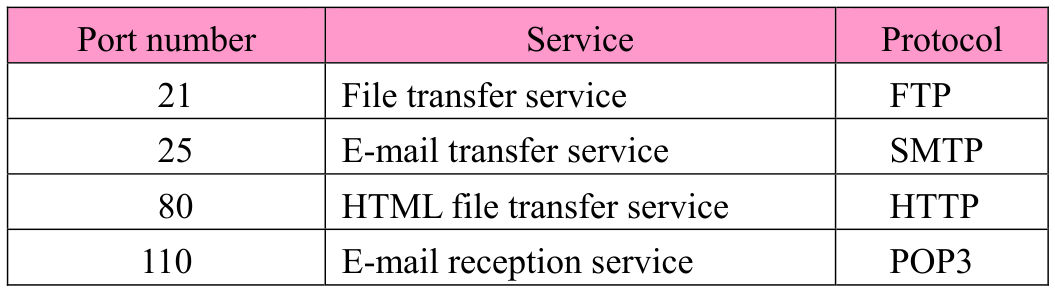
The main role of the transport layer is to deliver the data that is sent from the service (i.e., protocol) that is used by the source application to the service (i.e., protocol) that is used by the destination application. Moreover, sequence control and retransmission control using the sequence number are also performed. In the transport layer, a port number (i.e., protocol number) is used to identify the source and destination service (i.e., protocol). Generally, a well-known port number that is decided for each transport layer protocol (e.g., TCP, UDP) is used as the port number. The typical well-known port numbers that are used in TCP (Transmission Control Protocol) are as shown below.
Section progress
Original chapter exercises
Original chapter exercises →New FE Textbook Vol.1 · IT Fundamentals · First Edition, April 2015