Contents
Chapter 5 · NetworkPractice

LEARN WITH HARU

Video Lesson တွေက Haru အတန်းသားတွေအတွက်ပါ

Haru ရဲ့ ITPEC FE Full Course မှာ ယခု သင်ခန်းစာတွေကို တစ်ခုချင်း တစ်ကြောင်းချင်း အသေးစိတ်ရှင််ရှင်းပြထားပါတယ်

အခြေခံ မရှိတဲ့ ကျောင်းသားများစွာဟာလည်း ဒီ Course နဲ့ ပဲ အောင်မြင်ကုန်ကြပါပြီ

အတန်းမအပ်သေးပဲ Haru ဆီမှာ အစမ်းသင်ကြည့်ချင်ပါသလား?

သင်တန်းသားတွေရဲ့ စကားသံများ

သင်တန်းသားတွေရဲ့ စကားသံများ

Highlighted text? Practice this concept. Highlighted passages and figures open related questions.

Practice related questions (10)Progress & bookmarks

Current section

1 Network Mechanism

p. 289

Practice this section 10 linked exam questions with default filters

Progress

Not marked complete

Related questions in this lesson 2

Line speed and effective transfer time1Network traffic priority and QoS1
Progress and bookmarks

p. 289

1 Network Mechanism

In an information-driven society, the network supports the exchange of information (data communication). By using a network, it is possible to exchange information between computers. This section describes the basic mechanism of a network.

1 - 1 Types and Characteristics of Networks

Currently, the networks in use are broadly divided into two types.
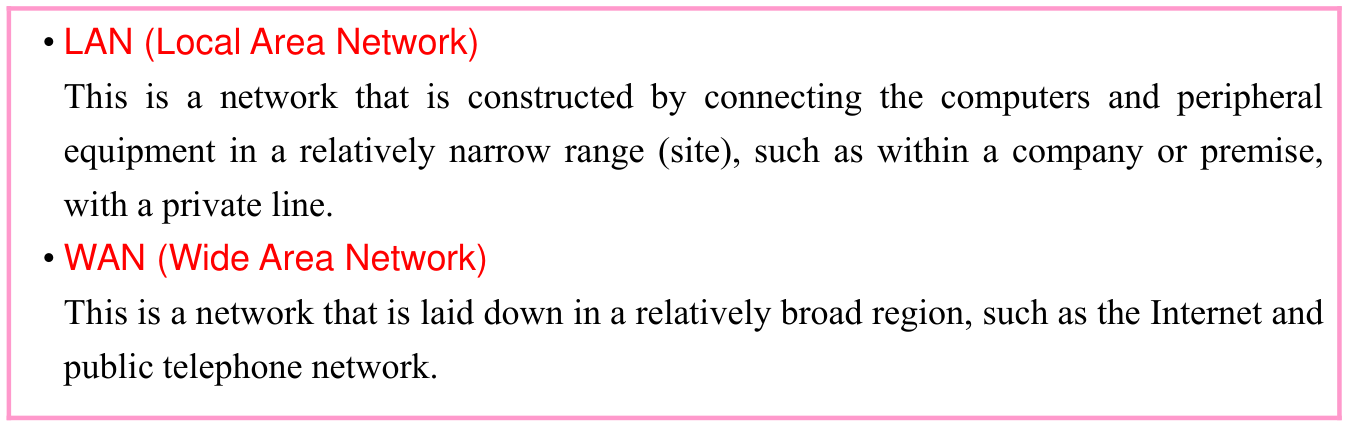
Original Types and Characteristics of Networks source table or explanation box, preserving its complete original arrangement, labels and values. Source text: • LAN (Local Area Network) This is a network that is constructed by connecting the computers and peripheral equipment in a relatively narrow range (site), such as within a company or premise, with a private line. • WAN (Wide Area Network) This is a network that is laid down in a relatively broad region, such as the Internet and public telephone network.
p. 289 · Enlarge

Moreover, networks such as LAN and WAN may be either wired (i.e., connected through a cable) or wireless (i.e., connected through electromagnetic waves). Common examples of a wired connection include the use of a leased line and a public telephone network for data transmission, but PLC (Power Line Communications), which makes use of a power line, is also included. On the other hand, examples of a wireless network include a sensor network in which data is collected by connecting several terminals (i.e., devices) on which a sensor is installed. A sensor network is a basic technique for implementing ubiquitous computing in which anyone can communicate anytime and anywhere. When a WAN is to be constructed, it is common to use a communication service that is provided by a telecommunications carrier. For example, if a user uses an Internet connection service that is provided by an ISP (Internet Service Provider), the user can easily construct a WAN to be connected to the Internet. At this time, if there are several telecommunications carriers who provide the same type of communication service, it becomes necessary to select the telecommunications carrier to sign a contract with depending on the usage charge and quality. In most cases, any one of the following billing systems is used for the usage charge of the communication service.

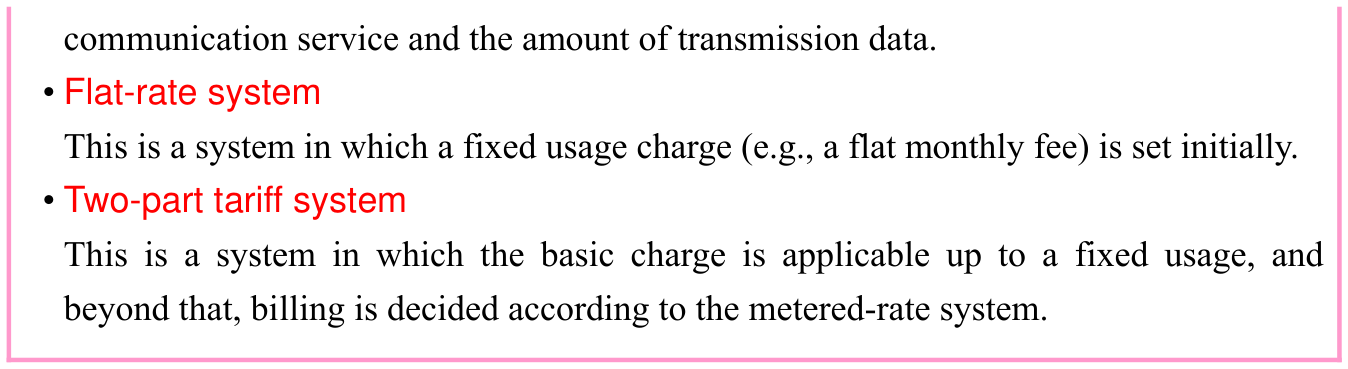
Original Types and Characteristics of Networks source table or explanation box, preserving its complete original arrangement, labels and values. Source text: • Metered-rate system This is a system in which billing is decided on the basis of the usage time of the
p. 289 · Enlarge

p. 290

Original Types and Characteristics of Networks source table or explanation box, preserving its complete original arrangement, labels and values. Source text: communication service and the amount of transmission data. • Flat-rate system This is a system in which a fixed usage charge (e.g., a flat monthly fee) is set initially. • Two-part tariff system This is a system in which the basic charge is applicable up to a fixed usage, and beyond that, billing is decided according to the metered-rate system.
p. 290 · Enlarge

On the other hand, the indexes or indicators shown below are used for evaluating the quality of the communication service.
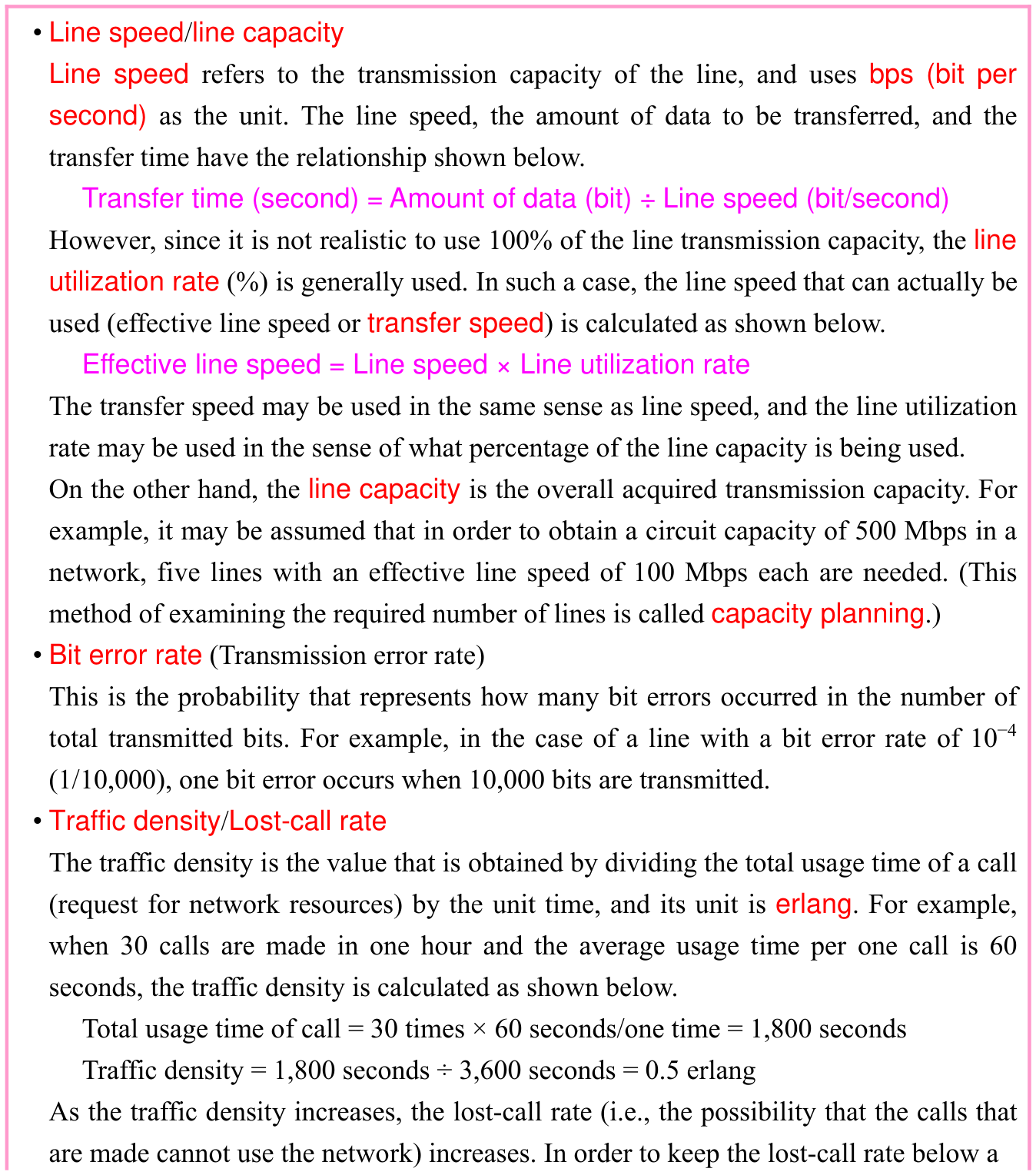
Original Types and Characteristics of Networks source table or explanation box, preserving its complete original arrangement, labels and values. Source text: • Line speed/line capacity Line speed refers to the transmission capacity of the line, and uses bps (bit per second) as the unit. The line speed, the amount of data to be transferred, and the transfer time have the relationship shown below. Transfer time (second) = Amount of data (bit) ÷ Line speed (bit/second) However, since it is not realistic to use 100% of the line transmission capacity, the line utilization rate (%) is generally used. In such a case, the line speed that can actually be used (effective line speed or transfer speed) is calculated as shown below. Effective line speed = Line speed × Line utilization rate The transfer speed may be used in the same sense as line speed, and the line utilization rate may be used in the sense of what percentage of the line capacity is being used. On the other hand, the line capacity is the overall acquired transmission capacity. For example, it may be assumed that in order to obtain a circuit capacity of 500 Mbps in a network, five lines with an effective line speed of 100 Mbps each are needed. (This method of examining the required number of lines is called capacity planning.) • Bit error rate (Transmission error rate) This is the probability that represents how many bit errors occurred in the number of total transmitted bits. For example, in the case of a line with a bit error rate of 10−4 (1/10,000), one bit error occurs when 10,000 bits are transmitted. • Traffic density/Lost-call rate The traffic density is the value that is obtained by dividing the total usage time of a call (request for network resources) by the unit time, and its unit is erlang. For example, when 30 calls are made in one hour and the average usage time per one call is 60 seconds, the traffic density is calculated as shown below. Total usage time of call = 30 times × 60 seconds/one time = 1,800 seconds Traffic density = 1,800 seconds ÷ 3,600 seconds = 0.5 erlang As the traffic density increases, the lost-call rate (i.e., the possibility that the calls that are made cannot use the network) increases. In order to keep the lost-call rate below a
p. 290 · Enlarge
Line speed and effective transfer time · 1 practice questions

p. 291

Original Types and Characteristics of Networks source table or explanation box, preserving its complete original arrangement, labels and values. Source text: fixed value, finding out the required number of lines and the upper limit of traffic density is also an example of capacity planning.
p. 291 · Enlarge

QoS (Quality of Service) is a quality assurance technique of such a communication service. The literal translation of QoS is service quality, but it is often used as a term that represents the technique of guaranteeing network quality, such as the line speed, for a specific communication service. In terms of QoS, the minimum line speed (i.e., communication speed) is secured through bandwidth control that secures an exclusive bandwidth (i.e., communication channel) beforehand, and priority control that adds a priority level to the transmission data. In contrast to a guarantee-type communication service that guarantees the minimum line speed by using QoS, the communication service that guarantees the maximum level of efforts for providing the upper limit of the line speed is called the best effort-type communication service. · 1 question

Original chapter exercises

Original chapter exercises →

New FE Textbook Vol.1 · IT Fundamentals · First Edition, April 2015