Contents
Chapter 5 · NetworkPractice

LEARN WITH HARU

Video Lesson တွေက Haru အတန်းသားတွေအတွက်ပါ

Haru ရဲ့ ITPEC FE Full Course မှာ ယခု သင်ခန်းစာတွေကို တစ်ခုချင်း တစ်ကြောင်းချင်း အသေးစိတ်ရှင််ရှင်းပြထားပါတယ်

အခြေခံ မရှိတဲ့ ကျောင်းသားများစွာဟာလည်း ဒီ Course နဲ့ ပဲ အောင်မြင်ကုန်ကြပါပြီ

အတန်းမအပ်သေးပဲ Haru ဆီမှာ အစမ်းသင်ကြည့်ချင်ပါသလား?

သင်တန်းသားတွေရဲ့ စကားသံများ

သင်တန်းသားတွေရဲ့ စကားသံများ

Highlighted text? Practice this concept. Highlighted passages and figures open related questions.

Practice related questions (4)Progress & bookmarks

Current section

1-5 Communication Services

p. 310

Practice this section 4 linked exam questions with default filters

Progress

Not marked complete

Related questions in this lesson 6

ADSL service1IP telephone and VoIP1LTE mobile communication3Tethering1
Progress and bookmarks

p. 310

1 - 5 Communication Services

In most cases, a communication service refers to the service that is provided by a telecommunications carrier. An overview of communication services is described below.

(1) Public line service

The public line service is a service that provides a network, as a public line, through which it is possible to communicate with an unspecified number of partners.

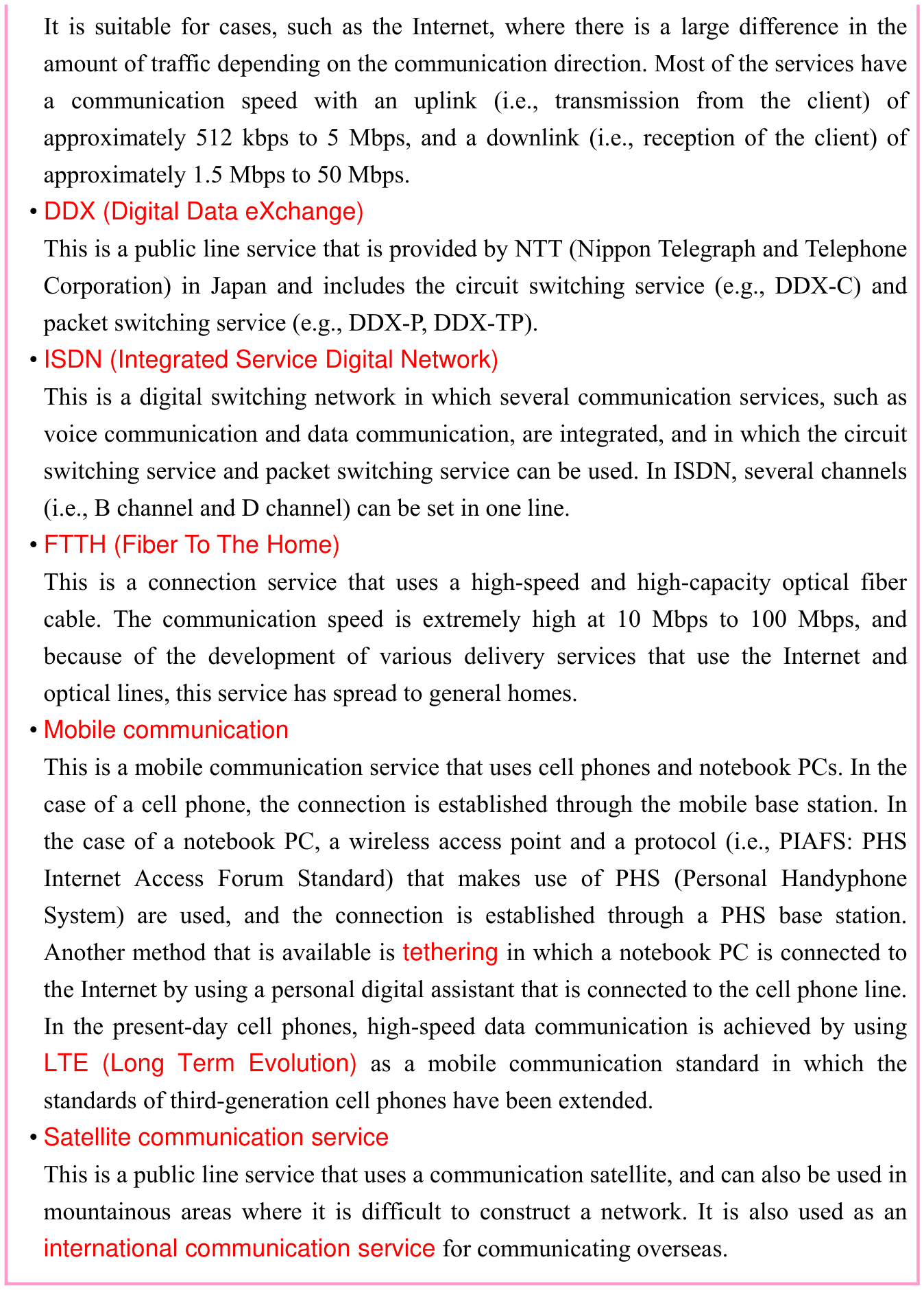
Original Communication Services source table or explanation box, preserving its complete original arrangement, labels and values. Source text: • ADSL (Asymmetric Digital Subscriber Line) This is a service that provides high-speed data transmission with a different uplink and downlink speed by using an existing telephone line (i.e., twisted pair cable).
p. 310 · Enlarge
ADSL service · 1 practice questions

p. 311

Original Communication Services source table or explanation box, preserving its complete original arrangement, labels and values. Source text: It is suitable for cases, such as the Internet, where there is a large difference in the amount of traffic depending on the communication direction. Most of the services have a communication speed with an uplink (i.e., transmission from the client) of approximately 512 kbps to 5 Mbps, and a downlink (i.e., reception of the client) of approximately 1.5 Mbps to 50 Mbps. • DDX (Digital Data eXchange) This is a public line service that is provided by NTT (Nippon Telegraph and Telephone Corporation) in Japan and includes the circuit switching service (e.g., DDX-C) and packet switching service (e.g., DDX-P, DDX-TP). • ISDN (Integrated Service Digital Network) This is a digital switching network in which several communication services, such as voice communication and data communication, are integrated, and in which the circuit switching service and packet switching service can be used. In ISDN, several channels (i.e., B channel and D channel) can be set in one line. • FTTH (Fiber To The Home) This is a connection service that uses a high-speed and high-capacity optical fiber cable. The communication speed is extremely high at 10 Mbps to 100 Mbps, and because of the development of various delivery services that use the Internet and optical lines, this service has spread to general homes. • Mobile communication This is a mobile communication service that uses cell phones and notebook PCs. In the case of a cell phone, the connection is established through the mobile base station. In the case of a notebook PC, a wireless access point and a protocol (i.e., PIAFS: PHS Internet Access Forum Standard) that makes use of PHS (Personal Handyphone System) are used, and the connection is established through a PHS base station. Another method that is available is tethering in which a notebook PC is connected to the Internet by using a personal digital assistant that is connected to the cell phone line. In the present-day cell phones, high-speed data communication is achieved by using LTE (Long Term Evolution) as a mobile communication standard in which the standards of third-generation cell phones have been extended. • Satellite communication service This is a public line service that uses a communication satellite, and can also be used in mountainous areas where it is difficult to construct a network. It is also used as an international communication service for communicating overseas.
p. 311 · Enlarge
Tethering · 1 practice questionsLTE mobile communication · 3 practice questions

p. 312

(2) Leased line service

The leased line service is a service that provides a network through which it is possible to communicate only with an identified partner. It includes services in which a leased line is physically laid down and services that use a virtual leased line.
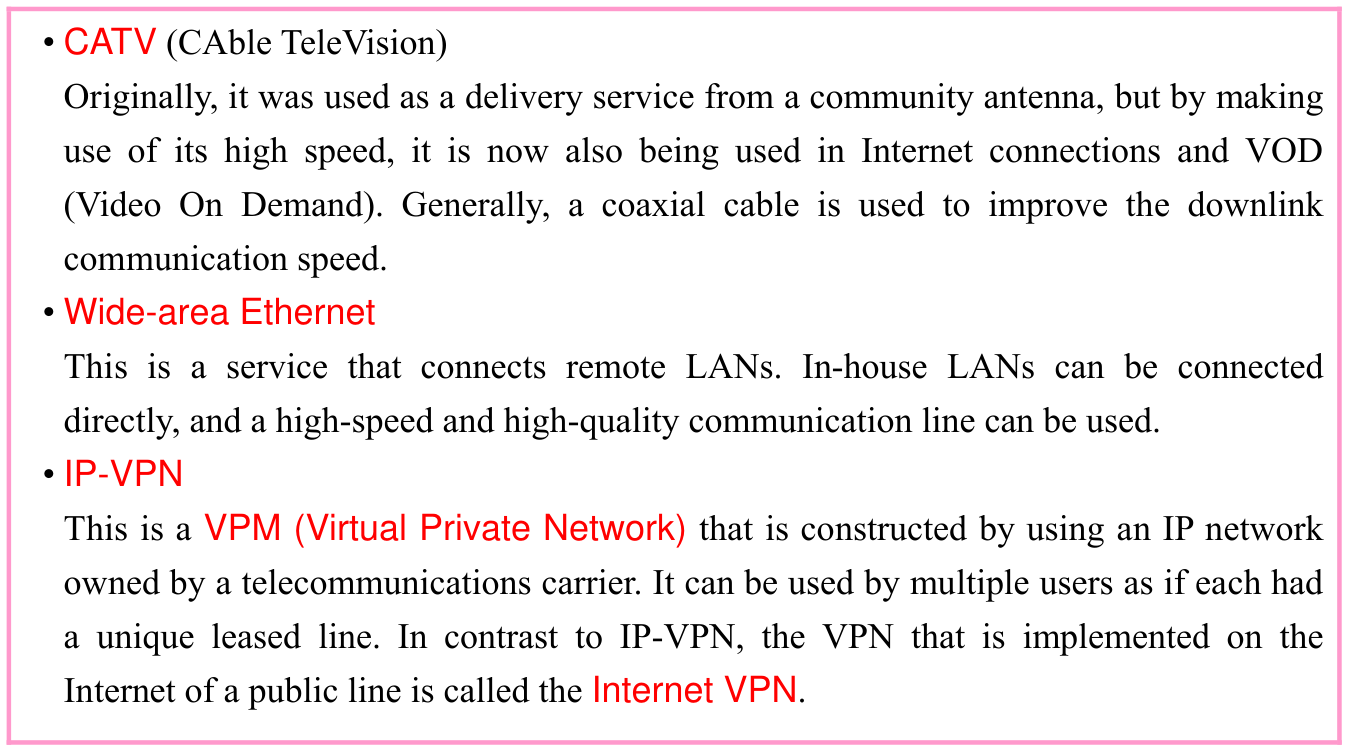
Original Communication Services source table or explanation box, preserving its complete original arrangement, labels and values. Source text: • CATV (CAble TeleVision) Originally, it was used as a delivery service from a community antenna, but by making use of its high speed, it is now also being used in Internet connections and VOD (Video On Demand). Generally, a coaxial cable is used to improve the downlink communication speed. • Wide-area Ethernet This is a service that connects remote LANs. In-house LANs can be connected directly, and a high-speed and high-quality communication line can be used. • IP-VPN This is a VPM (Virtual Private Network) that is constructed by using an IP network owned by a telecommunications carrier. It can be used by multiple users as if each had a unique leased line. In contrast to IP-VPN, the VPN that is implemented on the Internet of a public line is called the Internet VPN.
p. 312 · Enlarge

(3) Other communication services/techniques
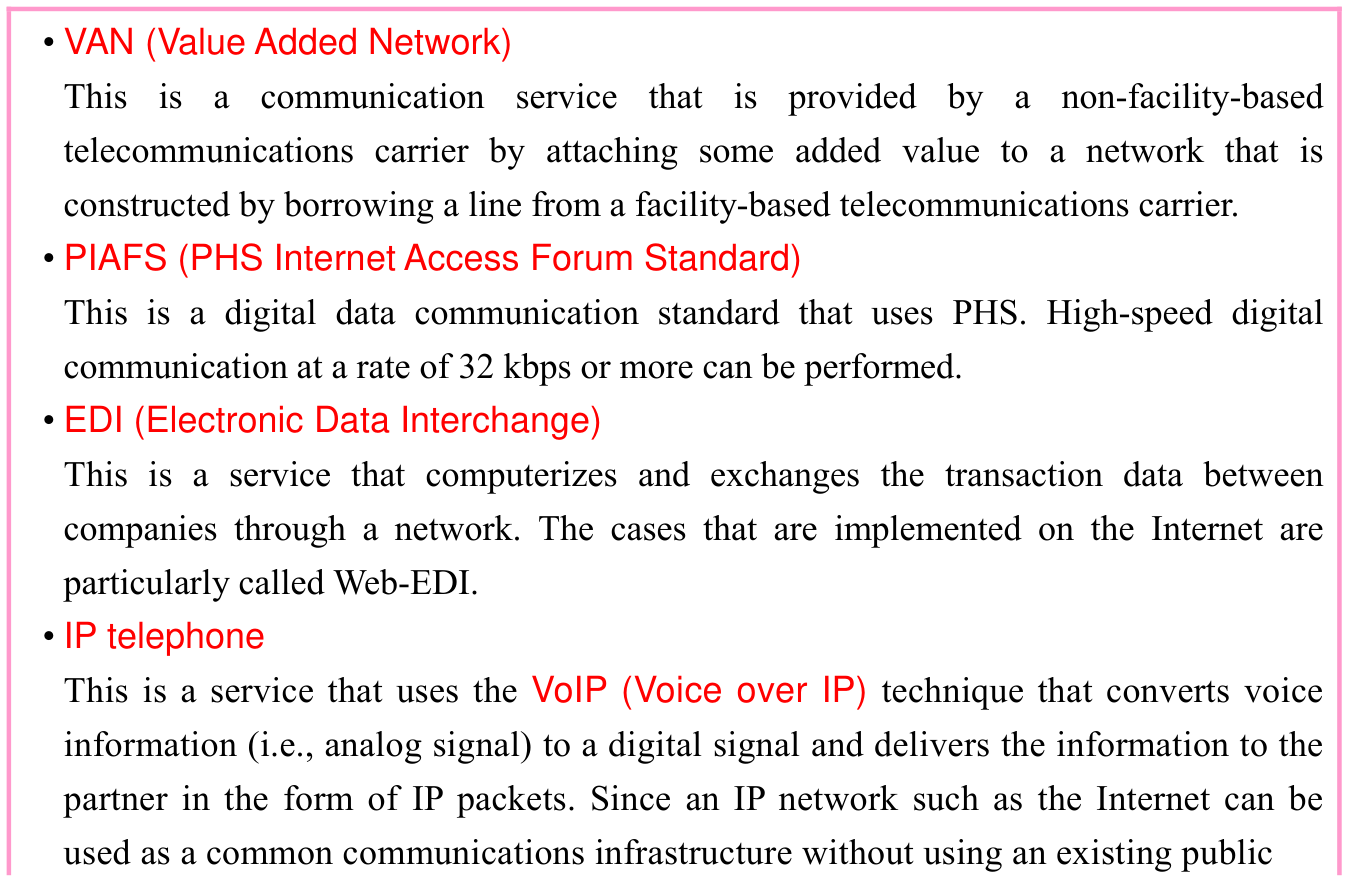
Original Communication Services source table or explanation box, preserving its complete original arrangement, labels and values. Source text: • VAN (Value Added Network) This is a communication service that is provided by a non-facility-based telecommunications carrier by attaching some added value to a network that is constructed by borrowing a line from a facility-based telecommunications carrier. • PIAFS (PHS Internet Access Forum Standard) This is a digital data communication standard that uses PHS. High-speed digital communication at a rate of 32 kbps or more can be performed. • EDI (Electronic Data Interchange) This is a service that computerizes and exchanges the transaction data between companies through a network. The cases that are implemented on the Internet are particularly called Web-EDI. • IP telephone This is a service that uses the VoIP (Voice over IP) technique that converts voice information (i.e., analog signal) to a digital signal and delivers the information to the partner in the form of IP packets. Since an IP network such as the Internet can be used as a common communications infrastructure without using an existing public
p. 312 · Enlarge
IP telephone and VoIP · 1 practice questions

p. 313

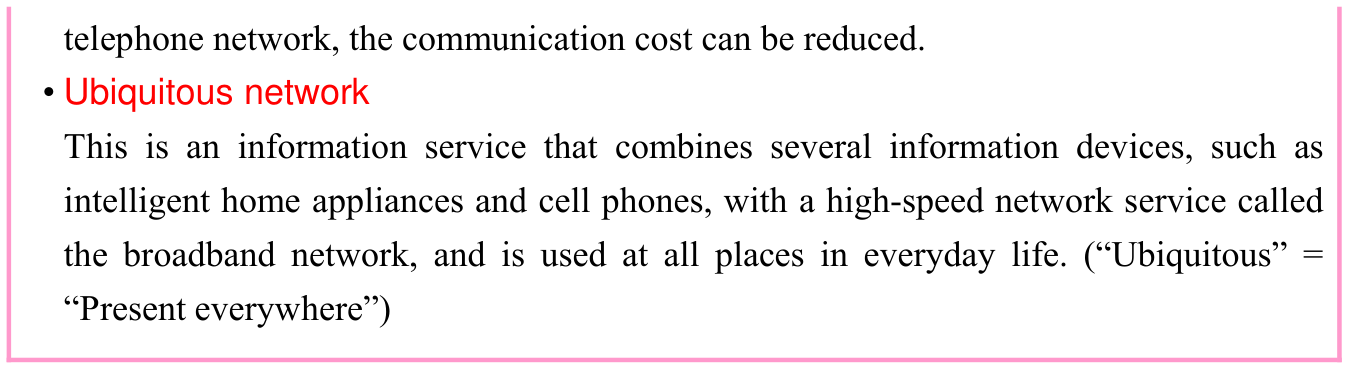
Original Communication Services source table or explanation box, preserving its complete original arrangement, labels and values. Source text: telephone network, the communication cost can be reduced. • Ubiquitous network This is an information service that combines several information devices, such as intelligent home appliances and cell phones, with a high-speed network service called the broadband network, and is used at all places in everyday life. (“Ubiquitous” = “Present everywhere”)
p. 313 · Enlarge

Original chapter exercises

Original chapter exercises →

New FE Textbook Vol.1 · IT Fundamentals · First Edition, April 2015