Contents
Chapter 5 · NetworkPractice

LEARN WITH HARU

Video Lesson တွေက Haru အတန်းသားတွေအတွက်ပါ

Haru ရဲ့ ITPEC FE Full Course မှာ ယခု သင်ခန်းစာတွေကို တစ်ခုချင်း တစ်ကြောင်းချင်း အသေးစိတ်ရှင််ရှင်းပြထားပါတယ်

အခြေခံ မရှိတဲ့ ကျောင်းသားများစွာဟာလည်း ဒီ Course နဲ့ ပဲ အောင်မြင်ကုန်ကြပါပြီ

အတန်းမအပ်သေးပဲ Haru ဆီမှာ အစမ်းသင်ကြည့်ချင်ပါသလား?

သင်တန်းသားတွေရဲ့ စကားသံများ

သင်တန်းသားတွေရဲ့ စကားသံများ

Highlighted text? Practice this concept. Highlighted passages and figures open related questions.

Practice related questions (11)Progress & bookmarks

Current section

4-1-2 Role of the Internet Layer

p. 329

Practice this section 11 linked exam questions with default filters

Progress

Not marked complete

Related questions in this lesson 13

IPv4 network and broadcast addresses6DHCP dynamic IP assignment2Network address translation1DNS name resolution2Subnet mask and CIDR prefix length2Global and private IPv4 addresses1
Progress and bookmarks

p. 329

4-1-2 Role of the Internet Layer

The main role of the Internet layer is to deliver the data that is sent from the source device (e.g., computer) to the destination device via the network. In IP (Internet Protocol), which is the protocol of the Internet layer, the IP address is used to identify the source and destination devices. The IP address is a unique address that is assigned to each device, and is managed by NIC (Network Information Center) and JPNIC (Japan Network Information Center) so that no duplication occurs across the world. IP addresses include those defined by IPv4 (IP version 4) and those defined by IPv6 (IP version 6). IP addresses that are defined by IPv4 are configured by 32 bits, and are normally represented as decimal numbers separated into four portions of eight bit each.

p. 330

Original IPv4 binary octets aligned above their dotted-decimal values. Source text: IP address 10110011 00110110 01101101 00010010 ↓ ↓ ↓ ↓ ( 179 . 54 . 109 . 18 )
p. 330 · Enlarge

On the other hand, IP addresses that are defined by IPv6 are configured by 128 bits, and are normally represented as hexadecimal numbers separated into eight portions of 16 bits each. IPv6 resolves the shortage of IP addresses that are defined by IPv4, and at the same time, strengthens the security function through packet encryption and authentication by using the security protocol called IPsec as the standard specification. An explanation is provided below concerning the structure of the IP address by using a 32-bit IP address that is defined by IPv4.

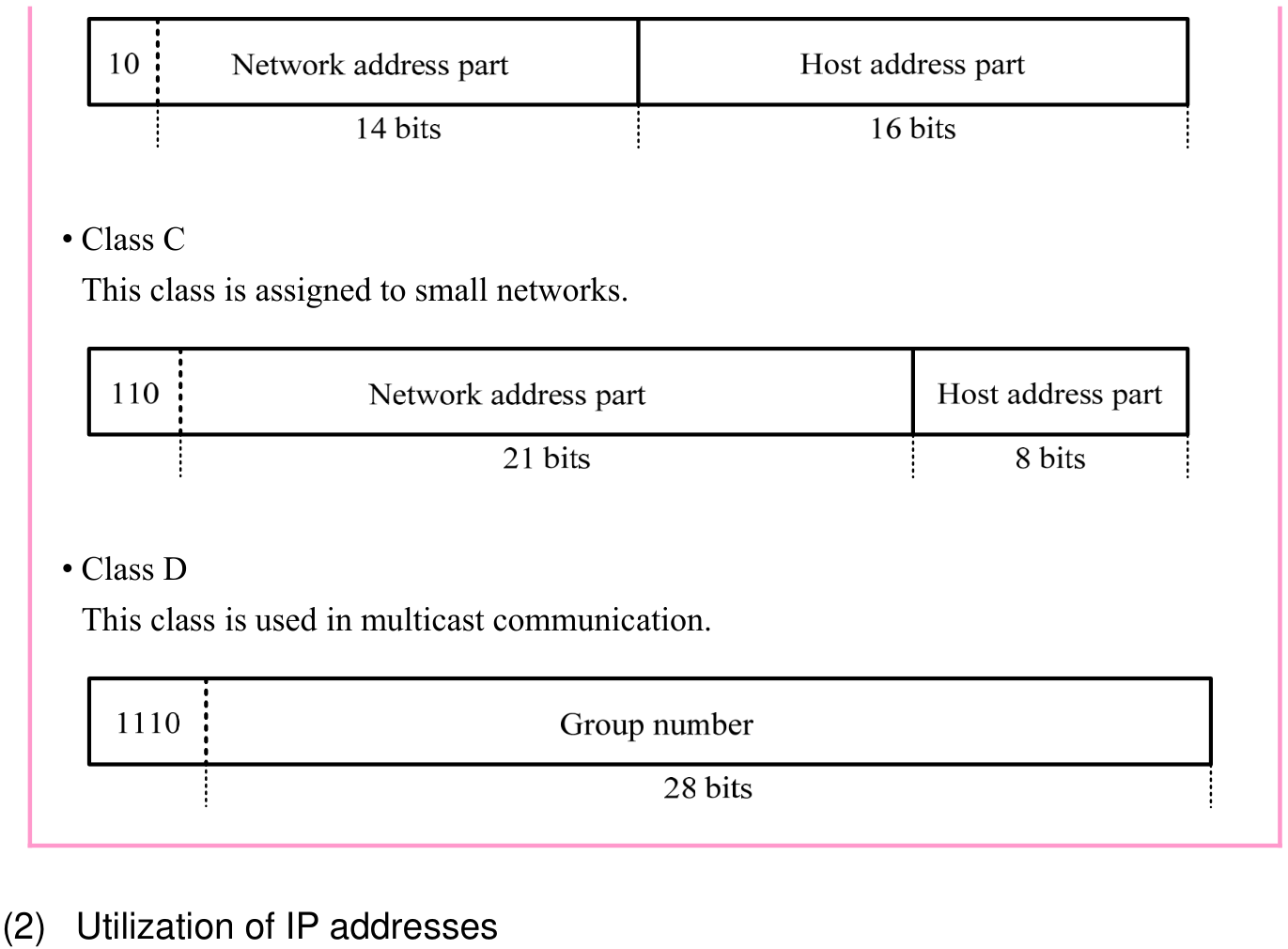
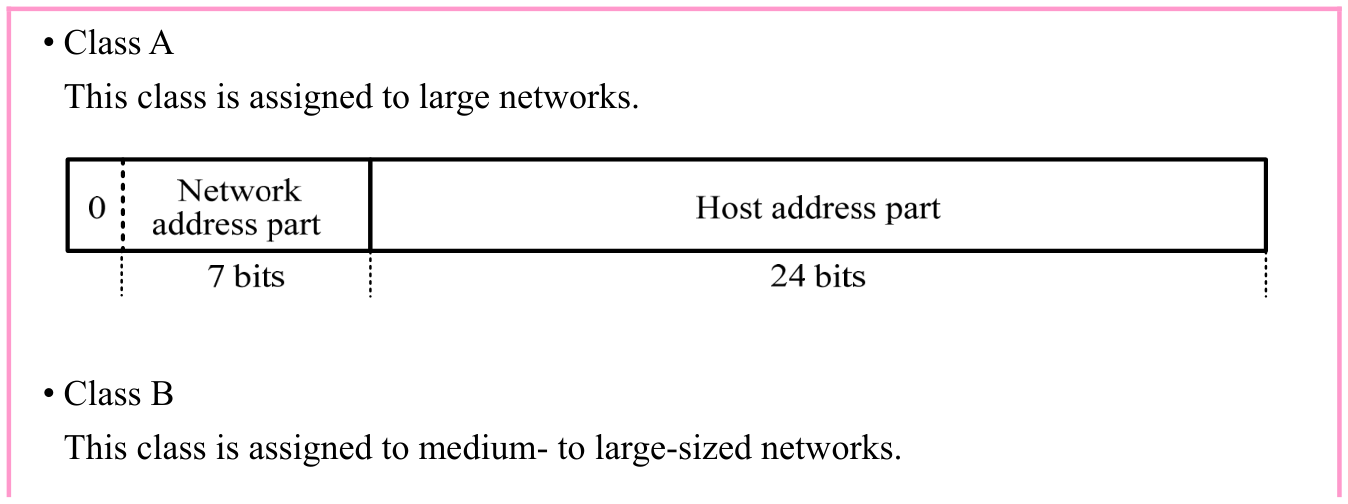
(1) Classification of IP addresses

The IP address is configured by a network address part and a host address part. The identifier (i.e., network address) indicating the network through which the devices are connected is recorded in the network address part, and the identifier (i.e., host address) indicating the devices is recorded in the host address part. Depending on the number of bits that is used in each part, the IP address is classified into classes A through D. Among these, class D is used only in multicast communication (where data is sent to all devices belonging to a specific group). Moreover, among the IP addresses of classes A through C, those with the host address part of all 0s are used as the network address, and those with the host address part of all 1s are used as the broadcast address (i.e., an address used in broadcast communication where data is sent to all devices that are connected to the network), and are not used generally because of their special meanings. One-to-one communication in which a host address indicating a single device is specified is called unicast. · 6 questions

The configuration of IP addresses of classes A through D is as shown below.
Original Role of the Internet Layer source table or explanation box, preserving its complete original arrangement, labels and values. Source text: • Class A This class is assigned to large networks. • Class B This class is assigned to medium- to large-sized networks.
p. 330 · Enlarge

p. 331

Original Role of the Internet Layer source table or explanation box, preserving its complete original arrangement, labels and values. Source text: • Class C This class is assigned to small networks. • Class D This class is used in multicast communication. (2) Utilization of IP addresses
p. 331 · Enlarge

The following two methods are available for an effective use of the IP address.
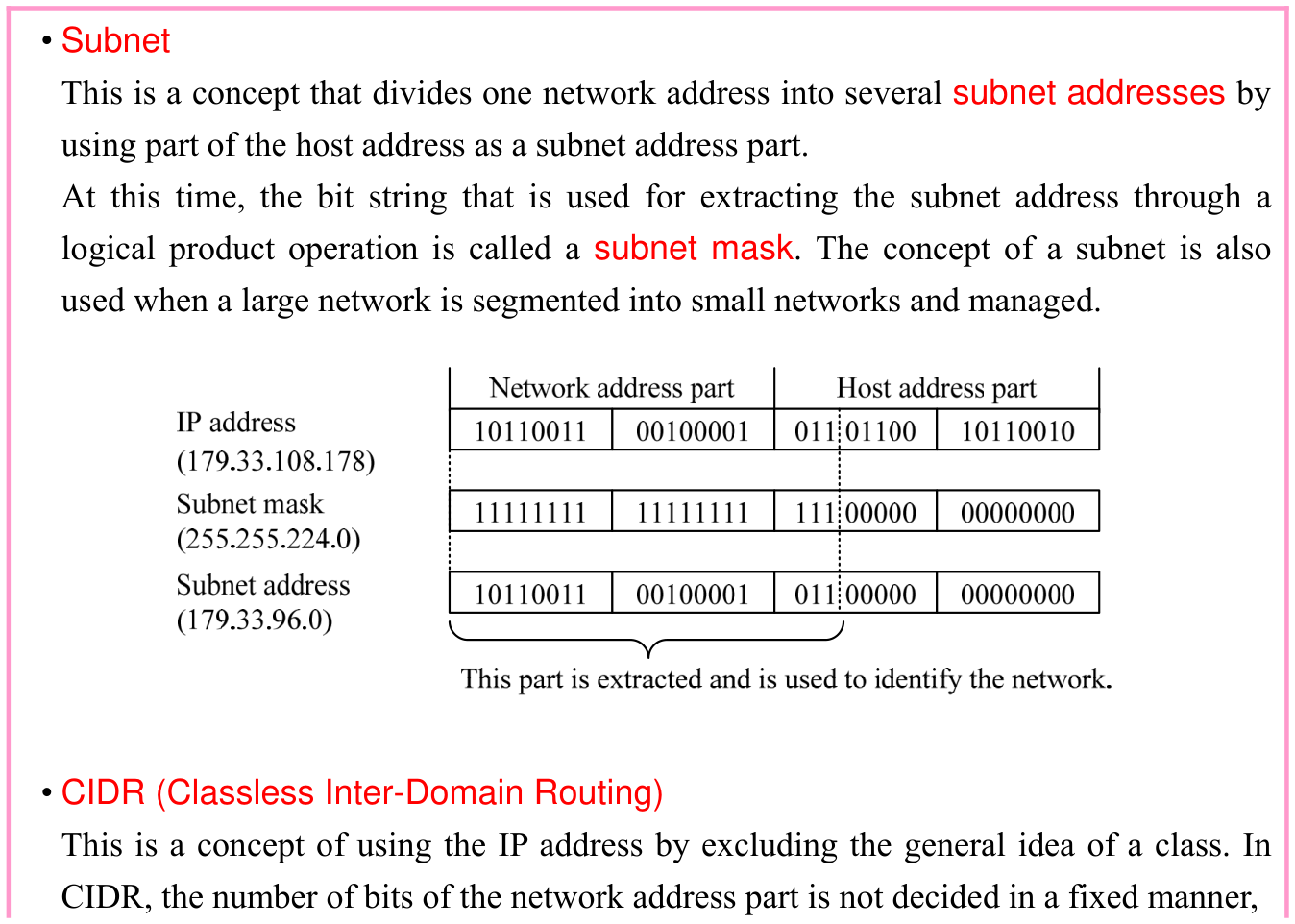
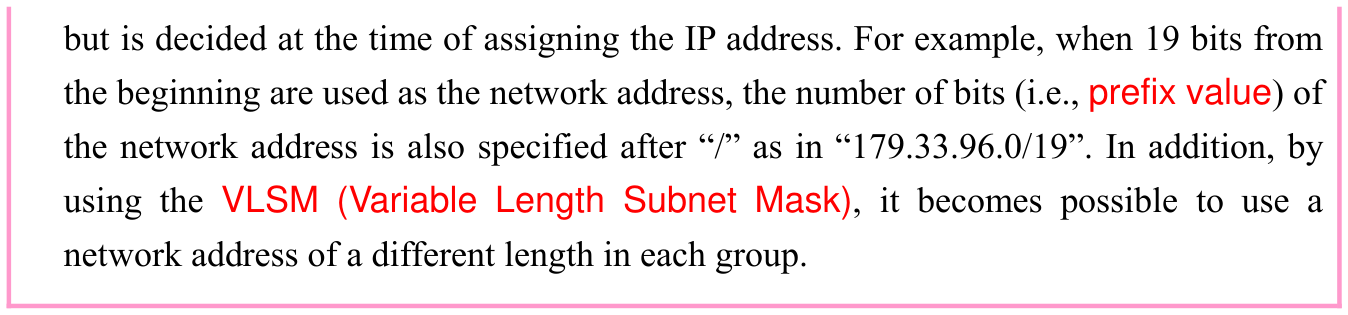
Original Role of the Internet Layer source table or explanation box, preserving its complete original arrangement, labels and values. Source text: • Subnet This is a concept that divides one network address into several subnet addresses by using part of the host address as a subnet address part. At this time, the bit string that is used for extracting the subnet address through a logical product operation is called a subnet mask. The concept of a subnet is also used when a large network is segmented into small networks and managed. • CIDR (Classless Inter-Domain Routing) This is a concept of using the IP address by excluding the general idea of a class. In CIDR, the number of bits of the network address part is not decided in a fixed manner,
p. 331 · Enlarge
Subnet mask and CIDR prefix length · 2 practice questions

p. 332

Original Role of the Internet Layer source table or explanation box, preserving its complete original arrangement, labels and values. Source text: but is decided at the time of assigning the IP address. For example, when 19 bits from the beginning are used as the network address, the number of bits (i.e., prefix value) of the network address is also specified after “/” as in “179.33.96.0/19”. In addition, by using the VLSM (Variable Length Subnet Mask), it becomes possible to use a network address of a different length in each group.
p. 332 · Enlarge

(3) Global IP address and private IP address
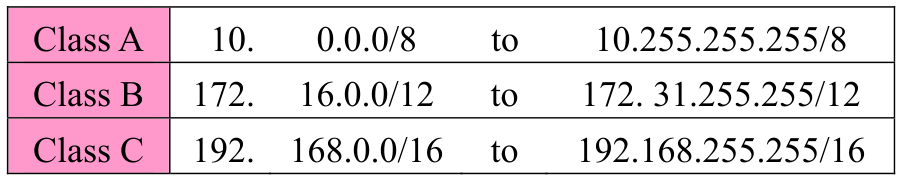
The global IP address is a unique IP address by which a device can be identified. While there is no problem if a global IP address is assigned to all devices, the number of IP address that can be assigned is limited. This has led to the birth of the concept of a private IP address that can be used only within a restricted area. Since there is no problem as long as the private IP address can be identified within a restricted area, the user can set any arbitrary private IP address. However, the range of the private IP addresses that can be set is determined as shown below for each class. · 1 question

Original Role of the Internet Layer source table or explanation box, preserving its complete original arrangement, labels and values. Source text: Class A 10. 0.0.0/8 to 10.255.255.255/8 Class B 172. 16.0.0/12 to 172. 31.255.255/12 Class C 192. 168.0.0/16 to 192.168.255.255/16
p. 332 · Enlarge

As long as the usage area is different, there is no problem even if the private IP address is a duplicate. However, since uniqueness is not maintained in an external network, it is not possible to connect to an external network through a private IP address. Therefore, in order to connect to an external network through a terminal on which a private IP address is set, it is necessary to convert the private IP address to a global IP address through a router or such other device. This conversion can be performed with the two types of methods as described below.
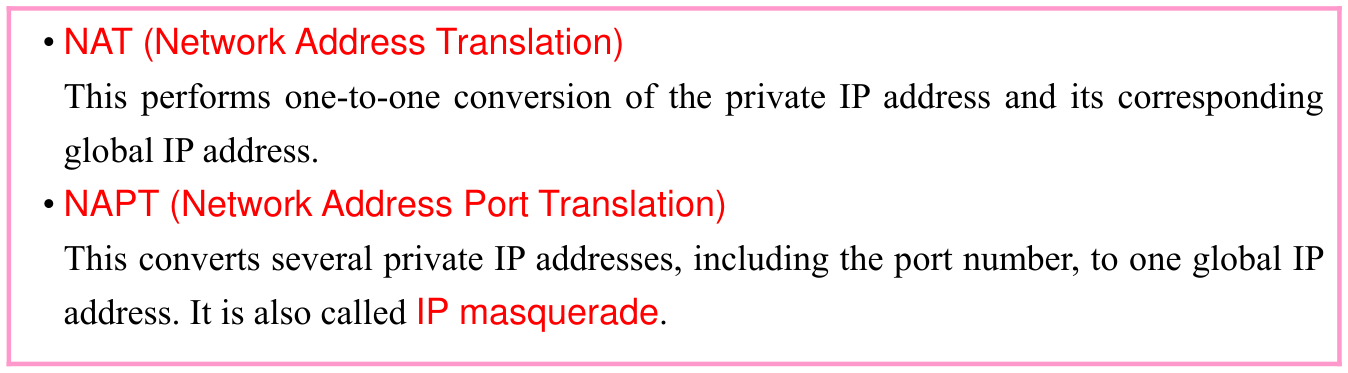
Original Role of the Internet Layer source table or explanation box, preserving its complete original arrangement, labels and values. Source text: • NAT (Network Address Translation) This performs one-to-one conversion of the private IP address and its corresponding global IP address. • NAPT (Network Address Port Translation) This converts several private IP addresses, including the port number, to one global IP address. It is also called IP masquerade.
p. 332 · Enlarge
Network address translation · 1 practice questions

p. 333

(4) DNS (Domain Name System)

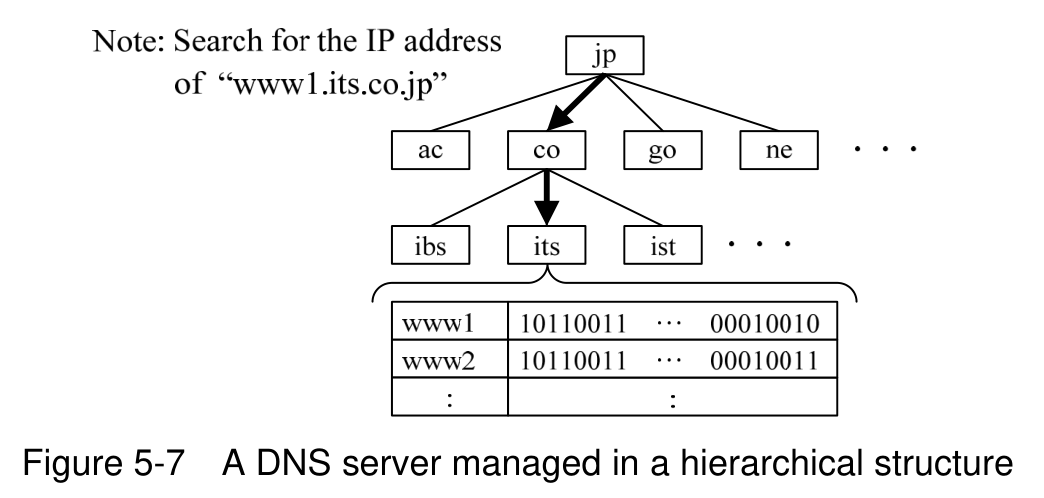
DNS is a protocol for converting FQDN (Fully Qualified Domain Name; fully qualified domain name = host name + domain name) to an IP address. This conversion is referred to as name resolution. Since the IP address is an enumeration of numeric characters, it is difficult for humans to remember it. Therefore, names (FQDNs) that can be understood easily by humans are used in the e-mail address of e-mails and also in the URL (Uniform Resource Locator) that is used to browse a web page. (For example, the URL “www1.its.co.jp” is an FQDN with the host name (i.e., server name) as “www1” and the domain name as “its.co.jp”.) An FQDN is used by converting to an IP address within the network. Therefore, conversion to the IP address is performed by the DNS server that manages the correspondence between the FQDN and IP address. However, it is not possible to record the FQDNs and IP addresses of the entire world in one DNS server. Therefore, the DNS server itself is managed in a hierarchical structure. Thus, the structure is such that by moving in order from an upper DNS server to a lower DNS server, it is possible to reach the DNS server in which the information of the target IP address is recorded. · 2 questions

Hierarchical DNS domain tree and host-address records, preserving original branches and the lookup note. Source text: Figure 5-7 A DNS server managed in a hierarchical structure
p. 333 · Enlarge

(5) DHCP (Dynamic Host Configuration Protocol)

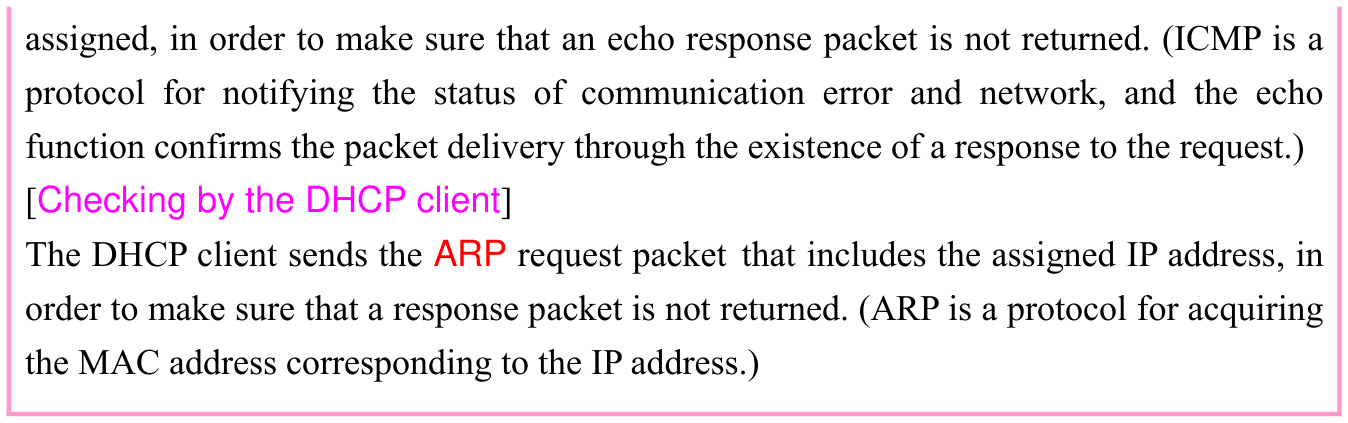
DHCP is a protocol for dynamically assigning an IP address to the devices (i.e., computers) that are connected to the network. By using DHCP, one IP address can be shared among several devices, and this saves the user from the trouble of configuring settings related to the IP address. However, since the same IP address cannot be used simultaneously, use the procedure that is described below to confirm that the IP address is not in use in the DHCP server and the DHCP client. · 2 questions

Original Role of the Internet Layer source table or explanation box, preserving its complete original arrangement, labels and values. Source text: [Checking by the DHCP server] The DHCP server sends the ICMP echo request packet that includes the IP address to be
p. 333 · Enlarge

p. 334

Original Role of the Internet Layer source table or explanation box, preserving its complete original arrangement, labels and values. Source text: assigned, in order to make sure that an echo response packet is not returned. (ICMP is a protocol for notifying the status of communication error and network, and the echo function confirms the packet delivery through the existence of a response to the request.) [Checking by the DHCP client] The DHCP client sends the ARP request packet that includes the assigned IP address, in order to make sure that a response packet is not returned. (ARP is a protocol for acquiring the MAC address corresponding to the IP address.)
p. 334 · Enlarge

(6) RIP (Routing Information Protocol)

RIP is a protocol for selecting the path up to the target network by using the IP address. (The process of directing transmitted data to another network is called routing.) In RIP, the number of hops (i.e., number of routers) that are passed is taken as the reference, and the distance vector algorithm for selecting the path with the minimum number of hops is used. Each router maintains a routing table, and the content of the routing table is updated through transmission at regular time intervals. However, there are disadvantages, such as the fact that “a parallel path cannot be created” and that “the minimum number of hops does not always become the shortest path.”
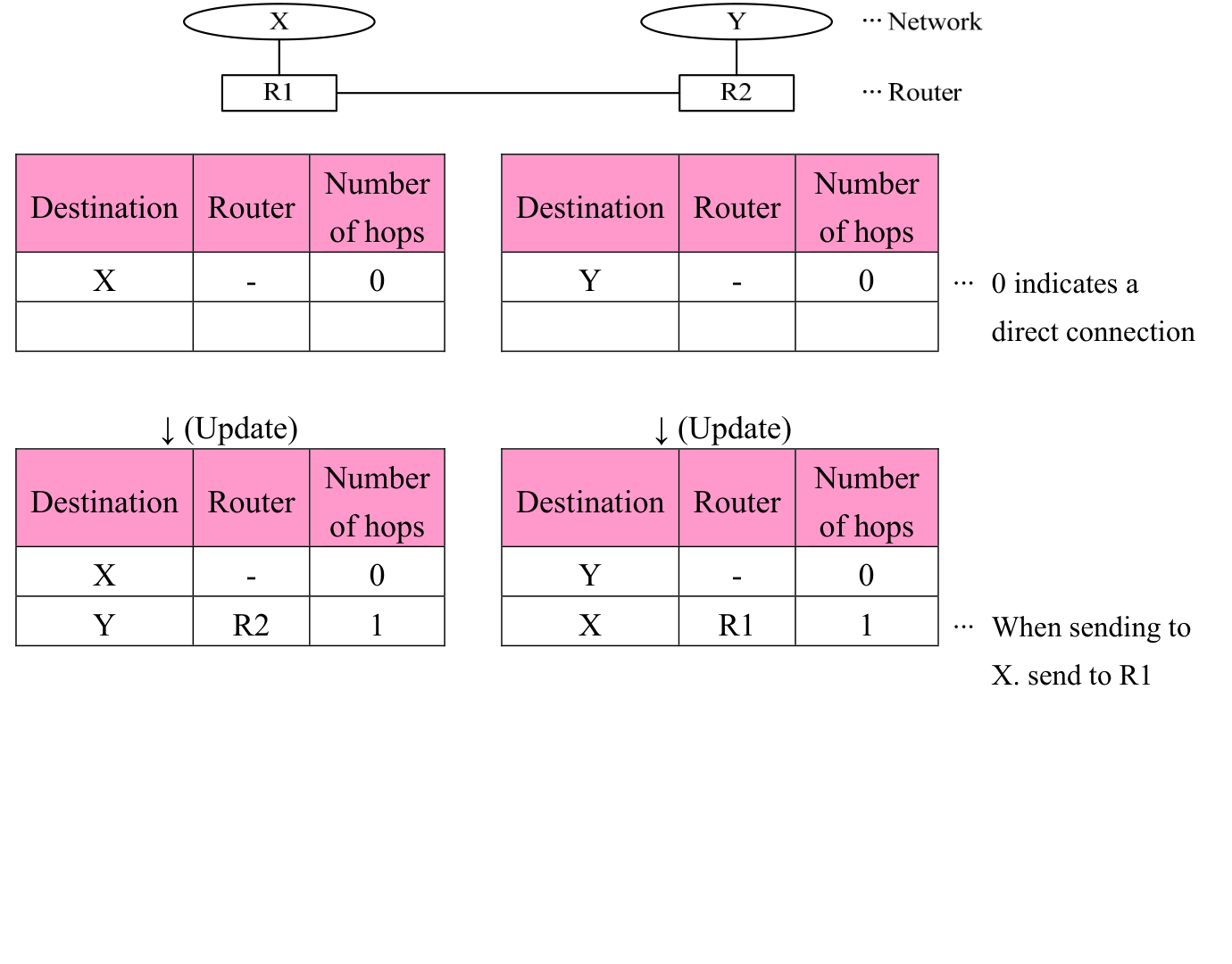
RIP routing example, preserving networks X and Y, routers R1 and R2, hop counts, update arrows and original table values. Source text: Destination Router Number Number Destination Router of hops of hops X - 0 Y - 0 ··· 0 indicates a direct connection ↓ (Update) ↓ (Update) Destination Router Number Number Destination Router of hops of hops X - 0 Y - 0 Y R2 1 X R1 1 ··· When sending to X. send to R1
p. 334 · Enlarge

Original chapter exercises

Original chapter exercises →

New FE Textbook Vol.1 · IT Fundamentals · First Edition, April 2015