Practice related questions (4)Progress & bookmarks
Current section
1-3 Basic Techniques of a Network
p. 293
Practice this section 4 linked exam questions with default filters
Progress
Not marked complete
p. 293
1 - 3 Basic Techniques of a Network
1-3-1 Modulation Method
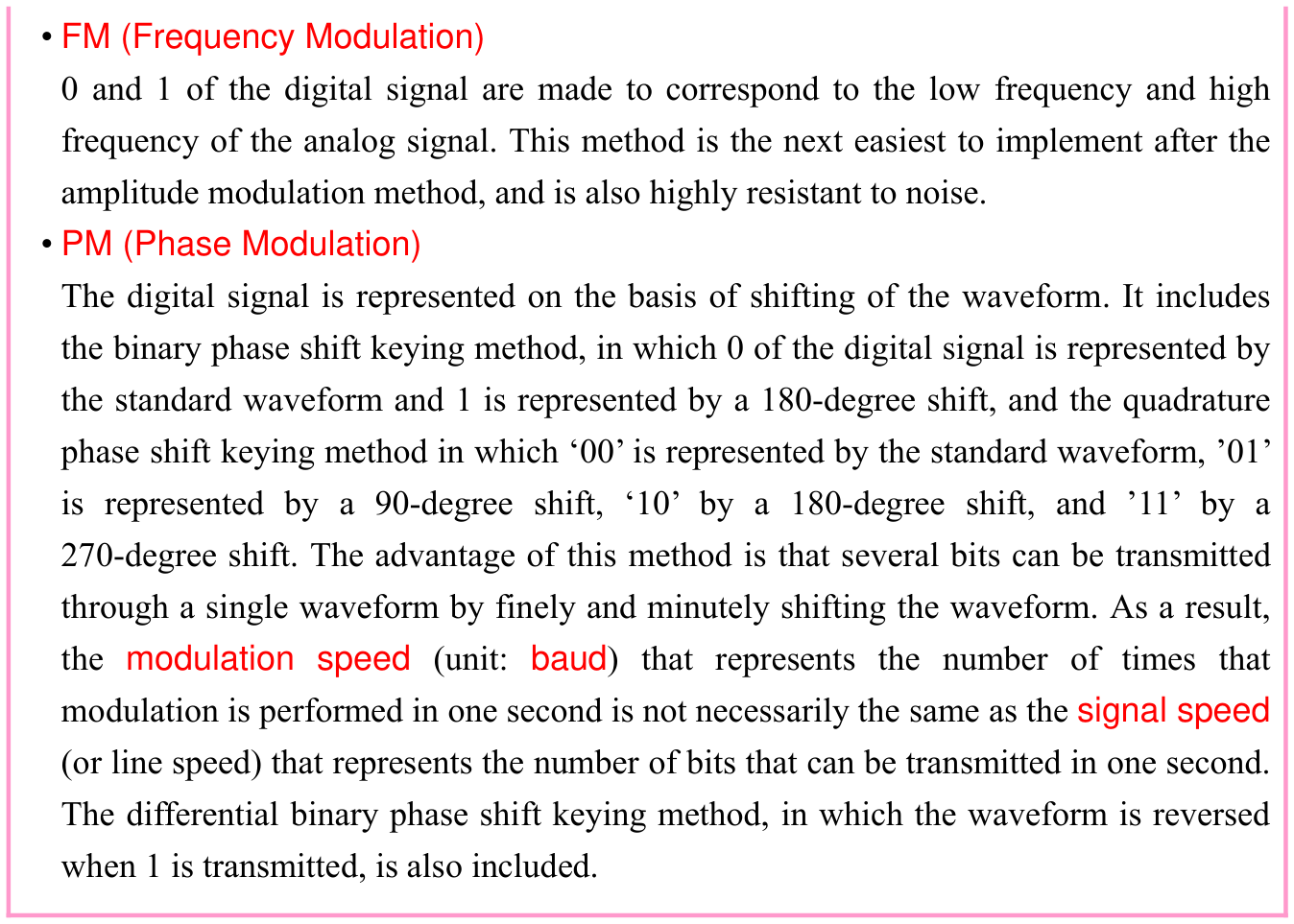
Modulation refers to the conversion of digital signals to analog signals, or analog signals to digital signals. (Returning converted signals to its original form is called demodulation.) The types of methods used to modulate digital signals to analog signals with a modem in order to transmit data on an analog line are as shown below.

p. 294
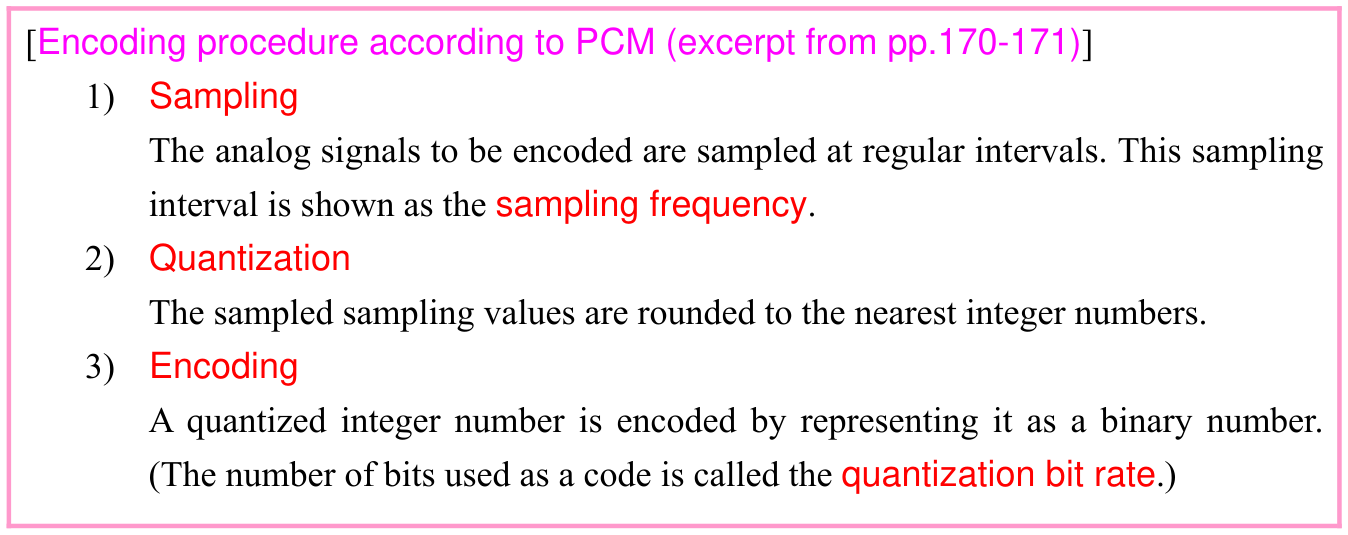
On the other hand, the modulation method by which voice signals (i.e., analog signals) are encoded (i.e., converted to digital signals) includes PCM (Pulse Code Modulation). In PCM, analog signals are modulated to digital signals through the procedures of sampling, quantization, and encoding.
Section progress
Original chapter exercises
Original chapter exercises →New FE Textbook Vol.1 · IT Fundamentals · First Edition, April 2015