Contents
Chapter 5 · NetworkPractice

LEARN WITH HARU

Video Lesson တွေက Haru အတန်းသားတွေအတွက်ပါ

Haru ရဲ့ ITPEC FE Full Course မှာ ယခု သင်ခန်းစာတွေကို တစ်ခုချင်း တစ်ကြောင်းချင်း အသေးစိတ်ရှင််ရှင်းပြထားပါတယ်

အခြေခံ မရှိတဲ့ ကျောင်းသားများစွာဟာလည်း ဒီ Course နဲ့ ပဲ အောင်မြင်ကုန်ကြပါပြီ

အတန်းမအပ်သေးပဲ Haru ဆီမှာ အစမ်းသင်ကြည့်ချင်ပါသလား?

သင်တန်းသားတွေရဲ့ စကားသံများ

သင်တန်းသားတွေရဲ့ စကားသံများ

Highlighted text? Practice this concept. Highlighted passages and figures open related questions.

Practice related questions (1)Progress & bookmarks

Current section

1-3-4 Switching Method

p. 300

Progress

Not marked complete

Related questions in this lesson 1

Frame relay characteristics1
Progress and bookmarks

p. 300

1-3-4 Switching Method

A switching method is used to determine how to transmit data to the other party through a line, such as a public line, for which the communication partner is not identified. Therefore, there is no need to consider the switching method in a leased line service that provides leased lines that are directly linked to the communication partner in a fixed manner.

(1) Circuit switching method

The circuit switching method is a method that has the similar configuration to a public telephone network, and transmits data by setting a physical communication channel with circuit switching equipment each time a data transmission request occurs. The network of the

p. 301

circuit switching method is called a circuit switched network, and a circuit switching service refers to the service that provides a communication environment by connecting the users within the network with circuit switching equipment.
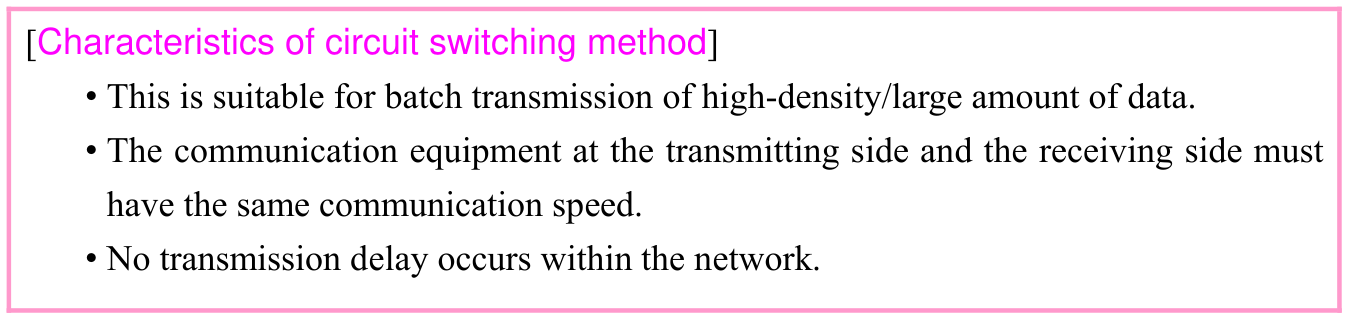
Original Switching Method source table or explanation box, preserving its complete original arrangement, labels and values. Source text: [Characteristics of circuit switching method] • This is suitable for batch transmission of high-density/large amount of data. • The communication equipment at the transmitting side and the receiving side must have the same communication speed. • No transmission delay occurs within the network.
p. 301 · Enlarge

(2) Store-and-forward switching method

The store-and-forward switching method is used to transmit data via store-and-forward switching equipment on the basis of the address that is appended in each data unit, without setting a physical communication channel for the transmission destination. In the store-and-forward switching method, the optimum relay line is determined according to the congestion of the communication line. This is because when the traffic (i.e., data) that flows across the communication line becomes too high, the transmission efficiency declines, and a delay occurs easily.
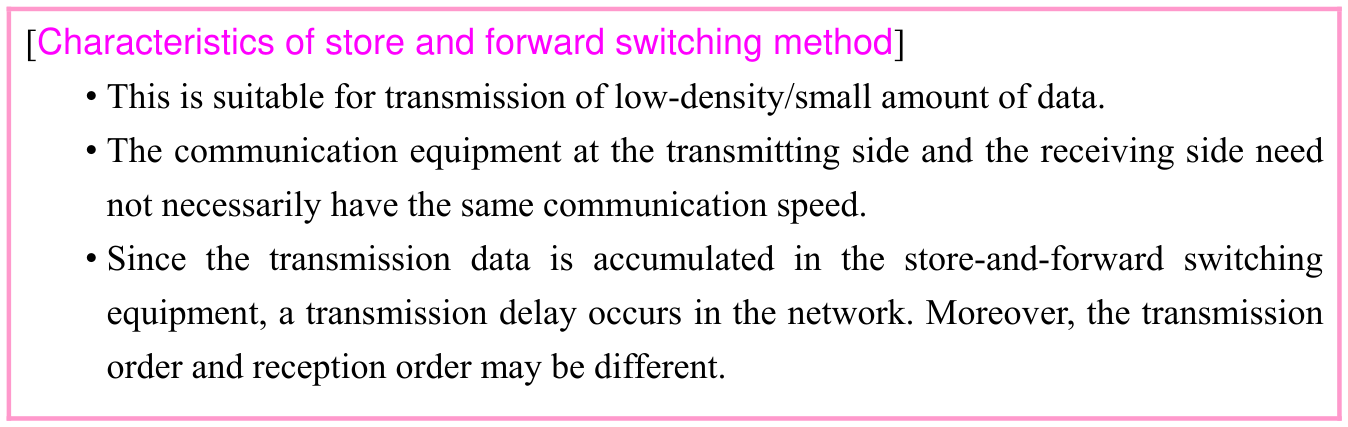
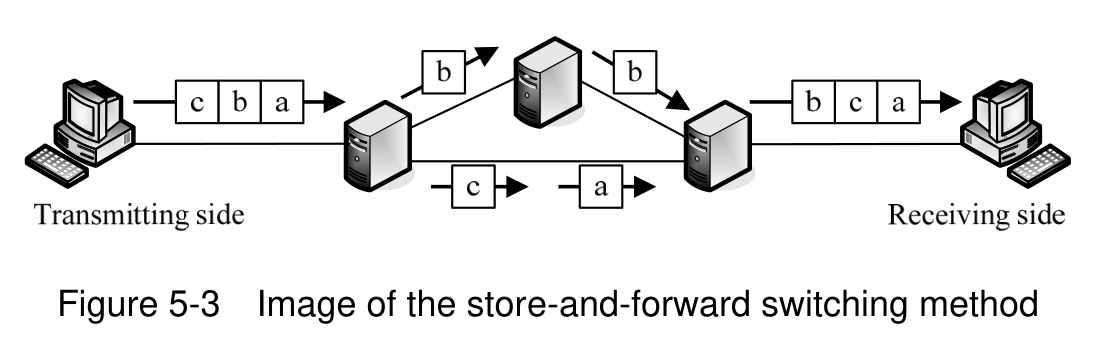
Original Switching Method source table or explanation box, preserving its complete original arrangement, labels and values. Source text: [Characteristics of store and forward switching method] • This is suitable for transmission of low-density/small amount of data. • The communication equipment at the transmitting side and the receiving side need not necessarily have the same communication speed. • Since the transmission data is accumulated in the store-and-forward switching equipment, a transmission delay occurs in the network. Moreover, the transmission order and reception order may be different.
p. 301 · Enlarge
Store-and-forward packet paths, with the original a, b and c data units and intermediate switching devices. Source text: Figure 5-3 Image of the store-and-forward switching method
p. 301 · Enlarge

The store-and-forward switching method has the following three kinds of typical transmission techniques and services.

p. 302

(1) Packet switching (Packet switching service) This is a method that divides the transmission data into units called packets. A header in which the address of the other party is recorded is appended to the packet. Generally, a PT (Packet mode Terminal) with a built-in PAD (packet assembly and disassembly) function is used to connect to the packet switched network. However, even in the case of NPT (Non-Packet mode Terminal), a connection can be established by providing the PAD function in the switching equipment.
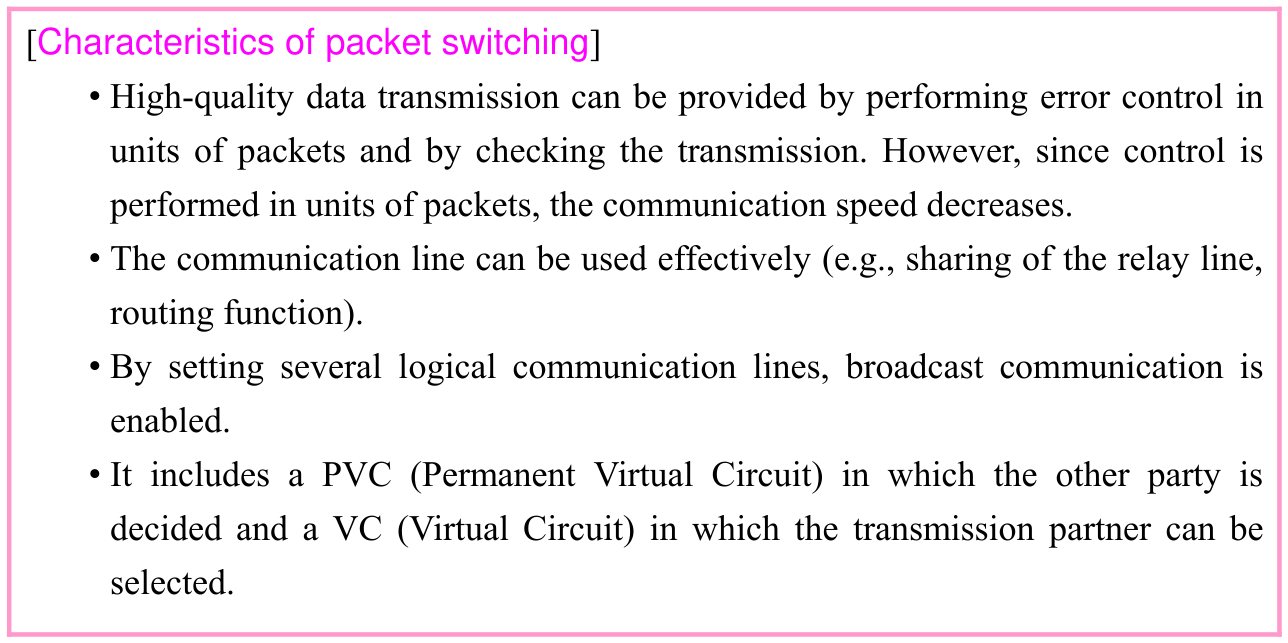
Original Switching Method source table or explanation box, preserving its complete original arrangement, labels and values. Source text: [Characteristics of packet switching] • High-quality data transmission can be provided by performing error control in units of packets and by checking the transmission. However, since control is performed in units of packets, the communication speed decreases. • The communication line can be used effectively (e.g., sharing of the relay line, routing function). • By setting several logical communication lines, broadcast communication is enabled. • It includes a PVC (Permanent Virtual Circuit) in which the other party is decided and a VC (Virtual Circuit) in which the transmission partner can be selected.
p. 302 · Enlarge

(2) Frame relay (Frame relay service) This is a method that divides the transmission data into frame units of a variable length, and may be thought of as a packet switching method with a high speed. An address part including a DLCI (Data Link Connection Identifier) that represents the other party is appended to the frame. A connection is established to the frame relay network by a FRAD (FRame Assembly/Disassembly device) that performs assembly and disassembly of the frame.
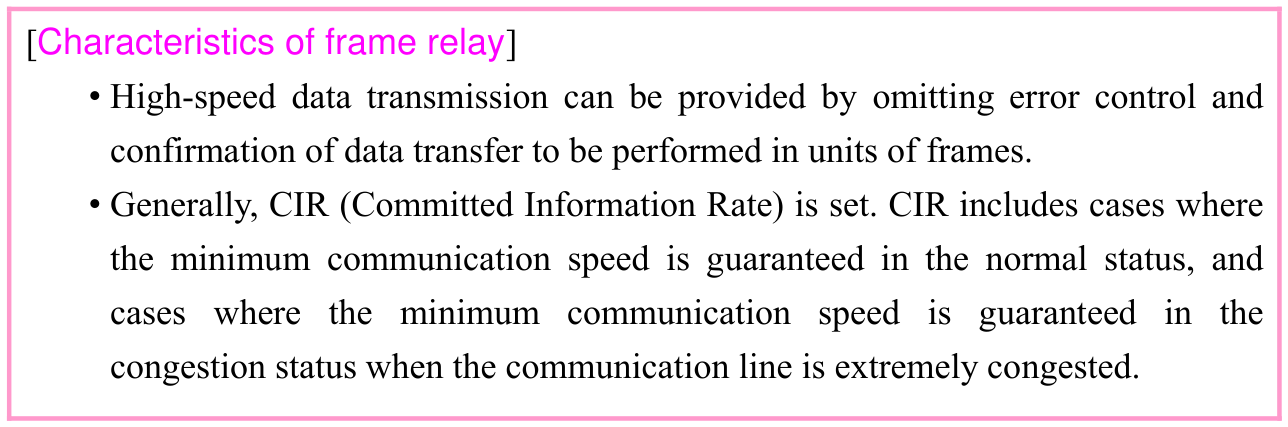
Original Switching Method source table or explanation box, preserving its complete original arrangement, labels and values. Source text: [Characteristics of frame relay] • High-speed data transmission can be provided by omitting error control and confirmation of data transfer to be performed in units of frames. • Generally, CIR (Committed Information Rate) is set. CIR includes cases where the minimum communication speed is guaranteed in the normal status, and cases where the minimum communication speed is guaranteed in the congestion status when the communication line is extremely congested.
p. 302 · Enlarge
Frame relay characteristics · 1 practice questions

(3) Cell relay/ATM switching (ATM service) This is a method that divides the transmission data into cell units of a fixed length. In

p. 303

cell relay, high-speed data transmission is achieved through hardware routing using the ATM (Asynchronous Transfer Mode) technique.
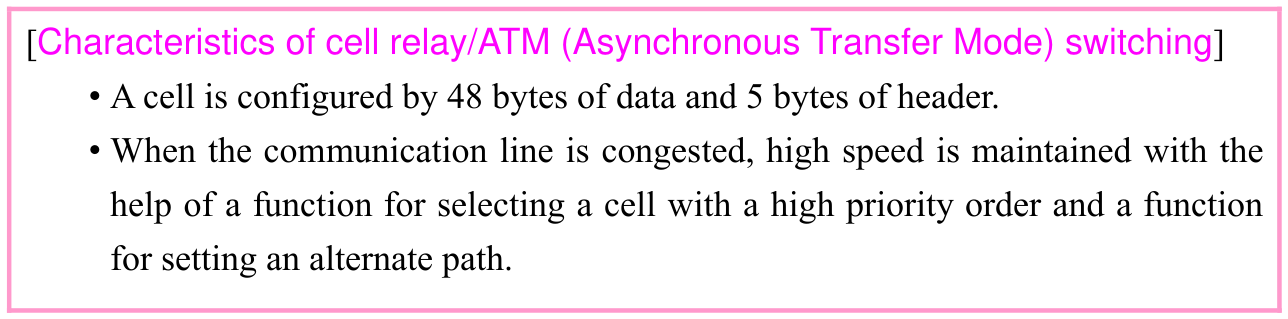
Original Switching Method source table or explanation box, preserving its complete original arrangement, labels and values. Source text: [Characteristics of cell relay/ATM (Asynchronous Transfer Mode) switching] • A cell is configured by 48 bytes of data and 5 bytes of header. • When the communication line is congested, high speed is maintained with the help of a function for selecting a cell with a high priority order and a function for setting an alternate path.
p. 303 · Enlarge

Section progress

Original chapter exercises

Original chapter exercises →

New FE Textbook Vol.1 · IT Fundamentals · First Edition, April 2015