Contents
Chapter 5 · NetworkPractice

LEARN WITH HARU

Video Lesson တွေက Haru အတန်းသားတွေအတွက်ပါ

Haru ရဲ့ ITPEC FE Full Course မှာ ယခု သင်ခန်းစာတွေကို တစ်ခုချင်း တစ်ကြောင်းချင်း အသေးစိတ်ရှင််ရှင်းပြထားပါတယ်

အခြေခံ မရှိတဲ့ ကျောင်းသားများစွာဟာလည်း ဒီ Course နဲ့ ပဲ အောင်မြင်ကုန်ကြပါပြီ

အတန်းမအပ်သေးပဲ Haru ဆီမှာ အစမ်းသင်ကြည့်ချင်ပါသလား?

သင်တန်းသားတွေရဲ့ စကားသံများ

သင်တန်းသားတွေရဲ့ စကားသံများ

Highlighted text? Practice this concept. Highlighted passages and figures open related questions.

Practice related questions (2)Progress & bookmarks

Current section

4-3 Internet Services

p. 337

Practice this section 2 linked exam questions with default filters

Progress

Not marked complete

Related questions in this lesson 4

SMTP mail transfer3Intranet1Original mail-routing diagram1
Progress and bookmarks

p. 337

4 - 3 Internet Services

Various services are provided over the Internet. The typical Internet services are as described below.

(1) Electronic mail (e-mail)

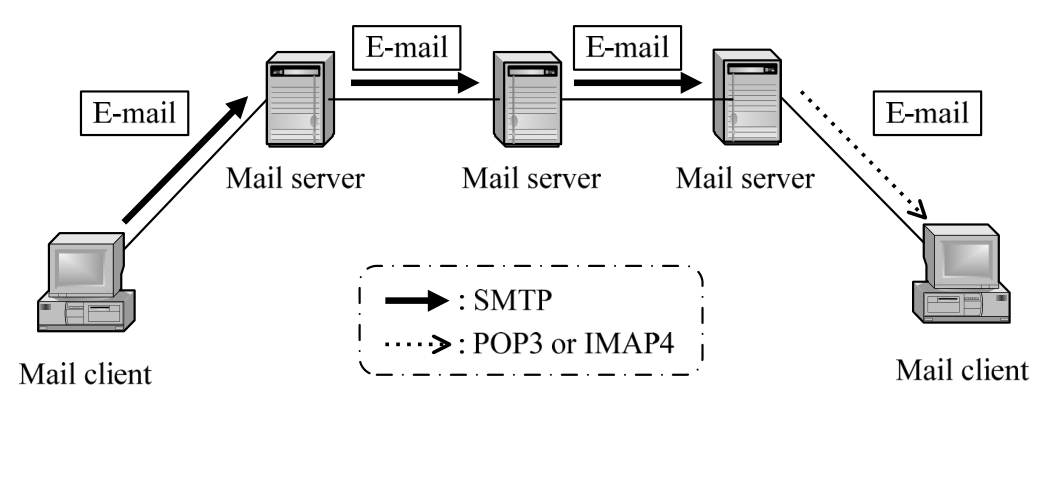
An electronic mail is an electronic letter that is sent to a specific partner. In addition to text (i.e., characters) data, image data and voice data can also be sent by using a protocol called MIME (Multipurpose Internet Mail Extensions). MIME uses an encoding method called BASE64 in which data is separated into six-bit portions and converted to 64 types of alphanumeric characters. An electronic mail that makes use of the Internet is also called an “e-mail.” When an e-mail is sent, the e-mail is first sent to the mail server to which the mail client of the transmitting side is connected. The mail server determines the destination mail server from the mail address and selects the most appropriate path. (In certain cases, the e-mail may pass through another mail server before the e-mail reaches the mail server of the other party.) When the e-mail reaches the mail server of the other party, the mail client of the receiving side can acquire the e-mail from the mail server at any desired timing. (Since the e-mail is sent through the store-and-forward switching method, the sending order and the receiving order may differ when there is a transmission delay.) The e-mail transfer protocol SMTP (Simple Mail Transfer Protocol) is used to transfer an e-mail to the mail server, or to transfer an e-mail between mail servers. On the other hand, in order to acquire an e-mail from the mail server, mail reception protocols such as POP3 (Post Office Protocol version 3), which acquires the entire information within the mail server in a batch, or IMAP4 (Internet Message Access Protocol version 4), which enables the selection of the e-mail by initially acquiring only the header information, are used. IMAP4 is effective in e-mail usage in a mobile environment. · 3 questions

p. 338

Original mail-client and mail-server paths, with SMTP and POP3 or IMAP4 arrow directions and legend. Source text:
p. 338 · Enlarge
Original mail-routing diagram · 1 practice questions

After an e-mail is sent, the e-mail may be returned along with a message “Returned e-mail: … unknown”. In such a case, if “Host” is unknown, check the portion after the @ mark of the mail address because the “mail server of the destination is not found,” and if “User” is unknown, check the portion before the @ mark of the e-mail address because the “the user of the destination is not found.”

(2) Web / WWW (World Wide Web)

Web/WWW is a mechanism (i.e., service) that enables the acquisition of information (e.g., web pages) that is registered on the web server by an individual or company through a simple operation. In most cases, the web pages that are published on the web server are created by a markup language, such as HTML and XML. A web page is hypertext (or hypermedia) in which reference information (hyperlink) that can be accessed on the related web page is embedded. Therefore, in order to acquire a web page from the web server, the web client uses HTTP (HyperText Transfer Protocol). The acquired web page can be browsed through with the help of software called a browser that exists in the web client. Generally, a URL (Uniform Resource Locator) is used to reference a web page. The URL is configured by the “Protocol name://Host name + domain name/File name” (e.g., “http://www.its.co.jp/map.html”). The URL shows the location of the files that are accumulated by the web server on the Internet, and is used through conversion to the IP address.

p. 339
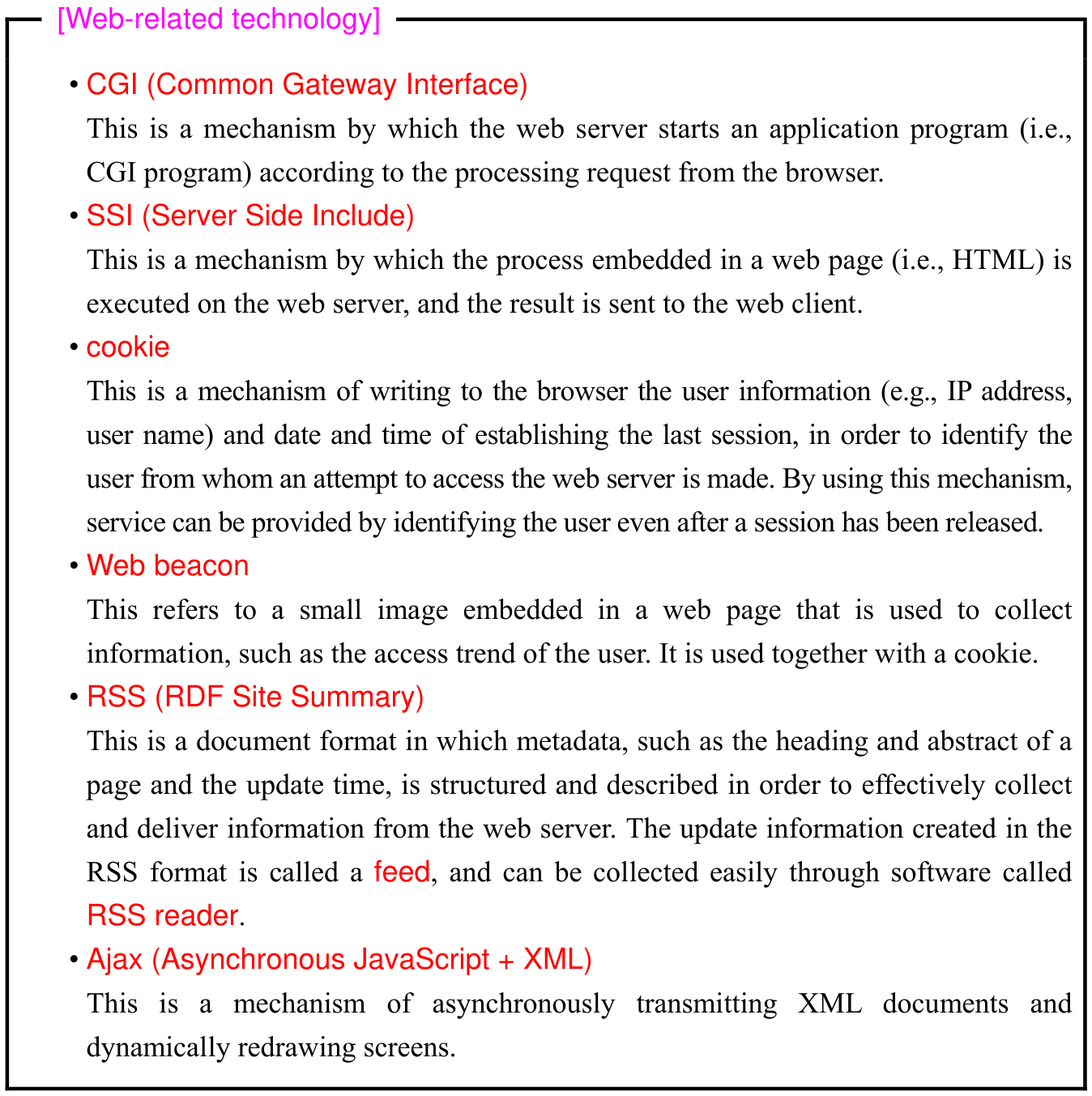
Original Internet Services source table or explanation box, preserving its complete original arrangement, labels and values. Source text: [Web-related technology] • CGI (Common Gateway Interface) This is a mechanism by which the web server starts an application program (i.e., CGI program) according to the processing request from the browser. • SSI (Server Side Include) This is a mechanism by which the process embedded in a web page (i.e., HTML) is executed on the web server, and the result is sent to the web client. • cookie This is a mechanism of writing to the browser the user information (e.g., IP address, user name) and date and time of establishing the last session, in order to identify the user from whom an attempt to access the web server is made. By using this mechanism, service can be provided by identifying the user even after a session has been released. • Web beacon This refers to a small image embedded in a web page that is used to collect information, such as the access trend of the user. It is used together with a cookie. • RSS (RDF Site Summary) This is a document format in which metadata, such as the heading and abstract of a page and the update time, is structured and described in order to effectively collect and deliver information from the web server. The update information created in the RSS format is called a feed, and can be collected easily through software called RSS reader. • Ajax (Asynchronous JavaScript + XML) This is a mechanism of asynchronously transmitting XML documents and dynamically redrawing screens.
p. 339 · Enlarge

(3) Search engine

A search engine is a program that performs the search process on a search site that is a collection of web pages for searching information. The information search service that is provided by the information search site is included as one of the web services. The mechanism of information search that is provided by the search engine is broadly classified into three types.
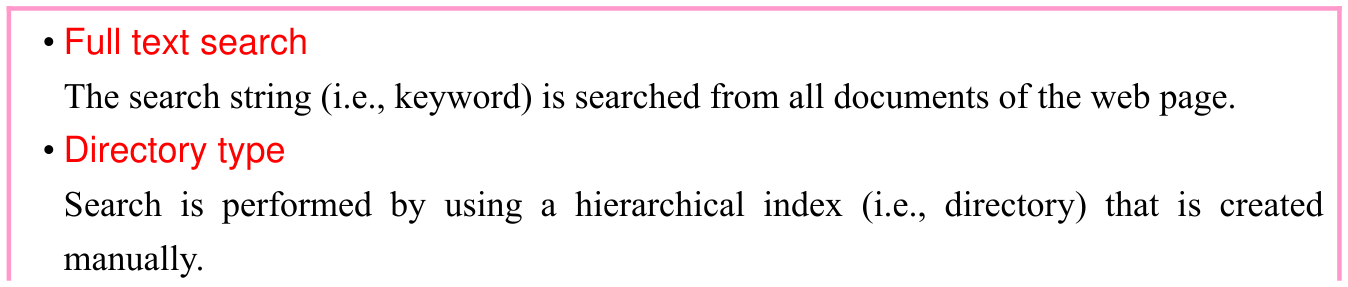
Original Internet Services source table or explanation box, preserving its complete original arrangement, labels and values. Source text: • Full text search The search string (i.e., keyword) is searched from all documents of the web page. • Directory type Search is performed by using a hierarchical index (i.e., directory) that is created manually.
p. 339 · Enlarge

p. 340

Original Internet Services source table or explanation box, preserving its complete original arrangement, labels and values. Source text: • Robot type Search is performed from the information that is accumulated and analyzed by using software (i.e., crawler) that automatically collects the information on the Internet and saves it as the database.
p. 340 · Enlarge

(4) File transfer service

The file transfer service is a service that downloads files to the client from an FTP server, and uploads files to the FTP server from the client. The URL is used for specifying the address in the file transfer service as well. However, since FTP (File Transfer Protocol) is used as a protocol, the portion indicating the protocol name of the URL becomes “ftp”.

(5) Other services

The following services (or utilization methods) that make use of Internet technologies are also available.
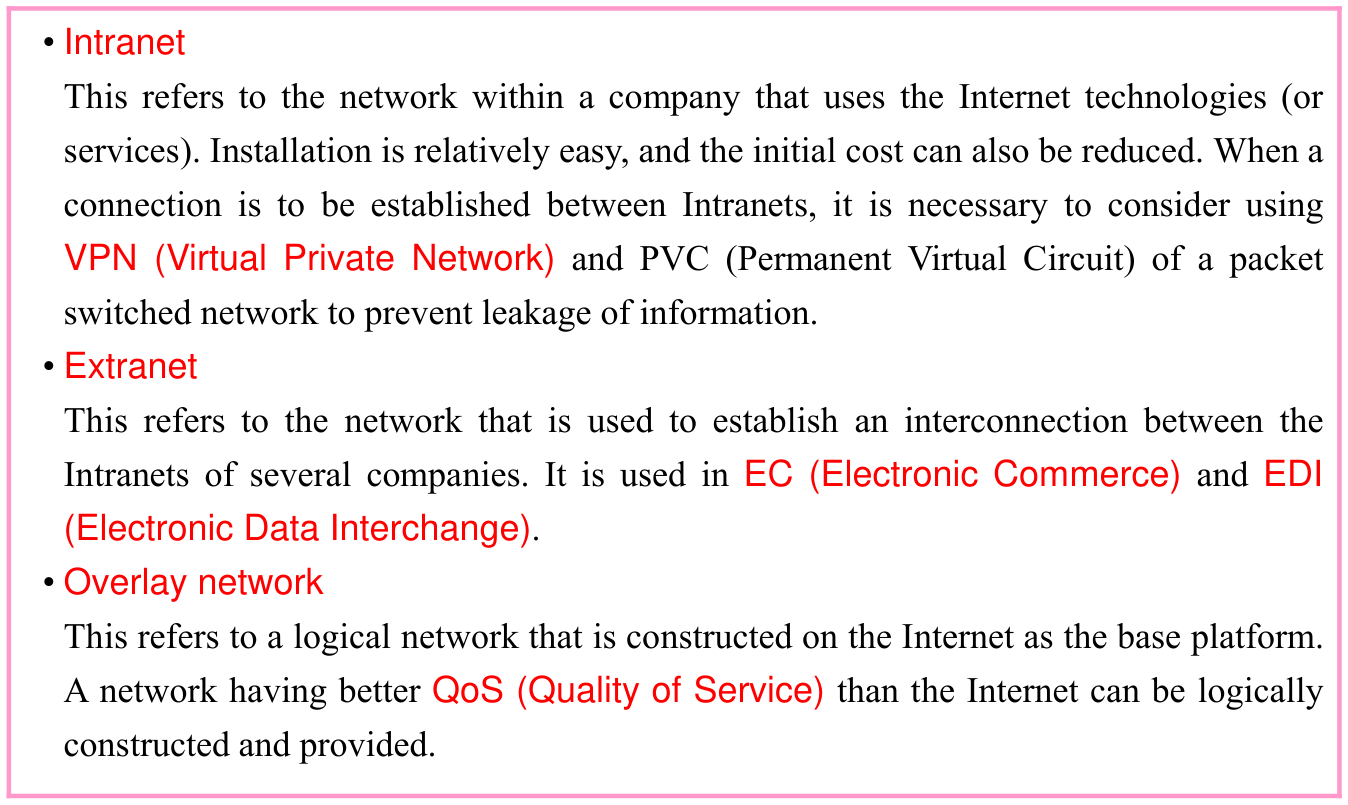
Original Internet Services source table or explanation box, preserving its complete original arrangement, labels and values. Source text: • Intranet This refers to the network within a company that uses the Internet technologies (or services). Installation is relatively easy, and the initial cost can also be reduced. When a connection is to be established between Intranets, it is necessary to consider using VPN (Virtual Private Network) and PVC (Permanent Virtual Circuit) of a packet switched network to prevent leakage of information. • Extranet This refers to the network that is used to establish an interconnection between the Intranets of several companies. It is used in EC (Electronic Commerce) and EDI (Electronic Data Interchange). • Overlay network This refers to a logical network that is constructed on the Internet as the base platform. A network having better QoS (Quality of Service) than the Internet can be logically constructed and provided.
p. 340 · Enlarge
Intranet · 1 practice questions

Original chapter exercises

Original chapter exercises →

New FE Textbook Vol.1 · IT Fundamentals · First Edition, April 2015