Highlighted text? Practice this concept. Highlighted passages and figures open related questions.
Practice related questions (1)Progress & bookmarks
Current section
3-1-2 MAC (Media Access Control)
p. 322
Progress
Not marked complete
Related questions in this lesson 1
CSMA/CD collision detection1CSMA/CD collision diagram1p. 322
3-1-2 MAC (Media Access Control)
MAC (Media Access Control) defines the data transmission method and error detection method. In a LAN, the method of acquiring access rights for data transmission is mainly controlled. The MAC of LAN is defined in the MAC sublayer of the data link layer of the OSI basic reference model. Therefore, when data (i.e., frames) is transmitted, the source address and the destination address are identified by the MAC address that is recorded in the LAN card as the identifier of the data link layer.
p. 323

(1) CSMA/CD
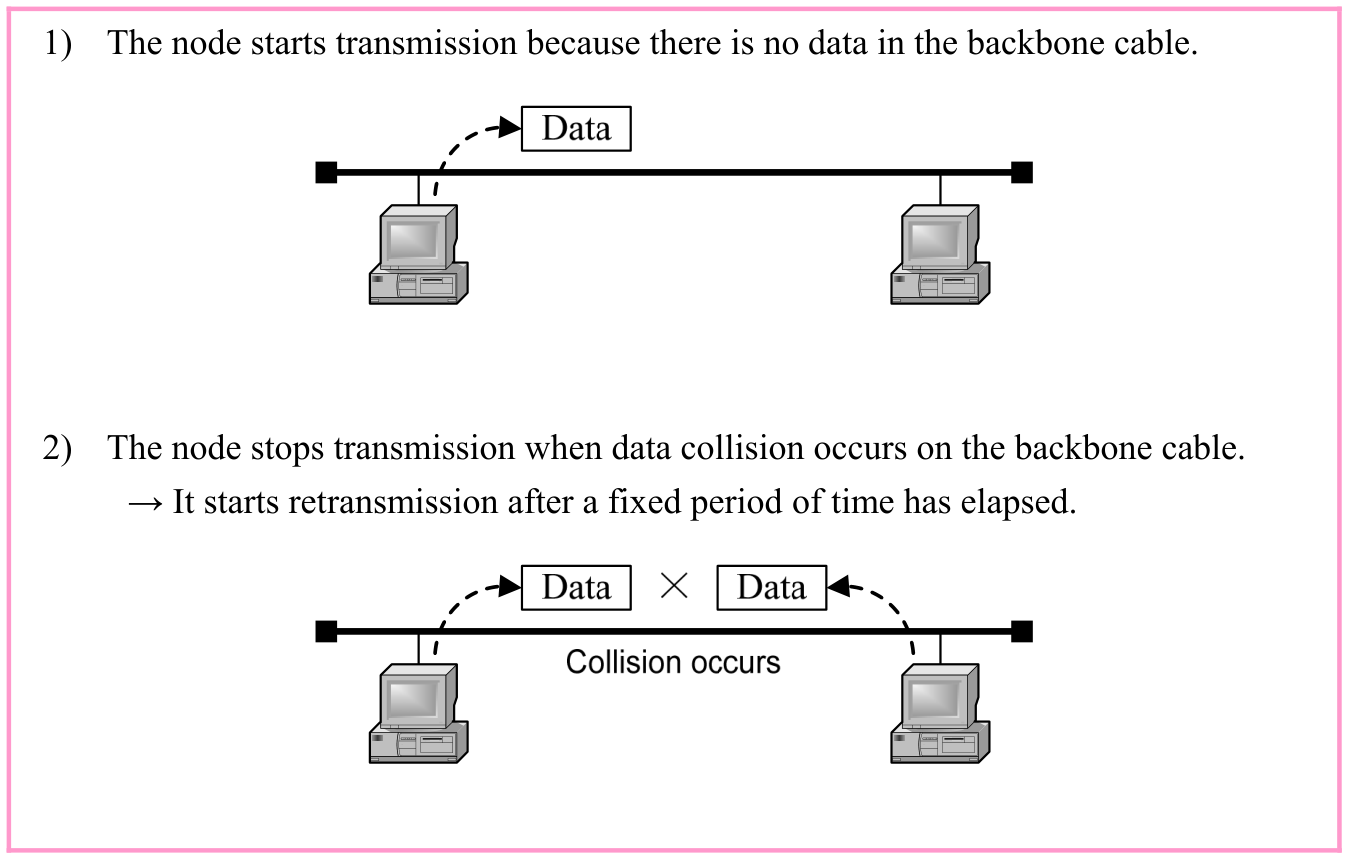
Since CSMA/CD must be used in half-duplex communication, it is not used very often in the current times when full duplex communication has become common. Moreover, since a collision cannot be detected in a wireless LAN, the CSMA/CA (CSMA with Collision Avoidance) method that checks the arrival of data on the basis of an ACK signal from the receiving side is used.
p. 324
(2) Token passing
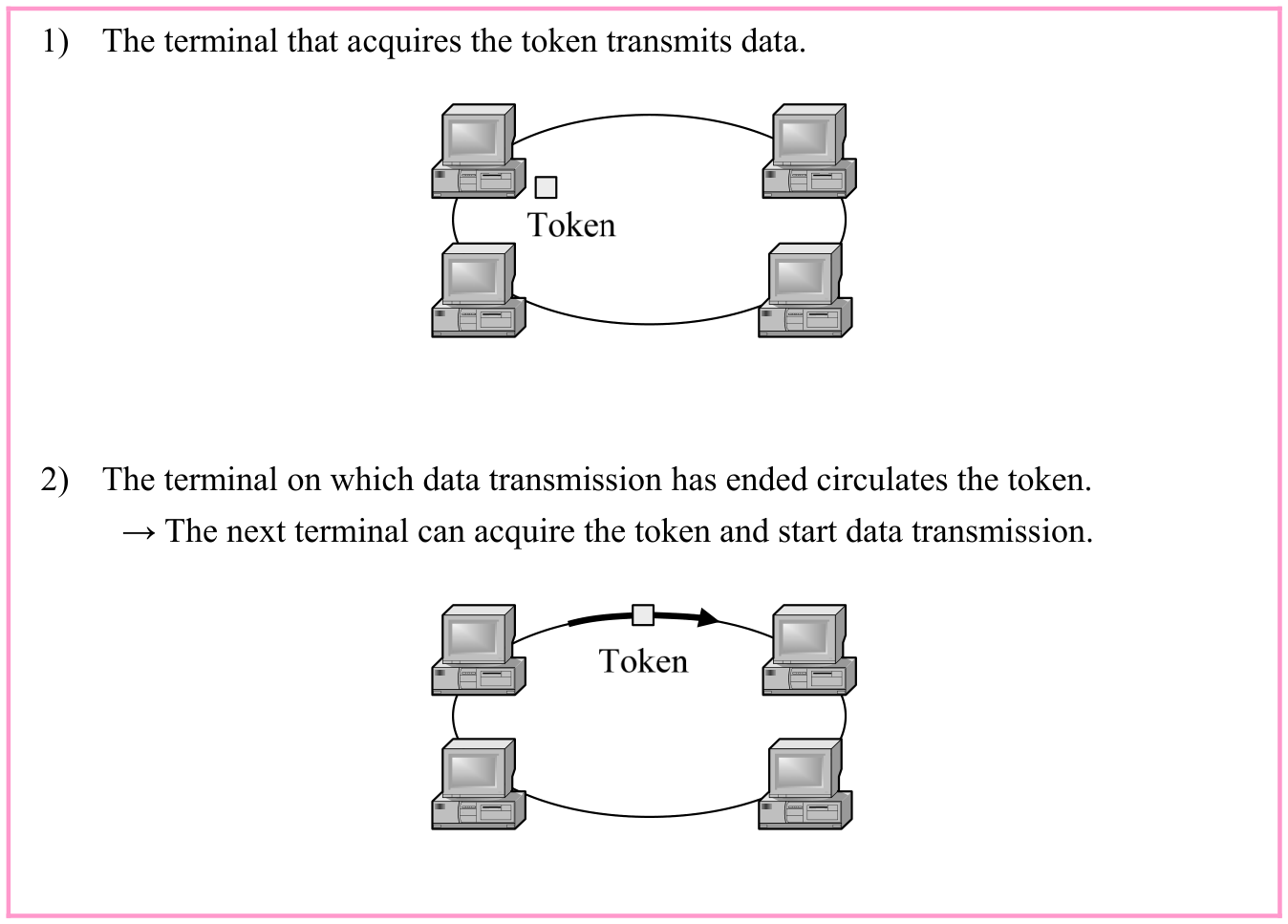
Token passing is a method by which a terminal that acquires special data called a token (i.e., transmission right) performs data transmission. It is referred to as token ring (i.e., IEEE 802.5) in the case of a ring LAN, and as token bus (i.e., IEEE 802.4) in the case of a bus LAN.
(3) TDMA (Time Division Multiplex Access)
TDMA (Time Division Multiple Access) is a method by which only the node to which a time slot has been assigned can perform data transmission. Since data transmission can be performed at regular intervals, a large transmission delay does not generally occur even in the high-traffic, high-load environment.
Section progress
Original chapter exercises
Original chapter exercises →New FE Textbook Vol.1 · IT Fundamentals · First Edition, April 2015