Highlighted text? Practice this concept. Highlighted passages and figures open related questions.
Practice related questions (2)Progress & bookmarks
Current section
4-6 Standardization and Certification Systems
p. 123
Practice this section 2 linked exam questions with default filters
Progress
Not marked complete
Related questions in this lesson 4
JIS environmental standard1JAN code1International standards bodies2p. 123 · PDF 127
4 - 6 Standardization and Certification Systems
4-6-1 Standards/Specifications and Standardization Organizations
(1) JIS (Japanese Industrial Standards) / JISC
JIS (Japanese Industrial Standards) is based on an original draft that is created by the JSA (Japanese Standards Association) and is deliberated by the JISC (Japanese Industrial Standards Committee). It is an industrial standard that is established by the competent ministers (i.e., Minister of the Environment, Minister of Economy, Trade and Industry, Minister of Health, Labor and Welfare, Minister of Land, Infrastructure and Transport, Minister for Internal Affairs and Communications, Minister of Agriculture, Forestry and Fisheries, and Minister of Education, Culture, Sports, Science and Technology), and is one of Japan’s national standards. In deliberative councils that are established by the Ministry of Economy, Trade and Industry, JISC conducts studies and deliberations on industrial standardization overall, on the basis of the Industrial Standardization Act. There are mainly two ways to formulate each JIS. One is to formulate it technologically identical to ISO or by modifying ISO. The other is to formulate it domestically or uniquely to Japan. In the case of the former type of JIS, the JIS number is identical to ISO number.
p. 124 · PDF 128
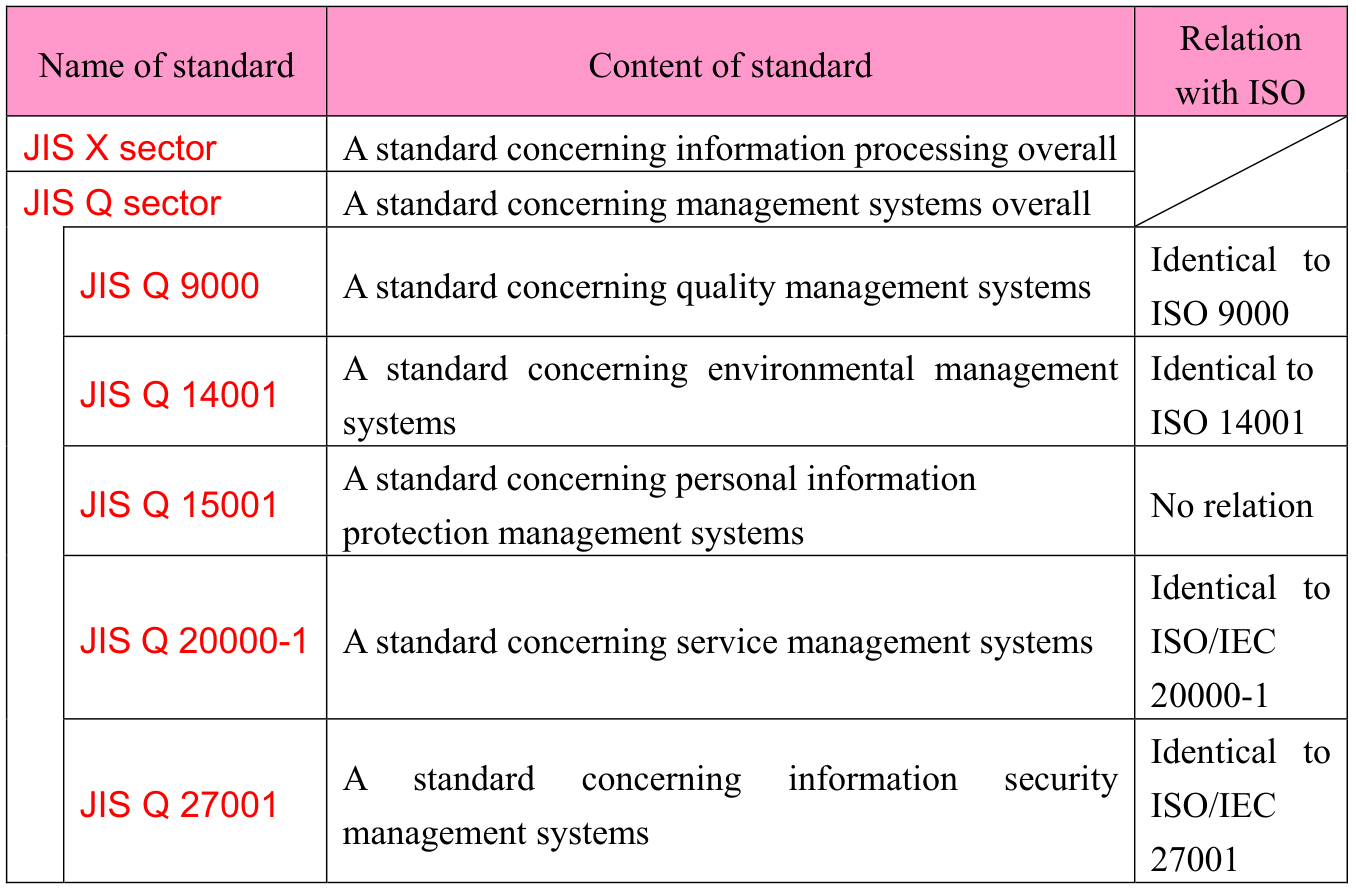
Source visual description
Original three-column table headed Name of standard, Content of standard, and Relation with ISO. The rows are JIS X sector, JIS Q sector, JIS Q 9000, JIS Q 14001, JIS Q 15001, JIS Q 20000-1 and JIS Q 27001. Original statements of identical ISO standards, the No relation entry and diagonal blank cells are preserved. The full original grid and exact native transcript are retained because detected cell geometry does not partition the source correctly.
Original visual text
Relation Name of standard Content of standard with ISO JIS X sector A standard concerning information processing overall JIS Q sector A standard concerning management systems overall Identical to JIS Q 9000 A standard concerning quality management systems ISO 9000 A standard concerning environmental management Identical to JIS Q 14001 systems ISO 14001 A standard concerning personal information JIS Q 15001 No relation protection management systems Identical to JIS Q 20000-1 A standard concerning service management systems ISO/IEC 20000-1 Identical to A standard concerning information security JIS Q 27001 ISO/IEC management systems 27001
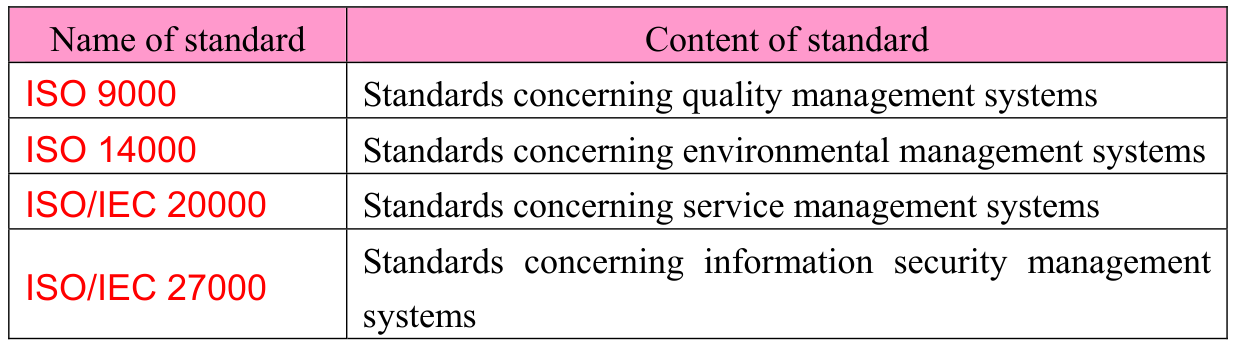
(2) IS (International Standards) / ISO
| Name of standard | Content of standard |
|---|---|
| ISO 9000 | Standards concerning quality management systems |
| ISO 14000 | Standards concerning environmental management systems |
| ISO/IEC 20000 | Standards concerning service management systems |
| ISO/IEC 27000 | Standards concerning information security management systems |
p. 125 · PDF 129
(3) Other standardization bodies
- • ITU (International Telecommunication Union)
This is an international standards body in the telecommunications sector, which was reorganized from the CCITT (Comité Consultatif International Téléphonique et Télégraphique = International Telegraph and Telephone Consultative Committee) in 1993. In addition to standardization work, the primary activities of the ITU include establishing international agreements and treaties concerning telecommunications. It is composed of organizations including major telecommunications service providers, financial institutions, and governmental institutions (Ministry of Internal Affairs and Communications in Japan) with jurisdiction over the telecommunications sectors in their respective countries. Its subordinate organizations include the ITU-T (International Telegraph Union Telecommunication Standardization Sector). - • IEC (International Electrotechnical Commission)
This is an international standardization body in the electrical and electronics technology sector, established in 1906. Its headquarters is located in Geneva, Switzerland. A part of IEC standards has been created jointly with ISO. - • IETF (Internet Engineering Task Force)
This is a voluntary association that promotes the standardization of Internet technology. IETF technical specifications are documented and published under the name RFC (Request For Comments). - • ANSI (American National Standards Institute)
This is a U.S. body for standardization in the industrial sector. Although ANSI standards are essentially U.S. domestic standards, they often become ISO or other international standards. - • IEEE (Institute of Electrical and Electronic Engineers)
This is a body related to the electrical and electronics sector, established in 1963. Its headquarters is located in New York, U.S. It is essentially an academic body, but it also engages in standardization activities and has contributed to standardization in the telecommunications sector in particular.
(4) De facto standards
De facto standards (or industry standards) are standards that were determined by a particular company or group but have become widely used, thus constituting standards for practical purposes. In contrast to de facto standards, those established by official standardization bodies are called de jure standards.
p. 126 · PDF 130
[Standardization bodies related to de facto standards]
- • OMG (Object Management Group)
This is a standardization group (or body) for object orientation technology. It manages the standard UML (Unified Modeling Language). - • W3C (World Wide Web Consortium)
This is an organization that sets a variety of technical standards that are used on the World Wide Web (WWW). It establishes standards for the HTML and XML that describe web pages.
4-6-2 Standards Related to Software Development
(1) Standardization of development and transaction processes
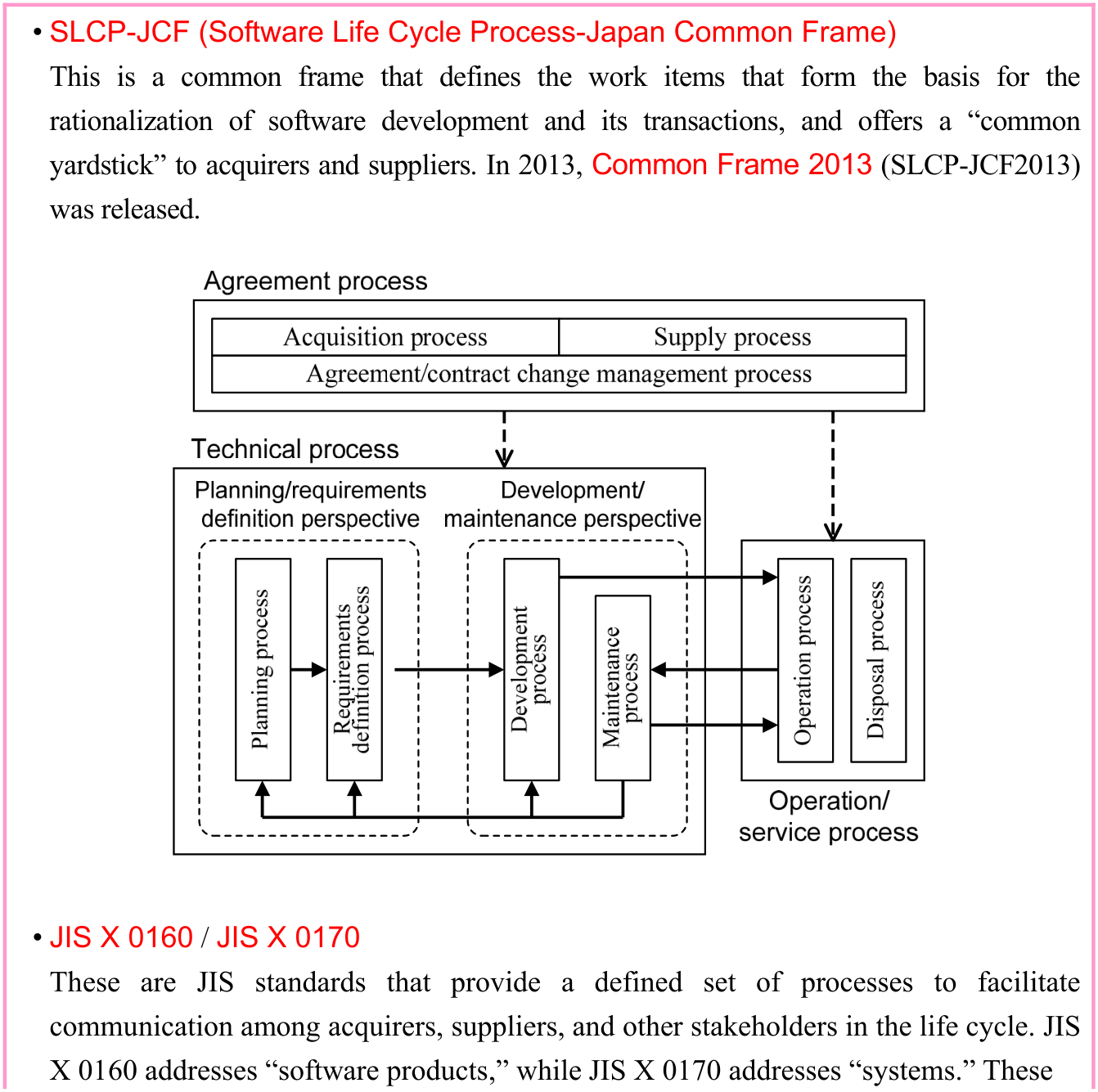
Source visual description
Original SLCP-JCF (Software Life Cycle Process-Japan Common Frame) and JIS X 0160/JIS X 0170 source box. The diagram has Agreement process with Acquisition process, Supply process and Agreement/contract change management process. Technical process contains Planning/requirements definition perspective with Planning process and Requirements definition process, and Development/maintenance perspective with Development process and Maintenance process. Operation process and Disposal process are grouped under Operation/service process. The original solid and dashed connectors, return arrows, process frames, 2013 Common Frame wording, and the cross-page source definition remain unchanged.
Original visual text
• SLCP-JCF (Software Life Cycle Process-Japan Common Frame) This is a common frame that defines the work items that form the basis for the rationalization of software development and its transactions, and offers a “common yardstick” to acquirers and suppliers. In 2013, Common Frame 2013 (SLCP-JCF2013) was released. • JIS X 0160 / JIS X 0170 These are JIS standards that provide a defined set of processes to facilitate communication among acquirers, suppliers, and other stakeholders in the life cycle. JIS X 0160 addresses “software products,” while JIS X 0170 addresses “systems.” These
p. 127 · PDF 131
standards form the basis for SLCP-JCF.
(2) Standards for environment and IT security evaluation
- • ISO 14001 / JIS Q 14001
This is a standard that specifies requirements for an environmental management system to enable an organization to develop and implement a policy and objectives which take into account legal requirements and information about significant environmental aspects. · 1 question - • ISO/IEC 15408 / JIS X 5070
This is a standard that stipulates evaluation criteria for security technologies and IT security, in the form of a guide for the development, evaluation and/or procurement of IT products with security functionality.
(3) Standards for software
- • CORBA (COmmon Request Broker Architecture)
This is a standard specification that enables message exchange among objects created by using different programming languages in a distributed environment. It is defined by OMG, a standardization group (or body) for object orientation technology. - • EJB (Enterprise JavaBeans)
This is a standard specification that is defined on the server side for distributed-network business applications, in the same manner as the JavaBeans specification which is a convention for handling programs that are developed in Java as components of applications.
(4) Standards for data
(i) Character codes These are the codes that represent characters (e.g., alphabetic characters, numerals). The following types are the character code sets that are used as standards in PCs, etc. in Japan.
- • JIS code
This is a code set that is established by JISC (Japanese Industrial Standards Committee) for displaying characters specific to Japanese. - • Unicode
p. 128 · PDF 132
This is a 2-byte, universal character code set that is proposed and endorsed by U.S. companies for the smooth interchange of PC data.
- • EUC (Extended Unix Code)
This is a character code set that is regulated by AT&T, for the internationalization of UNIX.
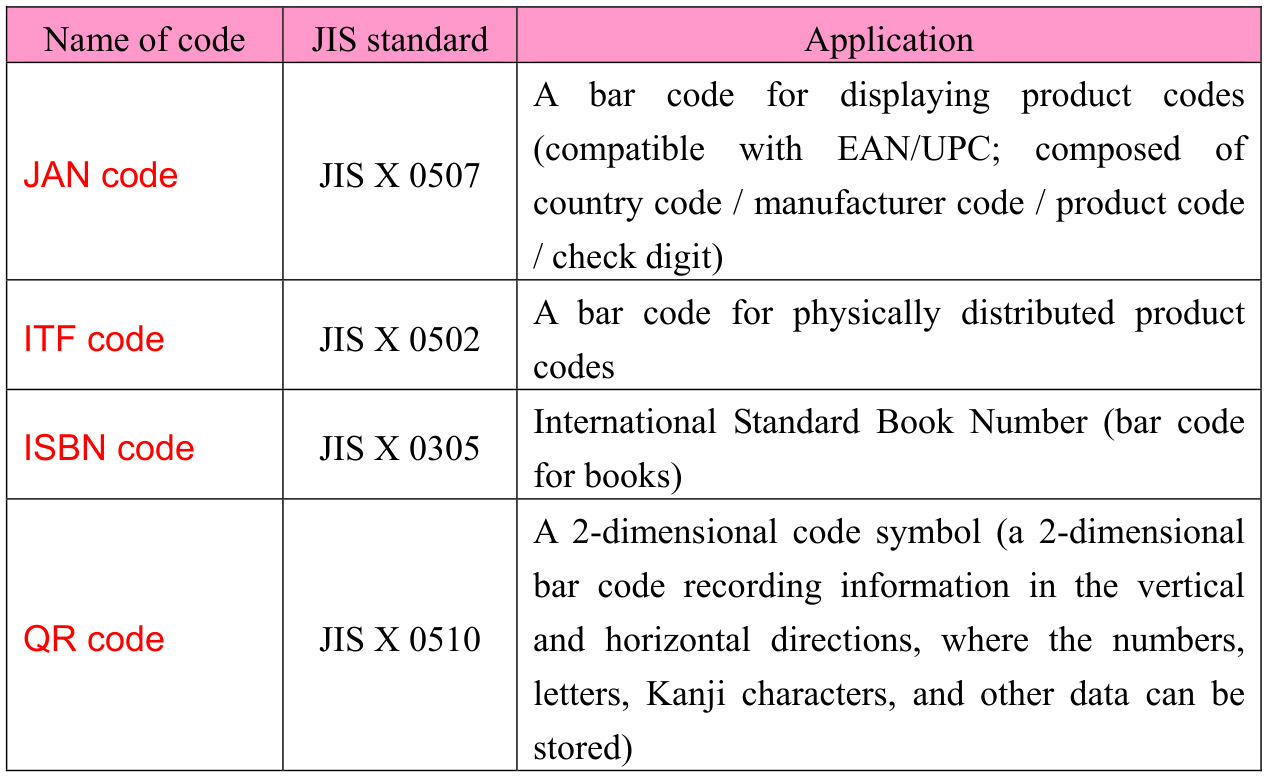
(ii) Bar codes This is a code that represents numbers or letters through differences in the thickness and spacing of lines. The following are JIS standards for bar codes that are used in Japan.
| Name of code | JIS standard | Application |
|---|---|---|
| JAN code | JIS X 0507 | A bar code for displaying product codes (compatible with EAN/UPC; composed of country code / manufacturer code / product code / check digit) |
| ITF code | JIS X 0502 | A bar code for physically distributed product codes |
| ISBN code | JIS X 0305 | International Standard Book Number (bar code for books) |
| QR code | JIS X 0510 | A 2-dimensional code symbol (a 2-dimensional bar code recording information in the vertical and horizontal directions, where the numbers, letters, Kanji characters, and other data can be stored) |
4-6-3 Certification Systems
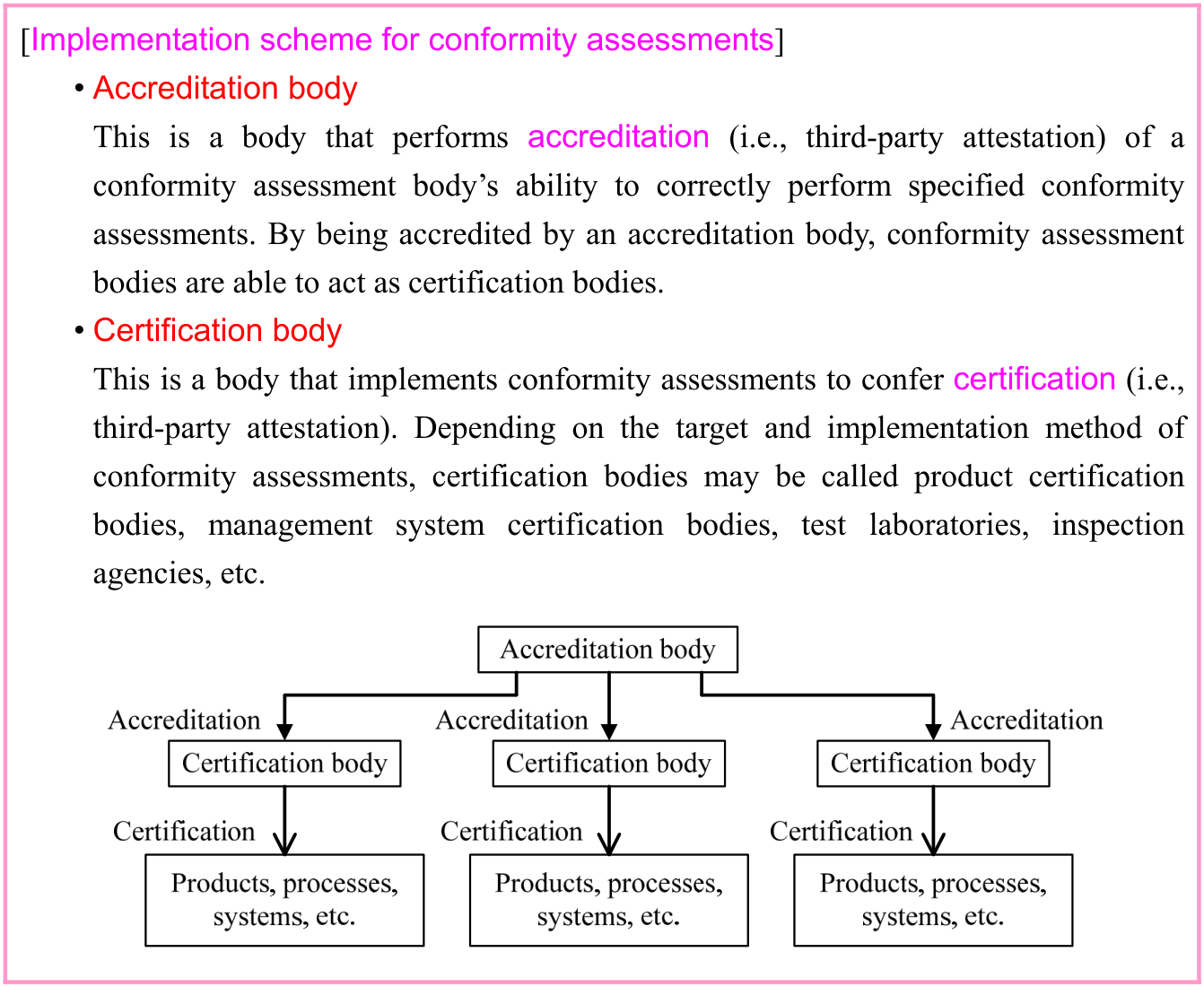
Certification systems are systems for examining and certifying whether products, processes, systems, etc. that are the targets of certification comply with the requirements of the corresponding standards. For organizations, it has important significance to obtain international certification such as ISO certifications. In certification, a conformity assessment body that is accredited by an accreditation body implements conformity assessments to verify whether products, processes, systems, etc. fulfill specified requirements. At this time, the certification cannot be accorded value (or reliability) if the conformity assessment body cannot perform a correct evaluation through fair examination. For that reason, ISO/IEC 17000 (JIS Q 17000) stipulates the implementation of conformity assessments in a 2-step tiered structure.
p. 129 · PDF 133
Source visual description
Original Implementation scheme for conformity assessments. The original definitions of Accreditation body and Certification body remain above the diagram. One Accreditation body branches through Accreditation arrows to three Certification body boxes. Each certification body points through Certification to a Products, processes, systems, etc. box. Every original arrow, label and source definition is preserved.
Original visual text
[Implementation scheme for conformity assessments] • Accreditation body This is a body that performs accreditation (i.e., third-party attestation) of a conformity assessment body’s ability to correctly perform specified conformity assessments. By being accredited by an accreditation body, conformity assessment bodies are able to act as certification bodies. • Certification body This is a body that implements conformity assessments to confer certification (i.e., third-party attestation). Depending on the target and implementation method of conformity assessments, certification bodies may be called product certification bodies, management system certification bodies, test laboratories, inspection agencies, etc.
The following are typical international certifications.
- • ISO 9000 certification
This is an international certification for quality management systems. It examines not only the quality of products, but also whether the organization’s quality management system overall is in conformance. - • ISO 14000 certification
This is an international certification concerning the construction of EMS (Environmental Management Systems). It calls for the construction of environmental management systems and the construction of a PDCA cycle to effect ongoing improvements. - • ISMS (Information Security Management System) conformity assessment
scheme This is an international certification for the construction of security management systems.
Section progress
Original chapter exercises
Original chapter exercises →New FE Textbook Vol.2 · First Edition, April 2015