Highlighted text? Practice this concept. Highlighted passages and figures open related questions.
Practice related questions (9)Progress & bookmarks
Current section
1 Corporate Activities
p. 11
Practice this section 9 linked exam questions with default filters
Progress
Not marked complete
Related questions in this lesson 4
Going concern1Green IT and conserving resources1Corporate governance and management monitoring1Business impact analysis and allowable downtime1p. 11 · PDF 15
1 Corporate Activities
Corporate activities are the business tasks and all other activities that are performed by a company according to the company’s goals and policies. This section describes the nature of corporate activities, which are primarily focused on the purpose of those corporate activities.
1 - 1 Purpose of Corporate Activities
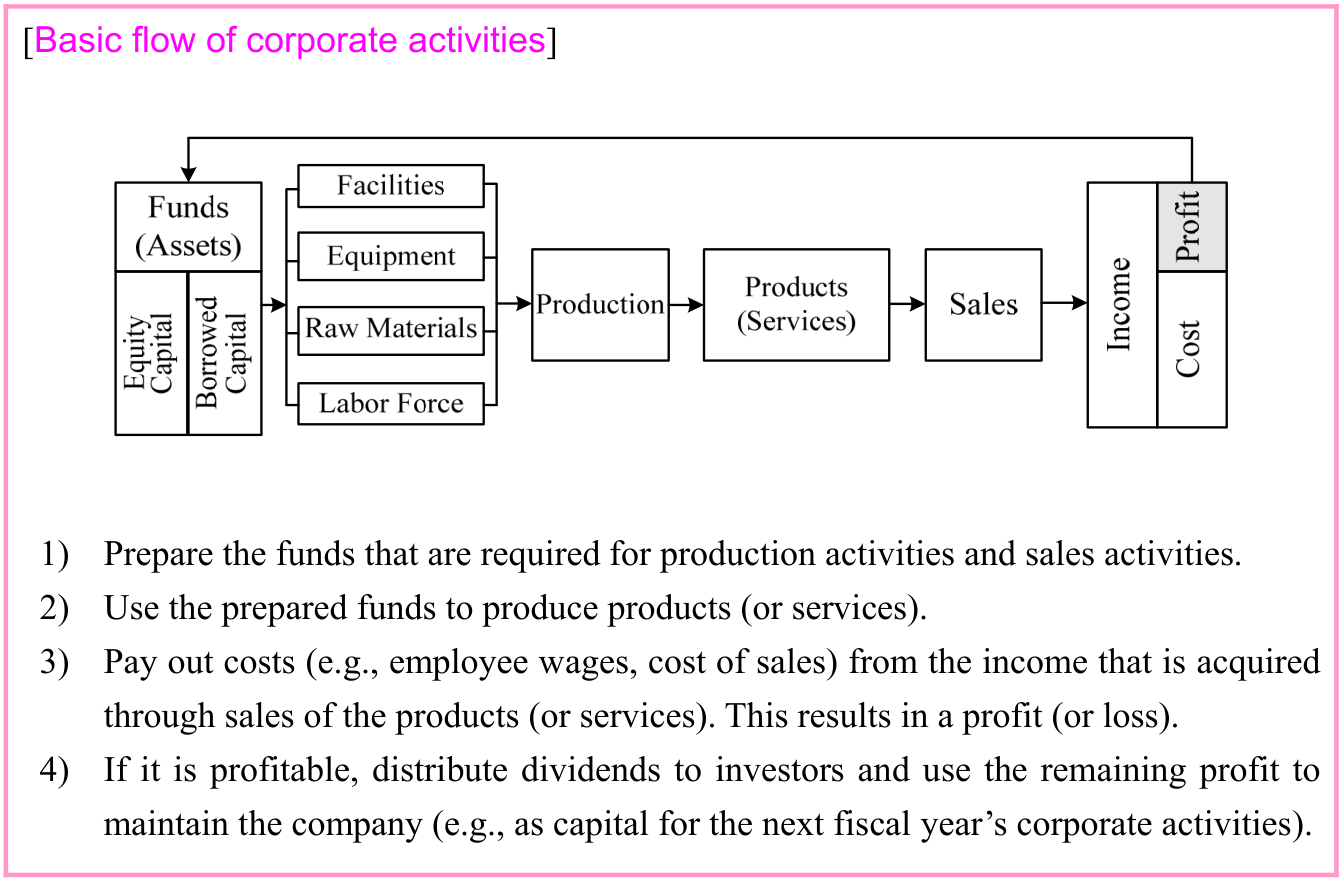
Corporate activities are activities that are conducted according to a company’s corporate philosophy (management philosophy) which indicates the fundamental concept of all corporate courses of action (i.e., the views, reason for existence, action policies, values, etc. that influence the management of a company). The purpose of corporate activities is to increase profits and enable a company to semi-permanently continue to exist under healthy management.
Source visual description
Original Basic flow of corporate activities. Funds (Assets), split into Equity Capital and Borrowed Capital, support Facilities, Equipment, Raw Materials and Labor Force. Arrows continue through Production, Products (Services), Sales and Income, with Profit and Cost subdivisions. The upper return arrow runs from Profit toward Funds. The four original numbered descriptions remain in the same complete source box.
Original visual text
[Basic flow of corporate activities] 1) Prepare the funds that are required for production activities and sales activities. 2) Use the prepared funds to produce products (or services). 3) Pay out costs (e.g., employee wages, cost of sales) from the income that is acquired through sales of the products (or services). This results in a profit (or loss). 4) If it is profitable, distribute dividends to investors and use the remaining profit to maintain the company (e.g., as capital for the next fiscal year’s corporate activities).
p. 12 · PDF 16
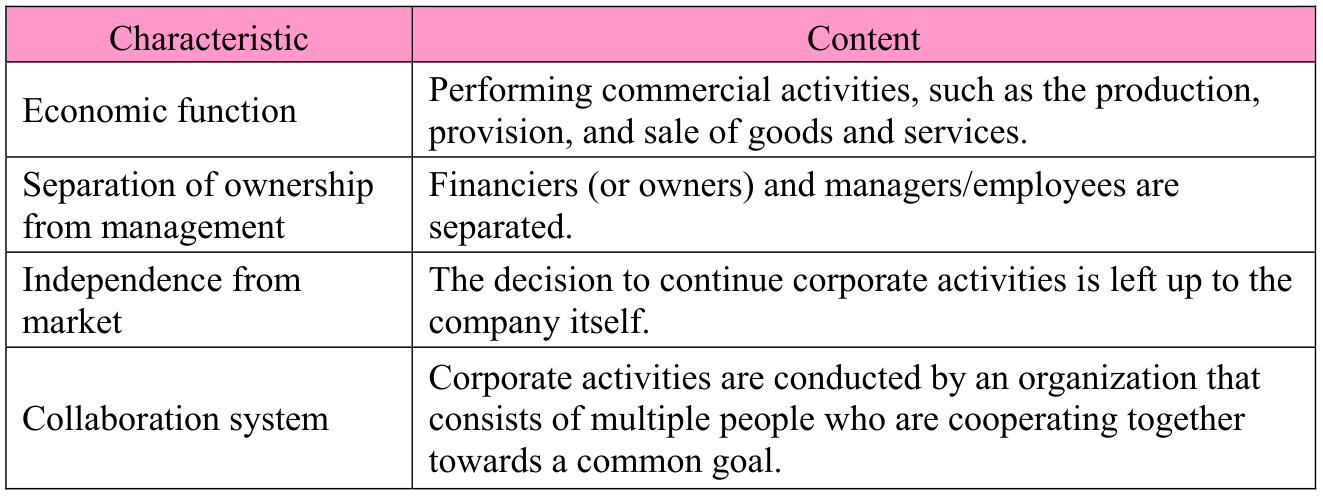
Companies that can smoothly execute these corporate activities are those that are organic organizations with the following multifaceted characteristics.
| Characteristic | Content |
|---|---|
| Economic function | Performing commercial activities, such as the production, provision, and sale of goods and services. |
| Separation of ownership from management | Financiers (or owners) and managers/employees are separated. |
| Independence from market | The decision to continue corporate activities is left up to the company itself. |
| Collaboration system | Corporate activities are conducted by an organization that consists of multiple people who are cooperating together towards a common goal. |
A company which has both multifaceted and organic characteristics successfully repeats the PDCA cycle (Plan, Do, Check, and Act) and plans for expansion in response to the present age and environment. Another important purpose of corporate activities is contribution to society. Companies exist to gain profit, but companies that do not act in the interests of society cannot stand the test of time. The contribution to society as part of corporate activities leads to an increase in corporate value (and in turn, maintaining the company’s existence). The following are some concepts that are related to corporate activities for the contribution to society.
- • CSR (Corporate Social Responsibility)
CSR refers to the responsibilities of a company in response to requests that are received from citizens, local communities, or the current social climate through their corporate activities. Companies must take responsibility for the effects that their decisions and activities have on society and the environment. - • Green IT
Green IT refers to the promotion of energy conservation in today’s whole modern IT-based society and the approach to the conservation of the global environment by reducing the energy that is consumed by computers, peripheral devices, network devices, and other IT-related devices and products, in addition to the efficient use of resources and other means. · 1 question - • CI (Corporate Identity)
CI is a concept in which the existential value and significance of a company is clearly defined through CSR or other means in order to create awareness of the corporate brand. - • Corporate governance
p. 13 · PDF 17
- • Disclosure
Disclosure is the act of publicizing the business and financial state of a company. Some disclosure is required by law, while other types of disclosure are left up to the discretion of the company. The latter type of disclosure is sometimes also referred to as IR (Investor Relations) because it acts as the provision of information for investors to base their investment decisions on. The broad definition of disclosure also includes information about products and the environment other than the business situation, and therefore can sometimes be considered as part of CSR. - • Going concern (Continuous Business Entities)
This refers to the underlying prerequisite concept for any company that “the company can continue its corporate activities indefinitely and continue to meet its social responsibilities/missions.” As long as this prerequisite is in place, investors can invest in the company and customers can use the services that are provided by the company. · 1 question - • BCP (Business Continuity Plan)
This refers broadly to the plan of action and policies that are designed to avoid in advance or quickly recover from any damages that may result in a risk of an interruption of vital business activities, such as a disaster or failure. BCP also includes business impact analysis, which determines policies, such as the maximum allowed amount of business stoppage time upon analysis of the losses and the effects of an interruption of business activities. · 1 question
Section progress
Original chapter exercises
Original chapter exercises →New FE Textbook Vol.2 · First Edition, April 2015