Highlighted text? Practice this concept. Highlighted passages and figures open related questions.
Practice related questions (9)Progress & bookmarks
Current section
2 Corporate Accounting
p. 22
Practice this section 9 linked exam questions with default filters
Progress
Not marked complete
Related questions in this lesson 8
Balance sheet3Balance-sheet structure2Fixed-rate depreciation2Operating profit1Operating-profit calculation1Inventory valuation methods1Straight-line depreciation1p. 22 · PDF 26
2 Corporate Accounting
Corporate accounting consists of financial accounting and management accounting. Financial accounting is performed in accordance with the Commercial Code, the Corporation Tax Act, and the Securities and Exchange Act which applies to organizations, such as publicly listed companies. Management accounting provides and manages information that is used to help executives in decision-making.
2 - 1 Financial Accounting
Financial accounting records and calculates business activities on the basis of commercial code and tax laws, and reports that information to stockholders, creditors, nations, and other entities.
2-1-1 Mechanism of Closing Accounts
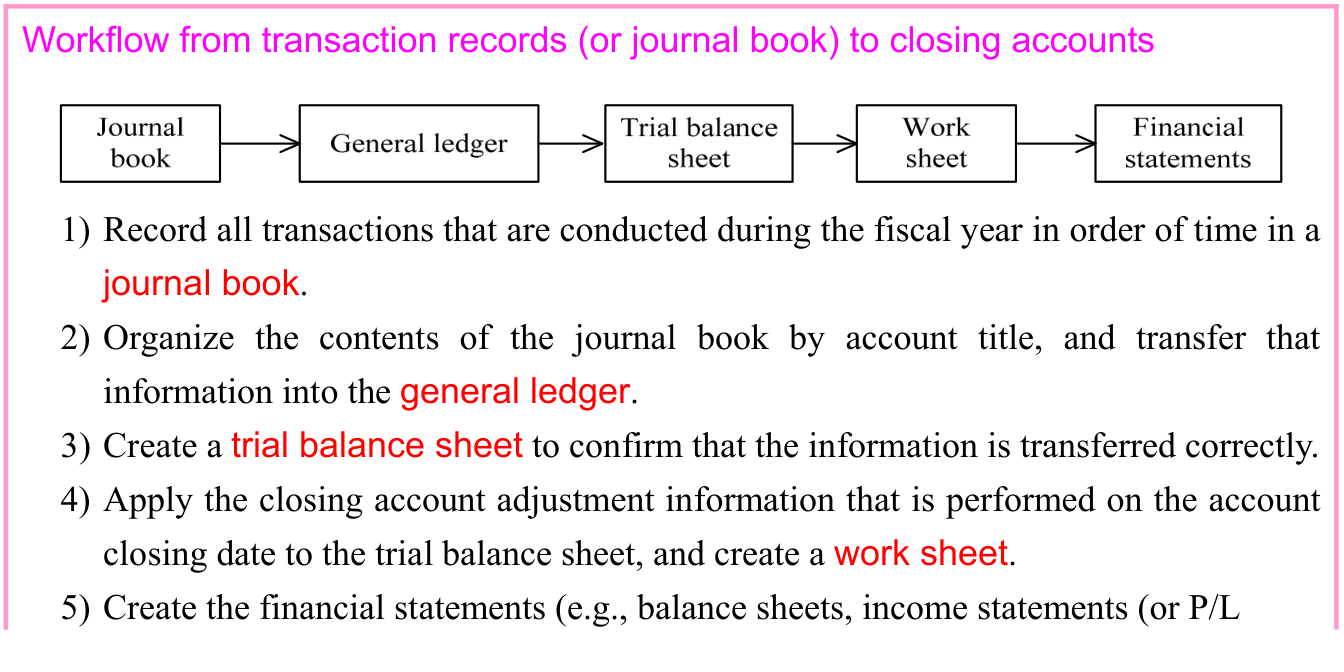
Since corporate activities are conducted indefinitely, the accounting processing for a corporation is performed for a fixed period (from any desired date) known as a fiscal year (i.e., accounting term). In Japan, many companies operate on a fiscal year that starts from April 1 and ends on March 31 of the next calendar year. Closing accounts is the process of authoring financial statements (e.g., balance sheets, income statements (or P/L statement)) on the basis of accounting standards after the last day (i.e., account closing date) of the fiscal year and finalizing profit and loss. The accounting standards include IFRS (International Financial Reporting Standards) that is established as an international standard by the IASB (International Accounting Standards Board).
Source visual description
Original workflow box. The sequence is Journal book, General ledger, Trial balance sheet, Work sheet and Financial statements. The original numbered closing-account steps are preserved; step five continues on the following page.
Original visual text
Workflow from transaction records (or journal book) to closing accounts 1) Record all transactions that are conducted during the fiscal year in order of time in a journal book. 2) Organize the contents of the journal book by account title, and transfer that information into the general ledger. 3) Create a trial balance sheet to confirm that the information is transferred correctly. 4) Apply the closing account adjustment information that is performed on the account closing date to the trial balance sheet, and create a work sheet. 5) Create the financial statements (e.g., balance sheets, income statements (or P/L
p. 23 · PDF 27

Source visual description
Final source fragment of the closing-account workflow box, completing the fifth numbered step from the preceding page. The original closing border is included.
Original visual text
statement)) from the work sheet.
The items applicable for closing accounts are any of those that are related to a change in assets, liabilities, net assets, income, and cost. Corporate activities which are only contract-based do not apply. However, any uniquely held “goodwill” assets with intangible value are evaluated as a monetary value amount and are therefore applicable for closing accounts. Publicly traded companies must create an earnings summary (i.e., advance earnings report) and submit that information to the securities exchange according to the common forms of the securities exchange when it publicizes its closing of accounts. The consolidated accounting system was introduced in the year 2000, which treats parent companies, subsidiaries, and all other related companies as a single organization, and therefore, must perform closing accounts for the entire organization as a whole. In such cases, the equity method may also be employed in which the financial status of companies in which a firm holds a significant investment is applied to the earnings report even though those companies are not considered consolidated subsidiaries.
2-1-2 Financial Statements
(1) B/S (Balance Sheet)
Source visual description
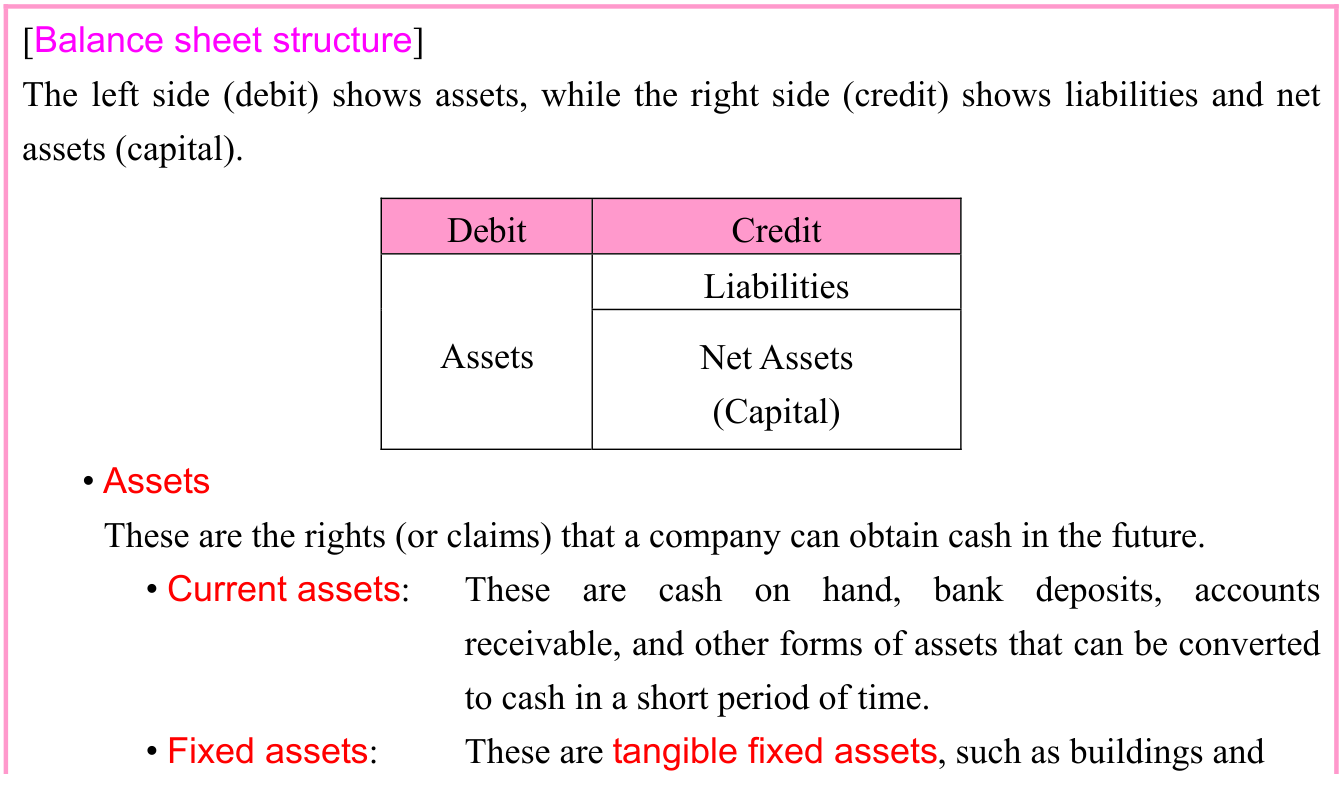
Original balance-sheet structure. Debit is the left side and Credit the right. Assets occupy the debit column; Liabilities and Net Assets (Capital) occupy the credit column. The original Assets definitions and current/fixed asset labels begin below the grid and continue on the next page.
Original visual text
[Balance sheet structure] The left side (debit) shows assets, while the right side (credit) shows liabilities and net assets (capital). Debit Credit Liabilities Assets Net Assets (Capital) • Assets These are the rights (or claims) that a company can obtain cash in the future. • Current assets: These are cash on hand, bank deposits, accounts receivable, and other forms of assets that can be converted to cash in a short period of time. • Fixed assets: These are tangible fixed assets, such as buildings and
p. 24 · PDF 28
Source visual description
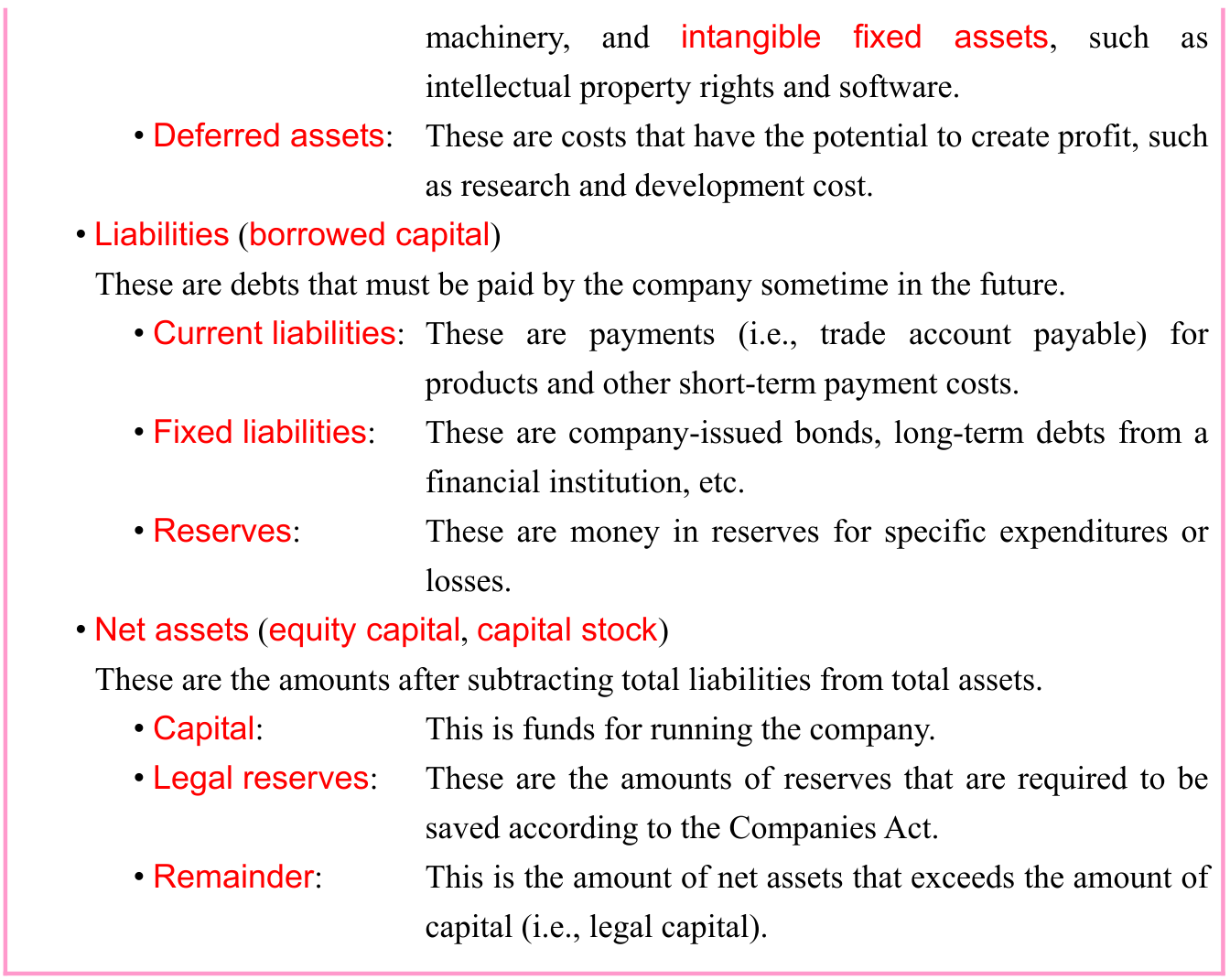
Original continuation of the balance-sheet definitions, retaining intangible fixed assets, deferred assets, liabilities (borrowed capital), current liabilities, fixed liabilities, reserves, net assets (equity capital, capital stock), capital, legal reserves and remainder in their original indentation and pairing.
Original visual text
machinery, and intangible fixed assets, such as intellectual property rights and software. • Deferred assets: These are costs that have the potential to create profit, such as research and development cost. • Liabilities (borrowed capital) These are debts that must be paid by the company sometime in the future. • Current liabilities: These are payments (i.e., trade account payable) for products and other short-term payment costs. • Fixed liabilities: These are company-issued bonds, long-term debts from a financial institution, etc. • Reserves: These are money in reserves for specific expenditures or losses. • Net assets (equity capital, capital stock) These are the amounts after subtracting total liabilities from total assets. • Capital: This is funds for running the company. • Legal reserves: These are the amounts of reserves that are required to be saved according to the Companies Act. • Remainder: This is the amount of net assets that exceeds the amount of capital (i.e., legal capital).
A balance sheet is named as it is called so because the total on the debit side (i.e., assets) must be the same total on the credit side (i.e., liabilities, net assets). Therefore, the following equalities must always be completed.
| Balance sheet equality | Assets = Liabilities + Net assets = Borrowed capital + Equity capital |
|---|---|
| Net assets equality | Net assets = Assets − Liabilities |

The amount of profit (i.e, current period net profit) and loss (i.e., current period net loss) can also be determined by comparing the balance sheets for the previous and current periods.
Accurate asset management is important to account for all assets that are owned by the company in order to create accurate and correct balance sheets. The following concepts are applied in asset management.
p. 25 · PDF 29
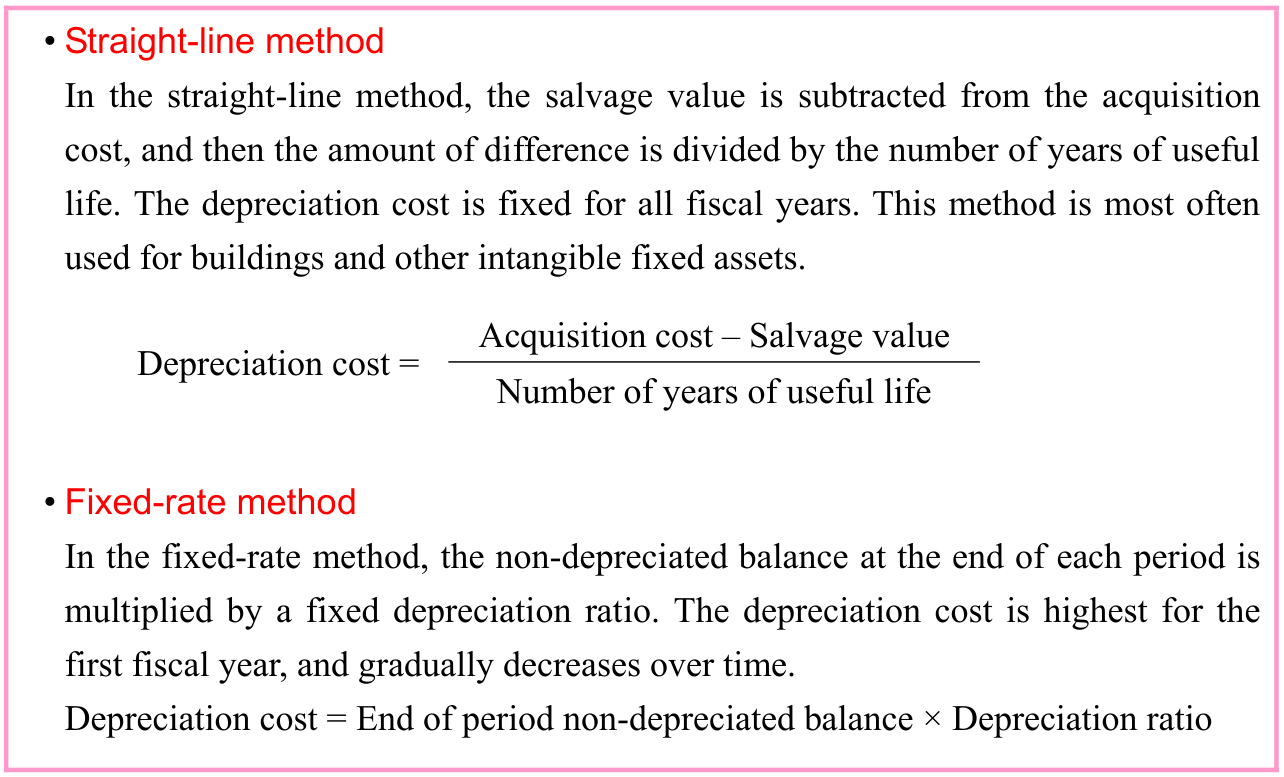
(i) Depreciation Value of buildings and equipment goes down in the course of being used. The reduction amount of value (i.e., depreciation) is included in a cost, and the amount is subtracted from the acquisition cost of those assets in order to perform the depreciation. Depreciation cost (i.e., the amount of depreciation) can be calculated by using the following methods.
Source visual description
Original two-method box. The straight-line method expression is Depreciation cost = (Acquisition cost - Salvage value) / Number of years of useful life. The fixed-rate method uses the non-depreciated balance multiplied by a fixed rate. All original method prose is retained.
Original visual text
• Straight-line method In the straight-line method, the salvage value is subtracted from the acquisition cost, and then the amount of difference is divided by the number of years of useful life. The depreciation cost is fixed for all fiscal years. This method is most often used for buildings and other intangible fixed assets. Acquisition cost – Salvage value Depreciation cost = Number of years of useful life • Fixed-rate method In the fixed-rate method, the non-depreciated balance at the end of each period is multiplied by a fixed depreciation ratio. The depreciation cost is highest for the first fiscal year, and gradually decreases over time. Depreciation cost = End of period non-depreciated balance × Depreciation ratio
(ii) Lease contract This is a long-term contract for borrowed devices, equipment, or other assets from a leasing company. If such a contract is canceled during the contract period, a penalty must be paid, and all maintenance costs for leased equipment are paid for by the borrower. In many cases, it is possible to purchase the leased equipment at the end of the leasing period for a discounted price. At one time, assets that were borrowed by leasing were not included in balance sheets (off-balance), but this rule was changed because there were cases of abusing it, and now these assets must be included in balance sheet calculations. There is also a rental contract which has less restrictions than lease contract. Rental contract is a short-term borrowing contract (generally around one year) which allows mid-term cancellation. Maintenance costs for borrowed equipment are also covered by the rental company.
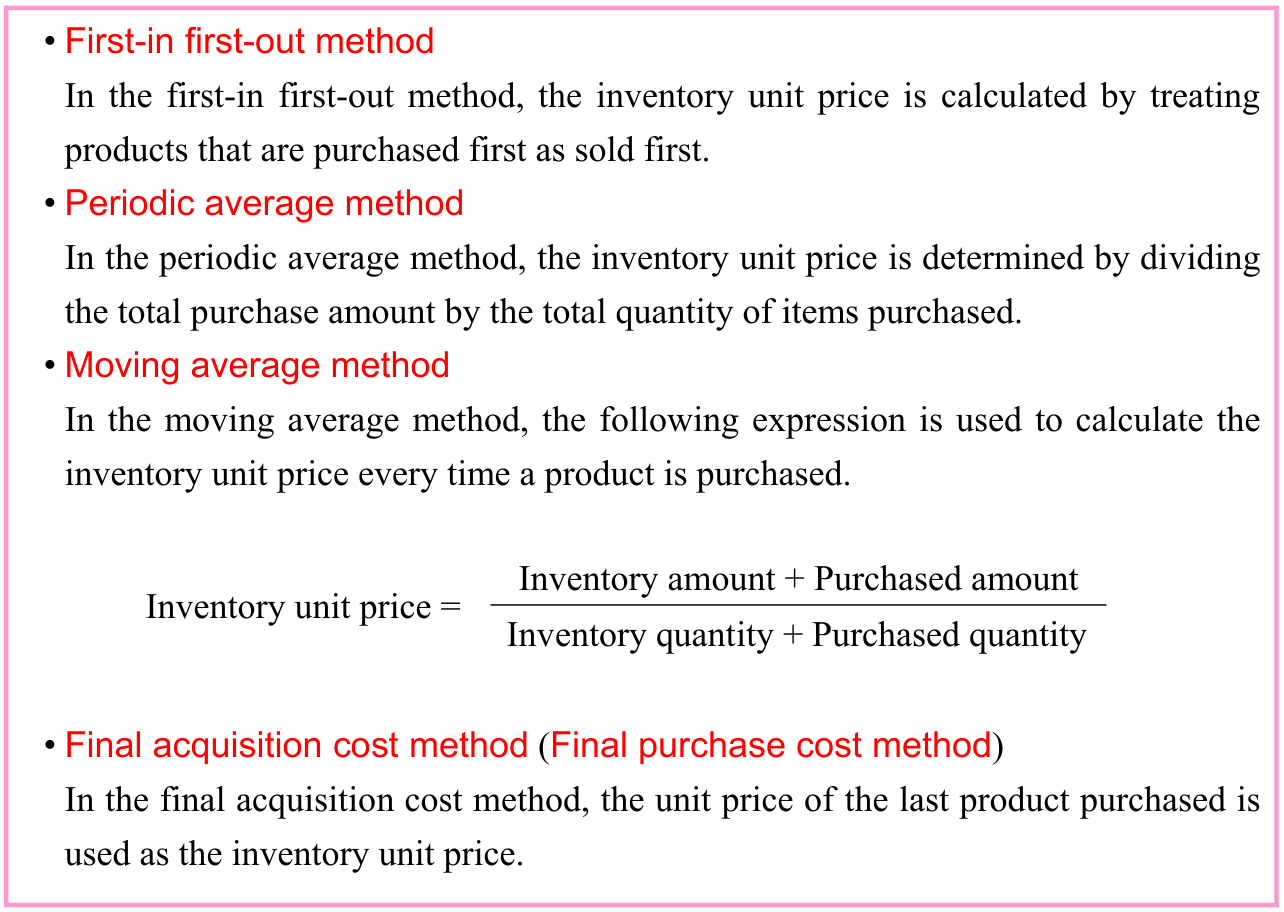
(iii) Inventory valuation This is the assessment of the value of inventory (e.g., products, services) at the time of closing account. Inventory can be converted into cash through sales, so it is counted within current assets.
p. 26 · PDF 30
Source visual description
Original inventory valuation box, retaining first-in first-out, periodic average, moving average and final acquisition cost (final purchase cost) methods. The moving-average expression divides Inventory amount + Purchased amount by Inventory quantity + Purchased quantity. The original fraction layout and descriptions remain intact.
Original visual text
• First-in first-out method In the first-in first-out method, the inventory unit price is calculated by treating products that are purchased first as sold first. • Periodic average method In the periodic average method, the inventory unit price is determined by dividing the total purchase amount by the total quantity of items purchased. • Moving average method In the moving average method, the following expression is used to calculate the inventory unit price every time a product is purchased. Inventory amount + Purchased amount Inventory unit price = Inventory quantity + Purchased quantity • Final acquisition cost method (Final purchase cost method) In the final acquisition cost method, the unit price of the last product purchased is used as the inventory unit price.
(2) Income statement (or Profit and Loss (P/L) statement)
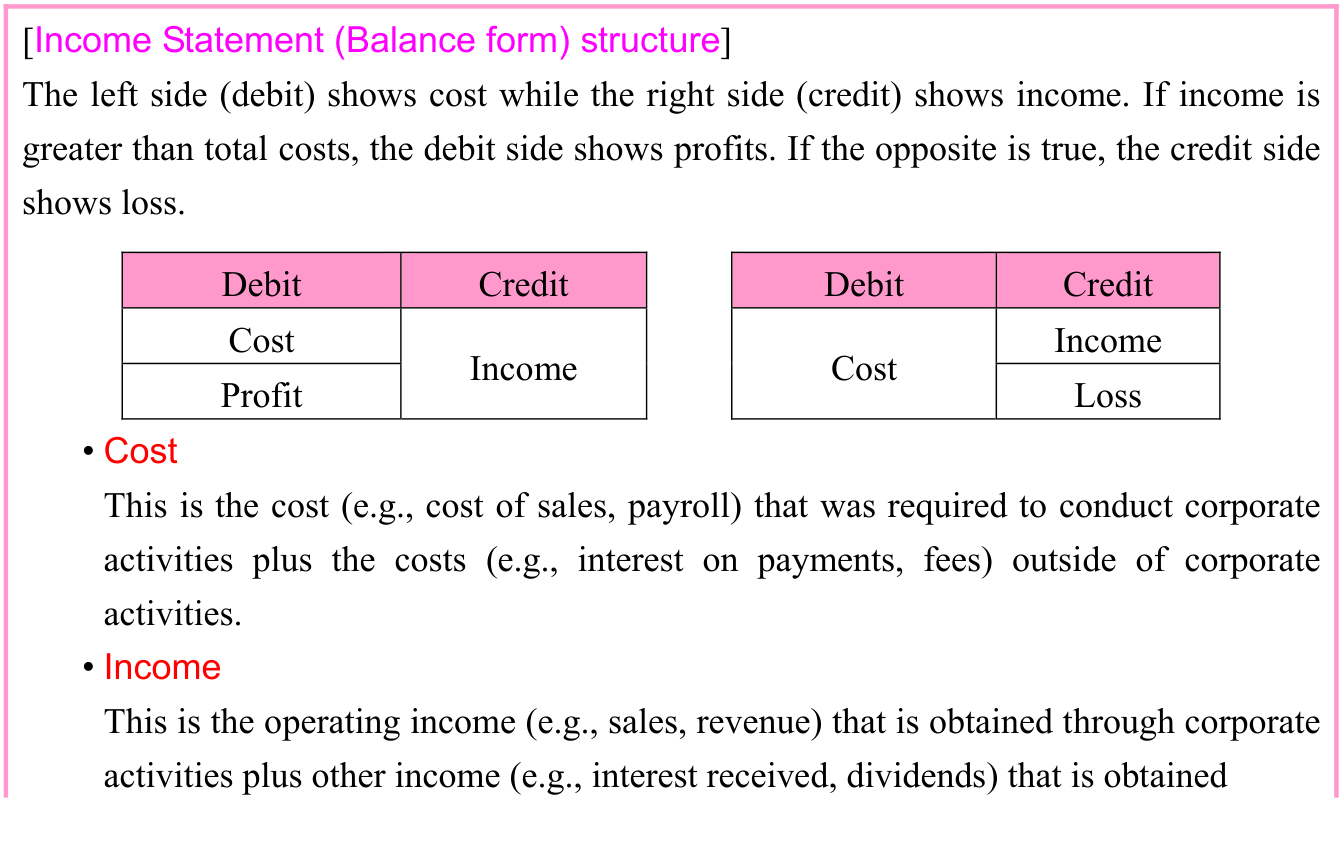
An income statement (or Profit and Loss (P/L) statement) is a financial statement that shows “cost/profit and income” or “cost and income/loss” to clarify a company’s business performance over a specified period (normally the fiscal year).
Source visual description
Original Income Statement (Balance form) structure with Debit and Credit columns in two alternative diagrams. In the profit diagram Cost and Profit are on the debit side and Income on the credit side. In the loss diagram Cost is on the debit side, while Income and Loss are on the credit side. Cost and Income definitions begin below the diagrams and continue on the next page.
Original visual text
[Income Statement (Balance form) structure] The left side (debit) shows cost while the right side (credit) shows income. If income is greater than total costs, the debit side shows profits. If the opposite is true, the credit side shows loss. Debit Credit Debit Credit Cost Income Income Cost Profit Loss • Cost This is the cost (e.g., cost of sales, payroll) that was required to conduct corporate activities plus the costs (e.g., interest on payments, fees) outside of corporate activities. • Income This is the operating income (e.g., sales, revenue) that is obtained through corporate activities plus other income (e.g., interest received, dividends) that is obtained
p. 27 · PDF 31

Source visual description
Original continuation of the income-statement balance-form box. It completes the preceding Income explanation and retains the Profit and loss definition with its closing border.
Original visual text
through other means. • Profit and loss This is the difference between income and cost. This represents the operating performance of a company over a specified period.
The following expressions are completed because the total debit and credit must also the same on income statements.
| Income statement equality | If there is a profit | Income = Cost + Profit |
|---|---|---|
| If there is a loss | Cost = Income + Loss |

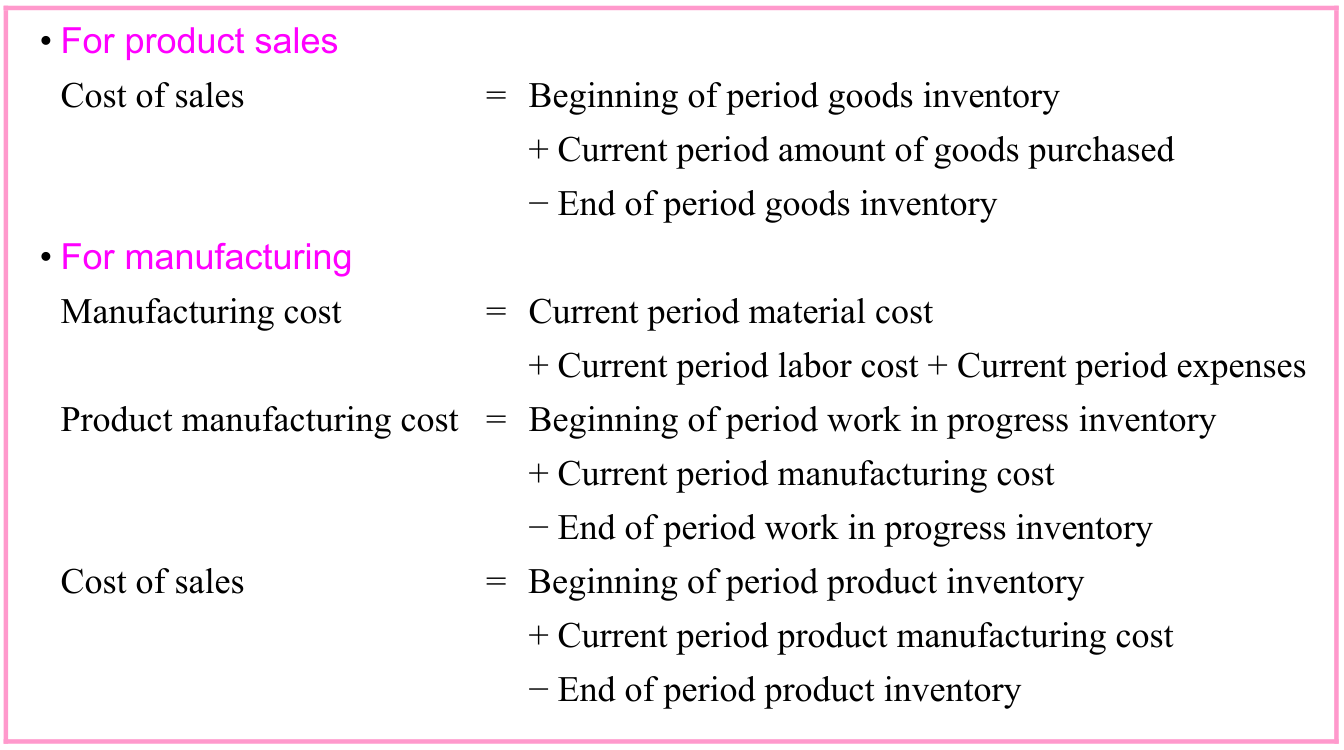
Costs must be recorded accurately in order to correctly create an income statement. Cost of sales (i.e., the selling cost for products) that is the cost for obtaining operating income is calculated differently for product sales (i.e., commercial bookkeeping) and for manufacturing (i.e., industrial bookkeeping).
Source visual description
Original aligned calculations for product sales and manufacturing. The full expressions retain beginning inventories, current-period purchases, material cost, labor cost, expenses, work-in-progress inventory, manufacturing cost and ending inventories, with each original plus and minus relationship in its original row.
Original visual text
• For product sales Cost of sales = Beginning of period goods inventory + Current period amount of goods purchased − End of period goods inventory • For manufacturing Manufacturing cost = Current period material cost + Current period labor cost + Current period expenses Product manufacturing cost = Beginning of period work in progress inventory + Current period manufacturing cost − End of period work in progress inventory Cost of sales = Beginning of period product inventory + Current period product manufacturing cost − End of period product inventory
In order to calculate cost of sales, inventory asset management is important. If the purchase unit price varies even amongst the same types of products, the inventory unit price must be calculated by using a method, such as the first-in first-out method, periodic average method, moving average method, or final acquisition cost method (Final purchase cost method). There are two types of costs: direct costs which are directly related to specific business
activities or products, and indirect costs (or overhead costs) which are indirectly related. However, there is no need to distinguish between these two types of costs when overall costs
p. 28 · PDF 32
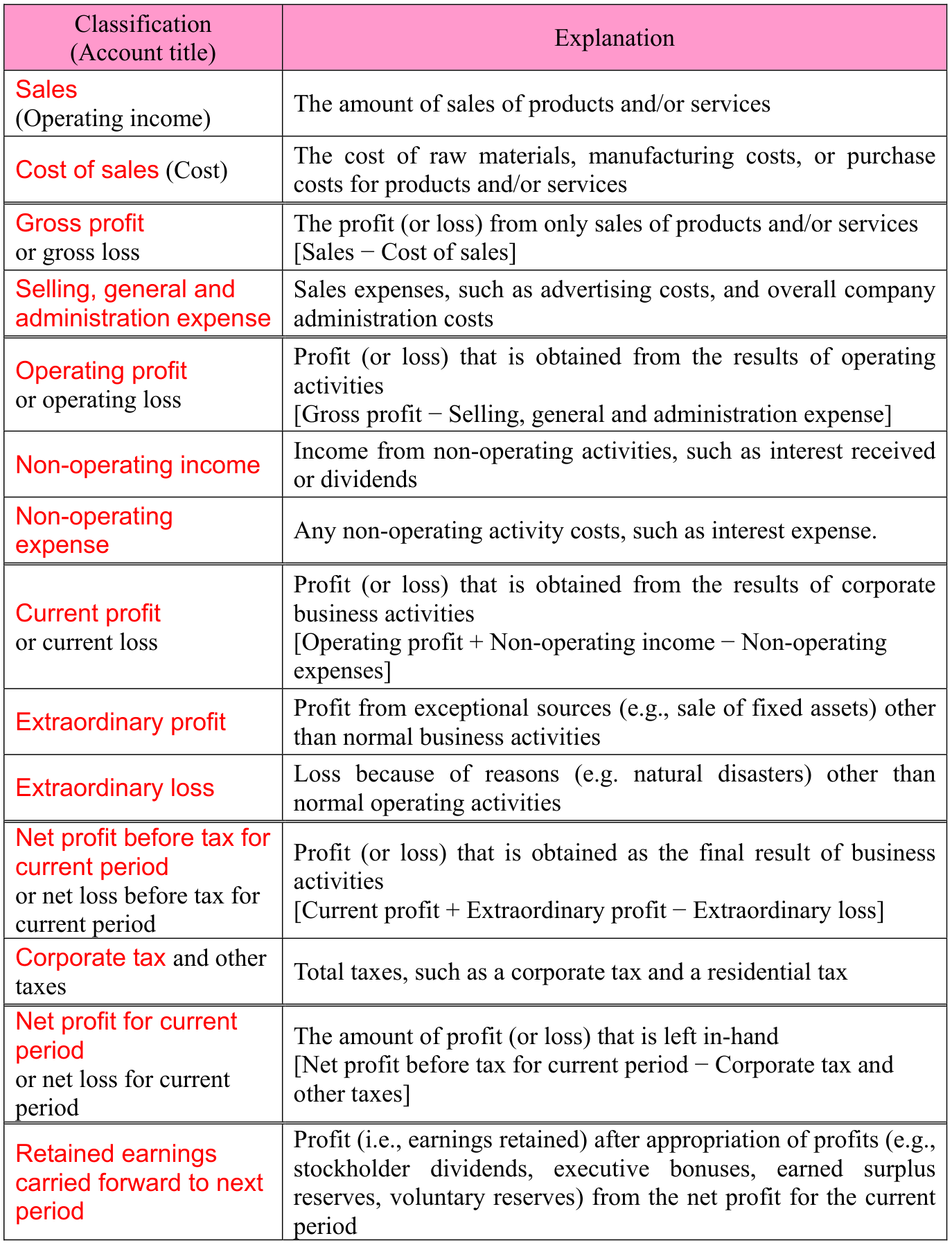
are considered. Income statements can also be formatted as a report form as well as a balance form. Report form income statements are not formatted by debit and credit, but instead the income, cost, and profit/loss are listed in order from the top for each category.
| Classification (Account title) | Explanation |
|---|---|
| Sales (Operating income) | The amount of sales of products and/or services |
| Cost of sales (Cost) | The cost of raw materials, manufacturing costs, or purchase costs for products and/or services |
| Gross profit or gross loss | The profit (or loss) from only sales of products and/or services [Sales − Cost of sales] |
| Selling, general and administration expense | Sales expenses, such as advertising costs, and overall company administration costs |
| Operating profit or operating loss | Profit (or loss) that is obtained from the results of operating activities [Gross profit − Selling, general and administration expense] |
| Non-operating income | Income from non-operating activities, such as interest received or dividends |
| Non-operating expense | Any non-operating activity costs, such as interest expense. |
| Current profit or current loss | Profit (or loss) that is obtained from the results of corporate business activities [Operating profit + Non-operating income − Non-operating expenses] |
| Extraordinary profit | Profit from exceptional sources (e.g., sale of fixed assets) other than normal business activities |
| Extraordinary loss | Loss because of reasons (e.g. natural disasters) other than normal operating activities |
| Net profit before tax for current period or net loss before tax for current period | Profit (or loss) that is obtained as the final result of business activities [Current profit + Extraordinary profit − Extraordinary loss] |
| Corporate tax and other taxes | Total taxes, such as a corporate tax and a residential tax |
| Net profit for current period or net loss for current period | The amount of profit (or loss) that is left in-hand [Net profit before tax for current period − Corporate tax and other taxes] |
| Retained earnings carried forward to next period | Profit (i.e., earnings retained) after appropriation of profits (e.g., stockholder dividends, executive bonuses, earned surplus reserves, voluntary reserves) from the net profit for the current period |
p. 29 · PDF 33
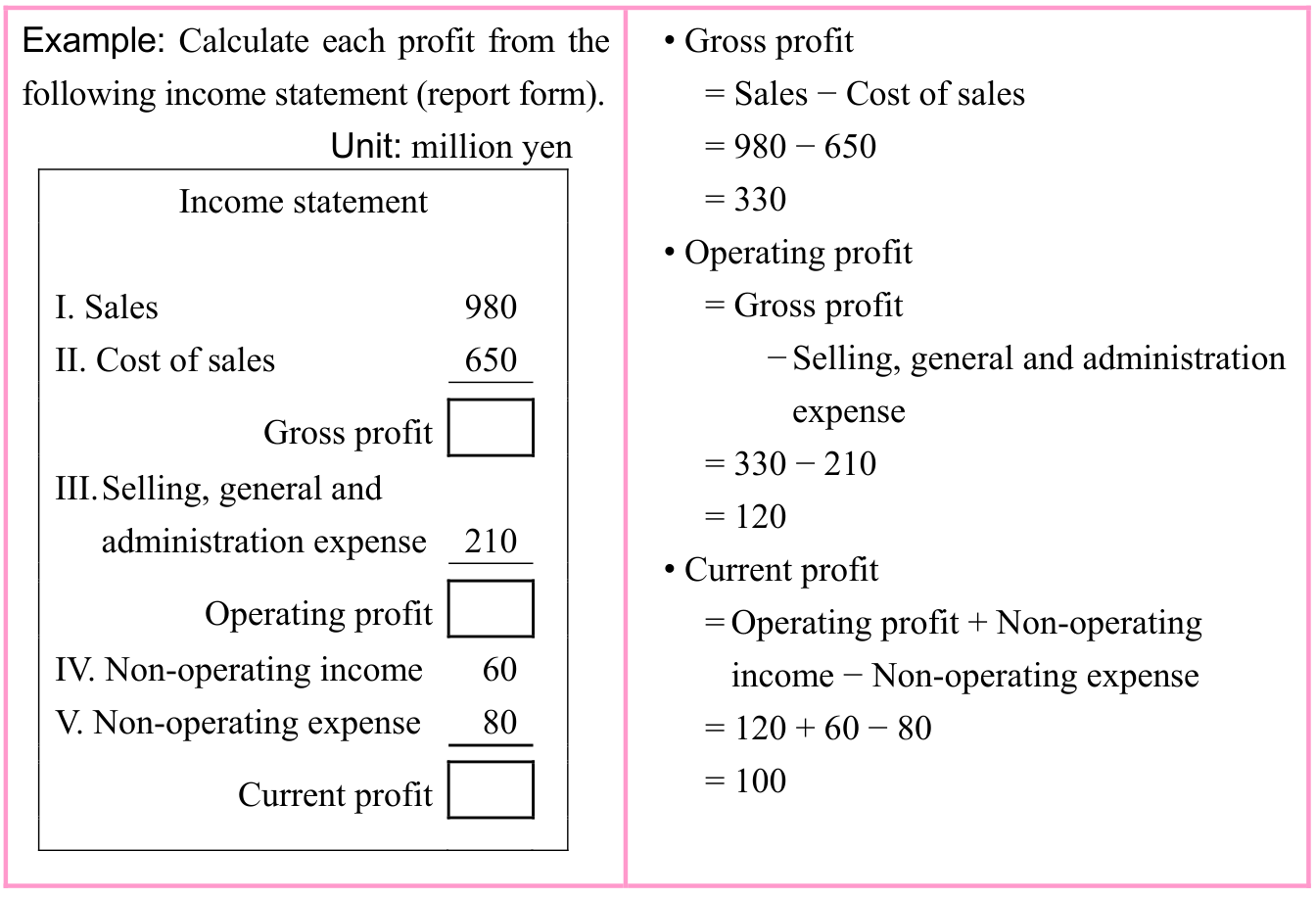
Source visual description
Original worked example in million yen. The source income statement gives Sales 980, Cost of sales 650, Selling/general administration expense 210, Non-operating income 60, and Non-operating expense 80. The source calculations show Gross profit 330, Operating profit 120, and Current profit 100; the original blank boxes and solution column remain paired.
Original visual text
Example: Calculate each profit from the • Gross profit following income statement (report form). = Sales − Cost of sales Unit: million yen = 980 − 650 = 330 Income statement • Operating profit = Gross profit I. Sales 980 − Selling, general and administration II. Cost of sales 650 expense Gross profit = 330 − 210 III. Selling, general and = 120 administration expense 210 • Current profit Operating profit = Operating profit + Non-operating IV. Non-operating income 60 income − Non-operating expense V. Non-operating expense 80 = 120 + 60 − 80 = 100 Current profit
(3) Other financial statements
In addition to balance sheets and income statements, there are also the following types of financial statements.
(i) Cash flow statement This is a financial statement that represents a balance of accounts for funds (i.e., cash) during the accounting period in the following three activity classifications: operating activities, investment activities, and financial activities. Since this represents cash flow, if cash (even from borrowed money) increases, cash flow increases.
- • Cash flow accounting
This is a method of accounting which focuses on changes in the amount of cash (e.g., cash on hand, and deposits). Even though balance sheets and income statements show a profit, there could be cases of insufficient cash for payments depending on when deposits are received or other factors. This type of situation can be avoided by using cash flow accounting to keep an eye on cash flow. - • Cash flow management
This is a management method which focuses on cash flow. This management method focuses on how much cash can be obtained, not on assets and profit on the balance sheets and income statements
p. 30 · PDF 34
- • Cash management
This is a management method which involves drafting a fund plan for procuring fund in consideration of the timing of income and cost so that there will always be enough fund on hand.
(ii) Statements of shareholders’ equity This is a financial statement which shows the amount of change in net assets (e.g., capital stock) on the balance sheet. This type of statement is created to determine changes in net assets during an accounting period. Net assets are classified into capital stock, valuation and conversion difference, share options, and minority interests, and then specified along with the amount of change in each of these types.
(iii) Consolidated financial statement This is a financial statement which is created when consolidated accounting is used. The consolidated accounting treats parent companies, subsidiaries, and all other related companies as a single organization, and therefore, must close accounts for the entire organization as a whole. They include financial statements, such as consolidated balance sheets, consolidated income statements, consolidated cash flow statements, and consolidated statements of shareholders’ equity.
(iv) Appropriation statement
This is a financial statement which shows information, such as current period unappropriated profit, appropriation of profit amount, or surplus profit carried forward to the following period.
(v) Annual securities report This is a report which discloses financial conditions and other relevant data in order to aid in making fair investment decisions.
Section progress
Original chapter exercises
Original chapter exercises →New FE Textbook Vol.2 · First Edition, April 2015