Highlighted text? Practice this concept. Highlighted passages and figures open related questions.
Practice related questions (2)Progress & bookmarks
Current section
1-2 Corporate Organizational Structure
p. 13
Practice this section 2 linked exam questions with default filters
Progress
Not marked complete
Related questions in this lesson 3
Divisional organization1CIO and company information strategy1Matrix organization1p. 13 · PDF 17
1 - 2 Corporate Organizational Structure
1-2-1 Corporation Forms
Corporation forms represent the relationship between equity participants and corporations. Corporation forms are classified as described below, on the basis of whether equity participants are individuals, private entities, or public entities and the scope of equity participants’ responsibilities.
p. 14 · PDF 18
- • Public enterprise (First sector)
This refers to a company which is funded by countries or local public entities. In the fields of highly public business, this type of company is established for the purpose of enhancing public profit. - • Private enterprise (Second sector)
This refers to a company which is funded by individuals or private entities. This classification is further divided into individual proprietorship which is funded by a single individual, and incorporated enterprise (i.e., joint venture) which is funded by two or more equity participants. Incorporated enterprises are further classified as described below, in accordance with the Companies Act of Japan. - • Limited partnership (Ownership and management are the same.)
This classification encompasses the following three types of enterprises: general partnership company in which all employees are members with unlimited liability, limited partnership company which consists of both members with limited liability and members with unlimited liability, and limited liability company in which all employees are members with limited liability. The limited liability company is also referred to as “Japanese style LLC (Limited Liability Company).” There are also LLP (Limited Liability Partnership) which acts as an entity rather than as a corporation. The LLP system shows promise for business deployment in areas, such as academic-industrial alliances. - • Stock company (Ownership and management are separated.)
This company is established by one or more founders and acquires funds by issuing stock (i.e., stock certificates). Stock can be bought and sold privately, or listed on a securities exchange where it can be traded freely on the securities market through an IPO (Initial Public Offering). Equity participants in this type of company are called stockholders and have limited liability. - • Stockholders’ meeting
This is the highest decision-making body that establishes the basic policy rules for a stock company. Stockholders can attend stockholders’ meetings and can exercise voting rights on the basis of the amount of stock in the company they hold. - • Board of directors
This is an organization where the chief executive officers, who acts as the external representative of the company, take the lead. It establishes important rules for how the company conducts business. The board of directors can also select outside directors not within their own organization. - • Auditor
p. 15 · PDF 19
An auditor performs audits of accounting or the execution of operations by directors, and presents the results of those audits at stockholders’ meetings. Large companies are required to have an auditor in place at all times.
- • Mixed enterprise (Third sector)
This refers to a company which is funded by “countries or local public entities” and “individuals or private entities.” - • Other corporations (Fourth sector)
This classification includes entities such as foundations that are established by individuals or private entities that do not distribute profits.
1-2-2 Corporate Hierarchy Structure
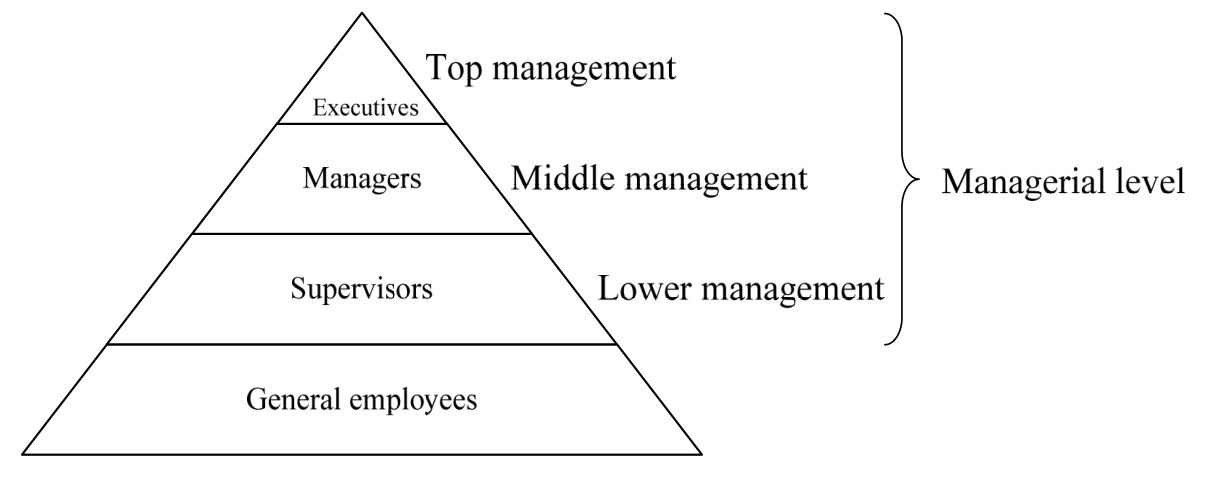
A corporate hierarchy structure represents the relationships between employees in a common corporation.
Corporate hierarchy structure
Source visual description
Original pyramid of Executives, Managers, Supervisors and General employees. The adjoining labels are Top management, Middle management and Lower management; a brace groups the upper three as Managerial level.
Original visual text
- • Executive tier (Top management)
This tier consists primarily of the people who make up the board of directors, such as the president, vice-president, and executive managing directors. The executives determine the overall direction of the company and make important company decisions. - • Management tier (Middle management)
This tier consists primarily of middle management positions, such as department managers and section chiefs. These employees determine plans of action to achieve concrete goals from the intentions of the executive tier, and manage those in the supervisor tier and below. - • Supervisor tier (Lower management)
This tier consists of on-site supervisors, such as assistant managers and chiefs.
p. 16 · PDF 20
These employees make concrete plans to meet specified goals and manage/direct actions to carry out those plans. They also supervise those in the general employee tier.
- • General employee tier (Staff members)
General employees are the on-site staff members who carry out business activities based on the direction of the management and supervisor tiers.
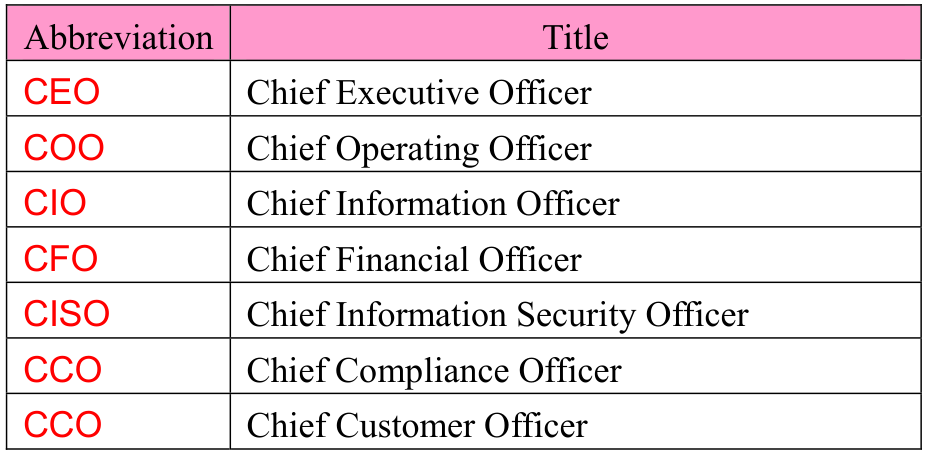
In the United States and many other countries, the following titles may be given to executives and management positions to further clarify their positions. These titles are also currently often used in Japan.
| Abbreviation | Title |
|---|---|
| CEO | Chief Executive Officer |
| COO | Chief Operating Officer |
| CIO | Chief Information Officer |
| CFO | Chief Financial Officer |
| CISO | Chief Information Security Officer |
| CCO | Chief Compliance Officer |
| CCO | Chief Customer Officer |
1-2-3 Management Organization
The management organization (corporate organization) is the organization form to conduct corporate activities. There are two concepts of management organization structures: vertical and horizontal.
- • Hierarchical organization (Vertical structure)
In a hierarchical organization, relationships are structured in a supervision-reporting structure (i.e., management-subordinates). Top-level management are at the top of the hierarchy, with all other tiers, such as departments, sections, and supervisors below. Therefore, this type of structure is also known as a pyramid organization. Generally, one manager is in direct supervision of multiple subordinates. However, the number of subordinates (span of control) he or she can directly supervise is said to be only five
p. 17 · PDF 21
or six people.
- • Functional organization (Horizontal structure)
In a functional organization, departments are divided up on the basis of specializations and roles, such as accounting, sales, or general affairs.
Most companies consist of a combination of these two types of organizational structures. Among these types of organizations, a flat management organization which utilizes an extremely small amount of middle management is known as flat organization. In addition to the above management organizations, some companies may utilize a different organizational structure on the basis of their management policies and business objectives. The section below lists a variety of management organizations that are specialized for specific objectives.
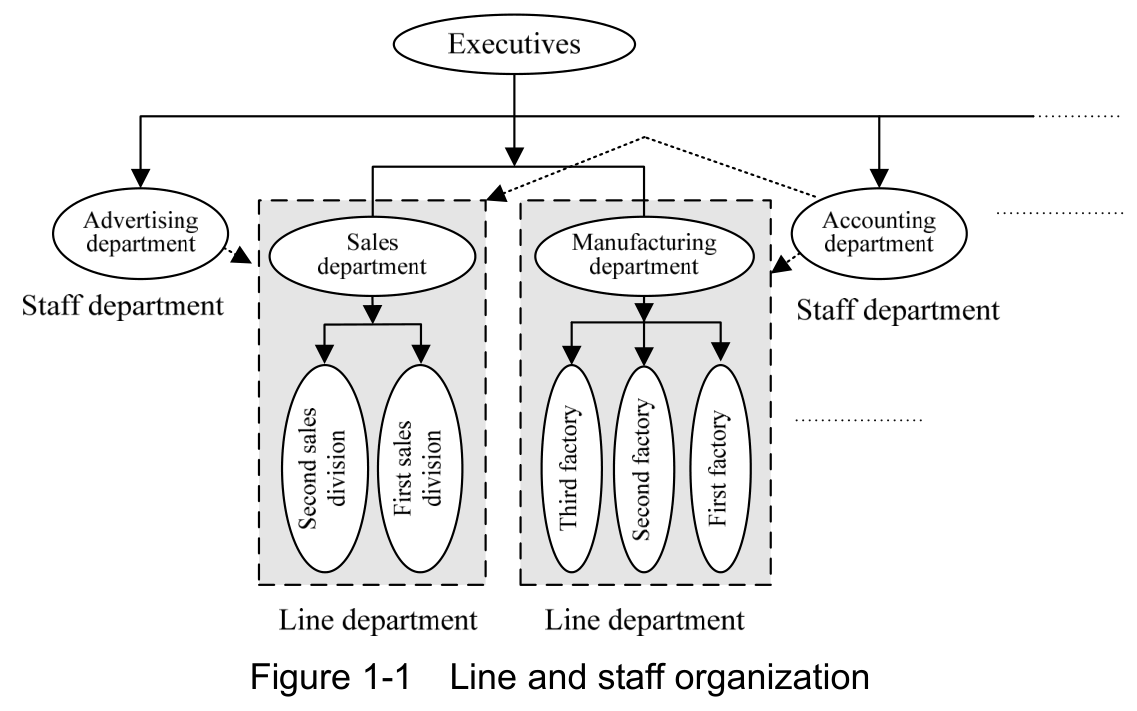
(1) Line and staff organization
A line and staff organization is a management organization which consists of a line department in charge of tasks, such as production and sales, and a staff department which is in charge of tasks, such as general affairs and accounting. In this type of organization, the staff department follows (i.e., advices, supports) the line department which is in charge of directly performing business activities.
Source visual description
Original Figure 1-1, Line and staff organization. Executives connect to Advertising department, Sales department, Manufacturing department and Accounting department. Advertising and accounting are labeled Staff department. The sales and manufacturing groups are labeled Line department. Sales contains Second sales division and First sales division from left to right; manufacturing contains Third factory, Second factory and First factory. All solid arrows, dotted support arrows, dotted continuation lines and dashed shaded group enclosures remain with the complete caption.
Original visual text
Figure 1-1 Line and staff organization
(2) Project organization
A project organization is a management organization that is formed temporarily as a group
p. 18 · PDF 22
of specialists from each department in order to resolve a specific problem (or reach a specific goal). It is a flexible type of organization which operates independently from all other standard organizations, with a pre-determined objective, period, budget, and set of resources.
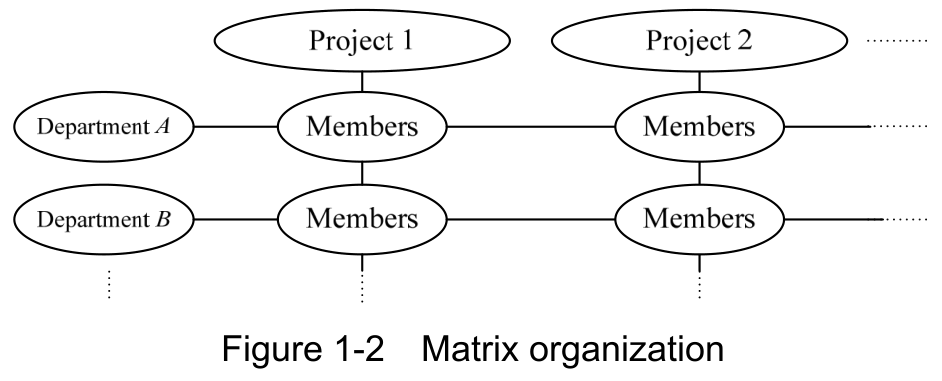
(3) Matrix organization
Source visual description
Original Figure 1-2, Matrix organization. The upper ovals are Project 1 and Project 2. Department A and Department B form rows; Members appear at the project intersections. The original horizontal, vertical and dotted continuation lines remain with the caption.
Original visual text
Figure 1-2 Matrix organization
(4) Divisional organization
- • In-house company system
This is a management organization which incorporates independent accounting system to treat business divisions as independent, autonomous in-house companies. This type of organization is generally used to separate the core business activities of a corporation into a separate, autonomously managed entity. By integrating development, manufacturing, sales, and all other divisions into a single company, this provides greater organizational structure and improved environmental adaptation. However, this fragments the shared management resources of the overall company and makes company-wide optimizations more difficult to implement. - • In-house venture organization
In this type of management organization, a new business activity or project is started
p. 19 · PDF 23
and executed as a semi-independent business. Full rights and responsibilities for the success of the business endeavor are given to the founder(s). This type of organization is used to deploy a venture business for a new product or service that is still managed by the parent corporation.
Section progress
Original chapter exercises
Original chapter exercises →New FE Textbook Vol.2 · First Edition, April 2015