Highlighted text? Practice this concept. Highlighted passages and figures open related questions.
Practice related questions (1)Progress & bookmarks
Current section
3-1-2 Proposition
p. 39
Progress
Not marked complete
Related questions in this lesson 1
Propositional logic1p. 39 · PDF 43
3-1-2 Proposition
A proposition is a sentence which can be uniquely determined as either True (i.e., correct) or False (i.e., incorrect).
“I am Japanese.” ··· This is a proposition. (The statement can be determined as either true or false.) “I am pretty.” ··· This is not a proposition. (The definition of “pretty” is unclear, so this statement cannot be clearly determined as true or false.)
Proposition P: It is raining. Proposition Q: I am putting up an umbrella.
The following four relationships can be derived from the two propositions P and Q.
| Relationship | Expression | Meaning |
|---|---|---|
| Implication | P→Q | If P, then Q. (If it is raining, then I am putting up an umbrella.) |
| Converse | Q→P | If Q, then P. |

p. 40 · PDF 44
| (If I am putting up an umbrella, then it is raining.) | ||
| Reverse | ¬P→¬Q | If not P, then not Q. (If it is not raining, then I am not putting up an umbrella.) |
| Contraposition | ¬Q→¬P | If not Q, then not P. (If I am not putting up an umbrella, then it is not raining.) |
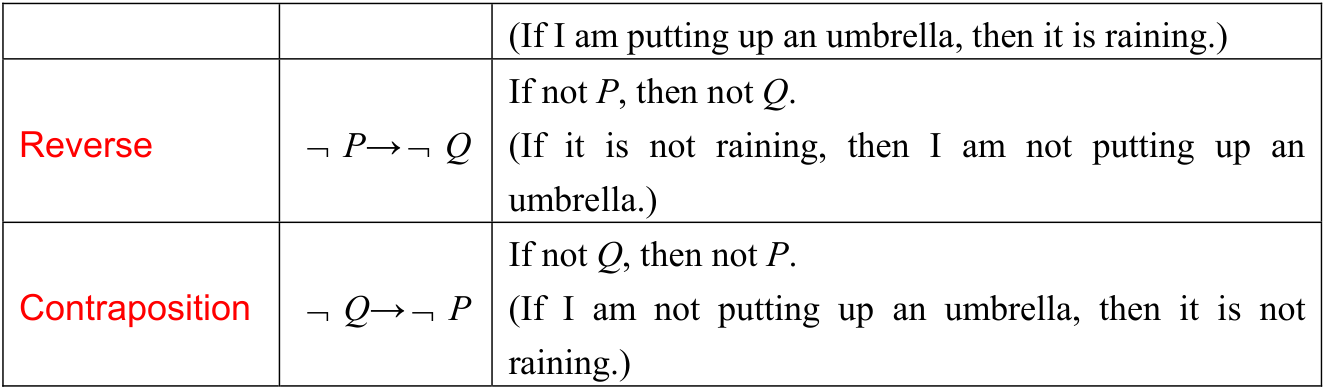
In this example, the statement of the contraposition is the only one where the fact of the true or false matches the implication (P→Q) regardless of the true or false values of the individual propositions P and Q.
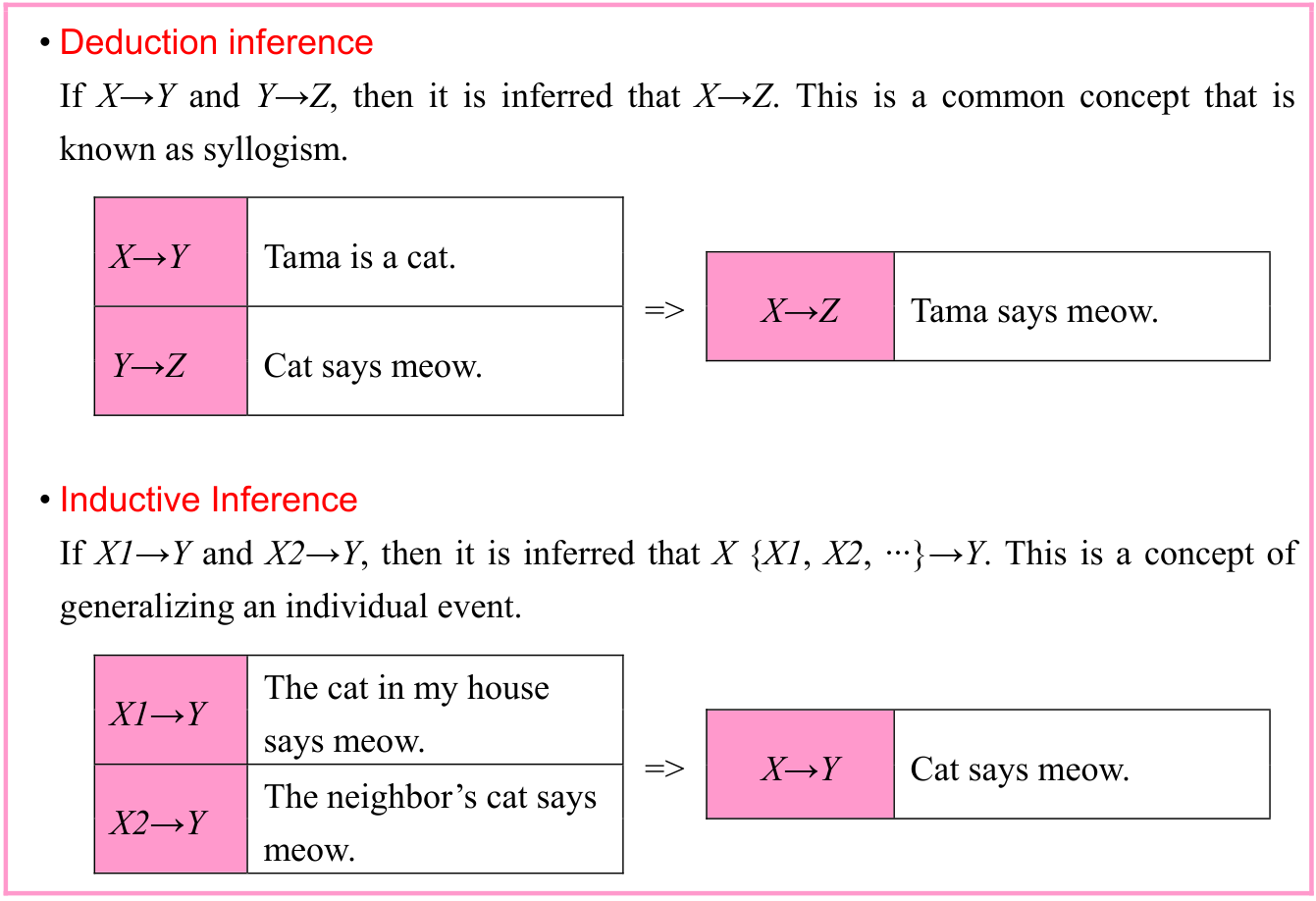
In propositional logic, the propositions themselves are not considered for analysis. For a concept of analysis of propositions as subjects and predicates, a predicate logic is used. Inference is used in both propositional logic and predicate logic. Inference is the process of extracting a new principle from an established event (i.e., fact), and has the following methods:
Source visual description
The deduction panel pairs X→Y with Tama is a cat, and Y→Z with Cat says meow. Its arrow leads to X→Z and Tama says meow. The induction panel pairs X1→Y with The cat in my house says meow, and X2→Y with The neighbor's cat says meow. Its arrow leads to X→Y and Cat says meow.
Selectable source glyphs (PDF extraction order)
• Deduction inference If X→Y and Y→Z, then it is inferred that X→Z. This is a common concept that is known as syllogism. X→Y Tama is a cat. => X→Z Tama says meow. Y→Z Cat says meow. • Inductive Inference If X1→Y and X2→Y, then it is inferred that X {X1, X2, ···}→Y. This is a concept of generalizing an individual event. The cat in my house X1→Y says meow. => X→Y Cat says meow. The neighbor’s cat says X2→Y meow.
A relational model is a model that is devised from set theory and predicate logic. Propositional logic and predicate logic are also used in relational databases which use relational models.
Section progress
Original chapter exercises
Original chapter exercises →New FE Textbook Vol.2 · First Edition, April 2015