Highlighted text? Practice this concept. Highlighted passages and figures open related questions.
Practice related questions (3)Progress & bookmarks
Current section
4-3 Laws on Labor and Transactions
p. 106
Practice this section 3 linked exam questions with default filters
Progress
Not marked complete
Related questions in this lesson 7
Discretionary labor system1Electronic consumer contracts1Site license1Dispatch agreement1Opening a shrink-wrap package1GPL as a copyleft license1Volume licensing1p. 106 · PDF 110
4 - 3 Laws on Labor and Transactions
This subsection explains major laws and regulations concerning labor and transactions. Generally accepted names are given in the text, with official names in brackets.
p. 107 · PDF 111
4-3-1 Laws on Labor
(1) Labor Standards Act
The Labor Standards Act is a law that regulates minimal standards for working conditions (e.g., wages, working hours, breaks, holidays, disciplinary actions, termination of employment) for the protection of workers.
[Terminology related to the Labor Standards Act]
- • Article 36 agreement
This is a labor-management agreement that is concluded for overtime or holiday work in excess of working hours that are stipulated in Article 32 (8 hours/day, 40 hours/week). The Article 36 agreement is so named for Article 36’s recognition of extension of working hours and holiday labor through the provision of notification of the agreement to administrative authorities. - • Discretionary labor system
This is a system by which actual working hours are left to the discretion of workers, with remuneration that is paid according to “deemed working hours” (Article 38, paragraph 3, 4). · 1 question - • Flexible working hours system
This is a system that leaves the starting and ending times for work to workers, within a fixed range (Article 32, paragraph 3). In general, a day is divided into core time and flexible time, and the starting and ending times of work are decided within flexible time. - • Maternity protection
These are protection provisions for pregnant women. The provisions stipulate leave prior to and after birth (Article 65), limits on working hours (Article 66), and child care hours (Article 67), among other matters.
Japan’s Three Labor Laws, consisting of the following two laws in combination with the Labor Standards Act, are the laws that form the core of laws on labor.
- • Trade Union Act
This is a law that enables negotiations on working conditions to take place on equal footing between workers and employers. It primarily stipulates matters concerning the conclusion of collective agreements, collective bargaining rights, and the organization of labor unions. - • Labor Relations Adjustment Act
p. 108 · PDF 112
This law provides for prevention and resolution of labor disputes and the fair adjustment of labor relations. Arbitration and mediation of labor disputes are performed by Labor Relations Commissions.
(2) Worker Dispatching Act (Worker Dispatching Business Law)
[Act for Securing the Proper Operation of Worker Dispatching Undertakings and Improved Working Conditions for Dispatched Workers]
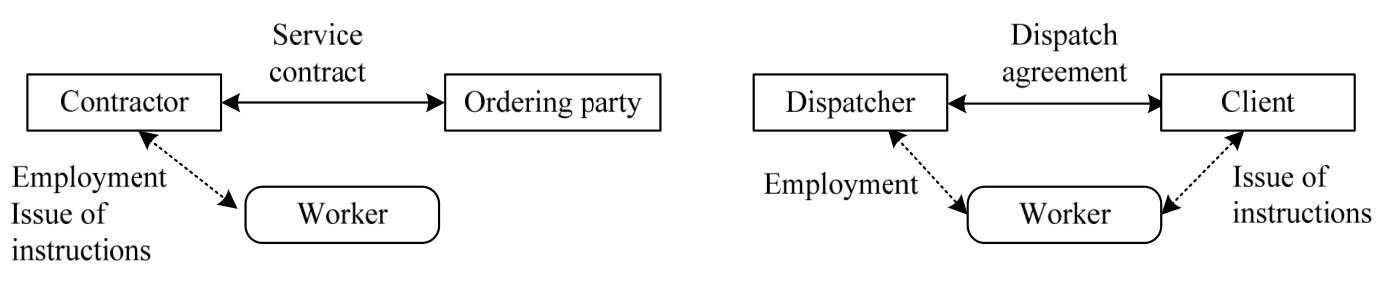
The Worker Dispatching Act is a law that is aimed at ensuring the proper operation of worker dispatching undertakings, the protection of dispatched workers, and the stability of employment. It stipulates the business types that are able to perform dispatching, the period of dispatch, and an approval system for dispatching companies (i.e., the dispatching business operator), for the protection of dispatched workers. Worker dispatching undertakings are those businesses that dispatch workers who have employment agreements with the dispatching companies, to client companies that have entered into a temporary worker dispatch contract. Workers dispatched to the client companies engage in work under the instruction of those companies. For that reason, secondary dispatch by which dispatched workers (who have not concluded employment agreements) are dispatched to another company, or disguised contract work by which the client company issues instructions with concluding service contracts that do not engender authority to provide instructions, is prohibited.
[Provisions of the Worker Dispatching Act (excerpt)]
- • Dispatching companies appoint a responsible person acting for dispatching
undertaking, and perform advice and guidance to dispatched workers, handling of the complaints by dispatched workers, management of dispatched workers’ personal information, and other tasks. - • Dispatching companies prepare management record of dispatching undertaking, and
record the dispatch period, the working days, the time of work, the type of work performed, etc. of dispatched workers. - • Client companies appoint a responsible person acting for client, and perform to
make the worker dispatch contracts known to other persons concerned, handling of the complaints by dispatched workers, liaison and coordination with dispatching companies, and other tasks. - • Client companies prepare management record of client, and record the working
days, the time of work, the break hours, the type of work performed, etc. of dispatched workers. Note: Period of dispatch, working days and holidays, time of work, work performed,
p. 109 · PDF 113
and other matters are managed by the dispatching company, and must not be subject to modification nor approval by the client company.
- • Dispatching companies do not bear the responsibility for completion of deliverables
or the defect liability.
(3) Other laws on labor
- • Industrial Safety and Health Act
This is a law that stipulates minimum standards concerning the health and safety of workers. - • Act on Securing, Etc. of Equal Opportunity and Treatment between Men and
Women in Employment This is a law that concerns securing, etc. of equal opportunity and treatment between men and women in employment. - • Act on the Welfare of Workers Who Take Care of Children or Other Family
Members Including Child Care and Family Care Leave This law concerns the welfare of workers who take care of children or other family members. - • Act on Improvement, etc. of Employment Management for Part-Time Workers
This law concerns matters including improvement of the employment management for part-time workers. - • Whistleblower Protection Act
This law stipulates measures to protect whistleblowers to provide for nullity, etc. of dismissal because of whistleblowing (i.e., reports of actions in violation of the protection of citizens’ lives or interests).
4-3-2 Laws on Transactions
(1) Subcontract Act
[Act against Delay in Payment of Subcontract Proceeds, Etc. to Subcontractors]
The Subcontract Act is a law that, by preventing delay in payment of subcontract proceeds, etc., ensures fair transactions between main subcontracting entrepreneurs that commission manufacturing or other contract, and subcontractors that undertake manufacturing or other contract, and that protects the interests of the subcontractors. Relationships between main subcontracting entrepreneurs and subcontractors are categorized according to capitals.
p. 110 · PDF 114
[Contracts included in manufacturing or other contract]
- • Manufacturing contract
This is the contract of the manufacture of products, components, or metal dies used in the manufacture, etc. - • Service contract
This is the contract of all or part of the provision of service. - • Information-based product creation contract
This is the contract of the creation of information-based products (e.g., programs).
(2) Civil Code
The Civil Code is the general law that is applied to resolution of civil issues. Matters concerning transactions in the Civil Code are covered in “Chapter 2 Contracts” of Part III, and the following two forms of contract are stipulated.
- • Service contract
This is a contract by which the contractor promises to complete work for the ordering party, and the ordering party promises to pay remuneration to the contractor for the outcome of the work. The contractor performs the arrangement of workers (e.g., subcontractors) and issues instruction, and bears responsibility for the completion of deliverables and the defect liability for a fixed period (excluding defects, etc. resulting from the direction of the ordering party). - • Mandate contract
This is a contract by which the mandator mandates a juridical act and the mandatary accept the mandate. The mandatary does not incur the responsibility for completion of deliverables or the defect liability in principle. A mandate contract that is not a juridical act is generally called a (quasi-)mandate contract.
In a service contract, the contractor issues instructions to workers in an employment relationship, directing the workers to execute the work. The following diagram shows the differences between a service contract and a (temporary worker) dispatch contract.
Source visual description
Original side-by-side Service contract and Dispatch agreement diagrams. The left diagram labels Contractor, Ordering party, Worker, Service contract, Employment and Issue of instructions; its employment/instruction link runs from Contractor to Worker. The right diagram labels Dispatcher, Client, Worker, Dispatch agreement, Employment and Issue of instructions; employment runs from Dispatcher to Worker and instructions from Client to Worker. The original two-direction contract arrows, boxes and both complete diagrams remain together.
Original visual text
p. 111 · PDF 115
A mandate contract takes the same form as a service contract, with secondment to subsidiaries or affiliated companies incurring authority to provide instructions to the secondment destination in the same manner as a dispatch contract (with the employment contract differing by form of secondment).
(3) Commercial Code
The Commercial Code is the general law that is applied to business, commercial transactions, and other commercial affairs of merchants. However, the Civil Code applies to matters of commercial affair that are not stipulated by the Commercial Code. The area of the Commercial Code that deals with transactions is “Part II Commercial Transactions”, which is sometimes called Commercial Transactions Law. Revisions to the Commercial Code are made in response to changes in forms of commerce over time, and areas of law such as the Companies Act have been separated from the Commercial Code to become independent codes.
(4) Other laws on transactions
- • Electronic Consumer Contract Act
- • Under Article 95 of the Civil Code, manifestation of intention (i.e., a contract) with
mistake has no effect in the event of gross negligence. However, in electronic consumer contracts over the Internet, mistakes in operation (i.e., negligence by the consumer) easily occur, which can make this determination of invalidation of mistakes difficult. In response, in the case that confirmation measures (e.g., screens confirming the content of agreements) were not implemented by the business operator, the law allows for the invalidation of contracts that are not intended by the consumer (e.g., measures against one-click fraud). - • Article 97 of the Civil Code provides for an arrival principle by which manifestation
of intent toward a party at a distance becomes valid from the time that notification of the intent arrives at the other party. On the other hand, Article 526 of the Civil Code provides for a dispatch principle, by which a contract between parties at a
p. 112 · PDF 116
distance becomes valid from the time that an acceptance notice is sent. However, a contract application and a notice of acceptance that are delivered by electronic means such as by e-mail between parties at a distance reach the counterparty almost instantaneously, and thus, Article 526 of the Civil Code (i.e., dispatch principle) will not be applicable. Instead, the time that the notice of acceptance for a contract (electronic acceptance notice) reaches the other party is deemed the time that the contract between parties at a distance enters validity.
- • Premiums Representation Act
[Act against Unjustifiable Premiums and Misleading Representations] This is a law that regulates misleading representations of product or service quality, content, prices, etc., while it also prevents sales that is accompanied by excessive premiums that are not commensurate with the products. It limits the maximum value of premiums, and protects the interests of general consumers by preserving an environment in which consumers can voluntarily and rationally select better products and services.
- • Specified Commercial Transactions Act
[Act on Specified Commercial Transactions] This is a law that stipulates transactions between service providers and consumers that are prone to troubles, such as door-to-door sales and mail order sales. It stipulates regulations on solicitations and other rules that service providers should follow to prevent disputes, and sets forth items such as a cooling-off system to protect consumers.
4-3-3 Contracts Concerning Transactions Between Companies
(1) Outsourcing contracts (subcontracts)
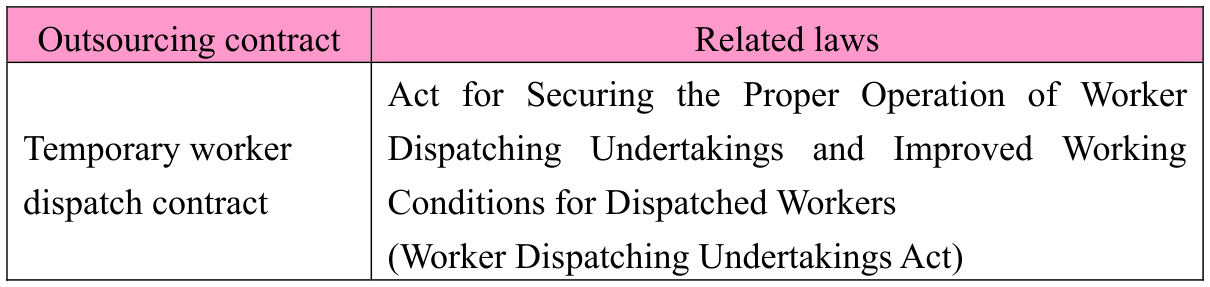
Outsourcing contracts (subcontracts) are contracts that are concluded when all or part of a business or work is commissioned to an external business operator that is not part of the contracting company. In concluding the contract, related laws must be taken into consideration in response to the commissioned content.
| Outsourcing contract | Related laws |
|---|---|
| Temporary worker dispatch contract | Act for Securing the Proper Operation of Worker Dispatching Undertakings and Improved Working Conditions for Dispatched Workers (Worker Dispatching Undertakings Act) |
p. 113 · PDF 117
| Service contract | Civil Code, Subcontract Act |
|---|---|
| (Quasi-)mandate contract | Civil Code |

(2) NDA (Non-Disclosure Agreement)
A NDA (Non-Disclosure Agreement) is an agreement that is concluded to enforce promises to not disclose a company’s trade secrets (i.e., to maintain those secrets) when the company commissions work to another business operator and the latter learns of trade secrets through the commissioned business. Different names such as secrecy agreement or confidentiality agreement may be used by some business operators, but the intended content of these is the same.
(3) License agreement (software license agreement)
License agreements (software license agreements) are agreements that are concluded between a software intellectual property rights holder and a user, concerning compliance items in the use of software (e.g., the possibility of or conditions for use, alteration, and redistribution). The compliance items are called a software license, and the form of which allows classification of software as follows:
- • Packaged software
This refers to software that is generally sold commercially. - • Freeware (free software)
This is software that is distributed free of charge. Copyrights are retained by the developer, and restrictions are set on alteration and redistribution. CC (Creative Commons) licenses and other means are used to display the restrictions that are set by the author. - • Shareware
This is software that allows trial use free of charge, but requires payment for continued use after the trial period. In other respects, it is the same as freeware. - • PDS (Public Domain Software)
This is software for which copyright has been abandoned and which can be used free of charge. - • OSS (Open Source Software)
This is software for which duplication, redistribution, alteration, etc. are not restricted.
The following are the license agreements that are applied to general package software.
p. 114 · PDF 118
Appropriate license agreements should be concluded to prevent unauthorized use of software.
- • Volume license agreement
This is an agreement, for companies and other large-volume purchasers of software, which provides a software master and sets the number of allowed installations. · 1 question - • Site license agreement (corporate license agreement)
This is an agreement which authorizes the use of multiple users and/or multiple computers in specified companies or organizations. · 1 question - • Server license agreement
This is an agreement that recognizes installation of software on a server and its use by clients. - • CAL (Client Access License)
This is an agreement that recognizes the right of clients to use software (or services) on a server. - • Machine license agreement
This is an agreement that recognizes the use of software on a single computer or a fixed number of specified computers. - • User fixed license agreement
This is an agreement that recognizes the use of software by a single user or a fixed number of specified users. - • Shrink-wrap license
A shrink-wrap license (with the name referring to shrink-wrap packaging) is a license that deems the purchaser of package software to have consented to the software usage agreement at the time of opening the package. · 1 question
By contrast, typical OSS licenses include the following. Rather than restricting duplication, redistribution, alternation, etc. of software, OSS licenses often adopt the concept of copyleft, which requires that the same license is also applied to secondary works.
- • GPL (GNU General Public License) / LGPL (GNU Lesser GPL)
This is a representative copyleft license that is created by the FSF (Free Software Foundation). · 1 question - • BSDL (BSD License)
This is a license that allows unrestricted reproduction, distribution, and alteration of software, on the condition that copyright is displayed and disclaimers (e.g., a notice that the software is non-warranted) are included.
p. 115 · PDF 119
(4) Software development consignment model contract
The software development consignment model contract is a software development license that is concluded when software development is commissioned to an external party. It was established by a general incorporated association, the JISA (Japan Information Technology Service Industry Association), on the basis of sources including the “information system/model transaction/contract” that is published by the Ministry of Economy, Trade and Industry.
Section progress
Original chapter exercises
Original chapter exercises →New FE Textbook Vol.2 · First Edition, April 2015