Highlighted text? Practice this concept. Highlighted passages and figures open related questions.
Practice related questions (2)Progress & bookmarks
Current section
4-4 Other Related Laws and Regulations
p. 115
Progress
Not marked complete
Related questions in this lesson 2
Financial instruments disclosure1Product liability1p. 115 · PDF 119
4 - 4 Other Related Laws and Regulations
(1) IT Basic Act
[Basic Act on the Formation of an Advanced Information and Telecommunications Network Society]
The IT Basic Act is a law that stipulates basic principles and a basic policy on the development of strategies with respect to the formation of an advanced information and telecommunication network society. The purpose of this Act is to determine the responsibilities of the Government of Japan and local public entities, to establish the Strategic Headquarters for the Promotion of an Advanced Information and Telecommunications Network Society (IT Strategic Headquarters), and to provide for the development of a Priority Policy Program on the formation of an advanced information and telecommunications network society to swiftly and thoroughly introduce the measures for the formation of an advanced information and telecommunications network society.
[Basic policy on development of strategies]
- • Integrated promotion of advanced information and telecommunications networks
including their continued expansion - • Formation of world-class advanced information and telecommunications network
society - • Promotion of education and learning and human resource development
- • Promotion of electronic commerce, etc.
- • Informatization of administration
- • Use of the information and communication technology in the public sector
- • Ensuring of security of advanced information and telecommunications networks,
etc. - • Promotion of research and development
- • International collaboration and contribution
p. 116 · PDF 120
(2) Network-related laws and regulations
Network-related laws and regulations are laws that are established for the appropriate and safe use of networks. In basic terms, these are laws and regulations that are placed upon telecommunications carriers, and one example of the network-related laws and regulations is Act on the Limitation of Liability for Damages of Specified Telecommunications Service Providers and the Right to Demand Disclosure of Identification Information of the Senders.
- • Telecommunications Business Law
This is a law for the purpose of making the operation of the highly public telecommunications business appropriate and rational, securing the smooth provision of telecommunications services, and protecting the benefit of users by the promotion of fair competition. - • Radio Law
This is a law for the purpose of increasing the public welfare by ensuring the fair and efficient use of radio waves. - • Communications Interception Law
[Law on Communications Interception During Criminal Investigations] This is a law that, within the context of criminal investigations, enables the interception of telephone and other telecommunications (e.g., e-mail) that are used for communication among criminals, etc. It is applied only in cases that it is extremely difficult to reveal the true facts of cases without performing interception of telecommunications that are used for communication among criminals.
(3) Financial Instruments and Exchange Act
- • Annual securities report (Article 24)
This is a report on key matters concerning accounting status and business contents, which is information that is required for the protection of the public interest and of investors. Companies which are the issuers of securities (e.g., stocks) shall submit a report to the Prime Minister for each business year.
p. 117 · PDF 121
- • Internal control report (Article 24-4-4)
This is a report on the evaluation of systems which is necessary to ensure the appropriateness of documents on finance calculation and other information. Companies which are required to submit an annual securities reports shall submit this report to the Prime Minister together with the annual securities report for each business year. The part of the internal control report in the Financial Instruments and Exchange Act is sometimes called J-SOX Act.
(4) Companies Act
The Companies Act is a law that stipulates the establishment, organization, operation, and management of companies. Within the Companies Act, “Part II Stock Company” covers the establishment of a stock company, stocks, company organs, and other matters. Chapter IV of this Part regulates matters including the selection and authority of a stock company’s organs (e.g., shareholders’ meetings, directors, board of directors, accounting advisors, auditors, board of auditors, accounting auditors or committees, and executive officers), according to standards such as Large Company (capital of ¥500 million or more, or total liabilities of ¥20 billion or more) and Company with Committees (a stock company with a nominating committee, an audit committee, and compensation committee). Part V regulates reorganization such as entity conversion, mergers, corporate splits, etc. The Companies Act also regulates the following two matters.
- • Business reports (Article 438)
At Stock Companies, the Financial Statements (e.g., the balance sheets, the profit and loss statements) and the business reports shall be submitted at annual shareholders’ meetings. Moreover, Directors shall report the content of business reports at annual shareholders’ meetings. - • Internal control (Article 362)
A Company with Board of Directors that is a Large Company shall decide matters concerning the development of systems necessary to ensure that the execution of duties by directors complies with laws and regulations and the articles of incorporation, and other systems prescribed by the applicable Ordinance of the Ministry of Justice as systems necessary to ensure the properness of operations of a Stock Company. Note: Internal control refers to mechanisms within a company or other organization, by which the organization constructs and operates systems for the proper execution of its business.
p. 118 · PDF 122
(5) Tax law
Tax law is a general name covering laws for the imposition of taxes. For each type of tax, laws stipulate matters concerning taxpayers, the scope of taxable income, etc., tax amount calculation methods, and procedures for the filling of return, the payment, and the refunds, and matters necessary to ensure the appropriate fulfillment of tax liability.
- • Corporation Tax Act
This law regulates the corporation taxes (e.g., business taxes) that corporations are liable to pay. - • Income Tax Act
This law regulates the income taxes that are imposed on the income of individuals and corporations. - • Consumption Tax Law
This law regulates the consumption taxes that are imposed on the transfer of assets, etc. (e.g., sale of goods).
(6) E-Document Law (Electronic Document Law)
The e-Document Law (Electronic Document Law) is a comprehensive name for two laws: the Act on Utilization of Information and Communications Technology in Document Preservation, etc. Conducted by Private Business Operators, etc.; and the Act on Revision, etc. of Related Acts that Accompany the Enforcement of the Act on Utilization of Information and Communications Technology in Document Preservation, etc. Conducted by Private Business Operators, etc. The Act admits the preservation, etc. of documents by private businesses in the form of electromagnetic records (i.e., digital data) rather than on paper. Since authenticity of documents is a vital matter under the Electronic Document Law, means such as time authentication (time stamp authentication) are used.
(7) Electronic Ledger Preservation Law
[Law Concerning Preservation of National Tax Records in Electronic Form]
The Electronic Ledger Preservation Law is a law that stipulates the methods of preserving national tax-related books and documents that are created through the use of computers as special provisions to the Income Tax Act, Corporation Tax Act, and other laws concerning national tax. The law’s aims include reducing burdens concerning the preservation of taxpayers’ national tax-related books and documents, with ensuring the appropriate fulfillment of national tax liability. The Law recognizes the preservation of books and documents by
p. 119 · PDF 123
using electronic records (i.e., digital data) or computer-output microfilm (i.e., microfilm created through the output of electromagnetic records using computers), as long as specific requirements are met.
(8) Information Disclosure Act
[Act on Access to Information Held by Administrative Organs / Incorporated Administrative Agencies, etc.]
The Information Disclosure Act is a law that stipulates that any person may request the disclosure of administrative documents that are made by administrative organs (documents and electromagnetic records having been prepared or obtained by employees of administrative organs in the course of his/her duties) or corporate documents. In principle, when there is a disclosure request for information that is made by a citizen, the information must be disclosed except non-disclosure information (e.g., personal information, corporate information, and information pertaining to national security). The Information Disclosure Act stipulates that administrative organs and incorporated administrative agencies bear an accountability for their activities to citizens.
(9) PL Act (Product Liability Act)
[Precautions in the PL Act]
- • In the pursuit of liability for compensation of damage, the Civil Code stipulates that
the burden of proof lies with the victim side, and therefore, the consumer side must demonstrate that damage resulted from defects in manufactured items. - • Since manufactured item refers to either manufactured or processed movables,
programs are not subject to the Law. However, in the case that a machine with an embedded program causes damage because of a defect in the program, the manufacturer of the machine will incur liability. - • Manufacturer, etc. refers to any person (i.e., manufacturer) who manufactured,
processed, or imported the products, and any person who provides any representation of name, etc. on the product which holds himself/herself out as its substantial manufacturer. - • Liability for compensation of damage is not incurred in cases such as the following.
- • When the state of science or technology at the time of delivery of the
manufactured item was unable to recognize the presence of the defect
p. 120 · PDF 124
- • When the defect resulted from the design or instructions of the party
commissioning (or requesting) manufacture, and there was not negligence in the occurrence of the defect - • When 3 years have passed since the victim or the proxy thereof became aware of
the damages and of the party that liable for the compensation of damages, or 10 years have passed since the delivery of the products
(10) Environment-related laws
- • Waste Management Act
[Waste Disposal and Public Cleansing Act] This is a law that is aimed at the preservation of the living environments and the improvement of public health, by the reduction of waste discharged, the appropriate process of separation, storage, collection, transport, recycle, disposal, etc. of wastes, and the clean-up of living environments.
- • Act for Promotion of Use of Recycled Resources
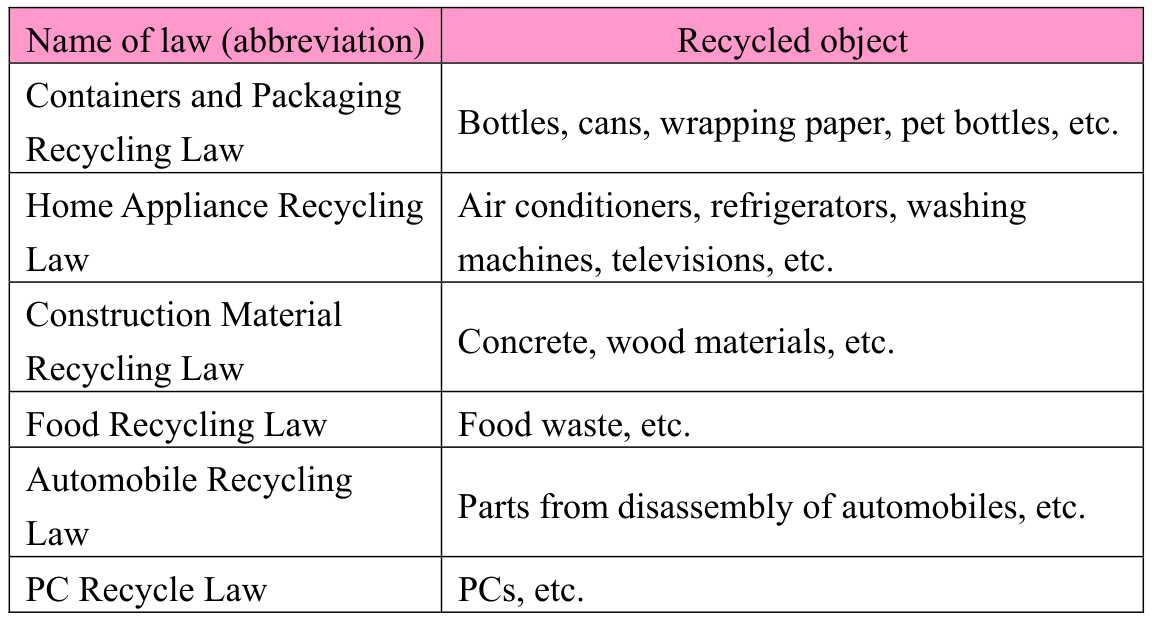
This is a law that stipulates the separation, collection, recycling, and reuse of resources and wastes. Laws including the following have been established for types of recycled object.
| Name of law (abbreviation) | Recycled object |
|---|---|
| Containers and Packaging Recycling Law | Bottles, cans, wrapping paper, pet bottles, etc. |
| Home Appliance Recycling Law | Air conditioners, refrigerators, washing machines, televisions, etc. |
| Construction Material Recycling Law | Concrete, wood materials, etc. |
| Food Recycling Law | Food waste, etc. |
| Automobile Recycling Law | Parts from disassembly of automobiles, etc. |
| PC Recycle Law | PCs, etc. |
Section progress
Original chapter exercises
Original chapter exercises →New FE Textbook Vol.2 · First Edition, April 2015