Highlighted text? Practice this concept. Highlighted passages and figures open related questions.
Practice related questions (4)Progress & bookmarks
Current section
1-3 Business Management
p. 19
Practice this section 4 linked exam questions with default filters
Progress
Not marked complete
Related questions in this lesson 4
In-basket training2Work sharing1On the Job Training during actual work1p. 19 · PDF 23
1 - 3 Business Management
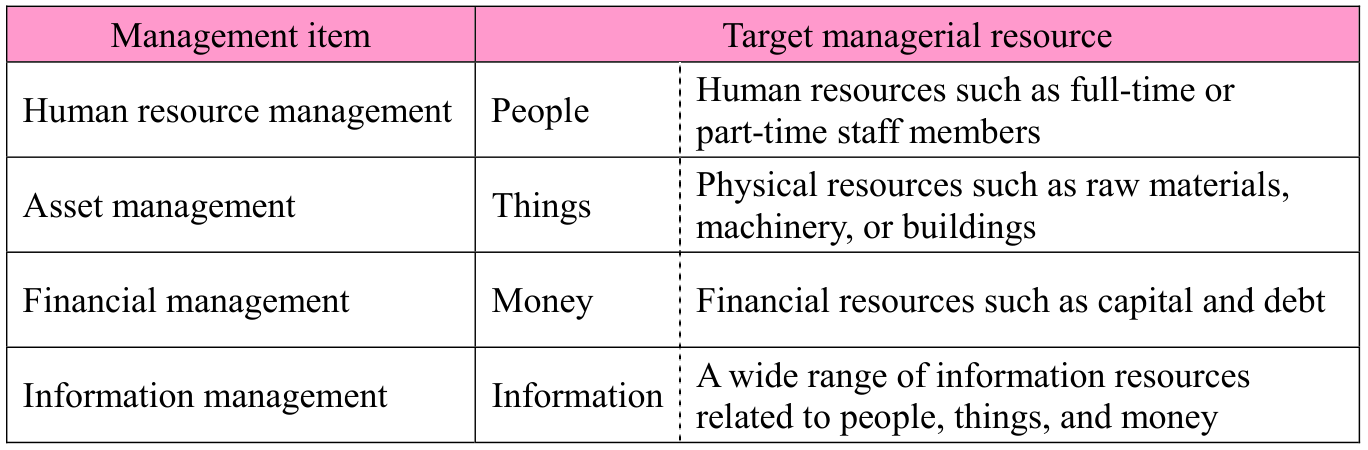
Business management is the act of managing a company overall to ensure that corporate activities are conducted smoothly in order to achieve the company’s goal that was established on the basis of the company’s corporate philosophy (business objectives). Business management requires the procurement and optimal distribution of management resources.
| Management item | Target managerial resource | |
|---|---|---|
| Human resource management | People | Human resources such as full-time or part-time staff members |
| Asset management | Things | Physical resources such as raw materials, machinery, or buildings |
| Financial management | Money | Financial resources such as capital and debt |
| Information management | Information | A wide range of information resources related to people, things, and money |
Business management is performed via the PDCA cycle: Plan (i.e., establishment of a management plan), Do (i.e., implementation of the management plan), Check (i.e., inspection and evaluation of the status of current activities), and Act (i.e., improvement of known issues). Furthermore, TQM (Total Quality Management) must also be integrated to improve management quality along with company-wide risk management to maintain and improve corporate value. In the risk management, risk identification, analysis, and evaluation are performed. A BCP (Business Continuity Plan) is planned against risks that cause the interruption of business activities. The ISO TC (Technical Committee) ISO/TC 223 standardizes BCMS (Business Continuity Management System) that support BCM (Business Continuity Management) for continuing corporate activities in standards such as ISO 22301 “Societal security — Business continuity management systems — Requirements.”
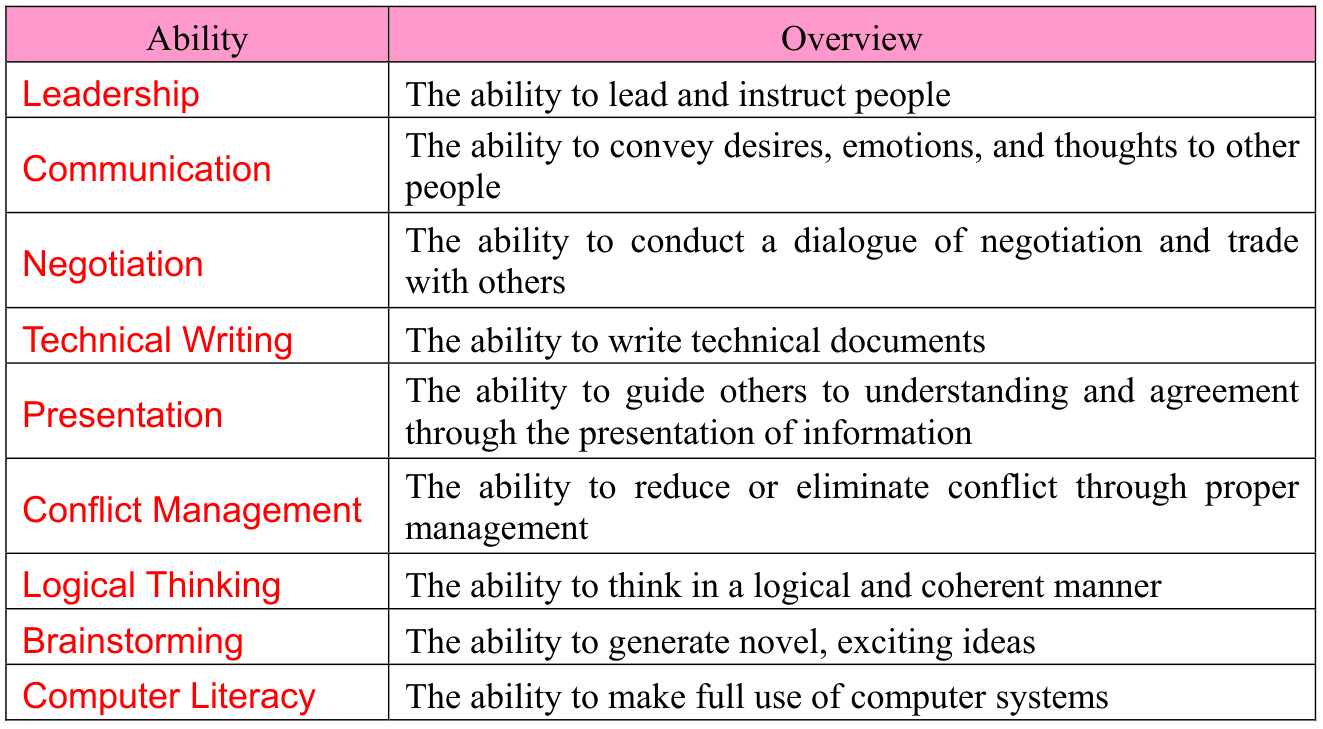
In today’s society, much emphasis is also put on human resource management for “human.” The following types of abilities are desired in human resources.
p. 20 · PDF 24
| Ability | Overview |
|---|---|
| Leadership | The ability to lead and instruct people |
| Communication | The ability to convey desires, emotions, and thoughts to other people |
| Negotiation | The ability to conduct a dialogue of negotiation and trade with others |
| Technical Writing | The ability to write technical documents |
| Presentation | The ability to guide others to understanding and agreement through the presentation of information |
| Conflict Management | The ability to reduce or eliminate conflict through proper management |
| Logical Thinking | The ability to think in a logical and coherent manner |
| Brainstorming | The ability to generate novel, exciting ideas |
| Computer Literacy | The ability to make full use of computer systems |
Motivation, or the will to achieve a certain goal or objective, is also an important element that is considered in human resources. Motivation management includes ideas, such as the hygiene theory which proposes that motivation is not promoted by simply eliminating dissatisfaction (i.e., hygiene factor) that causes a decrease in motivation and the XY theory which proposes that people hold opposing theories in the “control by direction theory X” and the “self-control theory Y.” The following explains some human resource development (or training) and management methods.
- • OJT (On the Job Training)
OJT is the education and training that are received while actual business activities are performed. Conversely, there is the training that is received while actual business activities are not performed, and it is called Off-JT (Off the Job Training). · 1 question - • Case study/Role-playing/Debate/In-basket
Case study aims to analyze and systematize problems on the basis of the past examples. Role-playing is used to experience simulated business activities. Debate involves discussions between two groups: for and against. In-basket involves processing a large number of issues that are put in the “in-basket” within a specific time period. These activities are education and training methods that can all be conducted by an individual or a group. · 2 questions - • e-Learning
E-Learning is an education method that utilizes computers and other information devices for learning. - • Competency
p. 21 · PDF 25
Competency is the behavioral characteristics of employees who achieve a high level of performance. The quality of all employees has the potential to be raised by modeling this behavior and using it as a standard of evaluation for other employees.
- • CDP (Career Development Plan)
CDP is a system that takes into account the specialization, workplace experience, and level of skill acquisition, and then creates a future plan for each individual with the aim of fulfilling the plan. - • Work-life balance
Work-life balance is a concept that emphasizes a proper balance between work and personal life. - • Mental health
Mental health is a concept that provides counseling and other services to limit and prevent negative psychological effects because of work-related stress and other factors. - • MBO (Management By Objective)
MBO is an objective-based management system in which the progress made towards objectives that is set by each individual employee is measured, evaluated, and managed in order to improve abilities and skills. - • Work-sharing
Work-sharing is a system in which a limited bracket of employment is shared by multiple workers through different combinations of work opportunities, working hours, and wages. · 1 question - • Discretionary labor system
The discretionary labor system is a system in which actual working hours are left up to the discretion of the workers, and wages are paid out on the basis of the deemed working hours.
Business management also includes tasks that are related to changes in the business environment, such as globalization that spans across different countries or expansion into new business activities. Recent years have revealed a large number of changes in the business environment, from the change of internal environment where more employees work in satellite offices away from the head office and work from home or small offices in SOHO (Small Office Home Office) environments via telecommuting, to the change of external environment where investments are made only in corporations that fulfill their CSR (Corporate Social Responsibilities) in light of the dissemination of SRI (Socially Responsible Investments).
Section progress
Original chapter exercises
Original chapter exercises →New FE Textbook Vol.2 · First Edition, April 2015