Highlighted text? Practice this concept. Highlighted passages and figures open related questions.
Practice related questions (29)Progress & bookmarks
Current section
3 Management Science
p. 36
Practice this section 29 linked exam questions with default filters
Progress
Not marked complete
Related questions in this lesson 3
Difference from a union2Set operators in original Venn regions1p. 36 · PDF 40
3 Management Science
Management science is an academic field which uses mathematics to determine the optimal methods or numeric values that are required to solve specific problems and to support business management. This section explains the applied mathematics that form the basic methodologies of management science, and after that, some of the most common management science methods.
3 - 1 Applied Mathematics
3-1-1 Set
A set is a collection of elements (e.g., numbers, things, or events) that meet the conditions listed below. For example, a collection of “30 year old Japanese people” can be a set, but a collection of “young people” is not called a set.
[Conditions for a set] When an element is taken out from a set, it must be clearly identifiable as an element of that set.
The event that becomes an element in the set can be of the following types:
- • Whole event: All possible events
- • Elementary event: Each single event which will occur in actual situations
- • Complementary event: An event wherein its negative (i.e., negation of the event)
will take place) - • Exclusive event: An event which cannot occur simultaneously with another event
For example, the following whole event U represents the spots of a dice when the dice is thrown, and is defined as follows: U = {1, 2, 3, 4, 5, 6}

Source visual description
The original paragraph uses an overbar on E for the complimentary event. The displayed equations are E equals {1, 3, 5} and E with an overbar equals {2, 4, 6}. The original spelling complimentary is retained.
Selectable source glyphs (PDF extraction order)
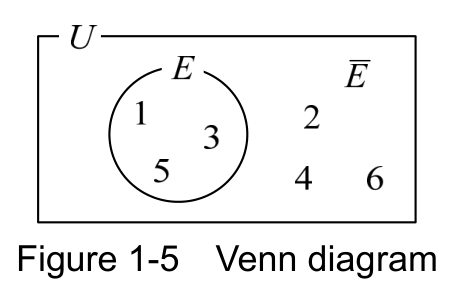
The event E which represents an odd spot when the dice is thrown, and the complimentary events E are defined as shown below. In this case, the event E and the complimentary event E are mutually exclusive. E = {1, 3, 5} E = {2, 4, 6}
Venn diagram can be used as shown in Figure 1-5 to demonstrate the relationship between
p. 37 · PDF 41
events. In this example, the elementary events {1, 2, 3, 4, 5, 6} make up the elements of the set.
Source visual description
The rectangle is U. The circle E contains 1, 3 and 5. E with an overbar labels the remaining rectangle area containing 2, 4 and 6. The original caption is Figure 1-5 Venn diagram.
Selectable source glyphs (PDF extraction order)
Figure 1-5 Venn diagram
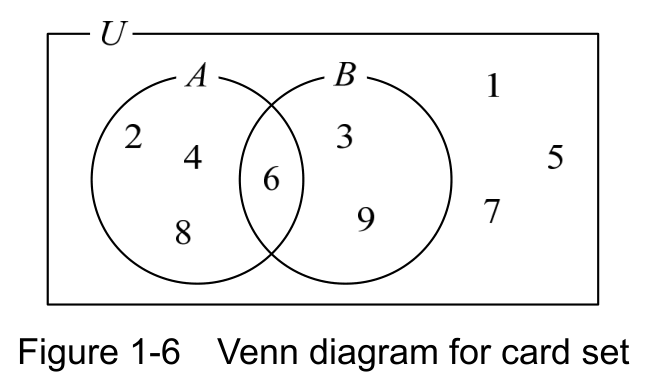
Here, there is a set of nine cards with the number 1 through 9 on them. If a universal set is U, the set A of “numbers that are multiples of 2”and the set B of “numbers that are multiples of 3” can be represented in the following Venn diagram.
Source visual description
The rectangle is U. Circle A contains 2, 4, 6 and 8, and circle B contains 3, 6 and 9. The overlap contains 6. Outside both circles are 1, 5 and 7. The original caption is Figure 1-6 Venn diagram for card set.
Selectable source glyphs (PDF extraction order)
Figure 1-6 Venn diagram for card set
If the elements of each set are taken out from the Venn diagram in Figure 1-6, each set is defined as follows:

Source visual description
Three original rows give U, A and B, with their source elements in the displayed order.
Selectable source glyphs (PDF extraction order)
U = {1, 2, 3, 4, 5, 6, 7, 8, 9} A = {2, 4, 6, 8} B = {3, 6, 9}
A set of equal elements in two different sets is called a product set (intersection set). A product set is represented by the “∩” (AND) symbol.

Source visual description
A intersection B equals {6}. The original note describes numbers that are at once a multiple of 2 and a multiple of 3.
Selectable source glyphs (PDF extraction order)
A ∩ B = {6} Note: The set of numbers that are at once a multiple of 2 and a multiple of 3.
On the other hand, the set of elements that are included in either of two sets is known as a union set. A union set is represented by the “U” (OR) symbol.

Source visual description
A union B equals {2, 3, 4, 6, 8, 9}. The original note describes numbers that are a multiple of 2 or a multiple of 3.
Selectable source glyphs (PDF extraction order)
A ∪ B = {2, 3, 4, 6, 8, 9} Note: The set of numbers that are a multiple of 2 or a multiple of 3.
p. 38 · PDF 42
The elements {1, 5, 7} are not in set A nor set B. This means that {1, 5, 7} is a result of the difference which the union set A ∪ B is subtracted from the universal set U. This type of set, which is determined by the difference between two sets, is known as a difference set and is represented by the symbol “−”. The set of elements {1, 5, 7} can be represented as follows:

Source visual description
U minus the parenthesized union of A and B equals {1, 5, 7}. The original note describes the numbers that are not a multiple of 2 or a multiple of 3.
Selectable source glyphs (PDF extraction order)
− = {1, 5, 7} U ( A ∪ B ) Note: The set of numbers that are not a multiple of 2 nor a multiple of 3.
Since U is the universal set, the set of elements {1, 5, 7} can also be regarded as the negation of the union set A ∪ B for the universal set. The set of elements that are not included in a specific set is known as the complement set, and is represented by the symbol “ ̄”.

Source visual description
A single continuous overbar covers A union B, followed by equals {1, 5, 7}.
Selectable source glyphs (PDF extraction order)
A∪ B = {1, 5, 7}
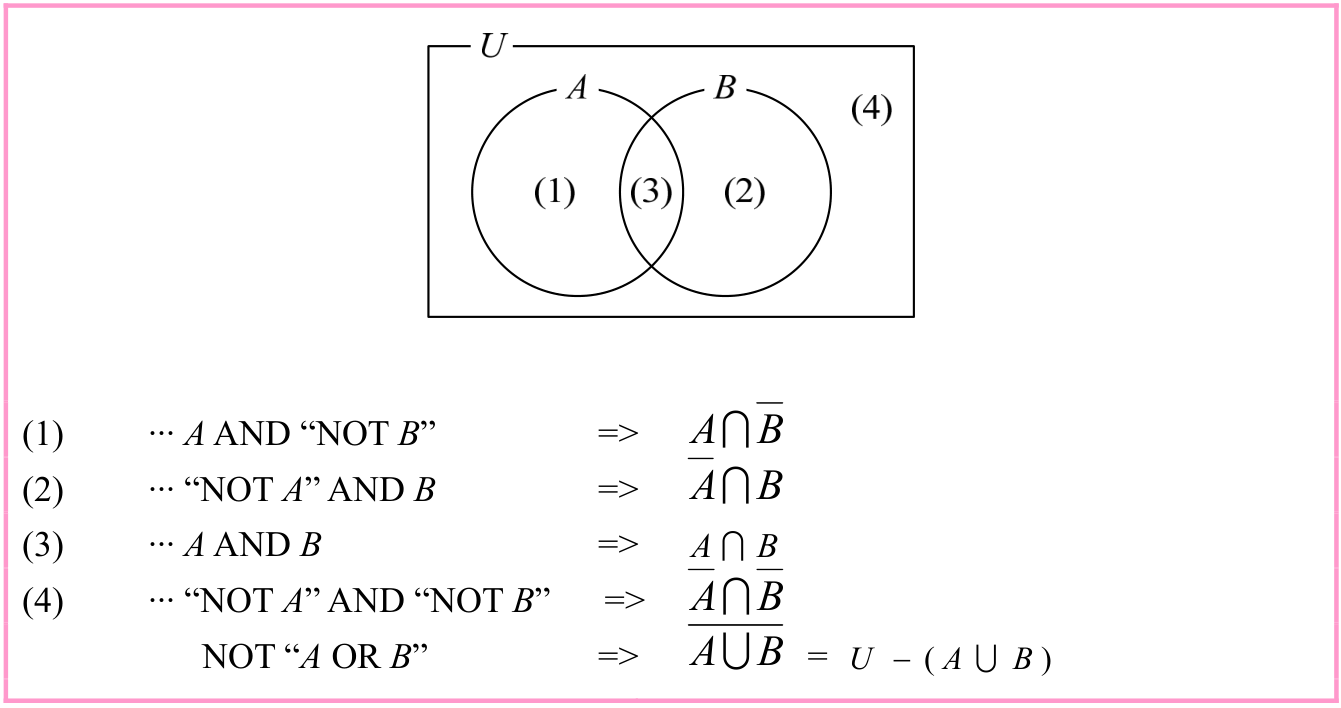
The symbols (“∩”, “ ∪”, and “ ̄”) which have been used at so far in this section are called set operators. These set operations are summarized by using a Venn diagram as follows:
Source visual description
U surrounds overlapping circles A and B. Regions are (1) A only, (2) B only, (3) the overlap and (4) outside both. The original numbered cases show A AND NOT B; NOT A AND B; A AND B; NOT A AND NOT B. The last case also has NOT A OR B with one continuous overbar on the union. All original row labels and the original extra equality with U minus (A union B) remain in the source crop.
Selectable source glyphs (PDF extraction order)
A∩ B (1) ··· A AND “NOT B” => A∩ B (2) ··· “NOT A” AND B => (3) ··· A AND B => A ∩ B A∩ B (4) ··· “NOT A” AND “NOT B” => A∪ B NOT “A OR B” => = − U ( A ∪ B )

Source visual description
The final paragraph compares the parenthesized product with separate bars over A and B to the parenthesized union with one bar over the entire expression. The two original parenthesized expressions are transcribed below in their source order.
Selectable source glyphs (PDF extraction order)
When (4) above is focused on, it can be said that “the product set of the negation of set A and A∩ B the negation of set B ( ) is the same as the negation of the union set of set A and set B A∪ B ( ).”
p. 39 · PDF 43
This is known as De Morgan’s laws, and can be summarized as below.

Source visual description
First row: one continuous bar over A union B equals A with a bar intersected with B with a bar. Second row: one continuous bar over A intersection B equals A with a bar union B with a bar. The original notes remain selectable in the source glyph disclosure.
Selectable source glyphs (PDF extraction order)
A∪ B A∩ B = Note: The complement set of the union set is equal to the product set of the complement set. A∩ B A∪ B = Note: The complement set of the product set is equal to the union set of the complement set.
(1) through (4) above are subsets of the universal set U. A subset is a set that is part of a larger set. This concept can also be applied to other types of sets other than universal sets.

Source visual description
The examples state that (1) is a subset of set A, and that (3), A intersection B, is a subset of set A union B.
Selectable source glyphs (PDF extraction order)
[Examples of subsets] • (1) is a subset of set A. • (3) A ∩ B is a subset of set A ∪ B .
Section progress
Original chapter exercises
Original chapter exercises →New FE Textbook Vol.2 · First Edition, April 2015