Highlighted text? Practice this concept. Highlighted passages and figures open related questions.
Practice related questions (8)Progress & bookmarks
Current section
4 Legal Affairs and Standardization
p. 93
Practice this section 8 linked exam questions with default filters
Progress
Not marked complete
Related questions in this lesson 6
Industrial property rights1Private-use reproduction1Trade secrets1Mutual patent licensing1Limited program backup copies1TRIPS protection of software1p. 93 · PDF 97
4 Legal Affairs and Standardization
Corporate activities are addressed by a variety of laws and regulations, and also by guidelines and standards that are proposed by the ministries and agencies and industry organizations. This section describes laws and regulations, guidelines, and standardization. Note: In regards to legal affairs, basic concepts of laws and regulations are common in many countries, but the actual laws and regulations are inevitably domestic. On the other hand, guidelines and standards may be domestic or international. Most of the descriptions from 4-1 to 4-5 in this section are written depending on Japanese laws and regulations, guidelines, and standards. Please check the relating laws and regulations, guidelines, and standards in each country. Basic concepts of international guidelines or knowledge about international standards may be asked in ITPEC Examination.
4 - 1 Intellectual Property Rights
Intellectual property rights refer to the property rights for all intellectual products that are created through human mental labor. The Intellectual Property Basic Act addresses intellectual property.
[Objectives of the Intellectual Property Basic Act (excerpt from Article 1)] The purpose of this Act is to promote measures for the creation, protection and exploitation of intellectual property in a focused and systematic manner by stipulating the basic principles on the creation, protection, and exploitation of intellectual property and the basic matters to achieve the principles, clarifying the responsibilities of national government, local governments, universities, etc. and business operators, establishing the Intellectual Property Strategy Headquarters, and providing stipulations on the development of a strategic program on the creation, protection, and exploitation of intellectual property.
Intellectual property rights are classified into rights concerning intellectual creations and rights concerning trade dress. These rights are protected by law, and their infringement is subject to compensation for damage.
p. 94 · PDF 98
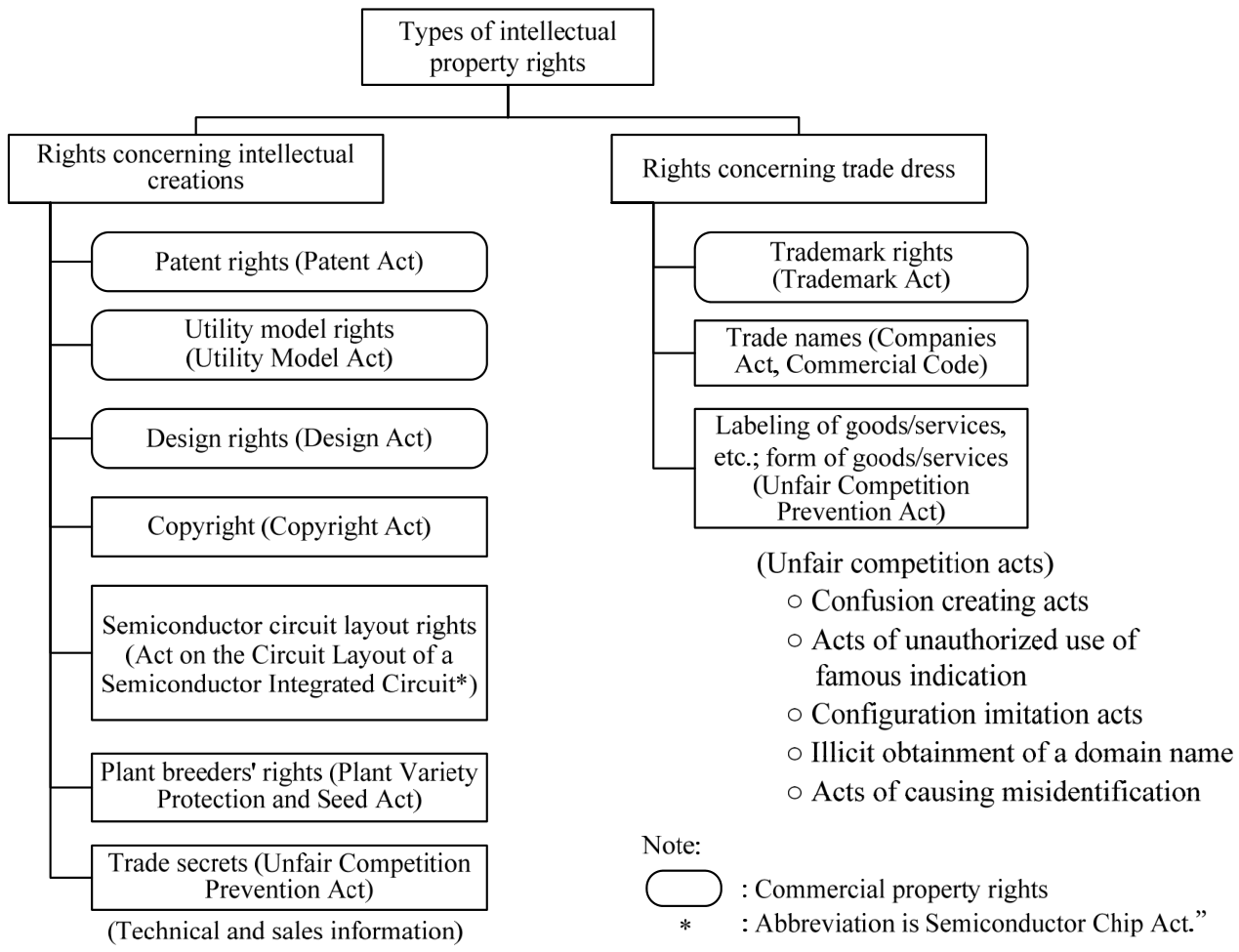
Source visual description
Original Types of intellectual property rights tree. The main branches are Rights concerning intellectual creations and Rights concerning trade dress. The creations branch includes Patent rights (Patent Act), Utility model rights (Utility Model Act), Design rights (Design Act), Copyright (Copyright Act), Semiconductor circuit layout rights, Plant breeders rights (Plant Variety Protection and Seed Act), and Trade secrets (Unfair Competition Prevention Act), with Technical and sales information noted. The trade-dress branch includes Trademark rights (Trademark Act), Trade names (Companies Act, Commercial Code), and Labeling of goods/services and form of goods/services (Unfair Competition Prevention Act). The original unfair-competition list retains Confusion creating acts, Acts of unauthorized use of famous indication, Configuration imitation acts, Illicit obtainment of a domain name, and Acts of causing misidentification. The rounded commercial-property-rights legend, Semiconductor Chip Act abbreviation note, every connector and statutory label remain intact.
Original visual text
The United Nations has established the WIPO (World Intellectual Property Organization) as an international expert body for protection of intellectual property. Also WTO (World Trade Organization) has articles about intellectual properties in TRIPS Agreement (Agreement on Trade-Related Aspects of Intellectual Property Rights).
(1) Copyright Act
The Copyright Act is a law for the protection of the rights (copyright) of author who created his/her works. Author’s works include works of language such as novels, screenplays, papers, and lectures; works such as music, dance, pantomime, paintings, prints, and photographs; and derivative works that are created through the translation or adaptation of works. However, notices, orders, notifications, and similar items from the central, regional, or other government bodies, and translations or compilations of these (e.g., white papers) are not deemed author’s works.
In the Copyright Act, copyrights are classified into moral rights of author (i.e., rights concerning the personal benefit of author), property rights of author (i.e., property rights pertaining to author’s works), and others.
p. 95 · PDF 99
| Moral rights of author | ||
|---|---|---|
| Right to make the work public | The right to make the work public or not make it public | |
| Right to determine the indication of the author’s name | The right to indicate or not indicate the author’s name (true name or pseudonym name) | |
| Right to maintain integrity | The right to maintain the integrity of author’s works and their titles | |
| Property rights of author | ||
| Right of reproduction | The right to reproduce author’s works | |
| Rights of public transmission | The right to effect a public transmission of author’s works (or to make transmittable to the public) | |
| Rights of distribution | The right to distribute author’s works through the reproductions | |
| Right of ownership transfer | The right to offer author’s works to the public by transferring ownership of the works or the reproductions | |
| Right of rental | The right to offer author’s works to the public through the rental of the works or the reproductions | |
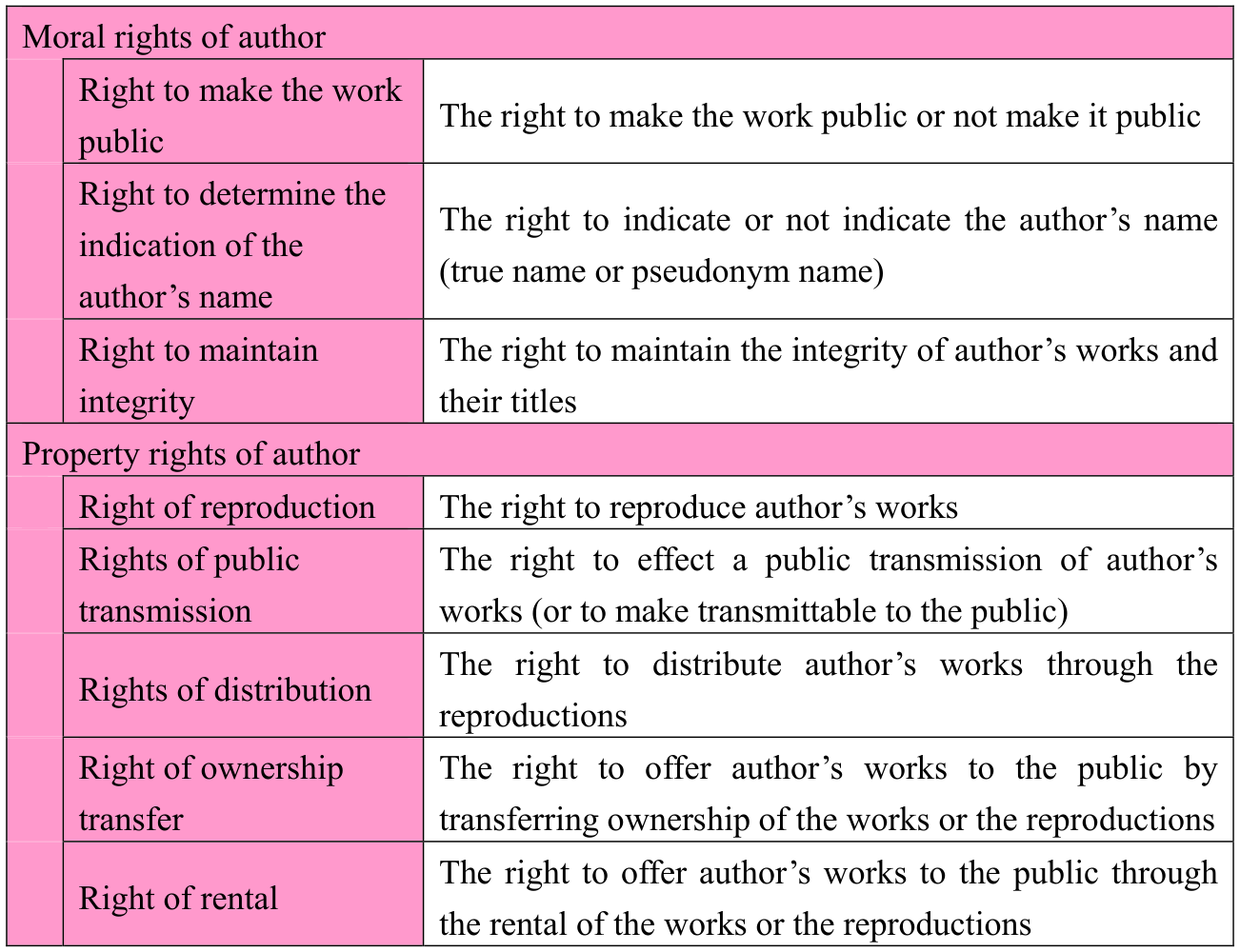
While the moral rights of author cannot be transferred to a third party, the property rights of author can be transferred. In addition, neighboring rights that are similar to the moral rights of author accrue to concerned parties who are engaged in activities closely related to the corresponding works.
Under the Copyright Act, when rights have been infringed upon by unauthorized reproduction, alteration, etc. of author’s works, the copyright holder may demand that the infringing party cease the unauthorized use or provide compensation for damages. (Copyright infringement constitutes a legal case when a suit is brought by the victim of infringement.) However, the following exceptions also apply.
- • Reproduction of a work for the purpose of private use does not constitute copyright
infringement. However, reproduction that makes transmittable to the public does constitute copyright infringement. · 1 question - • In the cases of non-profit-making activities, reproduction of a work included in books,
documents, and other materials from libraries, etc. does not constitute copyright infringement. - • Quotation of a work already made public does not constitute copyright infringement.
However, the quotation must be performed, to the extent justified by the purpose of the
p. 96 · PDF 100
quotation.
- • In schools or other educational institutions, reproduction of a work already made
public, to the extent deemed as necessary, does not constitute copyright infringement. However, this is not applicable in cases that unreasonably prejudice the interests of the copyright holder. - • Reproduction of a publicly available work as examination questions, etc. does not
constitute copyright infringement. However, this is not applicable in cases that unreasonably prejudice the interests of the copyright holder.
Since copyright is an automatic principle by which copyright accrues automatically at the time that a work is created by the author, there is no need to perform procedures, such as patent application, examination, or registration. However, in order to prevent disputes and to protect the rights of authors, a copyright registration system exists that allows registration of the true name, the issued date/creation date, rights, etc. with the Agency for Cultural Affairs. While the Agency for Cultural Affairs has jurisdiction over copyrights, the SOFTIC (SOFTware Information Center) is the point of contact for registration of computer programs.
In addition to the above, the following points should be noted with regard to copyrights related to the information processing area.
- • Protection of program works does not extend to any programming language, rule, or
algorithm used for creating the works. What is protected is expression, not know-how or algorithms. - • The authorship of a computer program work which, on the initiative of a juridical
person, etc. is made by an employee (including temporary employees) in the course of his/her duties in connection with the juridical person, etc.’s business, shall be attributed to such juridical person, etc., unless otherwise stipulated by contract or work regulations or the like at the time of the making of the work. => The making of the work by employee who is engaged in the juridical person,
p. 97 · PDF 101
etc.’s business, on the initiative of the juridical person is called employee work. For works other than programs that are created in the course of his/her duties, the juridical person is stipulated as the author in cases in which “the juridical person, etc. makes the work public under its own name.” For that reason, programs for which the juridical person is the author are generally recognized as works even when they are not made public.
- • The term of protection for a private work is from the time of the creation of the work to
50 years following the death of the author. In contrast to this, the term of protection for juridical person’s work is 50 years following the making public of the work. - • If the user had knowledge at the time of acquisition that the program was illegally
copied, it constitutes copyright infringement. However, if the program was acquired without knowledge that it was illegally copied, it does not constitute copyright infringement. - • Reproduction of a program for the purpose of backup, or alteration within allowed
limits through customization functions, etc., does not constitute copyright infringement. However, it constitutes copyright infringement by the act of reproduction through the forcibly removing copy protection (copy guard) that is set for the purpose of prohibition of reproduction, even if the purpose is to do backup. · 1 question - • For programs (or works) for which alteration is allowed, rights equivalent to those of
the original author are granted to the author of the altered derivative works.
(2) Industrial Property Law
- • Patent Act
Among technological creations by making use of laws of nature, this Act provides protection for highly advanced “inventions.” Patent rights become registered following application to the Japan Patent Office, and subsequent examination and assessment. The duration of a patent right is 20 years, during which the patent holder may possess an exclusive license to articles involving the patent. When patent rights have been infringed, the patent holder may claim an injunction on use or compensation for damages from the infringing party. - • Software patent
This is a patent for software that is necessary to achieve an invention, or for the
p. 98 · PDF 102
invention of the software.
- • Business model patent
This is a patent that is aimed at protection of a business model using IT (e.g., computers, software). - • Cross-licensing
This is a form of business by which two companies that hold patents mutually consent to license of patents each other. · 1 question - • Patent pool
This is a form of business by which patent rights that are held by multiple companies are shared and managed in one location. - • Utility Model Act
This is a law to protect “devices,” essentially minor inventions that are not necessarily technical or highly advanced. Common applications are for original and convenient improvements or ideas that are aimed at daily lifestyle goods, toys, etc. These become registered following application to the Japan Patent Office and subsequent examination and assessment. The duration of utility model rights is 10 years. - • Design Act
This is a law to protect the “design” such as form, color, and other design aspects of products. Its purposes are the protection and use of the rights of the design creator. The design becomes registered following application to the Japan Patent Office and subsequent examination and assessment. The duration of design rights is 20 years. In principle, in order to qualify for design registration, a design must not be publicly known. - • Trademark Act
This is a law to protect “trademark” such as trademarks, service marks, and other commercial marks. Its purposes are the protection and use of the rights of the trademark inventor. These become registered following application to the Japan Patent Office and subsequent examination and assessment. The duration of trademark rights is 10 years, but renewal registration is possible.
(3) Other intellectual property right laws
p. 99 · PDF 103
the Act is to protect these trade secrets and enable demands for injunctions and for compensation of damages in cases of theft or other unfair use. However, trade secrets that are protected by this law must fulfill the following requirements.
[Requirements for trade secrets]
- • Must be kept secret
- • Must be secret and useful for commercial activities considering technology
and business - • Must be publicly unknown to society
This law also prevents the following sort of actions as unfair competition.
- • The act of creating confusion with another person’s goods by using an indication
of goods or business that is identical or similar to an indication of goods or business that is well-known among consumers as that of another person. - • The act of selling goods that imitate the style or form of another person’s goods.
- • The act of selling devices or programs that make it possible to view images, listen
to sound, or run programs, which are restricted by technological restriction measures, by interfering with effectiveness of such technological restriction measures. - • The act (e.g., illicit obtainment of a domain name) of acquiring or holding a right
to use a domain name that is identical or similar to another person’s specific indication of goods or services for the purpose of acquiring a wrongful gain (or for the purpose of causing injury to another person)
(ii) Semiconductor Chip Act (Act on the Circuit Layout of a Semiconductor Integrated Circuits) This is a law that views the layout of the semiconductor integrated circuits in computers as intellectual property, and protects from imitation. Since this layout affects the performance of computers, the law was enacted to protect this intellectual property from imitation. Falling under the jurisdiction of the Machinery and Information Bureau of the Ministry of Economy, Trade and Industry, the duration of a circuit layout right is 10 years from the day that the circuit layout is registered.
(iii) Commercial Code This refers to general law concerning commercial practices. It stipulates that when merchants use a “trade name” to denote themselves in the pursuit of business, “No person may use, with a wrongful purpose, any name or trade name which makes it
p. 100 · PDF 104
likely that a company will be mistaken for another company.”
Section progress
Original chapter exercises
Original chapter exercises →New FE Textbook Vol.2 · First Edition, April 2015