Highlighted text? Practice this concept. Highlighted passages and figures open related questions.
Practice related questions (8)Progress & bookmarks
Current section
1-2 Marketing
p. 151
Practice this section 8 linked exam questions with default filters
Progress
Not marked complete
Related questions in this lesson 3
Marketing mix1Marketing mix four Ps1Early adopters1PEST external-environment analysis1p. 151 · PDF 155
1 - 2 Marketing
Marketing refers to business activities concerning the overall corporate activities, such as survey and analysis of market and customers, product development and design, advertising and public relations, business operations, distribution, sales promotion. In other words, marketing activities range from an accurate understanding of the needs of the market/customer through survey and analysis, and planning of new product development, up to technical development
p. 152 · PDF 156
performed according to the plan, designing and manufacturing of developed products, and sales and evaluation in the target market. In marketing, a marketing theory is employed. This is a theory that compiles the techniques for selling and providing products and services to the market and consumers.
1-2-1 Marketing Theory
Marketing theory is a theory that the practices of marketing are systematically organized. According to the marketing theory, the marketing strategy is created and executed as per the below-mentioned procedure.
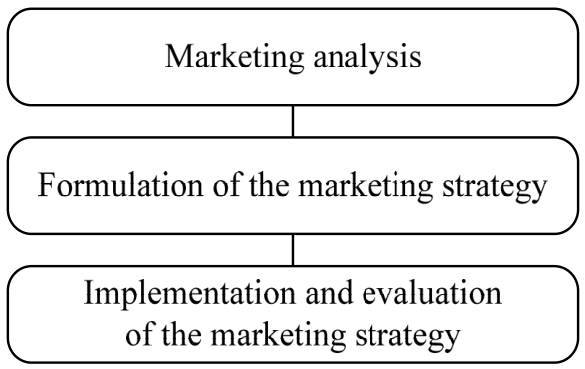
Source visual description
Three successive rounded boxes show Marketing analysis, Formulation of the marketing strategy, and Implementation and evaluation of the marketing strategy.
(1) Marketing analysis
Marketing analysis refers to the analysis of the market size, customer needs, management resources and performance of a company, and competitive relationships with other companies. The typical marketing analysis techniques include the following.
(i) 3C analysis
This is a technique of analyzing the 3Cs – namely Customer, Competitor, and Company. Its purpose is to find out the gap between the KFS (Key Factor for Success) of the business and the analysis results of a company, and then understand the business environment. In customer analysis, the LTV (LifeTime Value) acts as the indicator. Lifetime value refers to the amount of money used by the customer throughout his/her life or the degree of contribution. It is an indicator used to improve cost effectiveness while opportunity loss is avoided, and to control a balance between CS (Customer Satisfaction) and profits. A strategy used to improve the lifetime value is the brand strategy that improves the brand image of the company brand and product brand. This strategy leads to an improvement in the loyalty (i.e. customer loyalty) and commitment of the customer with respect to the products and services of a company. The effect of gaining a long-term repeater can be expected.
p. 153 · PDF 157
(ii) 5F analysis (5 Forces Analysis)
This is a technique of analyzing the positioning of a company in the industry from the five viewpoints of suppliers, new entrants, customers, substitute products, and hostile relationships between competitors.
- • Viewpoint of suppliers
The negotiation capability of suppliers (i.e., sellers) becomes stronger when a small number of suppliers hold monopoly in the industry, or when the supplied product that is being handled is special. - • Viewpoint of new entrants
The threat of new entrants becomes smaller when the barrier for new entrants is thick as a result of protection by the country’s regulations and laws, and also when a large amount of capital investment is required. - • Viewpoint of customers
The negotiation capability of customers (i.e., buyers) becomes stronger when the products and services to be sold are not special and can be selected from the products and services of several competitors. - • Viewpoint of substitute products
The threat of substitute products increases when there are substitute products that are different from the existing products and services but have a higher value. - • Viewpoint of hostile relationship between competitors
The hostile relationship between competitors becomes stronger in the case of an industry characterized by a large number of companies in the same trade or having the same size, where withdrawal is difficult.
(iii) PEST analysis
(iv) Marketing research
This is a technique of investigating and analyzing market (i.e., customer) trends. Since it is realistically impossible to conduct a marketing research focusing on all customers, the investigation results collected from specific sampled customers (i.e., focus group) are analyzed statistically.
[Method of customer survey]
- • Questionnaire
This is a method of questioning the customers through questionnaires and interviews, and collecting their opinions and thoughts.
p. 154 · PDF 158
- • Observation method
This is a method of getting the customer to use products on a daily basis and then collecting information by observing the status of use. - • Experimental technique
This is a method of collecting information that is related to a hypothesis from the activity of customers under a specific situation for verifying information in line with a certain assumption.
(2) Creation of the marketing strategy
In most cases, the marketing strategy is created through the procedure of STP analysis. According to STP analysis, the marketing strategy is created on the basis of the concept that “Rather than targeting all customers, it is more effective to specify only those customers who enable effective expansion of business as compared with competitors.”
[Procedure of STP analysis]
1) Segmentation The customer market is classified on the basis of the needs and customer layer (e.g., age, sex, occupation).
- • RFM analysis
This is a technique of classifying customers by analyzing three aspects: Recency (i.e., last purchase date), Frequency (i.e., purchase frequency), and Monetary (i.e., total purchase money).
2) Targeting The target market is selected from the classified customer markets.
3) Positioning The method and means are decided to be used to show the value of a company to appeal to customers for the selected target market. (The marketing strategy is created.)
When the marketing strategy is created on the basis of Positioning of STP analysis, the following concept is used.
(i) Marketing mix
p. 155 · PDF 159
| Seller’s perspectives (4P) | Buyer’s perspectives (4C) |
|---|---|
| Product | Customer value |
| Price | Customer cost |
| Place | Convenience |
| Promotion | Communication |
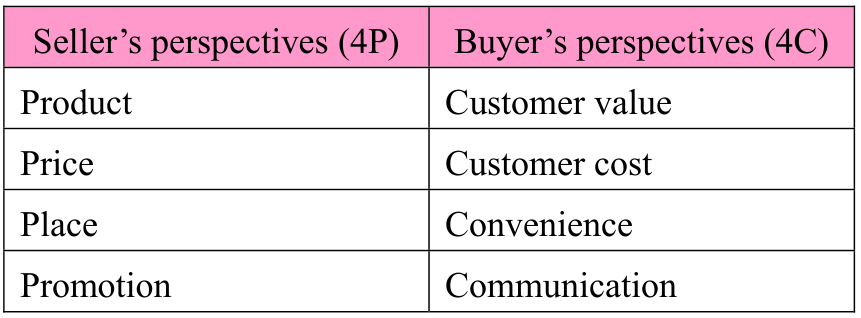
What is important at the time of using marketing mix is a planning and management activity called merchandising. This involves the provision of products matching the needs of the target customers with appropriate pricing and timing.
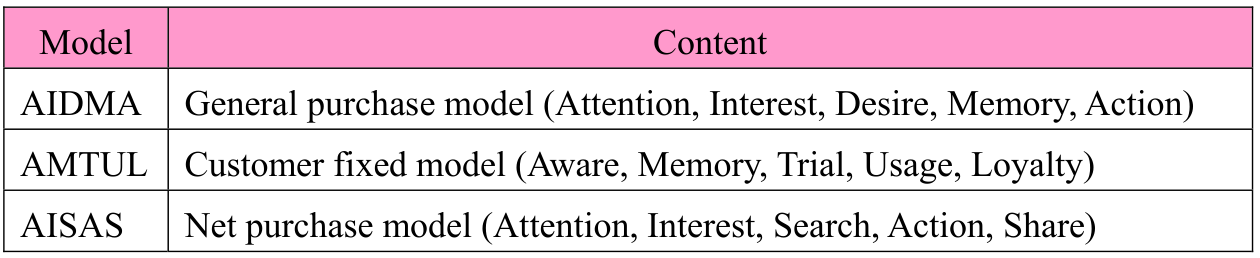
(ii) Consumer behavior model
This is a model that systematically organizes the behavior of consumers and is used as a policy at the time of appealing to the target (i.e., customers).
| Model | Content |
|---|---|
| AIDMA | General purchase model (Attention, Interest, Desire, Memory, Action) |
| AMTUL Customer fixed model (Aware, Memory, Trial, Usage, Loyalty) | |
| AISAS | Net purchase model (Attention, Interest, Search, Action, Share) |
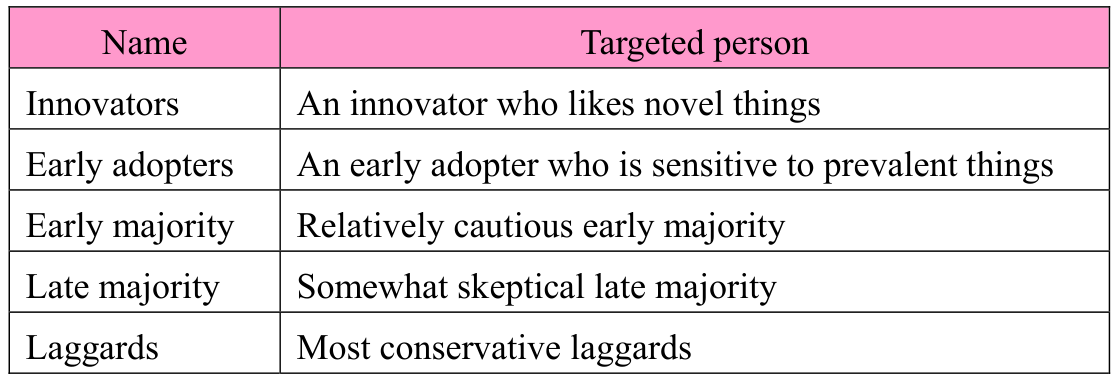
(iii) Innovator theory
in the market as an opinion leader who has a large power of influence on others.
| Name | Targeted person |
|---|---|
| Innovators | An innovator who likes novel things |
| Early adopters | An early adopter who is sensitive to prevalent things |
| Early majority | Relatively cautious early majority |
| Late majority | Somewhat skeptical late majority |
| Laggards | Most conservative laggards |
(iv) Service profit chain
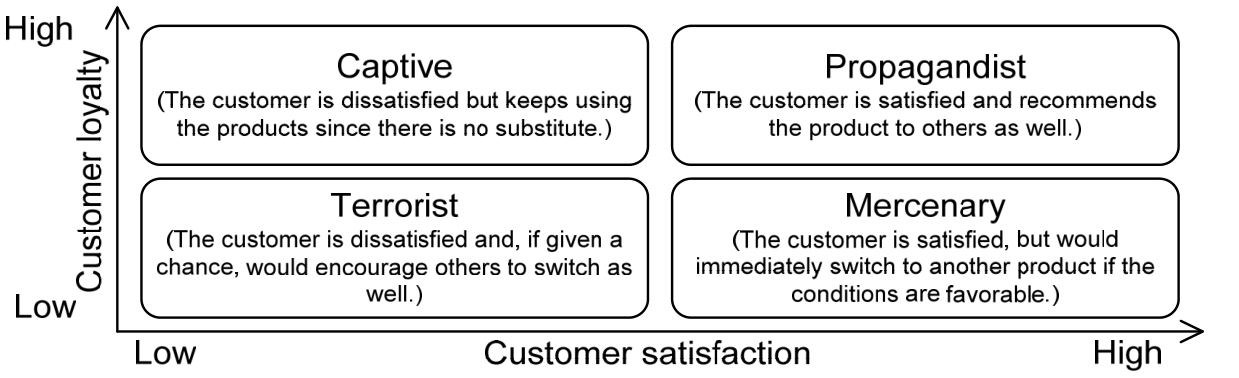
This is a model that was advocated by James L. Heskett on the basis of his idea that “customer satisfaction and employee satisfaction have a close relationship.” Heskett classified customers into the following four categories and explained the importance of improving customer satisfaction.
p. 156 · PDF 160
Source visual description
The original two-axis matrix places customer loyalty vertically and customer satisfaction horizontally. Captive is upper left, Propagandist upper right, Terrorist lower left and Mercenary lower right. The original explanatory labels within each quadrant remain in the source pixels.
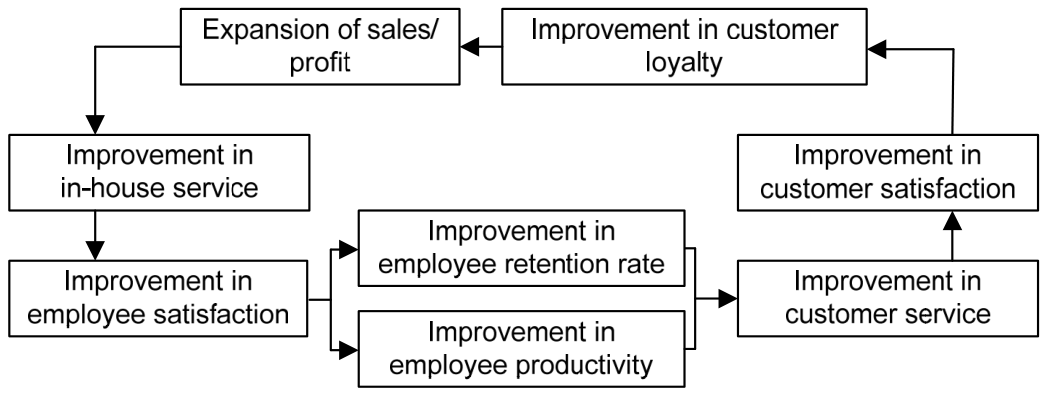
According to the service profit chain, it is advocated that an improvement in employee satisfaction based on an improvement in the in-house service will result in an improvement in customer satisfaction.
Source visual description
The source flow links improvements in employee satisfaction, internal service, employee productivity, service and customer satisfaction/loyalty with expansion of sales and profit. Original arrows and feedback connections are retained in the crop.
(3) Implementation and evaluation of the marketing strategy
The created marketing strategy is implemented, and the result is evaluated. While the evaluation procedure and evaluation viewpoint differ depending on the industry and business, these are generally evaluated on the basis of the sales volume, market share, and sales quantity. Even in the case of marketing, since the PDCA cycle is repeated, the execution result is evaluated, and a new marketing strategy is created on the basis of the evaluation result.
Section progress
Original chapter exercises
Original chapter exercises →New FE Textbook Vol.2 · First Edition, April 2015