Highlighted text? Practice this concept. Highlighted passages and figures open related questions.
Practice related questions (5)Progress & bookmarks
Current section
3-3 e-business
p. 178
Practice this section 5 linked exam questions with default filters
Progress
Not marked complete
Related questions in this lesson 6
Online mall B to C1Affiliate advertising2RFID through packaging2Online marketplace participants1p. 178 · PDF 182
3 - 3 e-business
E-business refers to the overall business techniques that actively make use of IT, such as computers and networks.
3-3-1 EC (Electronic Commerce)
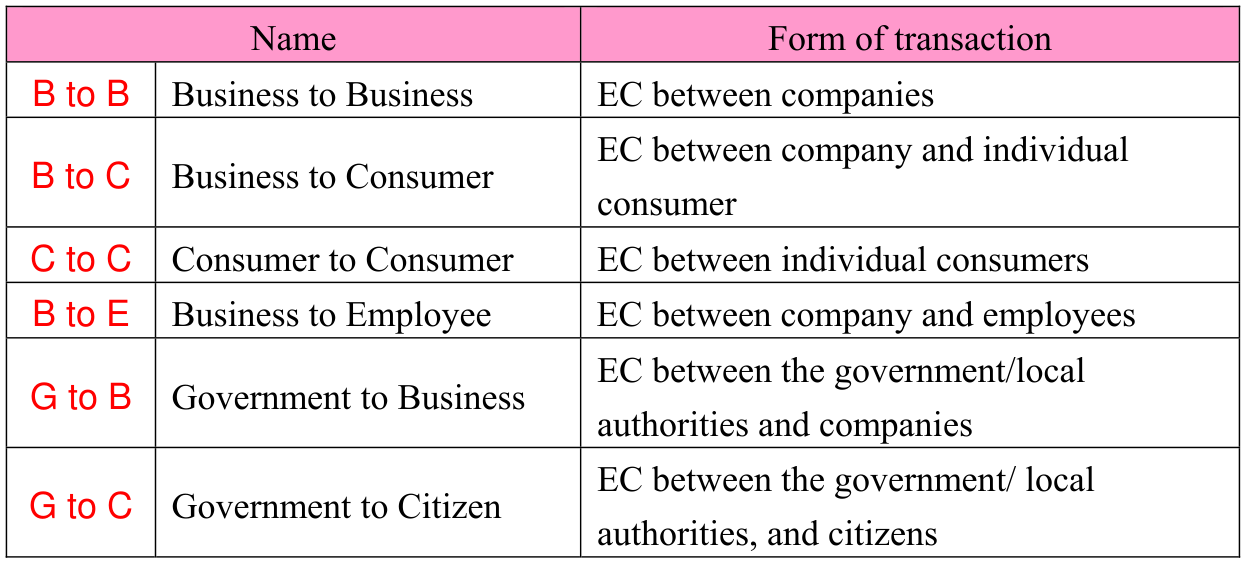
EC (Electronic Commerce) is a mechanism by which a company, organization, or individual performs sales, commodity distribution, advertising, and payment services by using a network. Depending on the form of transaction, EC can be classified as shown below.
p. 179 · PDF 183
| Name | Form of transaction | |
|---|---|---|
| B to B Business to Business | EC between companies | |
| B to C Business to Consumer | EC between company and individual consumer | |
| C to C Consumer to Consumer | EC between individual consumers | |
| B to E Business to Employee | EC between company and employees | |
| G to B Government to Business | EC between the government/local authorities and companies | |
| G to C Government to Citizen | EC between the government/ local authorities, and citizens | |
(1) Electronic ordering system
EOS (Electronic Ordering System) is a term for systems that support acceptance and placement of orders using a network, such as the Internet.
- • Online mall (cyber mall, virtual mall)
This is a site that is a collection of retail stores and mail order houses on the Internet. It is a “B to C” form of transaction including online shopping where customers buy the products of their choice. · 1 question - • Electronic procurement system
This is a system through which, when a company or a public organization procures external resources, a decision is made concerning the supplier by performing electronic bidding via the network after the required conditions have been provided. Procurement between companies is performed in the “B to B” form, and electronic bidding. such as public works, is performed in the “G to B” form. - • e-marketplace (Electronic marketplace, Internet business center)
This is a site that is a collection of seller companies and buyer companies on the Internet. It is a “B to B” form of transaction in which products are traded on a site. · 1 question - • Electronic auction (Internet auction)
This is an auction that is performed over an Internet site. It is a “C to C” form of transaction in which the seller (i.e., individual) exhibits its products on an auction site, and buyers (i.e., individuals) perform bidding, with the person offering the highest price becoming the successful bidder. Another type of auction is a reverse auction, where a buyer indicates the object(s) he/she wants to buy and the purchase conditions, and either an individual or several sellers respond to this demand.
p. 180 · PDF 184
(2) Electronic payment system
Electronic payment system is a collective term for systems by which a transaction is settled electronically (for example, charges are given and received). The typical electronic payments used in EC are as shown below. In an electronic payment system, the security of communications is ensured through SSL (Secure Sockets Layer).
- • Internet banking
This is a mechanism by which financial trading is performed with a bank by using the Internet, and it is used in account transfers and payment of transaction charges through account transfers. Since a dedicated terminal or dedicated software is not needed as in the electronic banking system, this system is used not only by corporations such as companies, but also by individual consumers, in large numbers. Moreover, net banks with Internet banking as their main component are also seen. - • EFT (Electronic Fund Transfer)
This is a mechanism by which funds are transferred (i.e., paid) electronically between banks and between accounts according to instructions from the requesting person. Generally, this method is used for payment between companies. - • Electronic money
This refers to money that is exchanged as electronic data instead of conventional money, and is used for payment by an individual consumer. The main electronic money services include the prepaid type known as Edy and the postpaid type known as iD.
A mechanism of implementing a transaction that does not use conventional money with the help of an electronic payment card is also an electronic payment system. The cards that are used include credit cards used for deferred payments, prepaid cards that involve advanced payments, and debit cards (cash cards) where the payment amount is immediately withdrawn from the bank account. Examples of other cards are Suica, PASMO, ICOCA, TOICA, Kitaca, and SUGOCA, which are used for transport facilities and can also be used for shopping. A card system that uses the cards described below to record electronic information is used in the electronic payment system.
- • Magnetic card
This is a card in which information can be recorded in the magnetic strip of the card. Since there is no mechanism for preventing unauthorized writing/reading, the reliability of this card is low. - • IC card (Smart card)
This is a card in which information can be recorded in an IC chip embedded in the card. Since data can be encrypted and access control is possible, this card has a high
p. 181 · PDF 185
(3) e-business utilization techniques
In addition to EC, various forms and techniques are also used in e-business. This subsection describes the techniques and the concepts of promoting e-business.
- • Internet business
This is a collective term for business models, including EC, which uses the Internet. There are various business models, including the content model that provides attractive contents and ensures sufficient customers, and the portal model that manages portal sites, such as Yahoo! and Google, which act as entry points on the WWW. - • SEO (Search Engine Optimization)
This is a technique or a service by which the website of a company is displayed at the top of the search results when a keyword search is performed using a search engine. - • Recommendation system
This is a system that provides a service (i.e., recommendation) and displays the information in which a user may be interested, on the basis of the already registered purchase history of the user on the top page. - • Long tail
This is a concept where, by continuing with high-mix low-volume sales, a large profit can be achieved even when the sales quantity of each type of product is small. In certain cases, this indicates that it is impossible to ignore the ratio of the sales total of a product with poor sales in relation to the overall sales. - • Internet advertising
This is a collective term for corporate advertising on the Internet. It includes affiliate (i.e., result-reward type advertisement) in which a company advertisement or a link to a website is posted on the web page of an individual and remuneration is paid according to the derived results; opt-in mail advertisement in which e-mails are sent to the persons who have given their consent to receiving · 2 questions
p. 182 · PDF 186
advertisements (i.e., opt-in mails); banner advertisement in which the link to a website is posted on a large portal site; pop-up advertisement that is displayed automatically in a separate window by adware; interstitial advertisement that is displayed on the search result page of a search site; and listing advertisement (i.e., keyword targeted advertisement) that is associated with a search keyword.
- • Escrow service
This is a service in which a provider serves as a mediator between a seller and a buyer in a C to C form of service, such as an Internet auction. - • Drop shipping
This is a sales form in which, upon receiving an order for a product, the operator of a net shop contacts a wholesaler to send the product to the ordering person. This enables the operator of the net shop to perform sales without keeping an inventory of the product, and on the other hand, the wholesaler can assign the sales activity to the net shop.
Section progress
Original chapter exercises
Original chapter exercises →New FE Textbook Vol.2 · First Edition, April 2015