Highlighted text? Practice this concept. Highlighted passages and figures open related questions.
Practice related questions (4)Progress & bookmarks
Current section
1-3 Business Strategy and Goals and Evaluations
p. 160
Practice this section 4 linked exam questions with default filters
Progress
Not marked complete
Related questions in this lesson 5
Critical success factor1Balanced scorecard perspectives2Total quality management2p. 160 · PDF 164
1 - 3 Business Strategy and Goals and Evaluations
Business strategy is a specific strategy of the business operations level that is set up on the basis of the management strategy and marketing strategy.
[Procedure of setting up a business strategy]
1) Setup/confirmation of the company vision Clarify the form (i.e., direction) that a company must have on the basis of the management philosophy.
2) Analysis of the business environment Clarify the position of a company in the market and consumer needs, and also the relationship with competitors.
3) Creation of the business strategy
p. 161 · PDF 165
Define the strategy objectives and clarify the specific strategy at the business operations level.
5) Setup of an implementation plan Set up a concrete implementation plan for accomplishing the objectives. At this time, set up the two indicators for evaluating the level of accomplishment of objectives, and create an evaluation plan as well.
- • KGI (Key Goal Indicator)
This is an indicator for quantitatively evaluating the level of accomplishment (i.e., result) of objectives. It uses the sales volume, profit margin, number of agreements, sales quantity, and so on. - • KPI (Key Performance Indicator)
This is an indicator for quantitatively evaluating the means (i.e., process) of accomplishing objectives. It uses the number of references, the number of customer visits, the number of claims, and so on. Note: According to another method, the specific strategy for accomplishing the CSF that is extracted in step 4 is taken into consideration in step 3. The order of the two is reversed here.
(1) Business environment analysis techniques
- • Needs/wants analysis
The consumers’ needs (i.e., things whose absence would create a problem, and indispensable things) and their wants (i.e., things whose absence would not create a problem, but where possessing them would be beneficial) are surveyed and analyzed. - • Competitive analysis
The technologies, knowhow, financial status, share, and selection of goods (i.e., product lineup) of competitors are surveyed and analyzed. - • Positioning analysis
The relative positioning of the products and services of a company in the market is surveyed and analyzed.
p. 162 · PDF 166
(2) Typical business strategies
- • VE (Value Engineering)
This is a strategy (or technique/activity) of analyzing the value of products and services, and working toward an improvement in the value with the lowest cost according to a systematically organized procedure. It is a coordinated activity that clarifies the functions that are required by customers and improves the value without affecting the performance, reliability, and quality. - • TQM (Total Quality Management)
This is a management technique (or strategy) according to which TQC (Total Quality Control) is applied to the management strategy and reflected in business operations and management. It uses Six sigma, which controls the variation by using the standard deviation σ (sigma) that represents the variation and sets the range from the center of normal distribution up to 6σ as the upper-limit value and the lower-limit value. · 2 questions
(3) Business strategy evaluation techniques
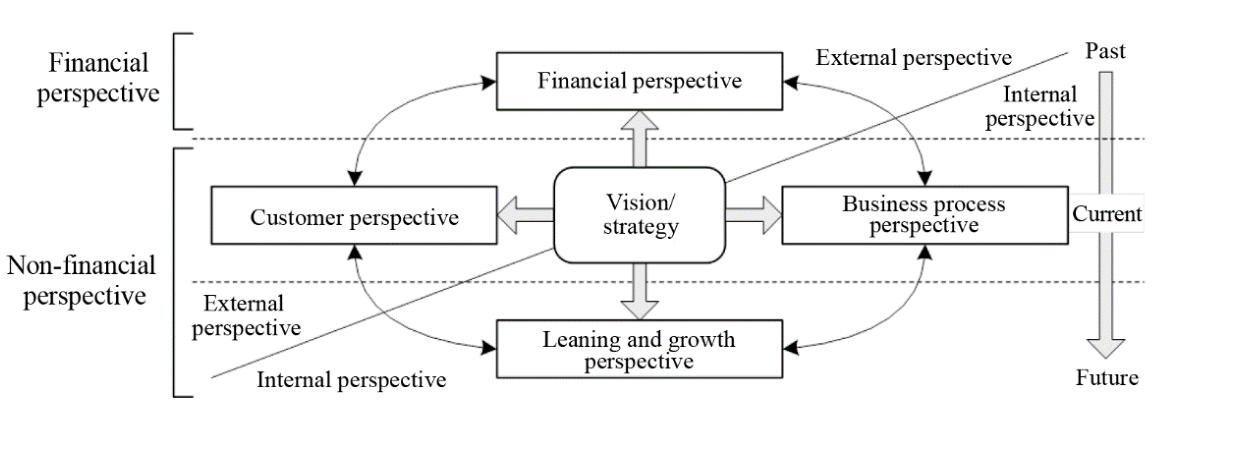
Source visual description
The original diagram places Vision/strategy at the center and the financial, customer, business process, and Leaning and growth (spelled this way in the original diagram) perspectives around it. Original arrows, financial/non-financial labels, internal/external and past/current/future directions remain in the crop.
- • Scoring model
p. 163 · PDF 167
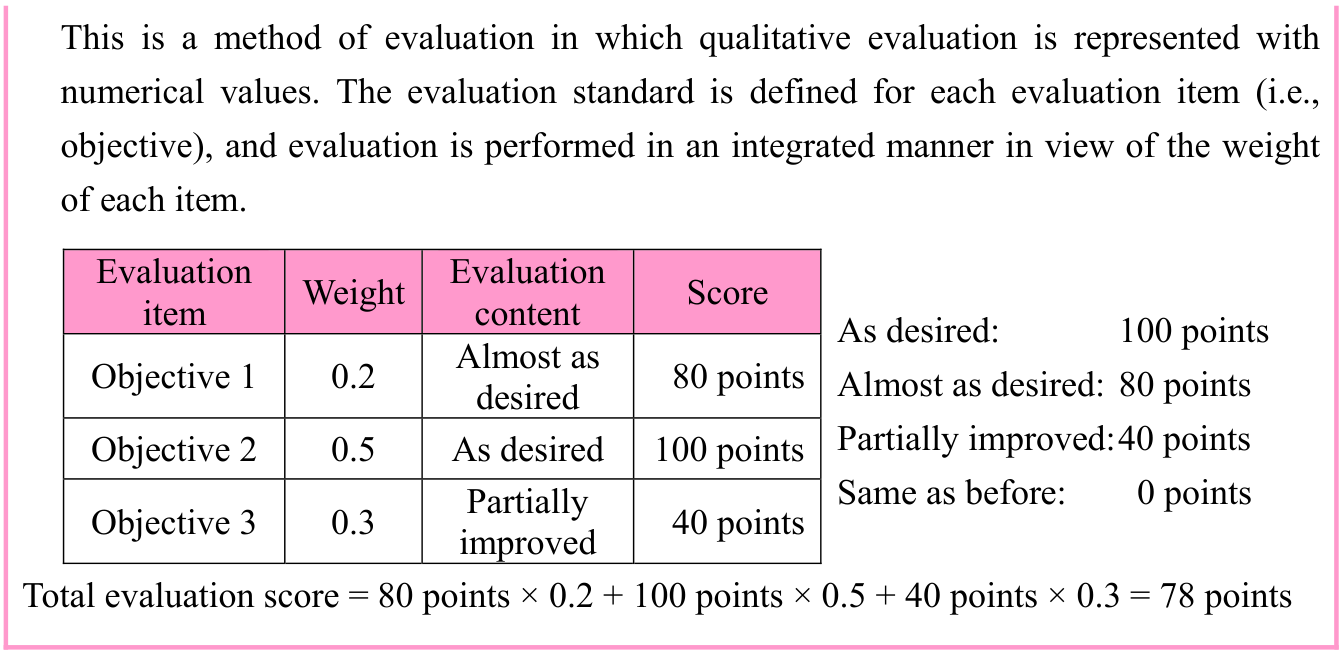
This is a method of evaluation in which qualitative evaluation is represented with numerical values. The evaluation standard is defined for each evaluation item (i.e., objective), and evaluation is performed in an integrated manner in view of the weight of each item.
| Evaluation item | Weight | Evaluation content | Score |
|---|---|---|---|
| Objective 1 | 0.2 | Almost as desired | 80 points |
| Objective 2 | 0.5 | As desired | 100 points |
| Objective 3 | 0.3 | Partially improved | 40 points |
Section progress
Original chapter exercises
Original chapter exercises →New FE Textbook Vol.2 · First Edition, April 2015