Highlighted text? Practice this concept. Highlighted passages and figures open related questions.
Practice related questions (27)Progress & bookmarks
Current section
1 Business Strategy Management
p. 144
Practice this section 27 linked exam questions with default filters
Progress
Not marked complete
Related questions in this lesson 3
Synergy effects1Comparing with advanced businesses2p. 144 · PDF 148
1 Business Strategy Management
The purpose of business strategy management is: to operate and develop management resources, such as people (human resources), objects (physical resources), money (funds), and information, and also operations in a more effective manner; and to effectively manage and operate the business strategy for making the business successful by adapting it to the external environment.
1 - 1 Business Strategy Techniques
1-1-1 Business Strategy
Business strategy is a strategy that is created to attain the business objectives of a company on the basis of the corporate philosophy (or management philosophy). In order for a company to attain its business objectives, it is important how the company strengthens the business status in the market and dominates the market. Therefore, in the environment surrounding the company, the business strategy theory theoretically indicates what must be done and in what way in order to carry out a business successfully. This theory was proposed by Michael E. Porter in the 1980s. In business strategy, management innovation is positioned at the top. Management innovation is a strategy that a company revises its past direction and puts efforts into new corporate activities.
[Concept of management innovation]
- • Benchmarking
This refers to a qualitative and quantitative understanding of products, services, and operation through comparison of the management of a company with the strongest competitor or more advanced company. On the basis of the comparative analysis with best practice, benchmarking is used in the management innovation of a company. · 2 questions - • Diversification
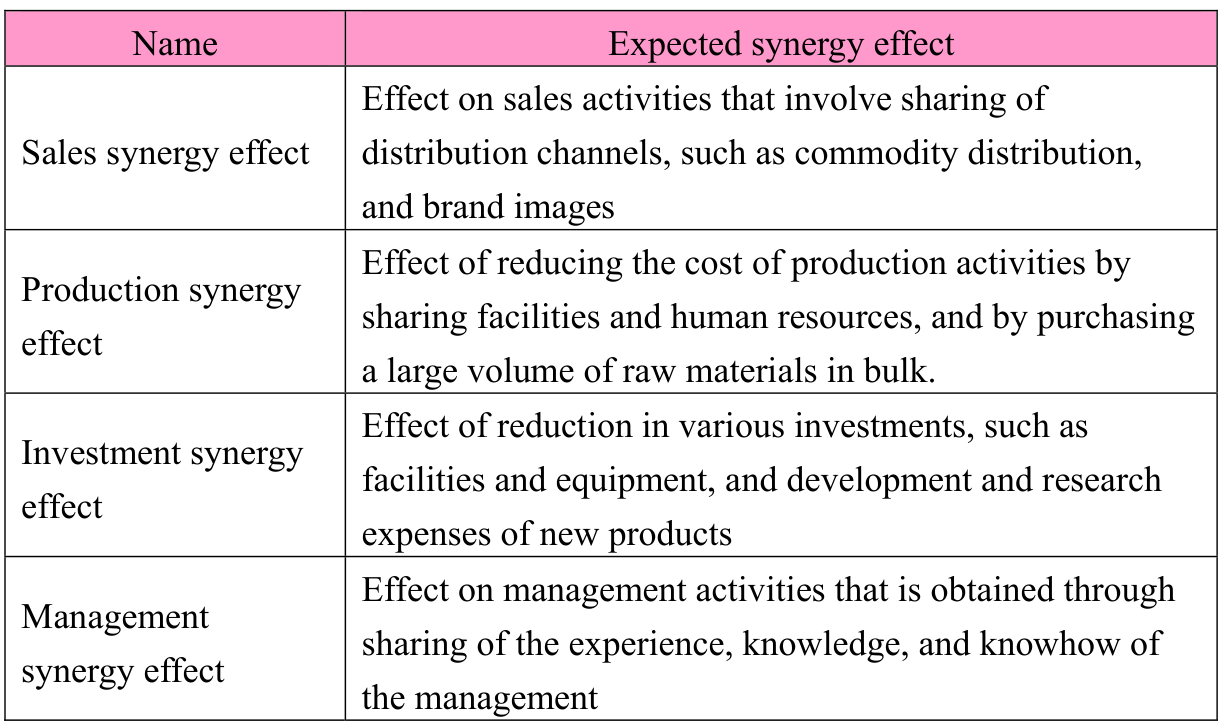
This is a management innovation that promotes the growth of business by foraying into new fields that are different from previous products and markets. Business administration involving extensive management of several businesses is called diversified management. The following synergy effect is expected as a result of a foray into new fields.
p. 145 · PDF 149
| Name | Expected synergy effect |
|---|---|
| Sales synergy effect | Effect on sales activities that involve sharing of distribution channels, such as commodity distribution, and brand images |
| Production synergy effect | Effect of reducing the cost of production activities by sharing facilities and human resources, and by purchasing a large volume of raw materials in bulk. |
| Investment synergy effect | Effect of reduction in various investments, such as facilities and equipment, and development and research expenses of new products |
| Management synergy effect | Effect on management activities that is obtained through sharing of the experience, knowledge, and knowhow of the management |
Section progress
Original chapter exercises
Original chapter exercises →New FE Textbook Vol.2 · First Edition, April 2015