Highlighted text? Practice this concept. Highlighted passages and figures open related questions.
Practice related questions (1)Progress & bookmarks
Current section
1-1-3 Enterprise Strategy
p. 149
Practice this section 1 linked exam question with default filters
Progress
Not marked complete
Related questions in this lesson 2
SWOT analysis1Ansoff market penetration1p. 149 · PDF 153
1-1-3 Enterprise Strategy
Enterprise strategy is a strategy that is created as a basic framework for competing under the environment of each enterprise. It includes strategies specific to each function field, such as business operations, development, and production, and strategies specific to each region. The enterprise strategy not only breaks down the corporate strategy, but rather it possesses a bidirectional aspect of expanding the possibilities of the corporate strategy from the enterprise strategy, and performing feedback.
Enterprise strategy is a competitive strategy for establishing competitive superiority in the individual enterprise unit. The typical competitive strategies include the basic strategies (e.g., cost leadership strategy, differentiation strategy, focus strategy) proposed by Michael E. Porter and the blue ocean strategy.
- • Cost leadership strategy
This is a strategy of establishing competitive superiority through lower cost than competitors. This is expected to bring the effect of reducing competitors’ competitiveness by providing products at a lower sales price than that of the competitors’ products, and the effect of securing a higher profit margin than that of the competitors by increasing the market share. - • Differentiation strategy
This is a strategy of establishing competitiveness by improving customer satisfaction through the brand image of the product, uniqueness of technology, quality and design of the product, customer service, and sales channel that help the customer recognize special value. - • Focus strategy
This is a strategy of achieving low cost and/or differentiation by concentrating and investing management resources (e.g., cost) in a specific product, or establishing
p. 150 · PDF 154
competitive superiority. In either case, the purpose is to compete more effectively and efficiently than the competitor by narrowing down the targets.
- • Blue ocean strategy
This is a strategy of establishing competitive superiority before the advancement of competitors by providing low cost and high value to customers in the blue ocean (i.e., an unknown market that has unlimited potential).
In order to create the enterprise strategy, it is necessary to skillfully apply various surveys and analysis techniques, and understand the current situation of the company and business. In order to conduct such surveys and analyses, the financial information of a company and the market information are collected, and office tools such as spreadsheet software and database software are used.
(1) SWOT analysis
- • Internal factors
The products, cost base, sales force, technical power, reputation, brand, finance, human resources, and decision-making of a company are compared with those of the competitors, and the results (e.g., merits and demerits) are classified. - • Strength:
Points in which a company is superior to its competitors - • Weakness:
Points in which a company is inferior to its competitors - • External factors
The macro factors (e.g., politics and economy, social conditions, technical progress, legal system) and micro factors (e.g., market size and growth possibility, customers’ sense of values, price trend) are classified. - • Opportunity: Factors that are advantageous to the company (motivating
factors) - • Threat:
Factors that are disadvantageous to the company (obstructive factors)
(2) Value chain analysis
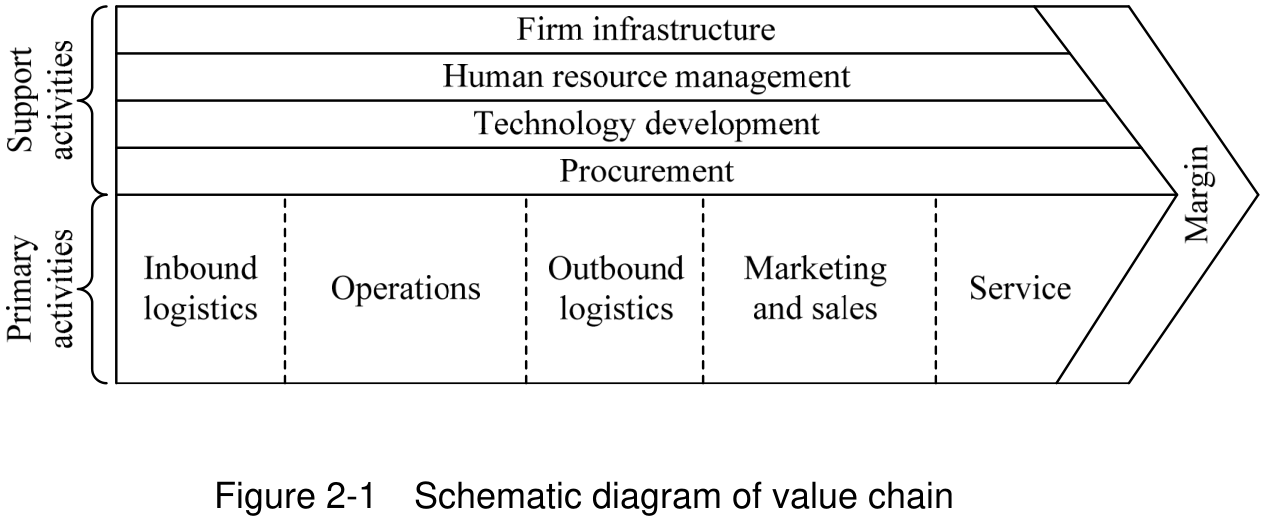
Value chain analysis is an analysis technique that divides corporate activities into primary
p. 151 · PDF 155
activities and support activities, and clarifies that the added value of the products and services provided by the company is generated through which activity. This analysis makes it clear that the points that can compete advantageously in each industry and market are different. This method proves to be effective in detecting the success factors (i.e., KFS (Key Factor for Success)) in the industry. Through the survey, analysis, and evaluation of the value chain, the structure of the industry, highest income business of a company, and the strong points and weak points of a company in the industry and market are clarified, and as a result, the value chain is systematically organized and the competitive strategy is created.
Source visual description
The value chain separates support activities above primary activities. Support activities are firm infrastructure, human resource management, technology development and procurement. Primary activities are inbound logistics, operations, outbound logistics, marketing and sales, and service, with margin at the right.
(3) Growth matrix analysis
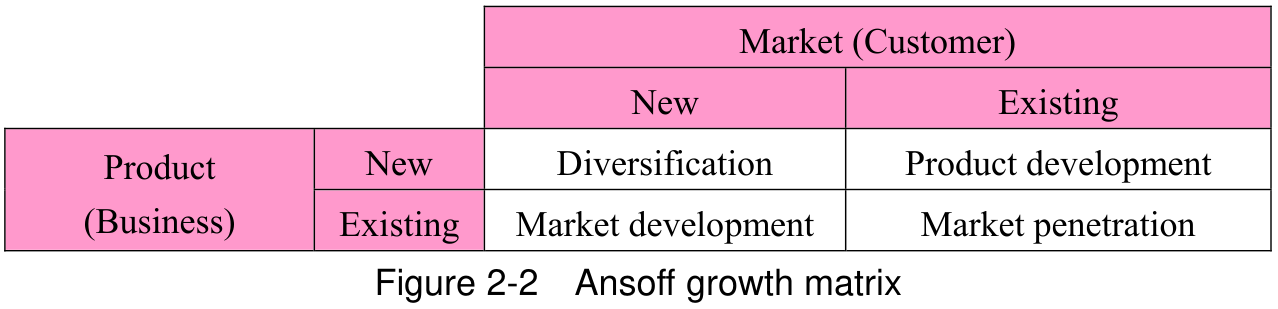
Growth matrix analysis is an analysis technique that uses the Ansoff growth matrix that shows the direction of growth of a company. The growth matrix is a strategy planning model that is used when the enterprise strategy for promoting the growth of the company is examined.
| Market (Customer) | |||
|---|---|---|---|
| New | Existing | ||
| Product (Business) | New | Diversification | Product development |
| Existing | Market development | Market penetration | |
Section progress
Original chapter exercises
Original chapter exercises →New FE Textbook Vol.2 · First Edition, April 2015