Highlighted text? Practice this concept. Highlighted passages and figures open related questions.
Practice related questions (4)Progress & bookmarks
Current section
3-4 Consumer Appliances and Industrial Devices
p. 185
Practice this section 4 linked exam questions with default filters
Progress
Not marked complete
Related questions in this lesson 5
Feedback control3Air-conditioner feedback diagram2Actuator movement from electrical signals1Sensors acquire measured data1p. 185 · PDF 189
3 - 4 Consumer Appliances and Industrial Devices
3-4-1 Embedded System
An embedded system is a small system that is embedded in home electric appliances or industrial products, and controls the device. The typical hardware and software configuring an embedded system are of the following types.
- • Microprocessor (Microcomputer)
This is a small processor (or small computer) that controls the embedded system. Generally, a dedicated embedded OS is used, but sometimes either a general OS may be used, or the hardware may be controlled directly by embedded software without the use of an OS. - • Sensor
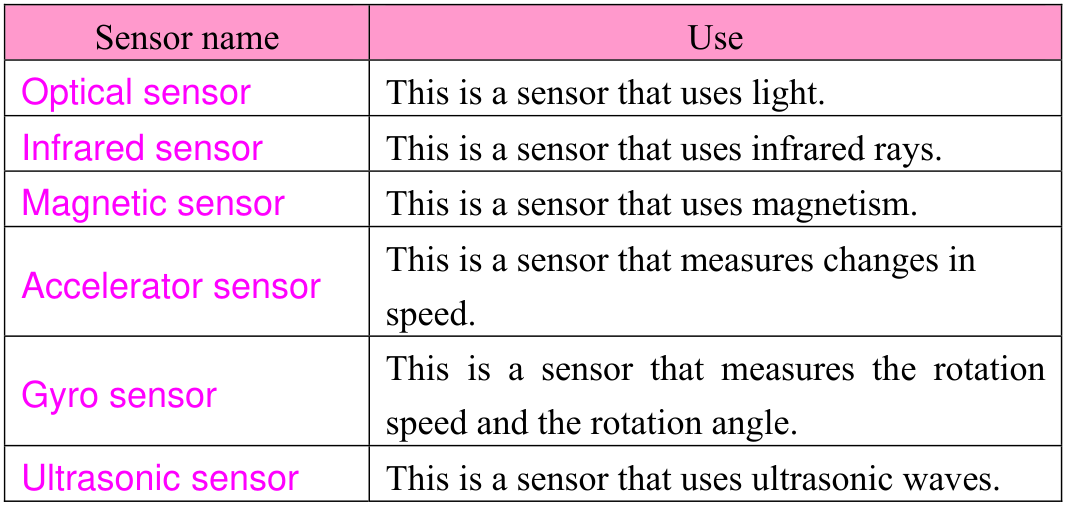
This is a device that analyzes analog waveforms, which are measurement values, and performs A/D conversion which converts them into electrical signals by performing signal processing such as filtering. · 1 question
| Sensor name | Use |
|---|---|
| Optical sensor | This is a sensor that uses light. |
| Infrared sensor | This is a sensor that uses infrared rays. |
| Magnetic sensor | This is a sensor that uses magnetism. |
| Accelerator sensor | This is a sensor that measures changes in speed. |
| Gyro sensor | This is a sensor that measures the rotation speed and the rotation angle. |
| Ultrasonic sensor | This is a sensor that uses ultrasonic waves. |
- • Actuator
This is a device that performs D/A conversion that converts electrical signals into movements. · 1 question - • Firmware
This is embedded software that is recorded in ROM to control the hardware. Although rewriting was not originally a prerequisite for this software, it is currently recorded on flash memory and may be rewritten after shipment. - • System LSI
This is a circuit in which the main electronic circuits of the embedded system are integrated into one chip. - • MEMS (Micro-Electro-Mechanical Systems)
p. 186 · PDF 190
This refers to micro-electro-mechanical elements of a few nanometer (10−9 meter) units, and their manufacturing technology. This is a device in which the sensors, actuators, and electronic circuits are integrated into one infrastructure, and it is also used in printer heads and electronic paper.
- • Seven-segment LED
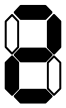
This is a device composed of seven segments. The ON/OFF process of each segment is controlled individually, and it corresponds to one bit. Therefore, numeric characters from 0 to 9 can be represented in seven-bit information.
Source visual description
The source displays an original seven-segment numeral illustration beside the seven-segment LED paragraph. It is retained as source pixels.
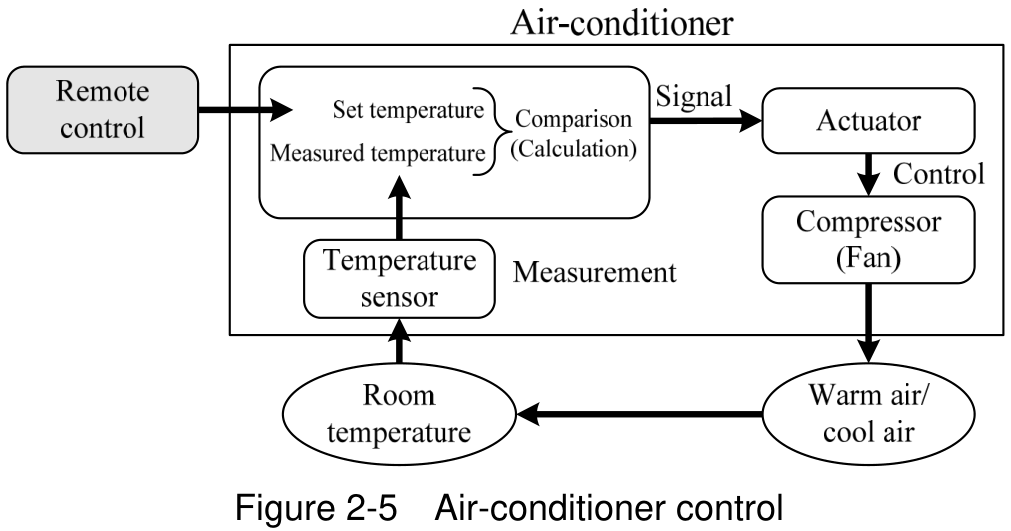
When an event, such as turning ON/OFF of a switch or a reception of an electrical signal from the sensor, occurs in the basic embedded system, the actuator is controlled by performing signal processing. For example, in a household air-conditioner, the signals (e.g., the temperature setting information) sent from the remote control are received by the air-conditioner. If there is a difference between the room temperature that is measured by the temperature sensor and the set temperature, a temperature adjustment signal is sent to the actuator to control the compressor.
Source visual description
The air-conditioner control diagram links remote control and set temperature to comparison/calculation, then actuator and compressor/fan. Room temperature is measured by a temperature sensor and compared with the set temperature. Warm air/cool air closes the original feedback path. Labels and all arrows remain original.
An embedded system requires real-time control that poses strong restrictions to the response time. In a life-related hard real-time system, it is especially essential to use a real-time OS to ensure that the processing is completed within the expected time. Such a control system for an embedded system includes the following types.
p. 187 · PDF 191
This is a method of performing a corrective operation beforehand by predicting and estimating the disturbances.
- • Sequence control
This is a method of gradually proceeding with control according to the predetermined procedure. - • Multivariable control
This is a method of determining several information items to be controlled in an integrated manner, and then controlling each item. - • Fuzzy control
This is a control method for an ambiguous status, such as “a somewhat large number,” “slightly.” - • PWM (Pulse Width Modulation) control
This is a method of performing control by changing the pulse according to the input signal in a fixed cycle.
A method by which the result (i.e., output) is reflected in the next control process, such as in feedback control, is called closed loop control. A method by which the result is not reflected in the control process, such as in feed-forward control and sequence control, is called open loop control. Whether these controls are being performed properly can be verified by testing the response characteristics and the control stability through a diagnostic program.
Section progress
Original chapter exercises
Original chapter exercises →New FE Textbook Vol.2 · First Edition, April 2015