Highlighted text? Practice this concept. Highlighted passages and figures open related questions.
Practice related questions (5)Progress & bookmarks
Current section
1-2-2 Marketing Strategy
p. 156
Practice this section 5 linked exam questions with default filters
Progress
Not marked complete
Related questions in this lesson 5
Franchising1Product life cycle growth stage1Cost plus price setting methods1Original product life cycle maturity stage2p. 156 · PDF 160
1-2-2 Marketing Strategy
Marketing strategy is a strategy that is created on the basis of Positioning of STP analysis. This subsection describes the strategy that is in line with the seller’s perspectives (4P) in the marketing mix.
(1) Product strategy
Product strategy is a strategy related to products, such as the functions, quality, design, brand, product line, services, and guarantee. Brand strategy is also one of the product strategies.
p. 157 · PDF 161
In the product strategy, the market growth rate and market share of the product are analyzed on the basis of the product portfolio, and the main policies are decided depending on the stage of the product life cycle in which the product is at the moment.
- • PLC (Product Life Cycle)
This is the cycle from the time of introduction of a product into the market until its withdrawal, which is classified into four stages.
1) Introduction stage: This is the stage when a product has entered the market only a short while ago and profits cannot be expected.
4) Decline stage: This is the stage when the product deteriorates functionally and the profits start declining
(2) Price strategy
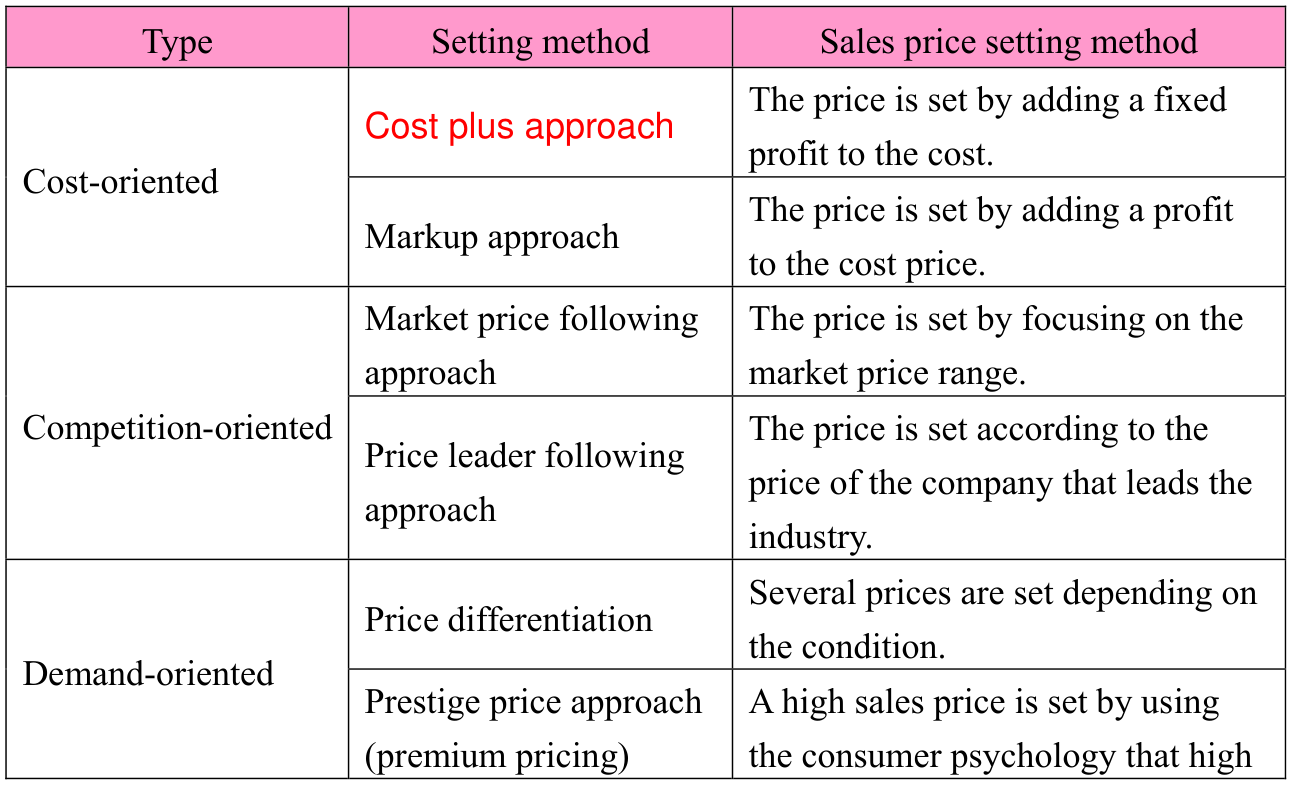
Price strategy is a strategy that is related to price, such as the retail price, wholesale price, standard price, discounted price, trading conditions, payment due date, margin transaction conditions, and allowance (e.g., support money for advertising objective). In the price strategy, the sales price of products is decided according to the following price setting methods.
| Type | Setting method | Sales price setting method |
|---|---|---|
| Cost-oriented | Cost plus approach | The price is set by adding a fixed profit to the cost. |
| Markup approach | The price is set by adding a profit to the cost price. | |
| Competition-oriented | Market price following approach | The price is set by focusing on the market price range. |
| Price leader following approach | The price is set according to the price of the company that leads the industry. | |
| Demand-oriented | Price differentiation | Several prices are set depending on the condition. |
| Prestige price approach (premium pricing) | A high sales price is set by using the consumer psychology that high |
p. 158 · PDF 162
| quality equals a high price. |

At this time, the price setting that satisfies both the consumer needs and the desired profit of the company between a high pricing policy (i.e., fast recovery of cost) and a low pricing policy (i.e., penetration in the market) is called value pricing. Moreover, since the sales price is closely related to product satisfaction (i.e., cost performance/cost effectiveness), matching it with the customer needs through discount amount and payment terms is also examined. Stable purchasing power regardless of the price implies a low price elasticity.
(3) Distribution strategy
(4) Promotion strategy (advertising strategy)
Promotion strategy (i.e., advertising strategy) is a strategy related to sales activities, such as advertising, PR activities, sales promotion, direct mail, and over-the-counter sales. Promotion strategy is an advertising strategy and sales promotion activity for informing the consumer about the characteristics of the product and increasing intention to buy. Moreover, publicity (e.g., reporting on products and services) in various types of media is also an important element. With regard to advertising, it becomes important to create an organizational and management structure to ensure that infringement of the below-mentioned rights does not happen.
- • Portrait right
This is the right to a portrait. This is considered a part of privacy. When a person’s
p. 159 · PDF 163
portrait and name are published without permission, it is regarded as an infringement of personal rights.
- • Publicity right
This is the right to monopolize the use of a portrait or name. For example, the use of the photograph and name of an entertainer, whose appearance is like a product, is restricted, and photography and recording in concerts are generally prohibited. The civil law is applicable to the case of infringement of publicity rights that may correspond to personal rights and property rights.
(5) Marketing concept
The marketing concept is a concept that marketing is positioned as a core function of corporate activities because acquisition and retention of customers is the main focus of corporate activities. This is also referred to as the concept of complying with the customers’ needs by offering a favorable environment surrounding the products rather than considering the production of good products as the core activity. Therefore, the marketing strategy includes not only the product strategy, but also the price strategy, distribution strategy, and promotion strategy.
Section progress
Original chapter exercises
Original chapter exercises →New FE Textbook Vol.2 · First Edition, April 2015