Highlighted text? Practice this concept. Highlighted passages and figures open related questions.
Practice related questions (3)Progress & bookmarks
Current section
1-1-2 Corporate Strategy
p. 145
Practice this section 3 linked exam questions with default filters
Progress
Not marked complete
Related questions in this lesson 6
Core competence3OEM production tie-up1PPM Star matrix1PPM Star investment1Specialization through a niche strategy1p. 145 · PDF 149
1-1-2 Corporate Strategy
Corporate strategy is a strategy that is created to show the management direction of the whole company according to the corporate philosophy (i.e., management philosophy). In corporate strategy, the number one objective in most cases is to establish corporate superiority by strengthening the position of a company in the market. The position of a company in the market is determined through competitive positioning analysis, and a strategy suitable to the current position is created.
- • Competitive positioning analysis
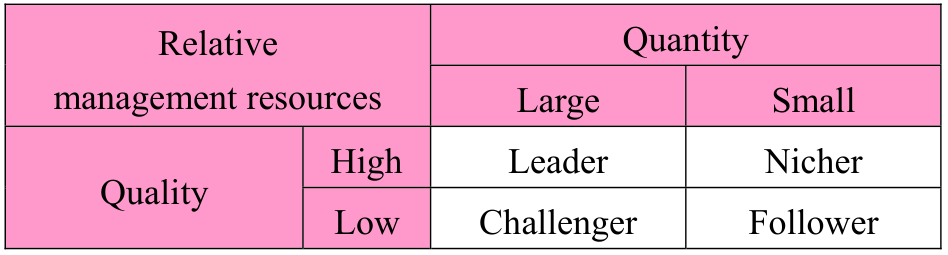
This is a technique of analyzing the position in the market through the quality and quantity of management resources to be invested. The position of a company is analyzed by creating a matrix in which the “quantity” that represents the capacity of management resources is plotted on the horizontal axis, and the “quality” that represents the uniqueness of management resources is plotted on the vertical axis.
| Relative management resources | Quantity | ||
|---|---|---|---|
| Large | Small | ||
| Quality | High | Leader | Nicher |
| Low | Challenger | Follower | |
- • Leader
Leader holds the top share of the industry with management resources that have excellent quantity and quality. The leader employs an omnidirectional strategy of
p. 146 · PDF 150
covering the entire market and securing the maximum share.
- • Challenger
Challenger holds the second- to fourth -largest share of the industry that is qualitatively inferior to the leader although the management resources are quantitatively excellent. The challenger aims at the leader and employs a differentiation strategy including the share pursuing that is necessary to attack a leader. - • Nicher
Since the management resources are qualitatively excellent, the nicher dominates a specific market (or product) but is quantitatively inferior to the leader. The nicher employs the specialization strategy that aims at specialization of products and market. There is also a concept of niche strategy, where business is developed by aiming at the gaps in the market that does not satisfy the needs of the customer from the beginning and by focusing on the nicher of a specific business. · 1 question - • Follower
Since the management resources have an inferior quantity and quality, the follower trails behind the leader. The follower employs the imitation strategy of quickly responding to the market opportunity by bringing down the price through cost reduction while it imitates the products of the leader.
- • Weak alliance (strict alliance)
This is an alliance without capital involvement and refers to tie-ups between companies, including business tie-ups and technological tie-ups. As globalization of business progresses, the development of new business models and technologies is achieved through tie-ups that extend beyond competitive relationships and industries - • Strong alliance
This is an alliance with capital involvement. It operates as an enterprise group by
p. 147 · PDF 151
incorporating other companies. The creation of a business strategy for such an enterprise group and managing it as one enterprise is called group management.
- • M&A (Mergers and Acquisitions)
This is the strongest alliance by which other companies are absorbed and governed through merger and acquisition of companies, or stock purchase and business transfer using TOB (Take-Over Bid or Tender Offer Bid), which involves declaration of the buying price and period and purchase of stocks from several unidentified stockholders. Sometimes, measures such as MBO (Management Buy-Out) may be taken for an unfriendly M&A that is performed without the consent of the company to be merged or acquired. - • Vertical integration / Horizontal integration
This is a company integration performed between companies of the same industry. While vertical integration extends from the process of manufacturing to sales, horizontal integration refers to integration that incorporates competitors performing the same process. In the case of horizontal integration, as far as the production quantity and cost of industrial products are concerned, if the production quantity increases, the total cost per unit decreases. This results in the scale economy alliance that the profit margin rises because of an increase in the production quantity. The relationship between the production quantity and cost at this time is represented by an experience curve.
While it is not strictly a company integration, outsourcing which outsources the specific business of a company to an external company, is also seen as a type of alliance from the viewpoint of cooperation with an external company.
[Forms of outsourcing]
- • Fabless manufacturing
This is a form that no manufacturing plant is set up in own company, and rather only the planning of products is performed. Manufacturing is outsourced to other company. Manufacturing and supply by the outsourced company on the basis of the trademark and brand of the partner is called OEM (Original Equipment Manufacturing). · 1 question - • Offshore outsourcing (Offshoring)
This is a form that business is outsourced to an overseas company where the price of commodities and labor cost are cheap. While a reduction in cost can be expected, one disadvantage is that long-distance control is difficult to perform.
In addition, the business strategies (i.e., corporate strategies) that are used to construct a new
p. 148 · PDF 152
relationship between companies include the following.
- • Shared service
This is a form that a company is set up to perform the business operations common to several companies in a specialized and independent manner. The company provides business services to each company. For example, a specialized company is set up and delivers products in collaboration with a company from a different industry, as a part of logistics. This is a comprehensive activity for optimizing commodity distribution. - • Incubator
This is a system or organization that supports entrepreneurs, such as venture businesses with new products and services as the main constituent. By supporting entrepreneurs, profits are acquired and new company relationships are established.
In corporate strategy, the business areas (i.e., business domains) and products in which to compete are also examined. Therefore, the type of business results that a business or product yields are compiled in a portfolio chart (e.g., business portfolio, product portfolio), and the respective business or product is analyzed.
- • PPM (Product Portfolio Management)
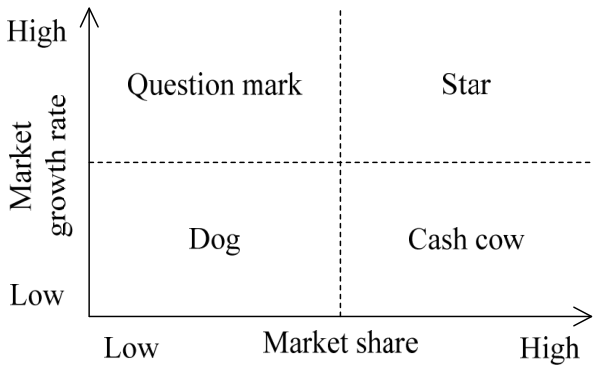
This is a technique of analyzing the characteristics of a business and a product from the relationship between the market growth rate and the market share. The characteristics are analyzed on the basis of a PPM matrix in which the market growth rate is plotted on the vertical axis. The market share is plotted on the horizontal axis, and the whole area is divided into four regions.
Source visual description
The original matrix has market growth rate increasing upward and market share increasing to the right. Question mark is upper left, Star upper right, Dog lower left and Cash cow lower right as actually printed; the original axis direction and labels are preserved.
- • Question mark
This is a region in which investments are deficient with respect to the market growth. Refraining from making additional investments or withdrawing from the market is considered. - • Dog
p. 149 · PDF 153
This is a region where basically withdrawal must be performed because there is no future.
- • Cash cow
This is a region where cash flow (i.e., flow of funds/cash) is generated even without any additional investment. The funds acquired here are invested in “Question mark” and “Star.” - • Star
This is a region where investments must be continued depending on the market growth. · 1 question
Section progress
Original chapter exercises
Original chapter exercises →New FE Textbook Vol.2 · First Edition, April 2015