Highlighted text? Practice this concept. Highlighted passages and figures open related questions.
Practice related questions (8)Progress & bookmarks
Current section
1-4 Business Management System
p. 163
Practice this section 8 linked exam questions with default filters
Progress
Not marked complete
Related questions in this lesson 9
Customer relationship management2Artificial intelligence: learning and inference3Supply chain information and total optimization1Original manufacturing supply chain2ERP and company-wide resources1Learning pattern recognition2Knowledge management and sharing1Company knowledge as a problem-solving resource1p. 163 · PDF 167
1 - 4 Business Management System
Business management system is an integrated system for achieving optimization and high efficiency of business. This is composed of a system that targets the entire company, a system that targets a specific business or department, a system that supports decision-making of the management and such other system.
(1) ERP (Enterprise Resource Planning)
ERP (Enterprise Resource Planning) is a concept for achieving higher efficiency of business through integrated management of corporate activities from the viewpoint of
effective utilization and optimal distribution of management resources.
(2) SCM (Supply Chain Management)
p. 164 · PDF 168
shortening the time for delivery, reducing dead stock).
Source visual description
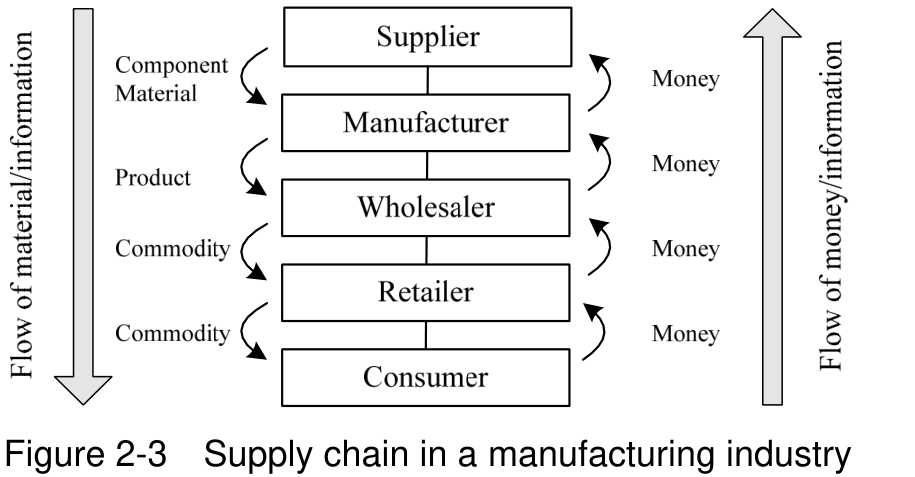
The manufacturing supply chain runs vertically through supplier, manufacturer, wholesaler, retailer and consumer. Downward product/material labels and the left flow-of-goods/information arrow contrast with upward money labels and the right flow-of-money/information arrow.
[SCM-related terminology]
- • CRP (Continuous Replenishment Program)
This is a method by which the suppliers replenish only the required amount at the required time. By supplying products according to the sales quantity, shortage of products can be prevented. - • TOC (Theory Of Constraints)
This is a concept that it is necessary to perform intensive management or improvement of the process that acts as a bottleneck in the overall schedule of the manufacturing process, because the bottleneck process is a constraint.
(3) CRM (Customer Relationship Management)
(4) KM (Knowledge Management)
p. 165 · PDF 169
- • AI (Artificial Intelligence)
This is a collective term for the techniques and studies performed to make a computer work in the same manner as a human brain. AI uses learning (i.e., acquiring knowledge from the collected information) based on the learning theory and inference (i.e., deriving new knowledge from several knowledge bases). Moreover, knowledge engineering, which involves technological handling of information accumulated in the knowledge database, is also an application example of artificial intelligence. · 3 questions - • Expert system
This is a system that uses the expert knowledge accumulated in the knowledge database, and it takes the decisions that are necessary for problem-solving in the inference engine. Logic programming that describes the “facts” and “rules” in a program is suitable for the development of an expert system. - • Neural network
This is a model that simulates the movement and characteristics of human brain cells (i.e., neurons) on a computer. It is capable of learning pattern recognition such as an output for an input. · 2 questions - • Fuzzy computer
This is a computer that uses the fuzzy theory, which is one of the research areas of artificial intelligence. The fuzzy theory is a theory used on a general computer that represents ambiguity (or fuzziness) by using an intermediate value (e.g., 0.6) with respect to a binary theory, such as true/false or 0/1.
(5) SFA (Sales Force Automation)
SFA (Sales Force Automation) is a support activity that aims at improving the efficiency and quality of sales activities by using IT, and thereby increasing the sales and profit. There are many cases where the sales staff has a large number of tasks outside the company, which makes it difficult to manage the schedule and sales activities. Thus, a system that supports sales activities by making use of a mobile PC and cellphone becomes necessary. In the SFA system, there are mostly the following five functions of the support activity that improve the productivity of sales activities.
p. 166 · PDF 170
- • SPM (Sales Process Management) function
This is a function that aims at an improvement in efficiency by standardizing the sales processes of business talks, proposals, and acceptance of orders. - • TM (Time Management) function
This is a function that performs schedule management and time management. - • CRM (Customer Relationship Management) function
This is a function that manages the sales progress status and the relationship with customers by sharing the customer information and case-related information. It is also called the contact management function. - • KM (Knowledge Management) function
This is a function that accumulates and manages the sales-related knowledge, such as case examples of proposals, information about business talks, and product information. - • Other support functions
These are functions that support various tasks associated with sales activities, such as creation of different types of documents on sales activities including sales reports, and adjustment of transport fees.
(6) DSS (Decision Support System)
DSS (Decision Support System) is a system for supporting the decision-making of corporate management. It is composed of the OLAP (On-Line Analytical Processing) system, which performs analysis of data accumulated in a huge database (i.e., data warehouse) for information analysis, an expert system, and so on.
(7) EIP (Enterprise Information Portal)
EIP (Enterprise Information Portal) is a system that integrates the information of various systems (i.e., business management systems) and databases that exist in the company, and enables its consolidated display and search on the computer screens of employees (i.e., users). It incorporates the functions of a portal site, such as a search engine, into the business system, and is quickly in widespread use.
Section progress
Original chapter exercises
Original chapter exercises →New FE Textbook Vol.2 · First Edition, April 2015