Contents
Chapter 4 · DatabasePractice

LEARN WITH HARU

Video Lesson တွေက Haru အတန်းသားတွေအတွက်ပါ

Haru ရဲ့ ITPEC FE Full Course မှာ ယခု သင်ခန်းစာတွေကို တစ်ခုချင်း တစ်ကြောင်းချင်း အသေးစိတ်ရှင််ရှင်းပြထားပါတယ်

အခြေခံ မရှိတဲ့ ကျောင်းသားများစွာဟာလည်း ဒီ Course နဲ့ ပဲ အောင်မြင်ကုန်ကြပါပြီ

အတန်းမအပ်သေးပဲ Haru ဆီမှာ အစမ်းသင်ကြည့်ချင်ပါသလား?

သင်တန်းသားတွေရဲ့ စကားသံများ

သင်တန်းသားတွေရဲ့ စကားသံများ

Highlighted text? Practice this concept. Highlighted passages and figures open related questions.

Practice related questions (4)Progress & bookmarks

Current section

1-2-3 Conceptual Design of Databases

p. 251

Practice this section 4 linked exam questions with default filters

Progress

Not marked complete

Related questions in this lesson 5

E-R arrowhead multiplicity3Original one-to-many E-R example1Conceptual database design and E-R models2
Progress and bookmarks

p. 251

1-2-3 Conceptual Design of Databases
Conceptual design of databases is the process of creating conceptual data models. For that, it is necessary to conduct data analysis at the beginning. The data analysis identifies the data that is required for the targeted operations where database is implemented, and then the meaning and relation of this data are analyzed and summarized. In addition, data items are standardized by using rules such as naming convention in order to eliminate data duplication. Metadata such as names, meanings, or attributes of data items are recorded in the data dictionary for users in DD/D (Data Dictionary/Directory) to ensure that synonyms/homonyms do not occur. The conceptual data model is created on the basis of the results of data analysis. For the conceptual data model, it is common to use E-R model (i.e., E-R diagram) that represents the target content with two concepts of entity and relationship. · 2 questions

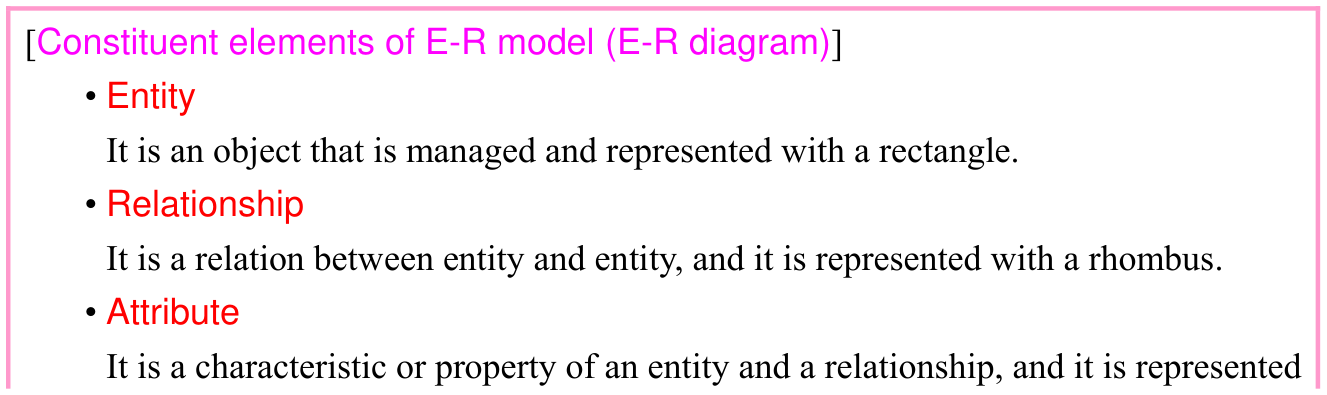
Original textbook table, example or syntax box, with its complete original layout. Source text: [Constituent elements of E-R model (E-R diagram)] • Entity It is an object that is managed and represented with a rectangle. • Relationship It is a relation between entity and entity, and it is represented with a rhombus. • Attribute It is a characteristic or property of an entity and a relationship, and it is represented
p. 251 · Enlarge

p. 252

Original textbook table, example or syntax box, with its complete original layout. Source text: with an ellipse.
p. 252 · Enlarge

In E-R model, it is possible to represent cardinality (i.e., multiplicity) of the relationship. There are three types of cardinality: “one-to-one”, “one-to-many”, and “many-to-many”. For example, Figure 4-4 in the E-R model shows a “many-to-many” relation where one instructor delivers a lecture to multiple students, and one student attends lectures of many instructors.
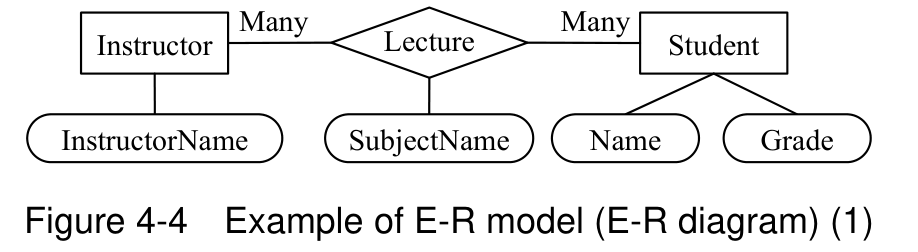

Many-to-many E-R diagram: Instructor and Student rectangles connect through Lecture, a relationship diamond. InstructorName belongs to Instructor; SubjectName to Lecture; Name and Grade to Student. Both Many labels and all attribute ellipses remain. Source text: Many Many Instructor Lecture Student InstructorName SubjectName Name Grade Figure 4-4 Example of E-R model (E-R diagram) (1)
p. 252 · Enlarge

When cardinality in E-R model is represented, “Many” is also represented as “*”, “M”, or “N”. Another notation method is to directly connect two entities with a line as shown in Figure 4-5. In this case, an arrow on the line means “Many.” Figure 4-5 shows that multiple types of products are purchased from a wholesaler, and products are always purchased from the same wholesaler. · 3 questions

Original Wholesaler-to-Product E-R diagram with its right-pointing arrow and complete caption. The surrounding original prose explains the arrow as Many. Source text: Wholesaler Product Figure 4-5 Example of E-R model (E-R diagram) (2)
p. 252 · Enlarge
Original one-to-many E-R example · 1 practice questions

Original chapter exercises

Original chapter exercises →

New FE Textbook Vol.1 · IT Fundamentals · First Edition, April 2015
