Highlighted text? Practice this concept. Highlighted passages and figures open related questions.
Practice related questions (1)Progress & bookmarks
Current section
3-2-2 Service Programs
p. 224
Practice this section 1 linked exam question with default filters
Progress
Not marked complete
Related questions in this lesson 2
DLL runtime linking2p. 224
3-2-2 Service Programs
An object program created by a language processor cannot be executed as is. In order to execute an object program, various service programs (i.e., utility programs) are required. There are also service programs that play an auxiliary role in program creation and execution but have no direct relationship with program execution. This subsection explains typical service programs.
(1) Linker (linkage editor)
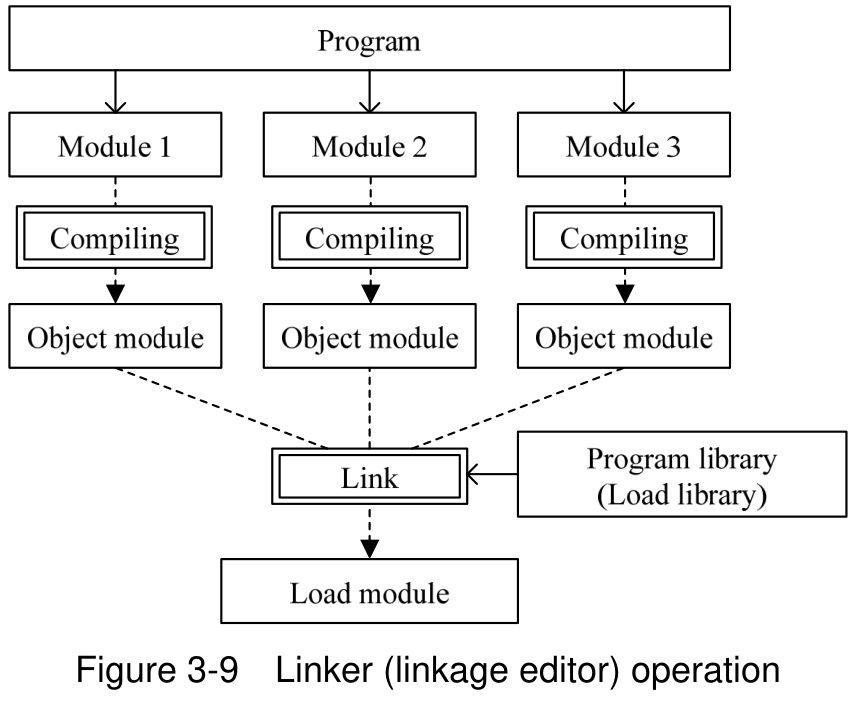
p. 225
(2) Loader
A loader is a program that stores load modules in main memory and executes them. There is also a program called a linking loader which makes an object module into an executable load module and stores it in main memory.
(3) Editor
An editor is software that performs an auxiliary role concerning program input, modification, and other programming activities. Generally, this refers to a text editor that is used for character input, but there are also other editors such as graphical editors that are used for inserting diagrams or images and structure editors that increase the input efficiency according to the structure of a specific programming language.
(4) Emulator
An emulator is a microprogram that creates a pseudo environment including a different OS and other programs, and executes the programs of another type of machine.

(5) Simulator
A simulator is a program or system that performs simulation concerning the complex phenomena of natural science and such other fields. In the case of a language processor, it is sometimes used as a program development tool to simulate the behavior of a program.
(6) Sort/merge programs
A sort program is a program that performs sort processing on data. A merge program is a program that performs merge processing to combine multiple sorted data into one. Since there is a close relationship between sorting and merging, they are often provided as a common service program (i.e., sort/merge program).
Section progress
Original chapter exercises
Original chapter exercises →New FE Textbook Vol.1 · IT Fundamentals · First Edition, April 2015