Practice related questions (5)Progress & bookmarks
Current section
3 Programming Languages and Language Processors
p. 211
Practice this section 5 linked exam questions with default filters
Progress
Not marked complete
p. 211
3 Programming Languages and Language Processors
A programming language is a language for creating a program that instructs a computer to do work. A language processor translates a program that is written in a programming language into another language that a computer can understand.
3 - 1 Classification of Programming Languages
In a computer, all information is recorded digitally. In other words, a computer is only able to understand the states 0 and 1. For this reason, in the early stages, machine languages were used to give instructions to a computer for work with combinations of the values 0 and 1. However, it is very difficult for humans to write programs in a machine language (using 0 and
- 1) and mistakes are prone to occurring. Hence, programming languages were invented to
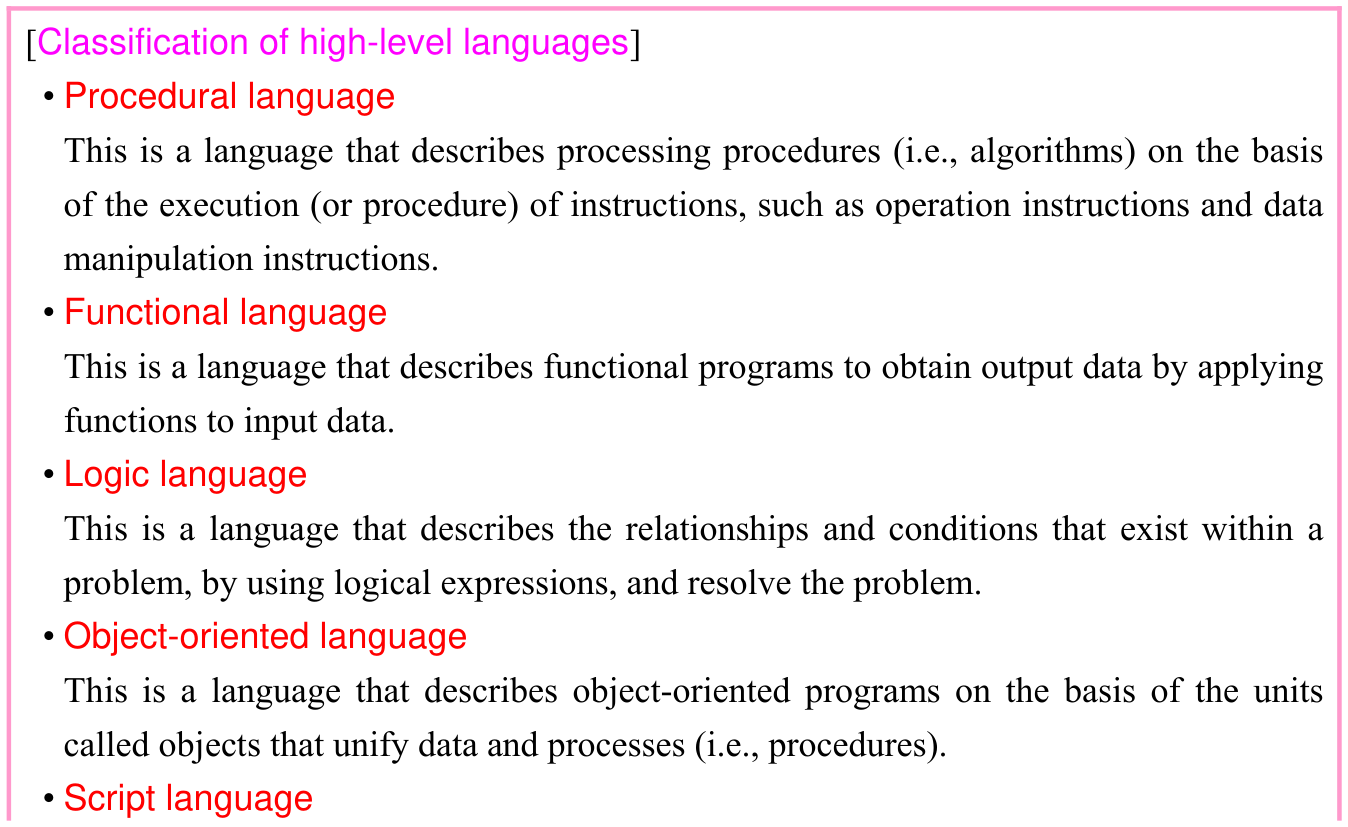
make symbols correspond to combinations of 0s an 1s. These are called assembly languages or symbolic languages. However, assembly languages still create symbols from combinations of 0s and 1s. Therefore, in order to create a program with assembly languages, it is necessary to have a detailed understanding of the mechanisms of the computer (i.e., hardware). In order to solve this, programming languages that enabled human thought processes to be written in a notation that is easy for humans to understand were developed. These were classified as high-level languages, and the machines languages and assembly languages that were used until this point were classified as low-level languages to distinguish them.
p. 212

The programming languages that are generally used at the present day are explained below.
Section progress
Original chapter exercises
Original chapter exercises →New FE Textbook Vol.1 · IT Fundamentals · First Edition, April 2015