Highlighted text? Practice this concept. Highlighted passages and figures open related questions.
Practice related questions (3)Progress & bookmarks
Current section
1-2 Classification by Software License
p. 192
Progress
Not marked complete
Related questions in this lesson 3
Shareware trial and paid continuation1OSD free redistribution2OSD nondiscrimination1p. 192
1 - 2 Classification by Software License
A software license is a document that describes the items that must be obeyed when the software is used (e.g., permission/prohibition/conditions for usage, modification, redistribution). Generally, it is included in the usage licensing agreement that is made between the right holder of the software and the user.
Software that is classified from this perspective includes those described below.
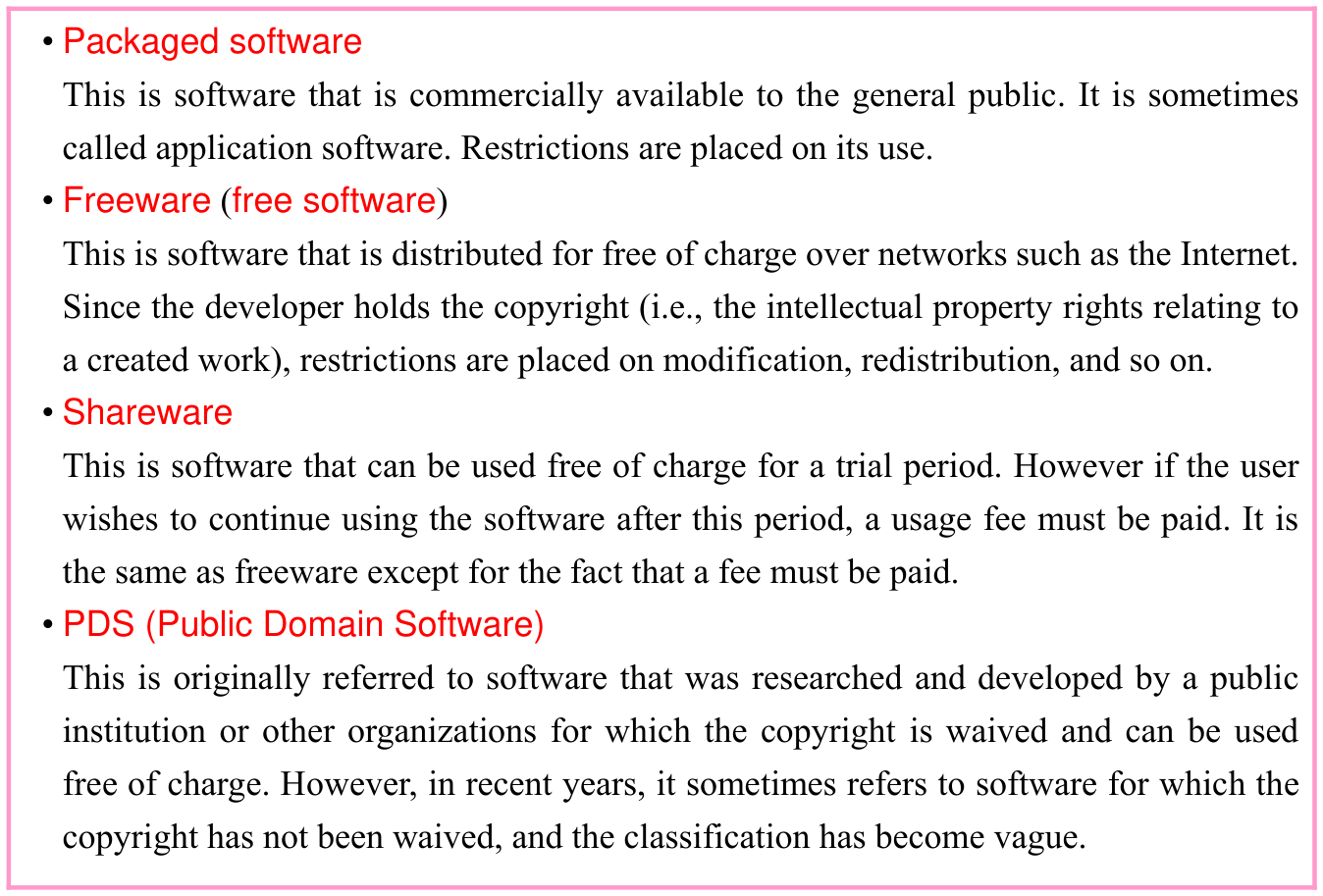
Furthermore, there exists a classification called OSS (Open Source Software (OSS) which is based on the OSD (The Open Source Definition) that was released by a nonprofit organization OSI (Open Source Initiative). A typical example of OSS is Linux whose kernel (Linux kernel), the core of the OS, has been published and distributed.

p. 193
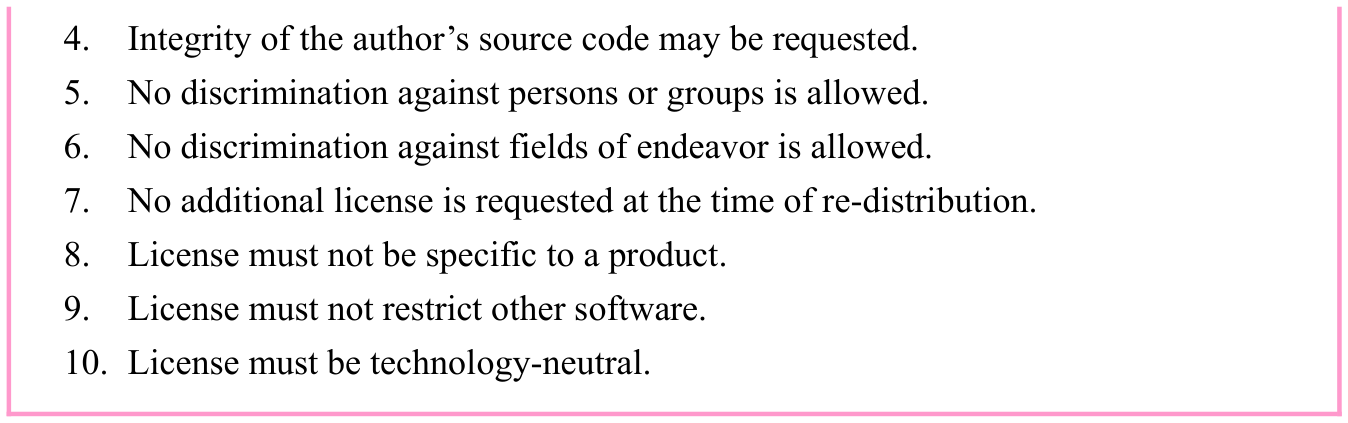
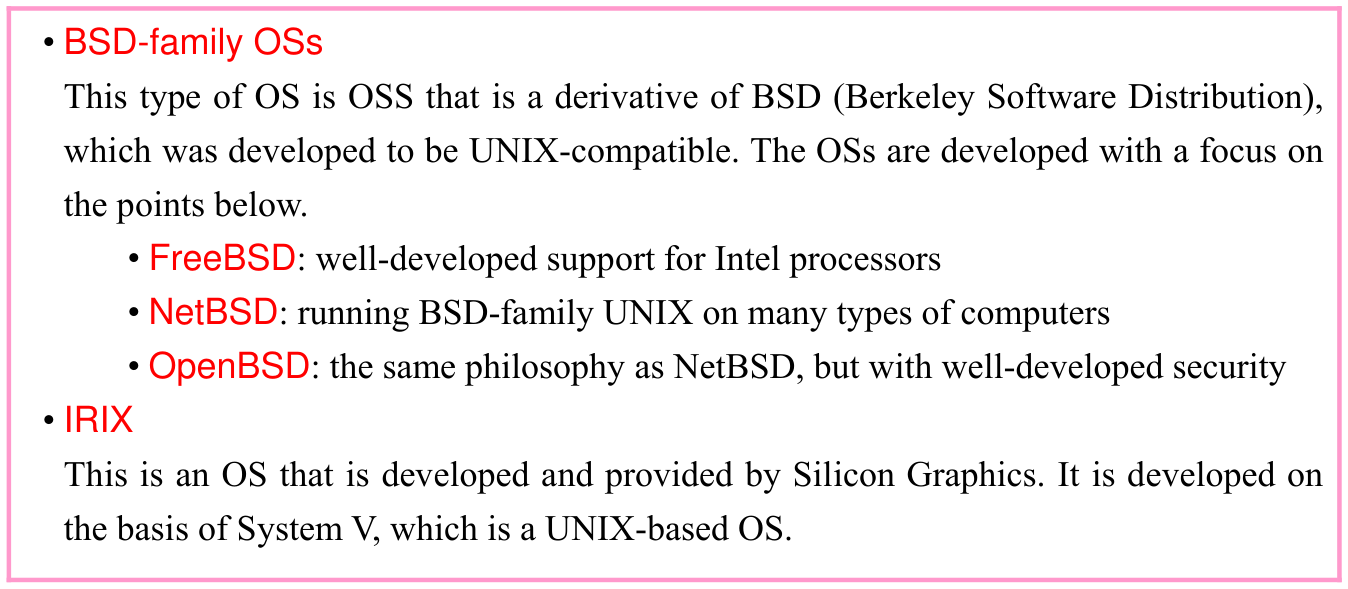
Other than Linux, the below are examples of OSS in UNIX-based OSs. The Open Group is a group that is aiming for the standardization of UNIX, and mainly promotes UNIX-based OSs to be released as open source software.
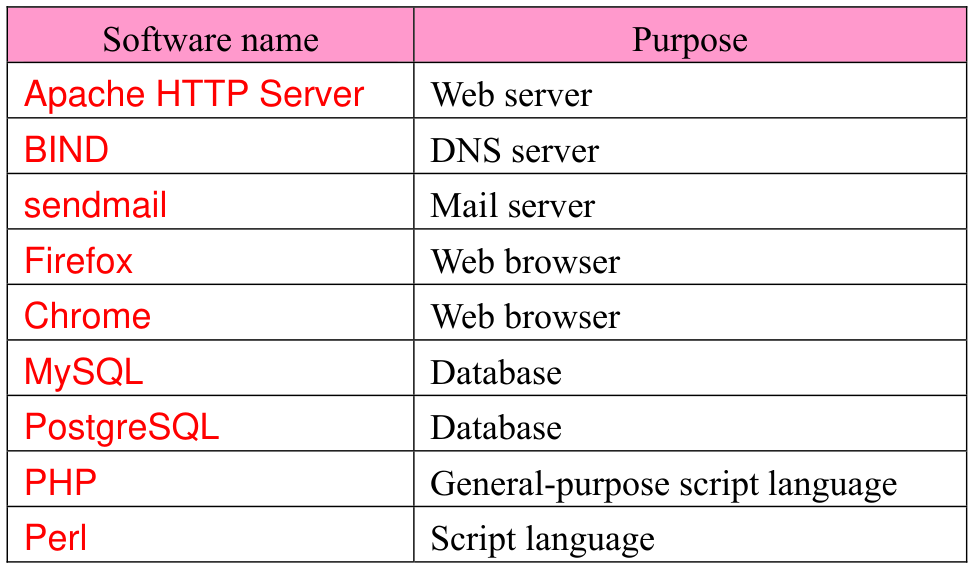
Typical OSSs other than UNIX-based OSs include the following. Furthermore, open source libraries that compile OSS components as a package include, the Perl library CPAN, the PHP library PEAR, and the JavaScript library jQuery.
p. 194

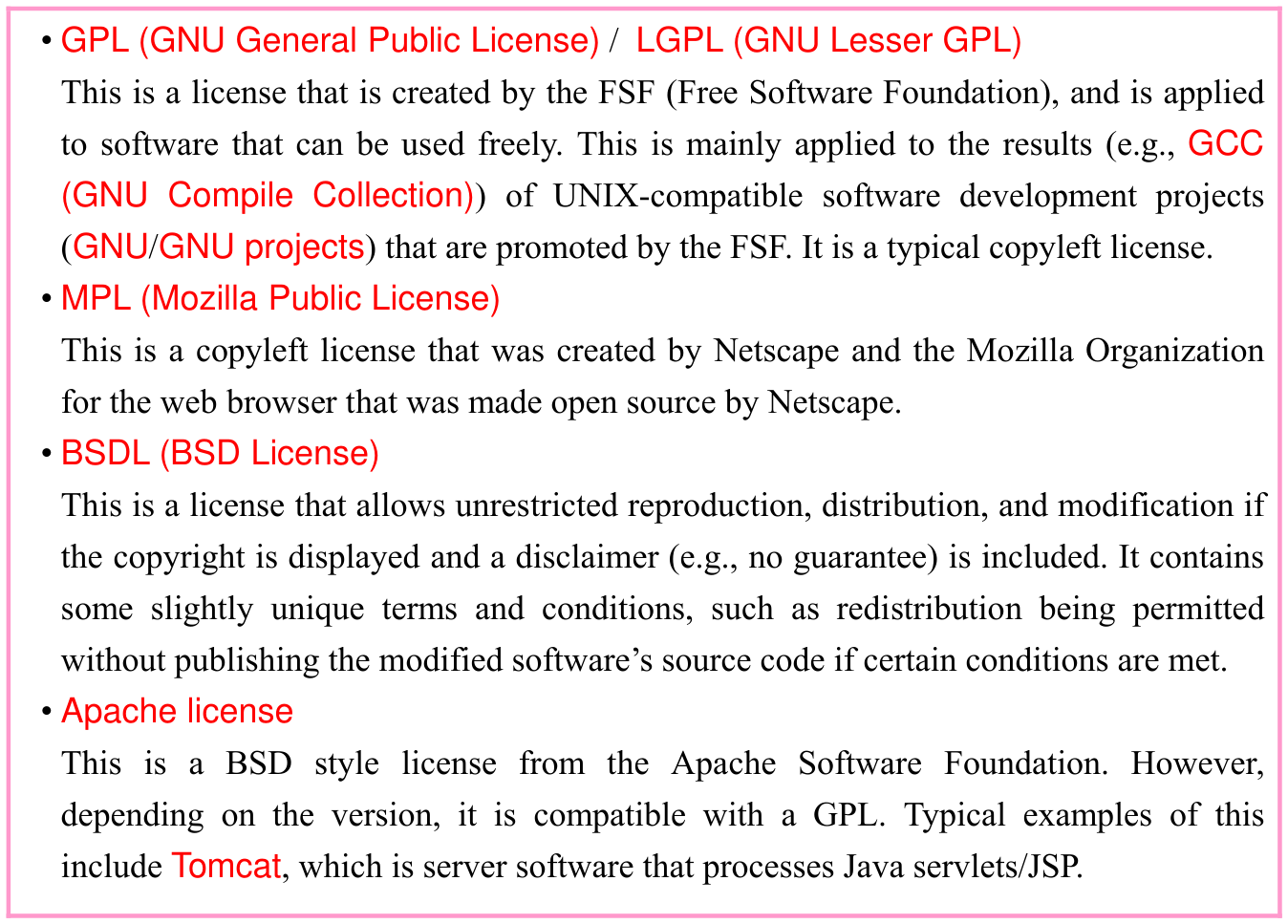
The typical OSS licenses regarding the use of OSS are described below. For OSS licenses, in many cases, a principle called copyleft is adopted where reproduction, redistribution, modification, and such other activities are not restricted, and in return, the same license must be applied to derivative works. Therefore, a dual license in which this is combined with another license that places restrictions on reproduction, redistribution, modification, and such other activities, is sometimes used for distribution (or sale) of a derivative work.
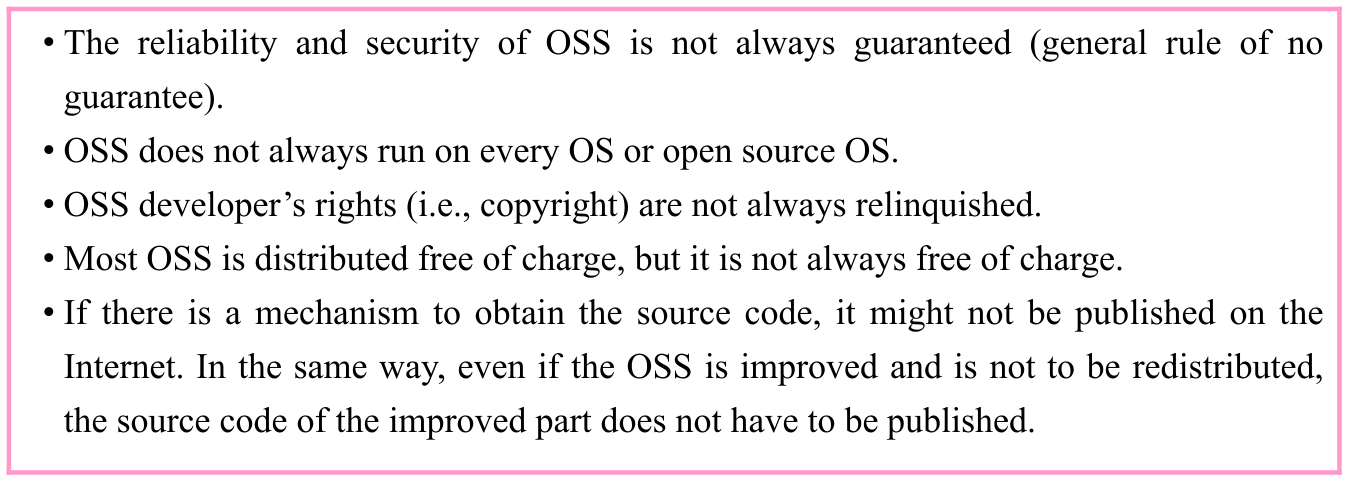
In order to use OSS, as well as the scope of the licenses above, it is necessary to pay attention to the points below.
p. 195
Research and development of OSS is being advanced through many open source communities (i.e., groups that aim for OSS development, improvement, and information exchange) by volunteers (e.g., engineers, users) around the world across the network. The number of companies that are proactively adopting OSS is increasing, so it is a field in which development is expected to continue.
Section progress
Original chapter exercises
Original chapter exercises →New FE Textbook Vol.1 · IT Fundamentals · First Edition, April 2015