Contents
Chapter 3 · SoftwarePractice

LEARN WITH HARU

Video Lesson တွေက Haru အတန်းသားတွေအတွက်ပါ

Haru ရဲ့ ITPEC FE Full Course မှာ ယခု သင်ခန်းစာတွေကို တစ်ခုချင်း တစ်ကြောင်းချင်း အသေးစိတ်ရှင််ရှင်းပြထားပါတယ်

အခြေခံ မရှိတဲ့ ကျောင်းသားများစွာဟာလည်း ဒီ Course နဲ့ ပဲ အောင်မြင်ကုန်ကြပါပြီ

အတန်းမအပ်သေးပဲ Haru ဆီမှာ အစမ်းသင်ကြည့်ချင်ပါသလား?

သင်တန်းသားတွေရဲ့ စကားသံများ

သင်တန်းသားတွေရဲ့ စကားသံများ

Highlighted text? Practice this concept. Highlighted passages and figures open related questions.

Practice related questions (1)Progress & bookmarks

Current section

3-1-5 Markup Language

p. 215

Practice this section 1 linked exam question with default filters

Progress

Not marked complete

Related questions in this lesson 2

SGML document structure1XML user-defined structure1
Progress and bookmarks

p. 215

3-1-5 Markup Language

Markup languages are a type of programming language for printing and screen display. Text (i.e. a character string) is enclosed in marks that are called tags, and attribute information is attached. Structural elements of a document (e.g., texts, paragraphs, titles, tables and diagrams) and their relationships can be easily defined.

(1) SGML (Standard Generalized Markup Language) This is a general purpose markup language that was standardized by ISO. It enables description of the logical structure, semantic structure, and attributes of a document. So, document management and data conversion can be performed easily. In SGML, the structure of a document is defined with a DTD (Document Type Definition). · 1 question

(2) HTML (HyperText Markup Language) This is a hypertext description language that extends SGML to enable it to handle not just text but also graphics, images, movies, and so on. Hypertext interconnects content with other content (i.e., web page) through a link comprising character information. HTML encloses text with a start tag and an end tag to specify character size and color, image files to be included, web pages to be linked, and so on. Although the specifications are standardized, companies that create web browsers add their own extended specifications. Therefore, some tags can only be used in browsers created by a specific manufacturer. Furthermore, CSS (Cascading Style Sheets) can be used to define only the layout of a web page that is completely separated from HTML.

p. 216
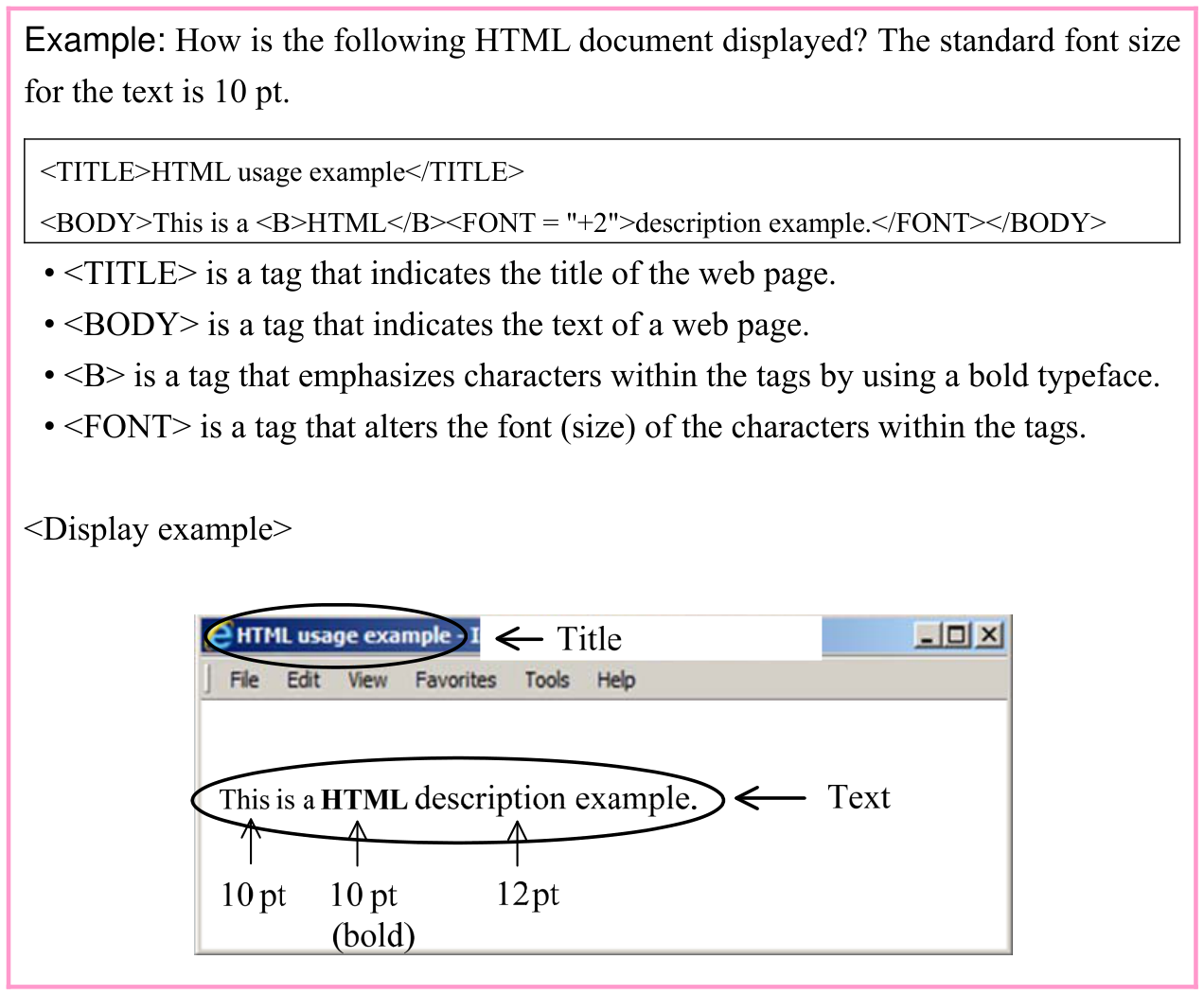
Complete original HTML worked example: TITLE sets HTML usage example; BODY contains This is a HTML description example. B makes HTML bold; FONT size +2 enlarges description example. The original browser screenshot labels title and text and marks 10 pt, 10 pt bold and 12 pt. This description preserves the original obsolete code and displayed example. Source text: Example: How is the following HTML document displayed? The standard font size for the text is 10 pt. <TITLE>HTML usage example</TITLE> <BODY>This is a <B>HTML</B><FONT = "+2">description example.</FONT></BODY> • <TITLE> is a tag that indicates the title of the web page. • <BODY> is a tag that indicates the text of a web page. • <B> is a tag that emphasizes characters within the tags by using a bold typeface. • <FONT> is a tag that alters the font (size) of the characters within the tags. <Display example>
p. 216 · Enlarge

(3) DHTML (Dynamic HTML) This is an extended HTML specification. By incorporating a script written in JavaScript or VBScript into an HTML page, it enables the dynamic creation of a web page according to user operations, and the checking of user input data.

(4) XML (Extensible Markup Language) This is a derivative of SGML and HTML, and is a hypertext description language that enables bidirectional linking. It is highly suitable for the Internet environment and is often used for corporate transactions via a network. By using a DTD (Document Type Definition), users can define their own tags. Currently, a dedicated XML schema language called XML Schema is often used instead of DTD. In HTML, the end tag can be omitted in some cases, but in XML there must be a start tag and an end tag even for a null element. XSL (Extensible Stylesheet Language) can be used for style sheets in XML. · 1 question

Original textbook callout or table. Source text: [Technologies related to XML] • XML parser This is software for the use of the structural elements of an XML document from an application. It allows use of APIs such as DOM (Document Object Model)
p. 216 · Enlarge

p. 217

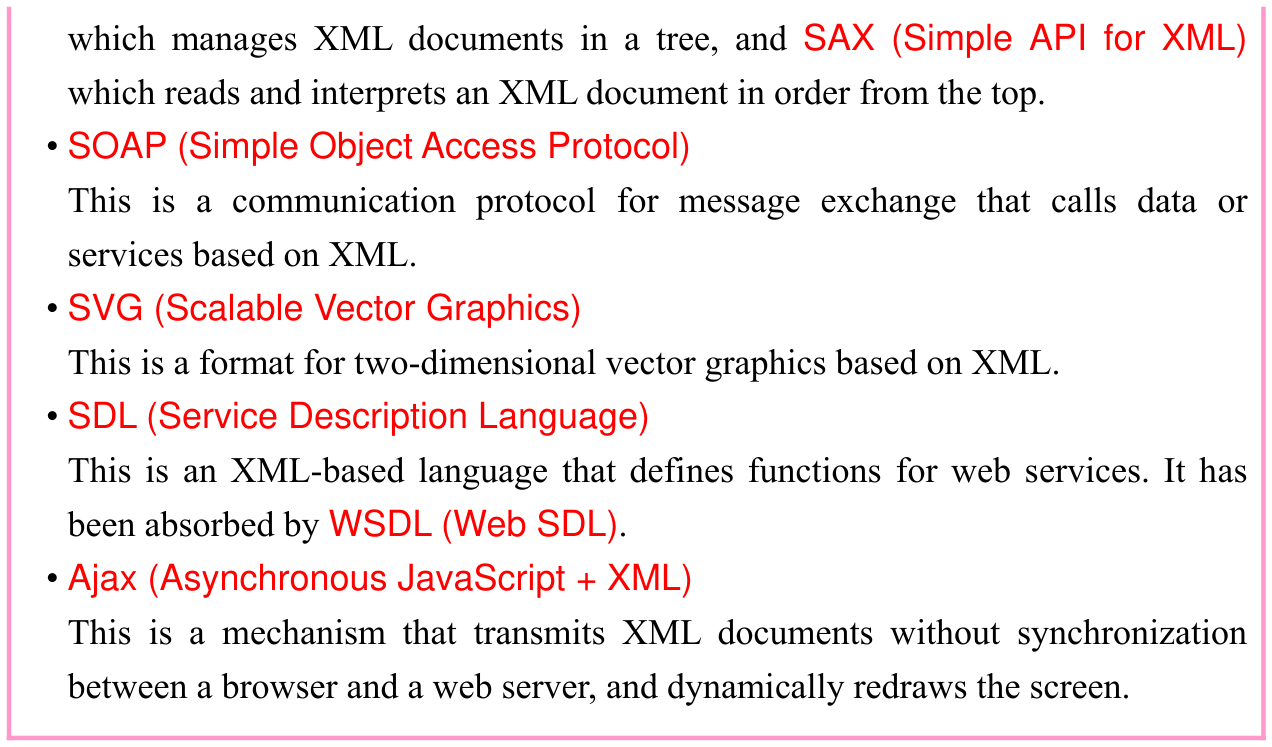
Original textbook callout or table. Source text: which manages XML documents in a tree, and SAX (Simple API for XML) which reads and interprets an XML document in order from the top. • SOAP (Simple Object Access Protocol) This is a communication protocol for message exchange that calls data or services based on XML. • SVG (Scalable Vector Graphics) This is a format for two-dimensional vector graphics based on XML. • SDL (Service Description Language) This is an XML-based language that defines functions for web services. It has been absorbed by WSDL (Web SDL). • Ajax (Asynchronous JavaScript + XML) This is a mechanism that transmits XML documents without synchronization between a browser and a web server, and dynamically redraws the screen.
p. 217 · Enlarge

(5) XHTML (EXtensible HyperText Markup Language) This is a markup language that has redefined HTML, which extends SGML, by using XML. The specifications are stricter than HTML; for example, “it is not possible to leave out a tag.” XHTML Basic is intended for use on cell phones and personal digital assistants and is a subset of combined modules defined on the basis of the specifications of the modularization of XHTML.

Original chapter exercises

Original chapter exercises →

New FE Textbook Vol.1 · IT Fundamentals · First Edition, April 2015