Highlighted text? Practice this concept. Highlighted passages and figures open related questions.
Practice related questions (16)Progress & bookmarks
Current section
2-2 Management Functions of OS
p. 197
Practice this section 16 linked exam questions with default filters
Progress
Not marked complete
Related questions in this lesson 3
Spooling and throughput2First-come first-served scheduling1p. 197
2 - 2 Management Functions of OS
Among the various functions that are provided by an OS, job management, task management, and memory management are sometimes called the three main functions of an OS. On the basis of these three main functions, this section explains the various management functions of an OS.
2-2-1 Job Management
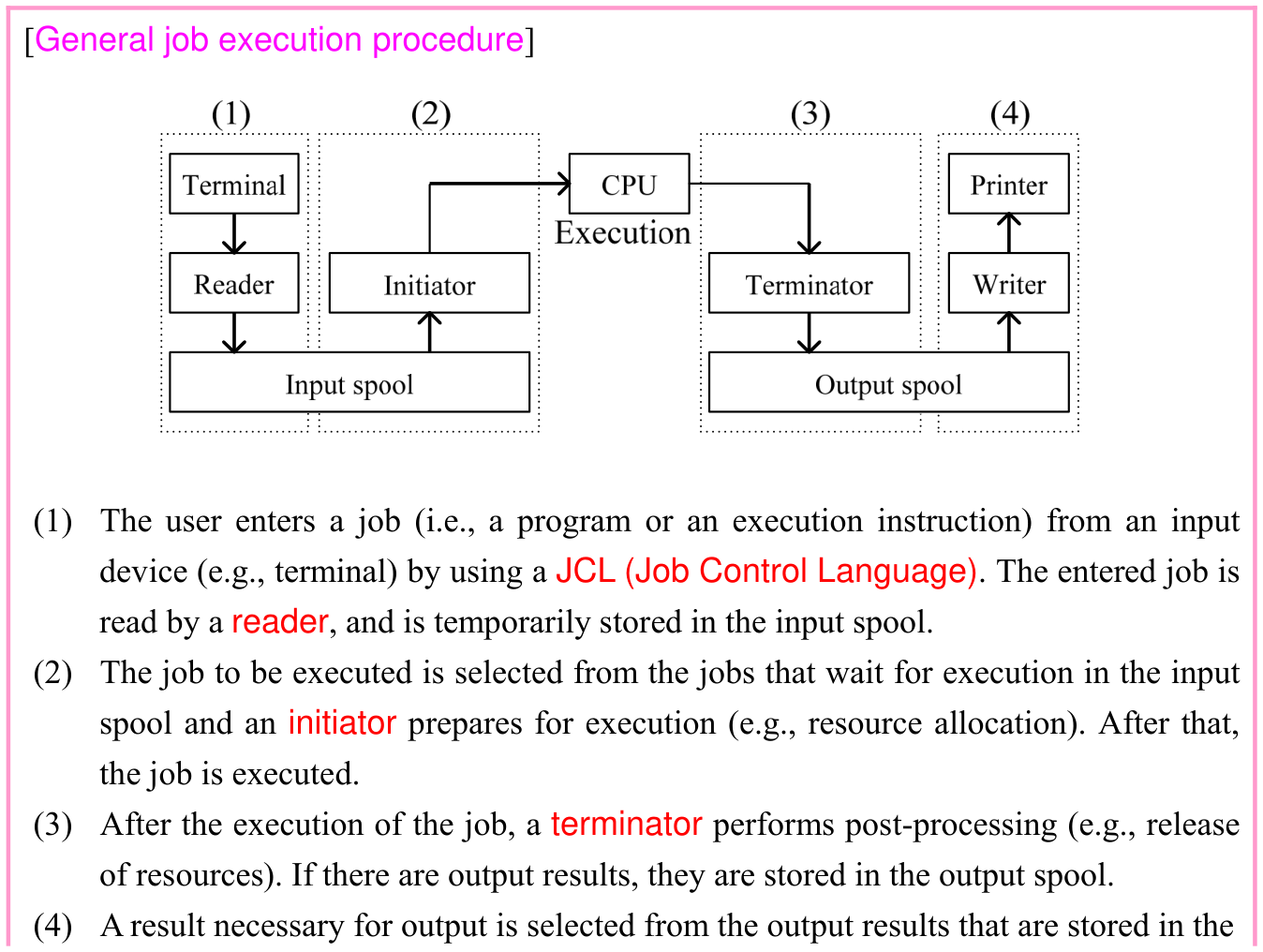
Job management is a function that manages the execution of jobs, which are the unit of activity from the perspective of a user. Generally, a job is defined as a set of job steps. A job step is a single unit of a divided work. Job management allocates resources to each job (i.e., job step), and it performs things such as consecutive execution of jobs. The general flow (i.e., procedure) for executing jobs with job management is shown below.
p. 198

Job management uses functions (1) to (3) below in order to implement this procedure for job execution.
(1) Spooling
(2) Job scheduler
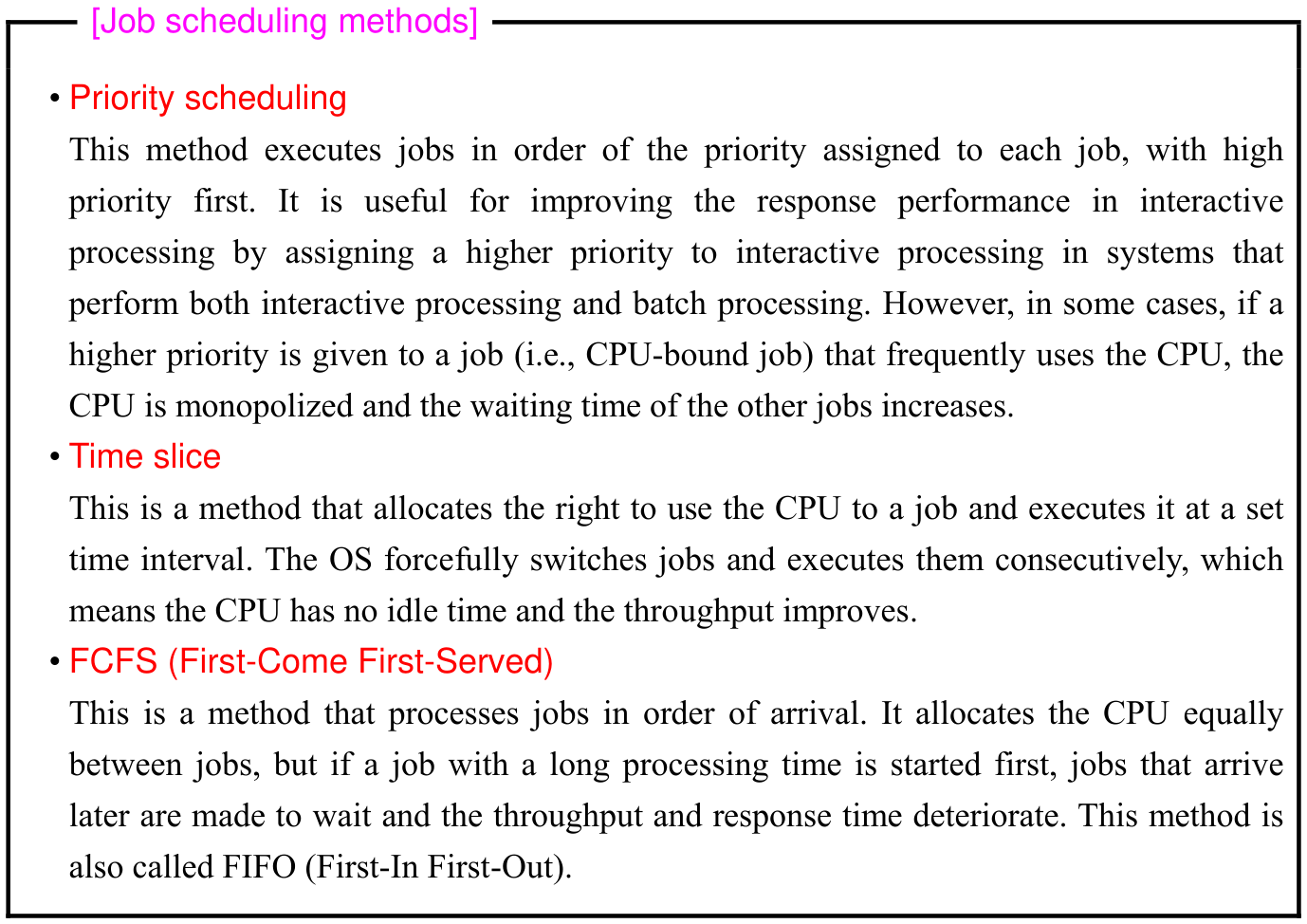
A job scheduler is a program that automatically executes jobs. It manages the control flow for jobs and also performs job scheduling, which selects a job to be executed from waiting jobs.
p. 199
(3) Master scheduler
A master scheduler is a program that mainly manages the interface between the user and the computer. It transmits directions (e.g., JCL) relating to job execution and various types of messages between the user and the computer.
Section progress
Original chapter exercises
Original chapter exercises →New FE Textbook Vol.1 · IT Fundamentals · First Edition, April 2015
![General job execution: terminal to reader to input spool; initiator to CPU execution to terminator to output spool; writer to printer. Numbered steps and their original explanation continue on the next page. Source text: [General job execution procedure] (1) The user enters a job (i.e., a program or an execution instruction) from an input device (e.g., terminal) by using a JCL (Job Control Language). The entered job is read by a reader, and is temporarily stored in the input spool. (2) The job to be executed is selected from the jobs that wait for execution in the input spool and an initiator prepares for execution (e.g., resource allocation). After that, the job is executed. (3) After the execution of the job, a terminator performs post-processing (e.g., release of resources). If there are output results, they are stored in the output spool. (4) A result necessary for output is selected from the output results that are stored in the](/private-assets/fe-v1/ch03/job-management/original-box-207-2-03b825c9b608.webp)

![Original textbook callout or table. Source text: [Job scheduling methods] • Priority scheduling This method executes jobs in order of the priority assigned to each job, with high priority first. It is useful for improving the response performance in interactive processing by assigning a higher priority to interactive processing in systems that perform both interactive processing and batch processing. However, in some cases, if a higher priority is given to a job (i.e., CPU-bound job) that frequently uses the CPU, the CPU is monopolized and the waiting time of the other jobs increases. • Time slice This is a method that allocates the right to use the CPU to a job and executes it at a set time interval. The OS forcefully switches jobs and executes them consecutively, which means the CPU has no idle time and the throughput improves. • FCFS (First-Come First-Served) This is a method that processes jobs in order of arrival. It allocates the CPU equally between jobs, but if a job with a long processing time is started first, jobs that arrive later are made to wait and the throughput and response time deteriorate. This method is also called FIFO (First-In First-Out).](/private-assets/fe-v1/ch03/job-management/original-box-208-1-42ea8f4ed0cd.webp)