Highlighted text? Practice this concept. Highlighted passages and figures open related questions.
Practice related questions (4)Progress & bookmarks
Current section
1-2 Business Process and Solution Business
p. 208
Practice this section 4 linked exam questions with default filters
Progress
Not marked complete
Related questions in this lesson 5
Business-improvement scoring model1Business process outsourcing1Business process reengineering3p. 208 · PDF 212
1 - 2 Business Process and Solution Business
A business process is the flow of each business operation in a company. Prior to the creation of an information systems strategy, the business operations environment and business processes are investigated and analyzed, and the existing organizational structure and business processes are reviewed. In addition, the optimization of business operations and system is considered along with the effective use of a system. At the same time, consideration is given to the use of a solution business, which provides a mechanism for problem resolution.
1-2-1 Business Process Improvement
Business process improvement refers to the improvement in efficiency of a business process. Among business process improvements, the analysis of current business operations and the identification and resolution of problems are referred to as business improvement.
p. 209 · PDF 213
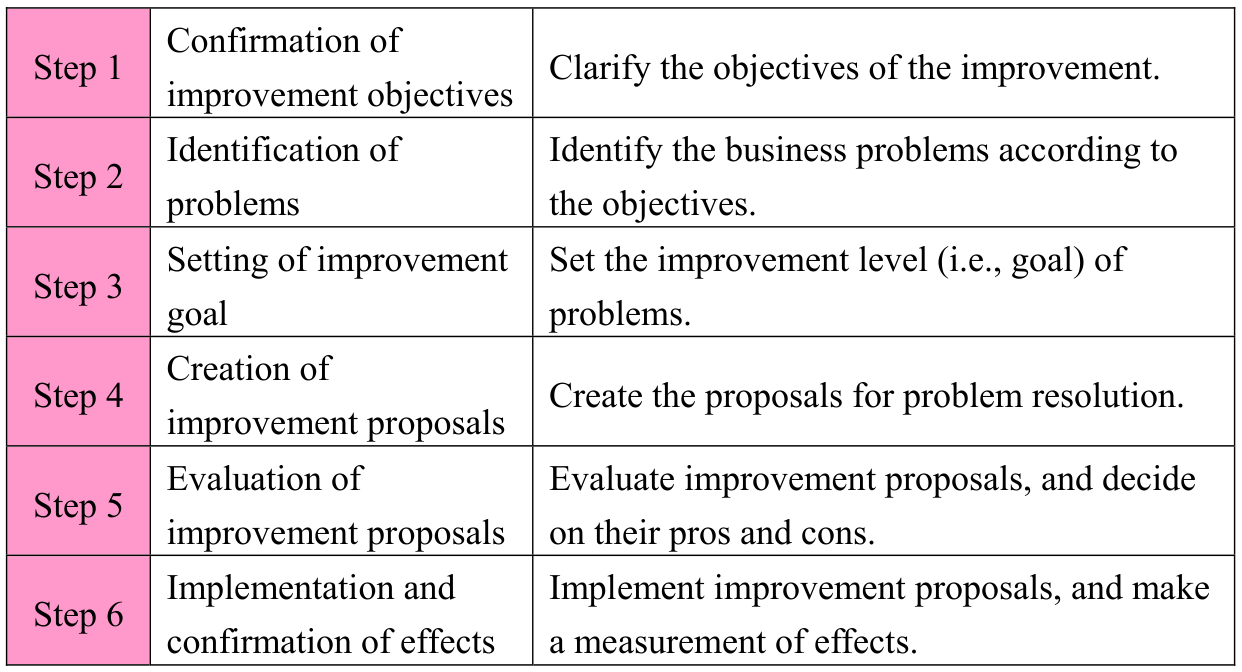
[General procedure of business improvement]
| Step 1 | Confirmation of improvement objectives | Clarify the objectives of the improvement. |
|---|---|---|
| Step 2 | Identification of problems | Identify the business problems according to the objectives. |
| Step 3 | Setting of improvement goal | Set the improvement level (i.e., goal) of problems. |
| Step 4 | Creation of improvement proposals | Create the proposals for problem resolution. |
| Step 5 | Evaluation of improvement proposals | Evaluate improvement proposals, and decide on their pros and cons. |
| Step 6 | Implementation and confirmation of effects | Implement improvement proposals, and make a measurement of effects. |
p. 210 · PDF 214
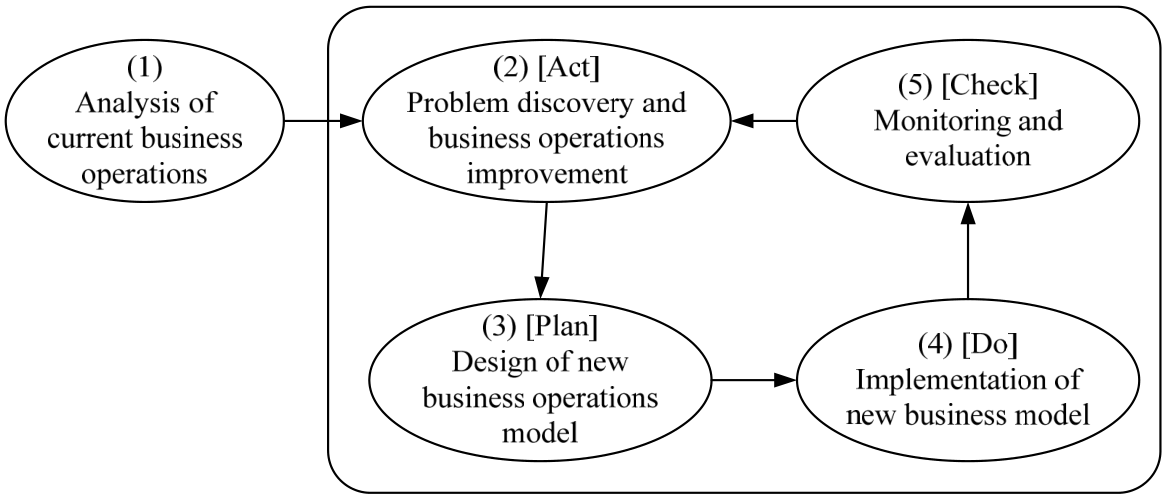
[PDCA cycle of BPM]
Source visual description
The original PDCA cycle of BPM connects (1) Analysis of current business operations to (2) [Act] Problem discovery and business operations improvement, (3) [Plan] Design of new business operations model, (4) [Do] Implementation of new business model, and (5) [Check] Monitoring and evaluation. The cycle returns from monitoring and evaluation to problem discovery and improvement.
(1) Analysis of current business operations The current business operations are analyzed (analysis of business operations) and modeled.
(2) Problem discovery and business operations improvement [Act] The modeled current business operations are reviewed and improved (business improvement).
(3) Design of new business operations model [Plan] On the basis of the improved business operations, a new business operations model is designed (business operations design).
(4) Implementation of new business operations model [Do] The new business operations model is implemented.
(5) Monitoring and evaluation [Check] The new business operations model is monitored and evaluated. (If there are any problems, improvement is carried out again from (2).)
The platform for implementing BPM is called a BPMS (Business Process Management System). A BPMS optimizes business processes by performing the design, implementation, and management of business processes.
In addition, the methods below for improvement of business processes also exist.
p. 211 · PDF 215
vendor. Because of the recent expansion in the use of IT, the number of companies that outsource business processes, such as corporate accounting processes and Internet sales, along with information systems is also increasing. Offshore outsourcing is also used to subcontract business processes to overseas companies where the cost of living and labor costs are low.
- • Workflow system
This is a system that automates routine processes. It includes systems that follow a determined procedure to transmit digital application forms and notifications, and approve them. Recently, products that enhance sales support efficiency have been launched by combining an SFA system (i.e., sales support system) and a workflow system.
Section progress
Original chapter exercises
Original chapter exercises →New FE Textbook Vol.2 · First Edition, April 2015