Highlighted text? Practice this concept. Highlighted passages and figures open related questions.
Practice related questions (1)Progress & bookmarks
Current section
1-1-2 Computerization Investment Planning
p. 203
Progress
Not marked complete
Related questions in this lesson 1
Return on investment1p. 203 · PDF 207
1-1-2 Computerization Investment Planning
A computerization investment plan (or IT investment plan) is a plan that is created according to the computerization investment policy that is defined in the total optimization policy and specifies how investment (i.e., budget) is made in order to construct an information system for the overall organization. The “System Management Standards” contains the following six points that are related to computerization investments.
(1) Ensure that the IT investment plan is created in consideration of consistency with corporate strategies.
(2) Compare multiple IT investment plan alternatives on the basis of impact, effects, schedule and feasibility.
(3) Execute IT investment budgets properly.
(4) Establish the standard methodology for estimating the return on IT investments.
(5) Assess financial performance of the overall information system and individual projects, and take necessary actions to solve any problems.
(6) Review whether IT investments have been properly executed or not.
In (4), the quantitative calculation methods below are applied to calculate the investment effect.
- • ROI (Return On Investment)
This is an index that measures the profit that is created from invested capital. Return on investment = profit ÷ invested amount · 1 question - • PBP (PayBack Period)
This evaluates the investment effect by calculating the number of years in which an invested amount can be recovered through the yearly increase in cash inflow without taking into consideration the value of time. - • NPV (Net Present Value)
This calculates, for the entire period from acquisition to disposal, the increase or decrease in cash inflow on the basis of an investment for each year with a discounted present value.
p. 204 · PDF 208
- • IRR (Internal Rate of Return)
This calculates the rate of discount (i.e., internal income ratio) for which the total present value of the annual cash income that is generated by an investment becomes equal to the total present value for the cash expense that is required for this investment, and evaluates the investment effect by using the magnitude of the internal income ratio.
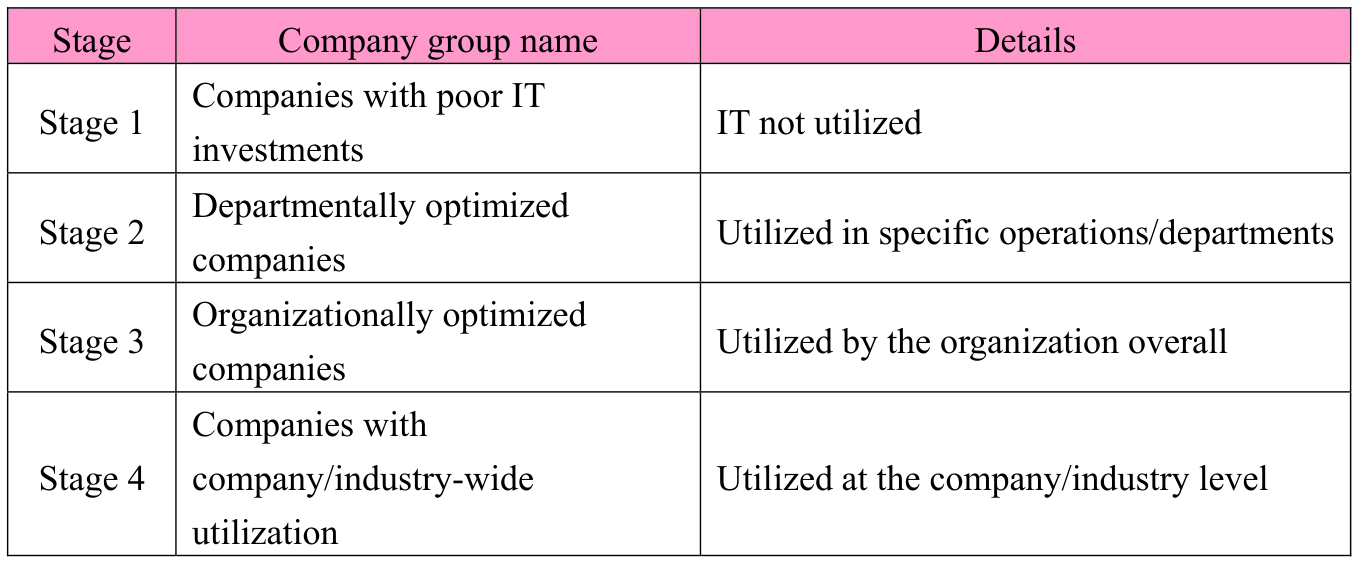
After the IT investment plan is created, IT investment management in which management and evaluation are performed is implemented to ensure that effective investment activities are continuously implemented. There is also the IT management power index that was created by METI (Ministry of Economy, Trade and Industry) and is an index that indicates whether the level of a company’s IT usage has increased as a result of IT investment. The IT management power index measures the level of IT utilization in four stages.
| Stage | Company group name | Details |
|---|---|---|
| Stage 1 | Companies with poor IT investments | IT not utilized |
| Stage 2 | Departmentally optimized companies | Utilized in specific operations/departments |
| Stage 3 | Organizationally optimized companies | Utilized by the organization overall |
| Stage 4 | Companies with company/industry-wide utilization | Utilized at the company/industry level |
Section progress
Original chapter exercises
Original chapter exercises →New FE Textbook Vol.2 · First Edition, April 2015