Highlighted text? Practice this concept. Highlighted passages and figures open related questions.
Practice related questions (6)Progress & bookmarks
Current section
2-3 Procurement
p. 222
Practice this section 6 linked exam questions with default filters
Progress
Not marked complete
Related questions in this lesson 6
Procurement procedure4Procurement alternatives2p. 222 · PDF 226
2 - 3 Procurement
Procurement refers to the acquisition of the required system resources (e.g., funds, human resources, hardware resources, software resources, network resources) in the implementation (or development) of an information system. Only for the procurement of systems, software products, or software services, the acquisition process of Common Frame 2013 is also applied.
[Purpose of acquisition process (excerpt from Common Frame 2013)] The purpose of the acquisition process is to obtain the products and/or services that satisfy the needs stated by the acquirer.
[Acquisition (excerpt from “System Management Standards”)]
(1) Define acquisition requirements from the development plan and user needs. Obtain approval of the responsible personnel from the user department, the system development department, the system operations department, and the maintenance department.
(2) Select hardware, software, and networking products on the basis of the procurement requirements.
(3) Prepare necessary staff members, budgets, facilities and, periods for completing system development.
(4) Clarify the skills required for staff members.
(5) Procure hardware, software, and networking products in accordance with procurement rules.
(6) Manage acquired resources in accordance with acquisition rules.
p. 223 · PDF 227
| Construction method | User (customer) | Provider (supplier) |
|---|---|---|
| Internal development | Executive level, user department, etc. | Internal systems department |
| Outsourced development | User company | IT vendor (e.g., software development company) |
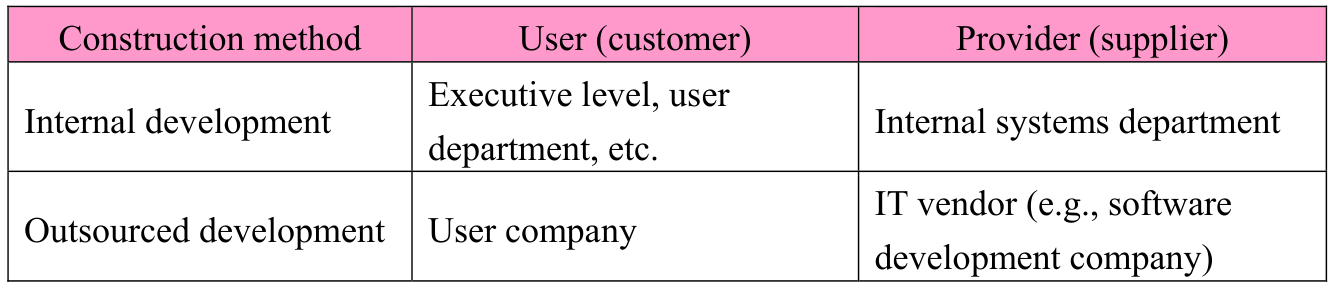
After the procurement method is decided, the scope of procurement, the procurement requirements, and the procurement conditions are defined. The procurement requirements sufficiently take into account consistency with the computerization plan and the requirements definition, and make arrangements for the necessary items for system construction. At this point, it is necessary to check whether or not the system functions, system performance, and system quality fulfill the requirements definition. A procurement plan is created on the basis of these results, and procurement is performed. For this, Software Supply Chain Management is sometimes used. SCM is an approach that manages the flow of product supply in the manufacturing and distribution industries, but this technique is applied to software (or information systems) to optimize the overall process by sharing and managing information between departments or companies concerning software (or information system) orders placed (or orders received), development, and supply.
In the case of outsourced development, the general procedure up to the selection of a vendor is shown below.
p. 224 · PDF 228
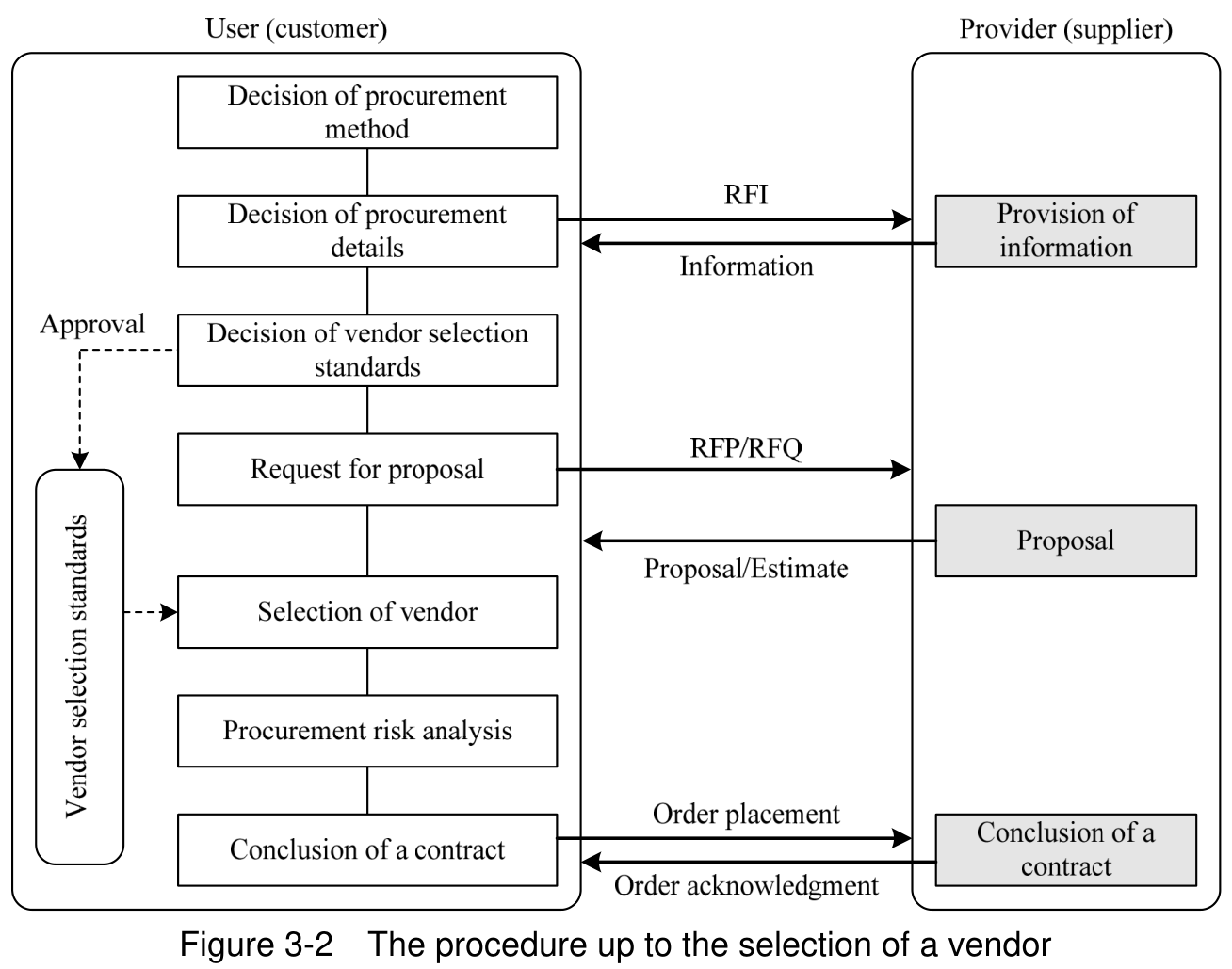
Source visual description
The original user and provider procedure shows decision of procurement method and details, vendor-selection standards and approval, request for proposal, selection of vendor, procurement risk analysis, and conclusion of a contract. Arrows between user and provider are labeled RFI, Information, RFP/RFQ, Proposal/Estimate, Order placement, and Order acknowledgment. Vendor selection standards feed the selection process.
Section progress
Original chapter exercises
Original chapter exercises →New FE Textbook Vol.2 · First Edition, April 2015