Highlighted text? Practice this concept. Highlighted passages and figures open related questions.
Practice related questions (2)Progress & bookmarks
Current section
1-2-2 Solution Business
p. 211
Practice this section 2 linked exam questions with default filters
Progress
Not marked complete
Related questions in this lesson 5
Service oriented architecture3Housing service1Hosting and housing asset ownership1SaaS functions via the Internet1p. 211 · PDF 215
1-2-2 Solution Business
Solution business refers to a service that provides a mechanism (i.e., solution) to resolve business problems. There are many different solution businesses, such as security solutions that provide mechanisms for information security measures, and CRM solutions that provide mechanisms for customer management. A company that conducts this kind of solution business is called a SP (Solution Provider). A solution business that collectively undertakes everything from the planning and design of an information system that meets business requirements to information system operations and management is called system integration. A vendor that considers support and improvement for problem resolution in business processes along with the customer, and makes proposals for a business system that fits the customer’s business strategy and information systems strategy is called a system integrator. Many of such vendors do not focus on their own development business, and therefore, they also make proposals for the utilization of commercial software (i.e., business packages) that provides the required functions, such as accounting operations and sales management operations.
(1) Cloud computing
Cloud computing is a type of computer usage that is based on the Internet (like “cloud”). If a user has the minimum necessary environment, it is possible to use a service with high scalability (i.e., expandability) and availability over the Internet just by paying a service fee.
p. 212 · PDF 216
when they are necessary.
- • PaaS (Platform as a Service)
This is a type of service that provides a platform for application execution via the Internet. The provider provides a virtualized application server on which users deploy and operate their own application. - • IaaS (Infrastructure as a Service)
This is a type of service that provides infrastructure via the Internet. The provider does not provide software. It provides only a virtualized server on which the user installs the necessary OS, and so on. - • DaaS (Desktop as a Service)
This is a type of service that provides a desktop environment for a terminal via the Internet. There is no OS or application on the client (i.e., thin client), and a virtualized desktop environment on cloud infrastructure is used over the Internet.
(2) SOA (Service Oriented Architecture)
(3) ASP (Application Service Provider)
ASP is a service or a form of provision that provides application software over a network. ASP is a single tenant method that provides servers and databases for each user company. However, the difference between the single tenant method of ASP and the multitenant method of SaaS is not strictly differentiated in many cases. In ASP, the user company does not own the software that is used in business operations, so there is no need for initial investment in business software. Therefore, software is treated as a variable cost, and there are no costs for version upgrades or maintenance. Furthermore, it is simple to terminate use of the software and to change providers, so this means it can flexibly deal with changes in the environment.
p. 213 · PDF 217
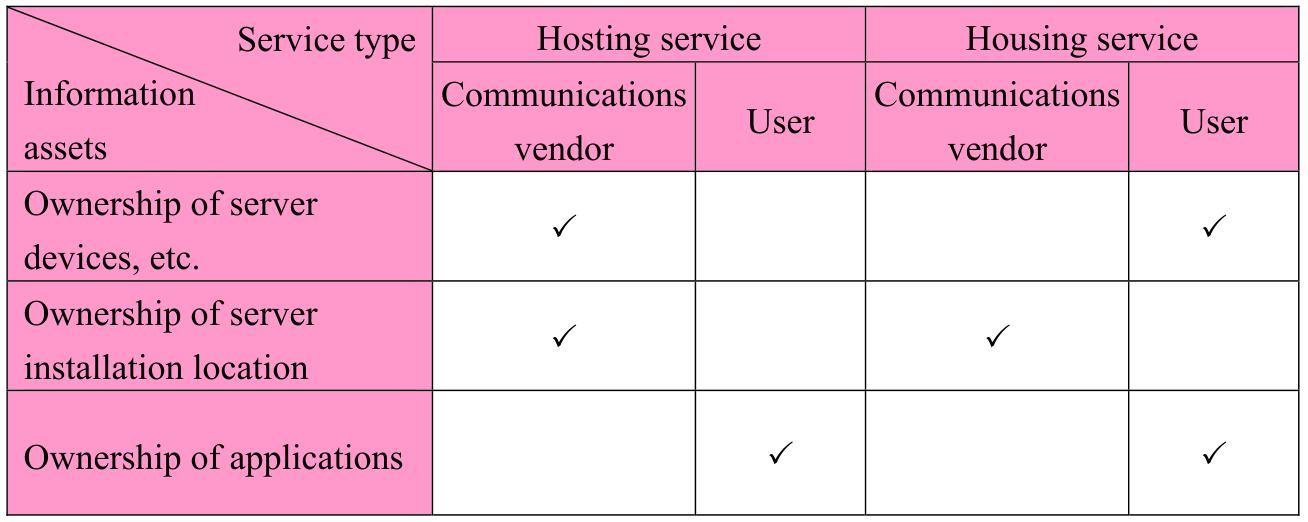
(4) Hosting service/housing service
This is a service that is provided by a communications vendor such as an ISP. A hosting
| Service type Information assets | Hosting service | Housing service | ||
|---|---|---|---|---|
| Communications vendor | User | Communications vendor | User | |
| Ownership of server devices, etc. |  |  | ||
| Ownership of server installation location |  |  | ||
| Ownership of applications |  |  | ||
(5) Outsourcing service
An outsourcing service is a service in which an external vendor undertakes some business processes. A housing service can be called an outsourcing service that is provided by a service provider (i.e., communications vendor) to which the operation of communication devices is outsourced.
Section progress
Original chapter exercises
Original chapter exercises →New FE Textbook Vol.2 · First Edition, April 2015