Highlighted text? Practice this concept. Highlighted passages and figures open related questions.
Practice related questions (3)Progress & bookmarks
Current section
(2) Planning of computerization
p. 216
Practice this section 3 linked exam questions with default filters
Progress
Not marked complete
Related questions in this lesson 4
Computerization investment-effect estimate3IT portfolio investment allocation1p. 216 · PDF 220
(2) Planning of computerization
Planning of computerization refers to the creation of a specific schedule for the implementation (or development) of an information system in consideration of consistency with the total optimization plan.
[Purpose of the planning process for computerization (excerpt from Common Frame 2013)] The purpose of the planning process for computerization is to make a specific computerization plan and a project plan, in which the feasibility of operations and effects is taken into consideration, and to gain the agreement of stakeholders, in order to make the computerization initiative in reality.
p. 217 · PDF 221
The procedure from creation to approval of “planning of computerization” is as below.
[Proposal]
1) Confirmation of the basic requirements for computerization planning
2) Confirmation of the details of business operations in the scope
3) Definition of system issues for business operations in the scope
4) Analysis of system in the scope
5) Survey of technology and techniques to be applied
6) Creation of business operations model
7) Identification of system functions and creation of systems architecture
8) Determination of basic policy concerning supplementary functions and supplementary facilities
9) Determination of basic policy concerning service level and quality
10) Setting of project goal
11) Feasibility study
12) Overall scheduling of development
13) Determination of policy for systems architecture selection
14) Estimate of cost and system investment effect
15) Creation of project promotion framework
16) Verification of consistency with business enterprise strategy, information strategy, and computerization initiative
[Approval]
1) Documentation and approval of computerization plan
2) Documentation and approval of project plan
In the computerization planning, a computerization plan and a project plan are created as deliverables.
| Plan name | Details |
|---|---|
| Computerization plan | Prerequisites concerning basic requirements such as the development, operation, maintenance person-hours, cost, schedule and environmental improvement, education and training (i.e., staff training plan), and quality for the system to be made in reality |
| Project plan | The required organization, resources, activity items (including activity items to be outsourced), schedule, and so on, for system development, operation, and maintenance |
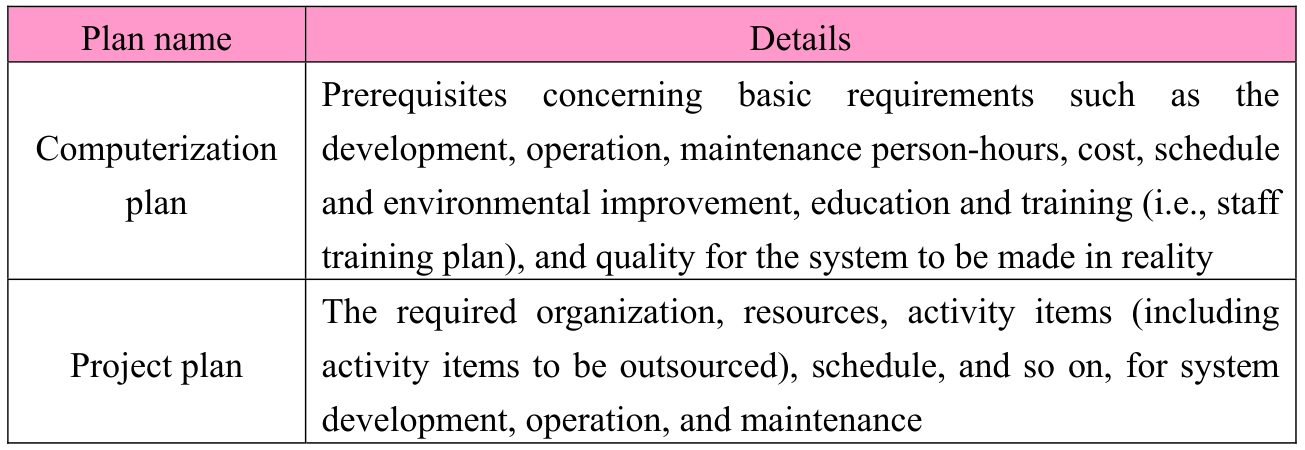
In the planning of computerization, an individual computerization plan is made for each individual information system according to the total computerization plan.
- • In “Confirmation of the basic requirements for computerization planning,” the
prerequisites of a computerization plan are confirmed, which include objectives, means,
p. 218 · PDF 222
staff, period, delivery date, facility, cost, activity allocation, and division of responsibility.
- • In “Confirmation of the details of business operations in the scope” and “Definition of
system issues for business operations in the scope,” the operations in the scope that were specified in the planning of computerization initiative are confirmed, and the system application scope is defined. If a system is actually operated for the business operation in the scope, the relations between the system in the scope, the business operations in the scope, and other related systems are identified. - • In “Creation of business operations model,” reconfiguration of business operations
functions is performed, and the business operations functions and organization are modeled. In the creation of a business operations model that models the overall image for business operations, the business process is defined, data classes are defined, the business model is defined/analyzed, and review/decision making are performed. - • In “Determination of basic policy concerning service level and quality,” the service
levels such as the reliability, performance, and security demanded of the system are clearly determined, and the basic requirements concerning the system quality and quality management structure on the basis of these are clearly determined. - • In “Setting of project goal,” the project (i.e., business and business operations that are
launched at irregular intervals in order to resolve a specific problem or achieve a specific goal) for the actual implementation (or development) of the information system is clearly specified, and target values and priorities are set for the quality, cost, and delivery date that are used as the basis for the project implementation. - • In “Overall scheduling of development,” a broad outline for the implementation (or
development) schedule for the overall system is decided. If a computerization plan is split into multiple projects, a schedule is created for each project. - • In “Estimate of cost and system investment effect,” estimates are made for the
development/operation/maintenance period, framework, and person-hours of the system, and quantitative/qualitative estimates are made for the cost and the effect. Since the cost and the effect are estimated by using the system life cycle (i.e., plan, development, operation, maintenance), it is necessary to clearly specify the conditions that determine the system life. · 3 questions
- • IT portfolio
This applies the idea of a portfolio to the field of IT investment. The recommended model ensures consistency between the organizational strategy and IT investment by managing the investment ratio in each of the four categories of “strategy,” “information,” “transactions,” and “infrastructure.” · 1 question - • Decision making on investment
In computerization planning, this is a decision making method to evaluate the return on development investment and determine the investment. Such methods include PBP,
p. 219 · PDF 223
NPV, IRR, and DCF.
- • DCF (Discounted Cash Flow)
This is a method that uses the present value to evaluate the future income (i.e., cash flow) that an investment project will generate.
It is also necessary to analyze and evaluate the risks that are caused by the implementation of a new system with information system implementation risk analysis.
Section progress
Original chapter exercises
Original chapter exercises →New FE Textbook Vol.2 · First Edition, April 2015