Highlighted text? Practice this concept. Highlighted passages and figures open related questions.
Practice related questions (1)Progress & bookmarks
Current section
2-2 Requirements Definition Process / Analysis
p. 219
Practice this section 1 linked exam question with default filters
Progress
Not marked complete
Related questions in this lesson 2
Non-functional requirements2p. 219 · PDF 223
2 - 2 Requirements Definition Process / Analysis
Requirements definition process/analysis is to identify the stakeholders in an information system to be implemented (or developed) and the business operations in the scope, define stakeholders’ needs and demands as stakeholder requirements, and then obtain stakeholders’ agreement.
[Purpose of the requirements definition process (excerpt from Common Frame 2013)] The purpose of the requirements definition process is to define the requirements for a system that can provide the services needed by users and other stakeholders in a defined environment.
[Analysis (excerpt from “System Management Standards”)]
(1) Obtain approval of responsible personnel from the user department, the system development department, the system operations department and the application maintenance department for the defined requirements based on the development plan.
(2) Define target, scope, and methodology for user requirement survey.
(3) Analyze the present states of information systems with personnel who are familiar with the business process from the user department, the system development department, the system operations department and the application maintenance department.
(4) Ensure that user requirements are documented and confirmed by the user department.
(5) Analyze potential risks that are generated by introducing the information system.
(6) Ensure that business processes, management structures, and rules/procedures, which are affected by installing the information system, are reviewed and assessed. (7) Assess the effectiveness of installing the information system from both
p. 220 · PDF 224
qualitative and quantitative perspectives. (8) Ensure that suitability for user needs is assessed before the use of software packages.
Note: The requirements definition process was changed in Common Frame 2013 to be specialized for the software life cycle process. The purpose of the requirements definition process prior to the change is to “clearly specify the requirements for the new system or business operations to be constructed (or reconstructed), and on the basis of this, to specifically define the scope of computerization and the functions.”
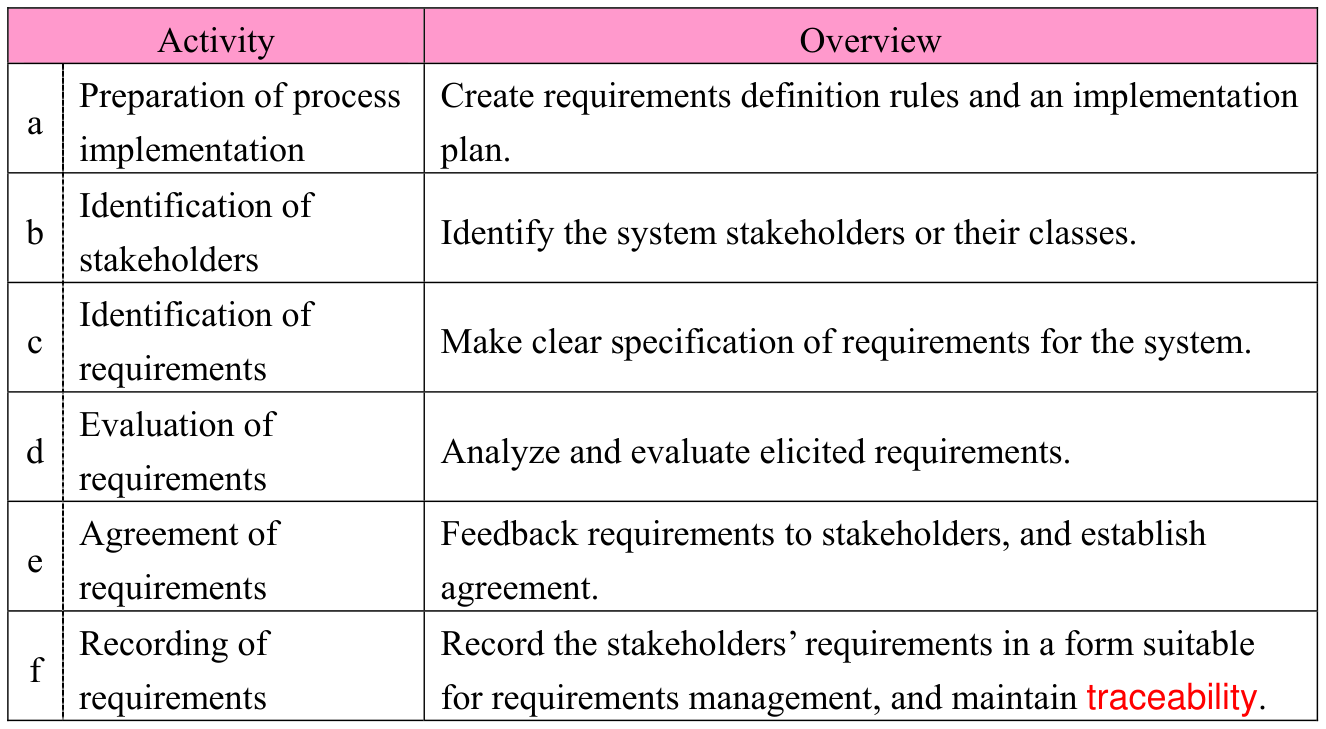
According to Common Frame 2013, in terms of the requirements definition process, “the following activities should be implemented according to applicable organization policies and procedures.”
| Activity | Overview | |
|---|---|---|
| a | Preparation of process implementation | Create requirements definition rules and an implementation plan. |
| b | Identification of stakeholders | Identify the system stakeholders or their classes. |
| c | Identification of requirements | Make clear specification of requirements for the system. |
| d | Evaluation of requirements | Analyze and evaluate elicited requirements. |
| e | Agreement of requirements | Feedback requirements to stakeholders, and establish agreement. |
| f | Recording of requirements | Record the stakeholders’ requirements in a form suitable for requirements management, and maintain traceability. |
(1) Requirements analysis
Requirements analysis refers to analyzing the diverse requirements of stakeholders, performing an investigation into solutions/feasibility analysis, and making a proposal for a new business operations model and workflow. User requirements are collected with user needs studies such as questionnaires, interviews, and a field study, and current state analysis is performed on the basis of the functions and performance of the current system, the definition of problems/issues, and the consistency with business processes, and the usage status. This information is analyzed and organized, and a requirements specification document which compiles feasible solutions is created as a new
p. 221 · PDF 225
business operations model/workflow.
(2) Requirements definition
Requirements definition is to determine the overall framework of the system and business operations, and also define the scope of computerization and the system functions as stakeholders’ requirements, in order to fulfill the requirements described by the requirements specification document. In the requirements definition, how the requirements are fulfilled is defined with the three sets of criteria below.
- • Operational requirements
These are requirements that should be fulfilled in terms of business operations, such as operational details (e.g., procedure, input/output information, organization, responsibility, authority) and operational characteristics (e.g., rules, restrictions). - • Functional requirements
These are requirements for system functions that are necessary to fulfill the operational requirements, such as the flow of information (i.e., data) between the functions that make up business operations, the scope of implementation for the relevant activities/system functions, and interfaces including information exchange with other systems. - • Non-functional requirements
These are requirements other than functional requirements that are necessary to fulfill the operational requirements, such as quality characteristics (i.e., functionality, reliability, usability, efficiency, maintainability, portability), technical requirements (i.e., system implementation method, system configuration, system development method (e.g., language), development standards, development environment), operational requirements, and migration requirements. · 2 questions
In the requirements definition, the structured analysis method and the object orientated analysis method are used to consider implementation in the system. The structured analysis method that focuses on functions is a POA (Process Oriented Approach), and its results can be organized into a DFD (Data Flow Diagram) or a decision table. On the other hand, the object oriented analysis method is a DOA (Data Oriented Approach) that focuses on data, and its results can be organized into UML. (The details of this will be covered in Chapter 4.) The results of requirements definition are established as stakeholders’ requirements when the approval of the stakeholders is obtained. Therefore, it is necessary to sufficiently verify the feasibility and validity of defined requirements and the consistency with the information systems strategy. During this verification, if the verification is vague or the stakeholders
p. 222 · PDF 226
compromise on anything, a large problem may occur later. Therefore, it is important to sufficiently utilize facilitation (e.g., technology/methods/acts to promote proactive conferences and meetings) and obtain the agreement of the stakeholders.
Section progress
Original chapter exercises
Original chapter exercises →New FE Textbook Vol.2 · First Edition, April 2015