Contents
Chapter 2 · Information Processing SystemPractice

LEARN WITH HARU

Video Lesson တွေက Haru အတန်းသားတွေအတွက်ပါ

Haru ရဲ့ ITPEC FE Full Course မှာ ယခု သင်ခန်းစာတွေကို တစ်ခုချင်း တစ်ကြောင်းချင်း အသေးစိတ်ရှင််ရှင်းပြထားပါတယ်

အခြေခံ မရှိတဲ့ ကျောင်းသားများစွာဟာလည်း ဒီ Course နဲ့ ပဲ အောင်မြင်ကုန်ကြပါပြီ

အတန်းမအပ်သေးပဲ Haru ဆီမှာ အစမ်းသင်ကြည့်ချင်ပါသလား?

သင်တန်းသားတွေရဲ့ စကားသံများ

သင်တန်းသားတွေရဲ့ စကားသံများ

Highlighted text? Practice this concept. Highlighted passages and figures open related questions.

Practice related questions (2)Progress & bookmarks

Current section

5-1-2 Sound Processing

p. 170

Practice this section 2 linked exam questions with default filters

Progress

Not marked complete

Related questions in this lesson 2

Digitized sound data quantity1Sampling in PCM1
Progress and bookmarks

p. 170

5-1-2 Sound Processing

Sound processing is a process that analog sound is handled as digital data. The techniques of A/D conversion by which an analog signal is encoded into a digital signal include PCM (Pulse Code Modulation). The procedure of encoding (i.e., A/D conversion) by PCM is as shown below.
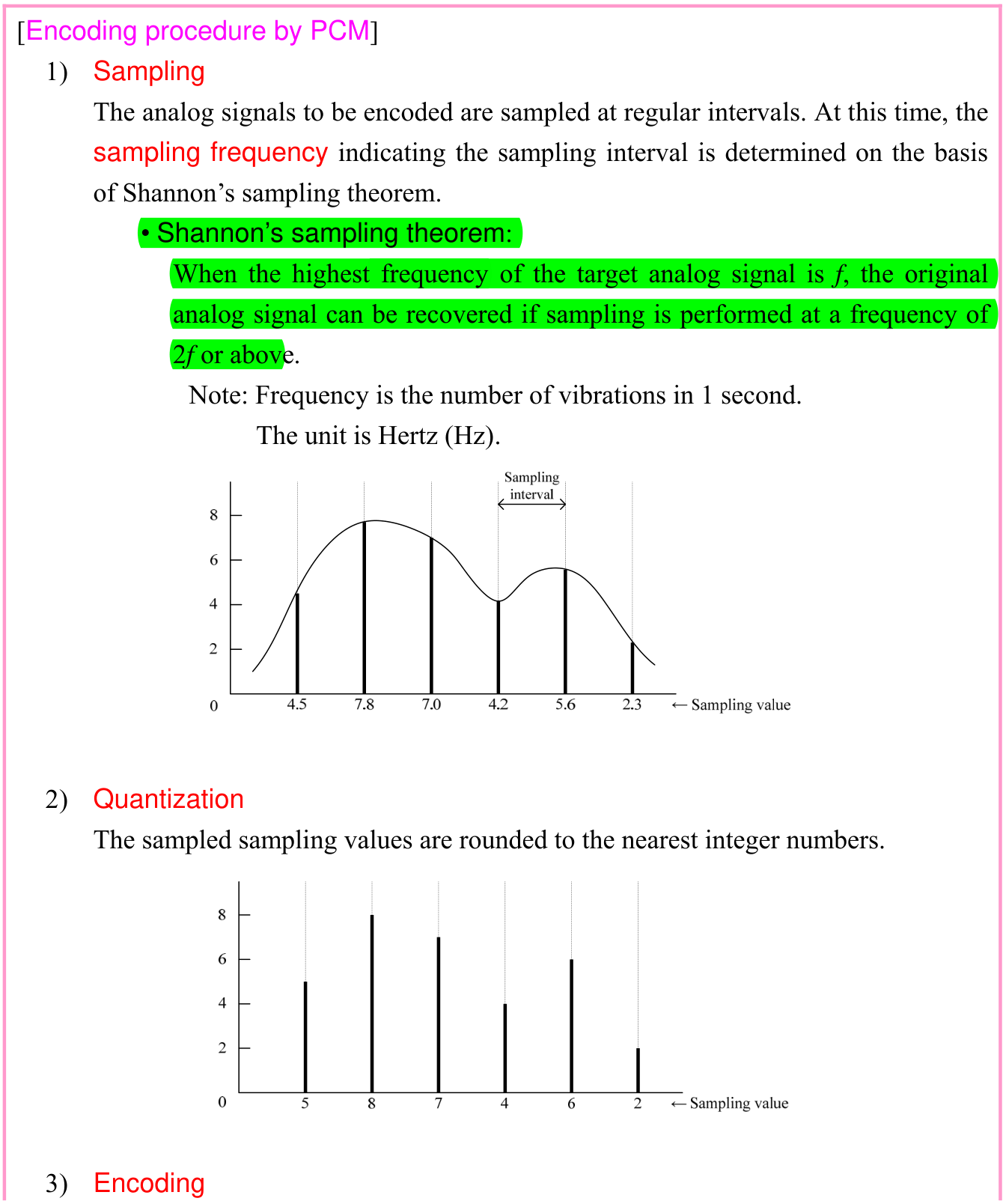
Original PCM encoding procedure, first page. Sampling takes the analog signal at regular intervals. Shannon’s sampling theorem requires a sampling frequency of at least twice the highest signal frequency f. The analog waveform is shown with sample lines and sampling interval. Quantization rounds sampled values to integer levels. The second graph shows levels 5, 8, 7, 4, 6 and 2 at successive samples. Step 3 Encoding continues on the following page.
p. 170 · Enlarge
Sampling in PCM · 1 practice questions

p. 171

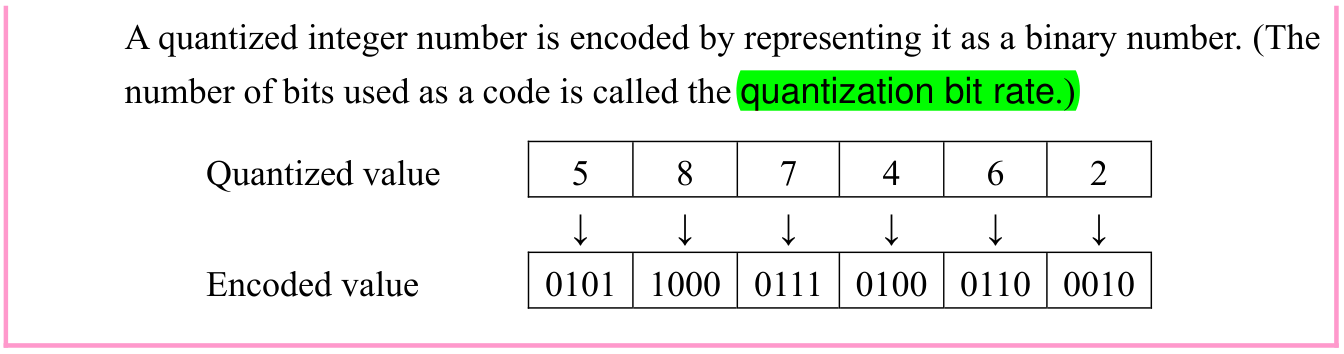
Original PCM encoding procedure continuation. An integer quantized value is represented as a binary number. The aligned row maps quantized values 5, 8, 7, 4, 6, 2 to encoded values 0101, 1000, 0111, 0100, 0110, 0010 respectively. Downward arrows connect each original value to its code. The source calls the number of code bits the quantization bit rate.
p. 171 · Enlarge
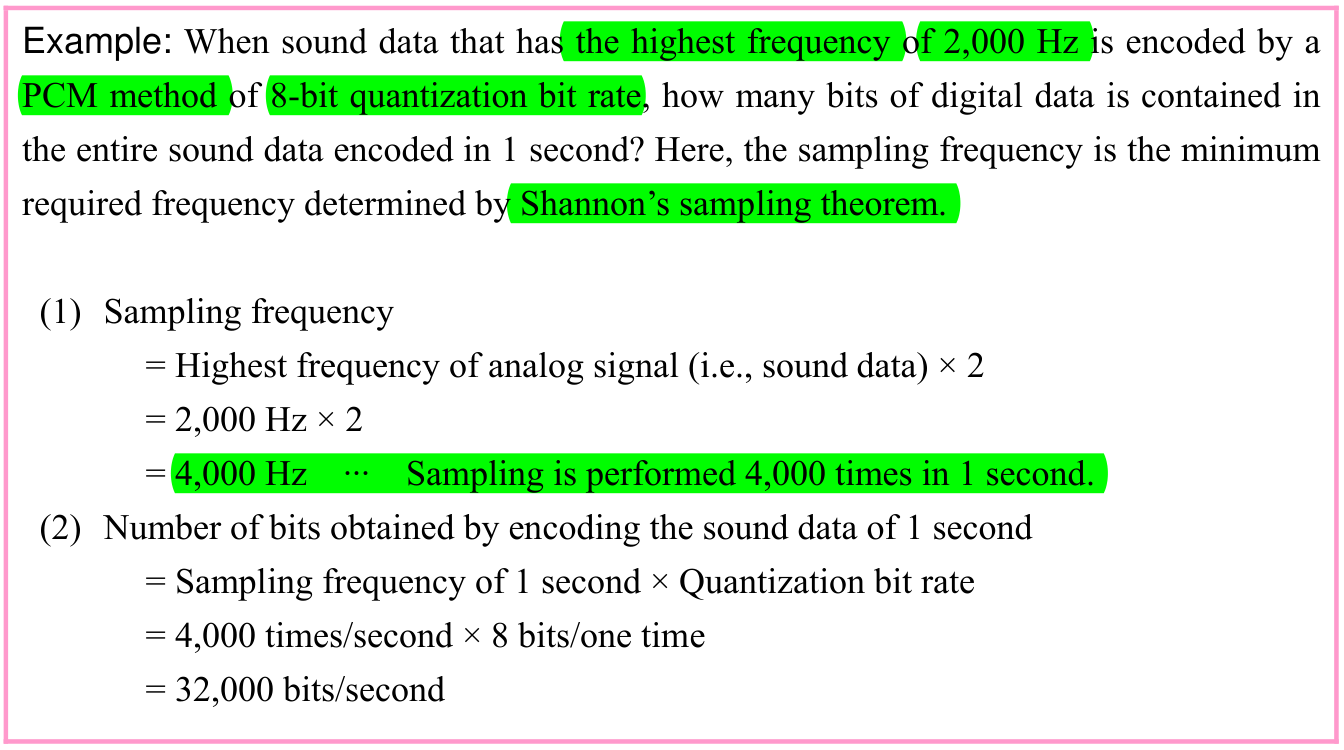
Complete original PCM worked example. Highest sound frequency 2,000 Hz, 8-bit quantization. Minimum sampling frequency is 2,000 Hz times 2, equal to 4,000 Hz or 4,000 samples per second. One second of encoded sound has 4,000 samples per second times 8 bits per sample, equal to 32,000 bits per second. The question, assumptions and both solution steps remain together.
p. 171 · Enlarge

As clear from the above example, the amount of digital data after encoding is determined on the basis of the sampling frequency (i.e., sampling interval) and quantization bit rate. Moreover, D/A conversion that a digital signal (i.e., code) is restored as an analog signal (i.e., sound data) can be implemented by performing the encoding procedure in the reverse manner. At this time, in order to be able to perform restoration at a quality level that is closest to the original analog signal, either the sampling frequency is increased (sampling interval is shortened) and the number of sampling values is increased, or the quantization bit rate is increased to perform detailed staging of sampling values. · 1 question

The typical formats (i.e., standards) of a sound file are as follows:

  • • MIDI (Musical Instruments Digital Interface)
    It is a file format that an electronic musical instrument and PC are connected and music data is exchanged. Not sound as such, but the rendition information for playing back the sound is handled.
  • • MP3 (MPEG1 Audio Layer3)
    It is a high-quality sound compression and decompression format using the sound

p. 172

technology of MPEG (moving images compression and decompression format) standardized by ISO. It is also used in Internet music distribution and portable players.

  • • WAV (RIFF Waveform Audio Format)
    It is a sound data format that is mainly used in Windows systems. Various formats of data, such as ADPCM and WMA, can be stored in the container format.
    • • ADPCM (Adaptive Differential Pulse Code Modulation):
      It is a sound signal compression method in which the PCM technique is applied.
    • • WMA (Windows Media Audio):
      It is a streaming technique of music distribution that was originally developed by Microsoft. Recently, it has been used as a sound compression technique.

Original chapter exercises

Original chapter exercises →

New FE Textbook Vol.1 · IT Fundamentals · First Edition, April 2015