Highlighted text? Practice this concept. Highlighted passages and figures open related questions.
Practice related questions (4)Progress & bookmarks
Current section
1 Processing Type of Information Processing System
p. 121
Practice this section 4 linked exam questions with default filters
Progress
Not marked complete
Related questions in this lesson 5
Client/server processing roles1Platform as a service1Software as a service1Transactions without mutual interference1Grid computing1p. 121
1 Processing Type of Information Processing System
The functions that are common to computer systems used at various places include input of certain data, execution of processing according to a fixed procedure, and output of result. These functions are collectively referred to as the information processing systems, but depending on the usage method and equipment configuration, the information processing systems are classified as various types.
1 - 1 Non-interactive Processing System and Interactive Processing System
(1) Non-interactive processing system
A non-interactive processing system is a system in which a set of instructions is issued all together to the computer. Once the computer starts the processing, the user (i.e., human) cannot intervene in the processing at all.
(2) Interactive processing system
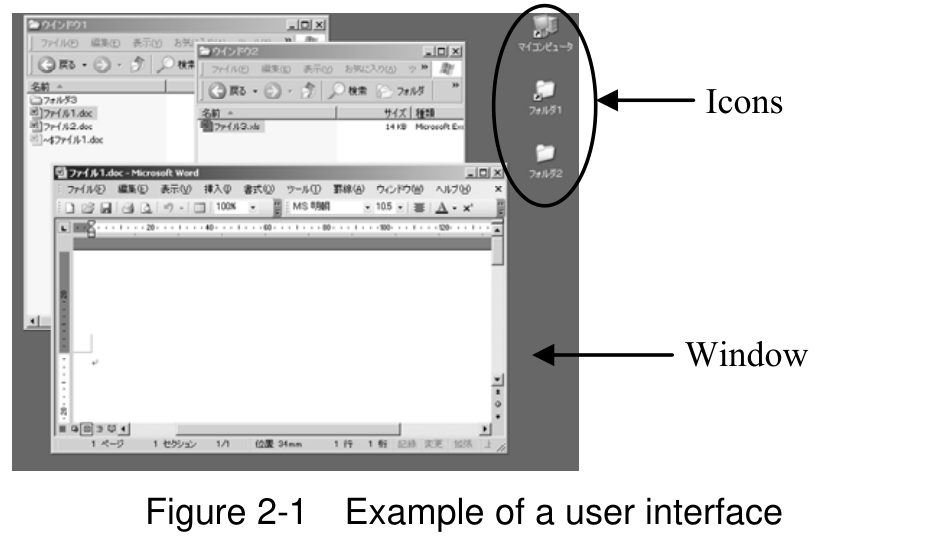
An interactive processing system is a system in which data is processed by commands that a computer user sends one by one while the user looks at the information that is displayed on the screen. It can be called a method by which a human proceeds with their work as if the human were interacting with the computer. In an interactive processing system, humans are also incorporated as part of the system, so it is necessary to improve the productivity of the user. Therefore, in order to implement a system that is easy for humans to use, it is necessary to enhance the user interface. A typical user interface includes the window and icons shown in Figure 2-1.
p. 122
1 - 2 Batch Processing System and Real-time Processing System
1-2-1 Batch Processing System
A batch processing system is a system that accumulates the data to be processed by the computer and then processes it all together at a particular time. It is used in periodic tasks (e.g., calculation of employees’ salary) that do not need to be performed immediately.
(1) Center batch processing
In center batch processing, data is accumulated at the site where the process is requested, and taken to the computer center after every fixed period or at every appointed date, and then processed.
- • Open batch processing This is a method that the user performs all processes from input to operation.
- • Closed batch processing This is a method that the operator performs all processes from input to operation.
- • Cafeteria method This is a method that the user performs input and the operator performs the operations.
(2) Remote batch processing
In remote batch processing, the processing that is requested from an off-site RJE (Remote Job Entry) terminal are sent to the computer center, accumulated, and then processed periodically.
[Transaction processing]
Transaction processing is a general term for the processes that are used to update the master file and database on the basis of the processing requests that are collected in the transaction file. The transaction processing requires the following ACID characteristics:
- • Atomicity It is a property that either “All are executed” or “None is executed.”
- • Consistency It is a property that inconsistencies do not occur because of the processing of the transaction.
- • Isolation (separation)
p. 123
It is a property that transactions do not interfere with one another. · 1 question
- • Durability (persistence) It is a property that the recorded result continues to be retained even if a fault occurs.
1-2-2 Real-time Processing System
A real-time processing system is a system in which the computer immediately starts processing each time a process is requested. It is used in tasks that need to be performed immediately (when there is a strong restriction in the processing time) and in a situation where the system can perform work in place of humans.
- • Hard real-time system It is a real-time system such as an airbag control system in which there are strong restrictions in the response time, and if the processing does not finish within that
time, fatal damage such as threats to life is sustained.
- • Soft real-time system It is a real-time system such as a seat reservation system in which there are restrictions in the response time, but no fatal damage is sustained even if the processing does not finish within that time.
(1) Real-time control processing system
A real-time control processing system is a system that replaces humans and sequentially interprets and processes the information obtained by a sensor or a set of sensors. It is used for controlling industrial robots in factories or used in autopilot systems of airplanes.
(2) OLTP (On-Line Transaction Processing) system
An online transaction processing system is a system that sends remotely-generated processing requests (transactions) to the computer center and performs the processing then and there. It is also known as online real time processing and is used in the ATM system of banks. In the online transaction processing, in most cases, the master file and database in the computer center are used as the processing targets. The online transaction processing is also a type of transaction processing, and therefore, requires ACID characteristics.
(3) TSS (Time Sharing System)
A TSS (Time Sharing System) is a system that several users perform the interactive
p. 124
processing on a single computer as if each of them exclusively owned the computer. In reality, the usage time is divided up into minute units of time (time slice) for each user, and the use of the computer is assigned sequentially to each user.
1 - 3 Centralized Processing System and Distributed Processing System
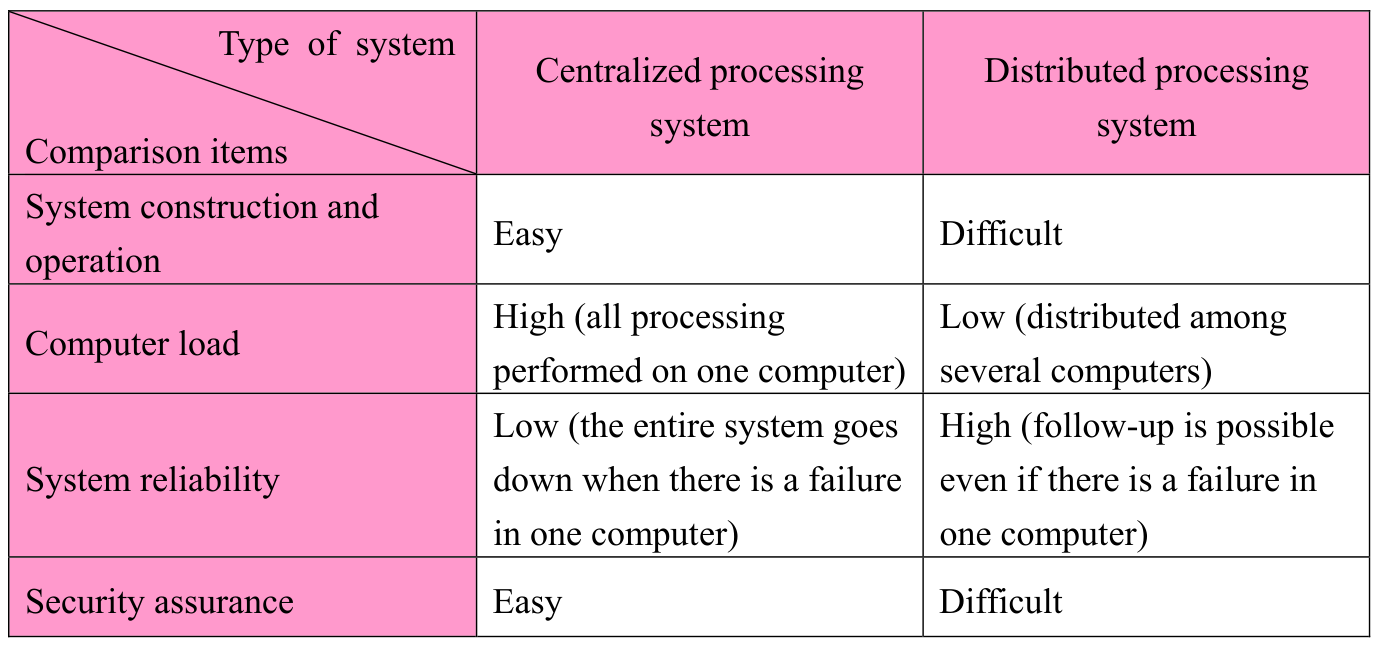
A centralized processing system is a system that processes the data and resources centrally at one location, and all early information processing systems are this type. In contrast, a distributed processing system is based on a concept developed along with the progress that is made in network technology and is a system that achieves load distribution and function distribution by decentralizing the data and resources. The characteristics of the respective system are compiled as follows:
1-3-1 Classification of Distributed Processing Systems
Depending on the relationship between the connected computers, the distributed processing systems are classified into a horizontal distributed system and a vertical distributed system.
(1) Horizontal distributed system
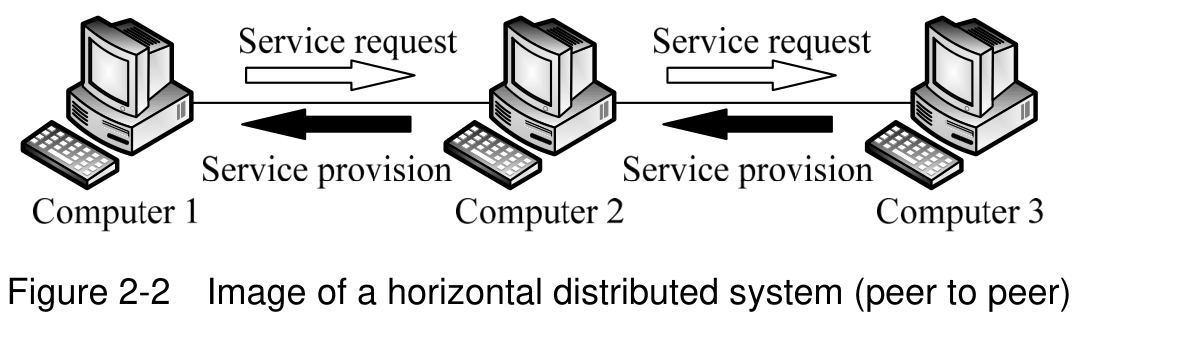
A horizontal distributed system is a distributed processing system in which all connected computers are in an equivalent position.
(a) P2P (Peer to Peer) This is a horizontal distributed processing system that directly connects computers that
p. 125
are in an equivalent position. While system installation is easy and the cost can also be kept low, all computers need functions that enable them to respond to the processing requests. Also, the shared resources within the network must also be managed. Therefore, this form is not suitable for large systems.
(2) Vertical distributed system
A vertical distributed system is a distributed processing system in which a clear hierarchical relationship is assigned to the connected computers.
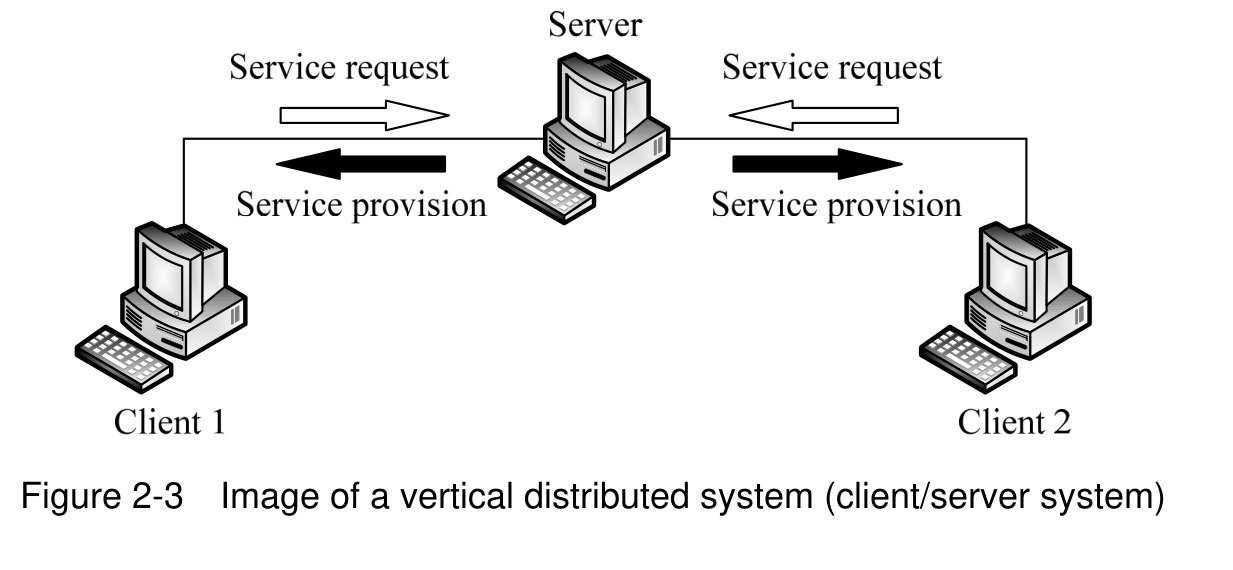
The typical types of servers used in a client/server system are described below. In the server virtualization technology, one server is used as multiple servers, and a single server can support several functions (e.g., the functions of a print server and file server).
p. 126
- • Print server This server is equipped with a high-performance printer and manages the print processing.
- • File server This server is equipped with a large-capacity auxiliary storage device and manages files (or data) in a consolidated manner.
- • Database server This server is equipped with a large-capacity auxiliary storage device and manages the database in a consolidated manner.
- • Communication server (Gateway server) This server manages the connection between computers through different types of networks.
- • PROXY server This server is used to establish a connection with an external network (e.g., the Internet) in place of the client (acts as a proxy.)
- • Three-tier client/server system The past client/server systems were mainly two-tier client/server systems in which processing and calculation of data were performed at the client side and the server was requested only to do the processes of the database (e.g., search or update). However, when function expansion of applications is performed in a two-tier client/server system, it becomes necessary to update the application in all client terminals. Thus, a three-tier client/server system that is logically divided into the three-tier structure detailed below is designed.
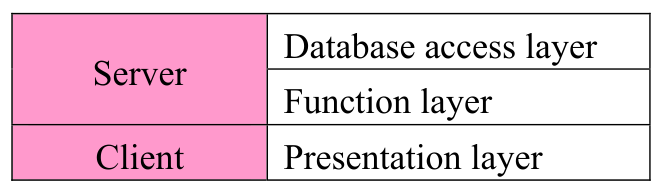
(1) Database access layer (data layer) This layer is used for accessing the database and referencing the required data. (2) Function layer (application layer) This layer is used for processing (e.g., calculating and analyzing) messages (i.e., SQL statements) and data. (3) Presentation layer This layer is used to implement the user interface (i.e., data input and result display) for exchanging data with the user.
A three-tier client/server system can independently manage the respective functions. Also,
p. 127
since most of the functions are maintained at the server side, this system is also effective from the viewpoint of the application development work and function expansion. In addition, because of the fact that the server undertakes the functions of the database access layer and the function layer, the communication volume between the client and the server is reduced, thereby resulting in a reduction in communication load.
[Functions of the three-tier client/server system]
- • Stored procedure function This is a method that frequently used commands (e.g., a series of SQL statements for database query or update) are prepared beforehand in the server. This method was conceived of to eliminate the fact that the SQL statement communication between the client and the server results in network load in the two-tier client/server system that uses a database server, but it is also used in the three-tier client/server system.
- • Group commitment function This is a function by which several writing operations are performed in a synchronous manner in a server environment where several operations are performed in parallel.
- • Thin client system The concept that applications are placed at the server side and only the minimum functions are maintained at the client side is called thin client. The concept used in the thin client system (the software (or server) that implements the mechanism (i.e., system) of the thin client is called thin client agent). In the thin client system, there is no need to record the application (i.e., program) at the client side, and therefore, there is no auxiliary storage device at the thin client terminal; that is, the data is recorded in the network storage, which is a storage unit that can be used via the network. As a result, prevention of information leakage can be expected. Moreover, just like the thin client system, the procedures provided by the application (i.e., program) at the server side can be used by the client side as if they were present on the client side’s computer. This communication method is called RPC (Remote Procedure Call). RPC, which is one of the communication methods between programs, enables a computer to request another computer to handle part of the process.
- • Fat client This is a traditional method that all applications and the entire data are retained at the client side.
- • Rich client This is a method of downloading applications at the client side and then using them if necessary.
p. 128
(b) Web system This is a system that processing is requested to the web server, which provides information transmission services over the Internet called web services, from a web browser (e.g., software for seeking information from the web service and displaying it). This system can be referred to as a type of the client/server system. A typical web system is a system in which information is sought from the database. In such a case, the commonly used configuration is to divide the three-tier client/server system into two servers: the database access layer that becomes the database server, and the function layer that becomes the application server (i.e., web server). The client performs only the role of the presentation layer that displays the result received according to the description of HTML (HyperText Markup Language) on the screen. Here, HTML is the description language for web pages. Therefore, in most cases, a thin client terminal that has only the minimum required functions is used in a web system.

(c) Cloud computing This is a system that the user can easily receive services with high scalability (expandability) and availability by the computer resources (e.g., hardware and software) that are provided via the network. Cloud indicates that the user can use the service even without any knowledge of the mechanism at the other end of the cloud (i.e., the mechanism of providing the service). The user can use the service at any time as long as the minimum required environment (e.g., a client terminal like the PC, a web browser, and an Internet-connected environment) is available. The typical services provided by cloud computing are described below:
- • SaaS (Software as a Service) This is a service that provides the functions of software. Generally, the multi-tenant method that is shared among several users is adopted. · 1 question
- • PaaS (Platform as a Service) This is a service that provides the platform for running applications. A virtualized server and necessary databases are provided, and the user deploys and operates his/her own application. · 1 question
- • IaaS (Infrastructure as a Service) This is a service that provides the infrastructure. Only a virtualized server is provided, and all other necessary OS and applications are prepared by the user.
p. 129
- • DaaS (Desktop as a Service) This is a service that provides the desktop environment for the terminal. The virtual desktop environment on the cloud infrastructure is used from the thin client terminal.
[Backup site]
When a website (i.e., a collection of web pages) like a web system or a cloud computing system is used, a backup site must be prepared to deal with faults. The following backup sites become available in order of the fault recovery time from shortest to longest.
- • Hot site The data of a backup site that is configured by the same system is always updated to the most recent status via the network and is kept on standby.
- • Warm site The required data is uploaded periodically to the backup site and stored there.
- • Cold site Only the backup site is prepared, and the required data is transferred when a fault occurs.
1-3-2 Parallel Processing System
A parallel processing system is a system that achieves a reduction in the processing time and large-scale calculation processing by performing the distributed processing in parallel (i.e., by performing parallel processing).
(1) Multiprocessor system
Multiprocessor system is a general term for a system in which several computers are combined together. However, when we simply say “multiprocessor,” it could also indicate a single computer on which several processors (i.e., processor cores) are loaded. In a broad sense, cluster and grid computing are also included in a multiprocessor system.
(2) Cluster
A cluster (or cluster system) is a system in which several computers are linked and used as if they were a single high-performance computer; the method by which such a system is configured is called clustering. A cluster can be highly reliable because it can prevent the entire system from stopping by making other computer take over the processing when a fault
p. 130
occurs in some computers configuring the system.
(3) Grid computing
- • HPC (High Performance Computing) It is a process that involves extremely high computational complexity, which is performed to resolve natural phenomena. In comparison to the general parallel processing, it is sometimes referred to as large-scale parallel processing. An example of high performance computing includes the project for mapping the human genome (gene).
Section progress
Original chapter exercises
Original chapter exercises →New FE Textbook Vol.1 · IT Fundamentals · First Edition, April 2015