Highlighted text? Practice this concept. Highlighted passages and figures open related questions.
Practice related questions (1)Progress & bookmarks
Current section
4-2-2 Code Design
p. 159
Practice this section 1 linked exam question with default filters
Progress
Not marked complete
Related questions in this lesson 3
Code checking and check digits2Weighted check-digit calculation1p. 159
4-2-2 Code Design
In the code design, the data to be coded is selected from the data items used within a system and a code table is created for each target.
p. 160
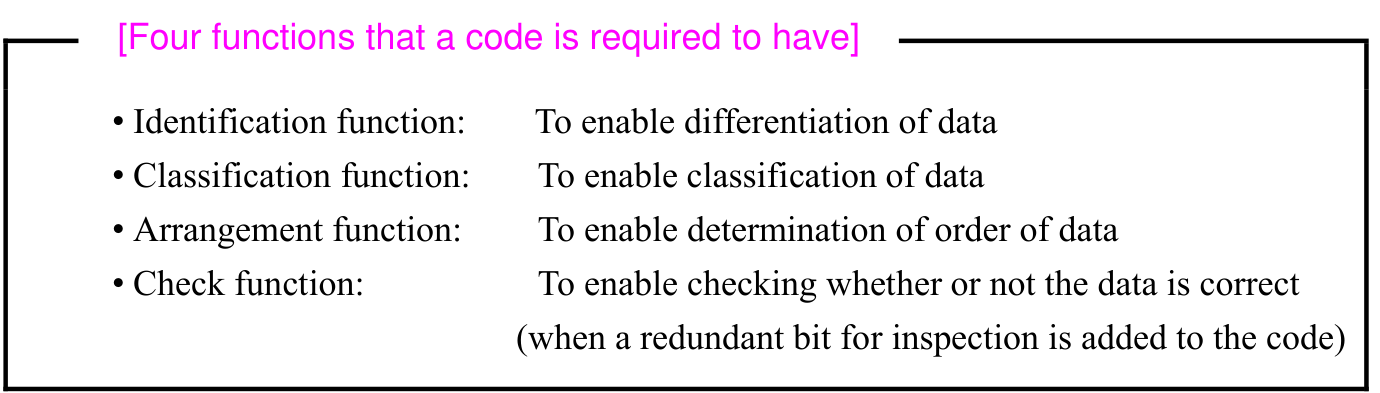
As a principle, a code is mainly composed of numbers and letters. Although double byte characters (e.g., Kanji characters) are effective in enabling an easy understanding of the meaning of codes, they are not appropriate from the viewpoint of retention and maintenance. Typical types of codes are as follows:
- • Sequence code
It is a code that is assigned sequentially from the first item. Example: Prefecture code {01: Hokkaido, 02: Aomori prefecture, 03: Iwate prefecture, ···} - • Block code (Classification code)
It is a code that is divided into several blocks, and a serial number is assigned in each block.
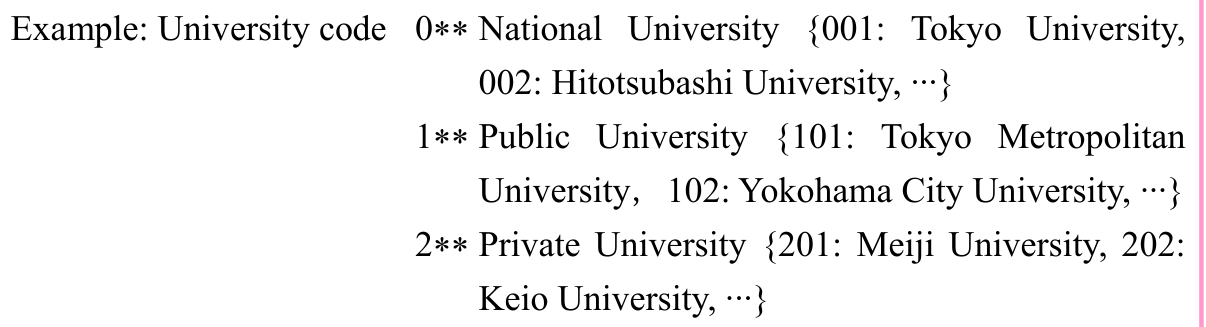
- • Group classification code
It is a code that imparts the meaning of major category, medium category, and minor category to each digit.
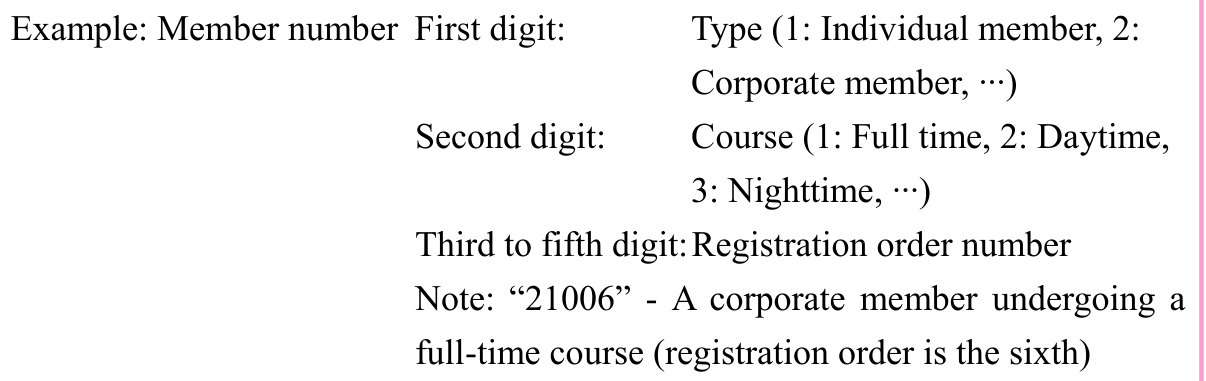
- • Mnemonic code
It is a code that uses the name and abbreviation of the data to be coded. Example: Product code
p. 161
JP20CTV: 20-inch color TV made in Japan FR16MTV: 16-inch monochrome TV made in France
- • Synthetic code
It is a code in which several types of codes are combined together.
During code design, the following points should be considered.
- • Scope of the code
When there is a possibility that the code may be used in a system other than the target system, do not make the code design in view of only the target system. Basically, systems should be able to use the codes commonly. If there is an existing code or standard code, it should be put to use. - • Usage period of the code
Depending on the usage period of codes, the number of necessary codes may be extremely large. For example, when the product code is designed on the basis of the sequence code and the current number of product types is 800, it is possible to code 1,000 types of products in three-digit numbers, which may not be a problem. However, if as many as 50 types of new products are developed every year, the codes will become insufficient after four years. - • Maintenance of codes
The maintenance method of codes is also taken into consideration in the code design stage. Particularly, the codes table is decided in consideration of the person in charge of creation and the creation timing so that no contradiction occurs in data. - • Importance of the code
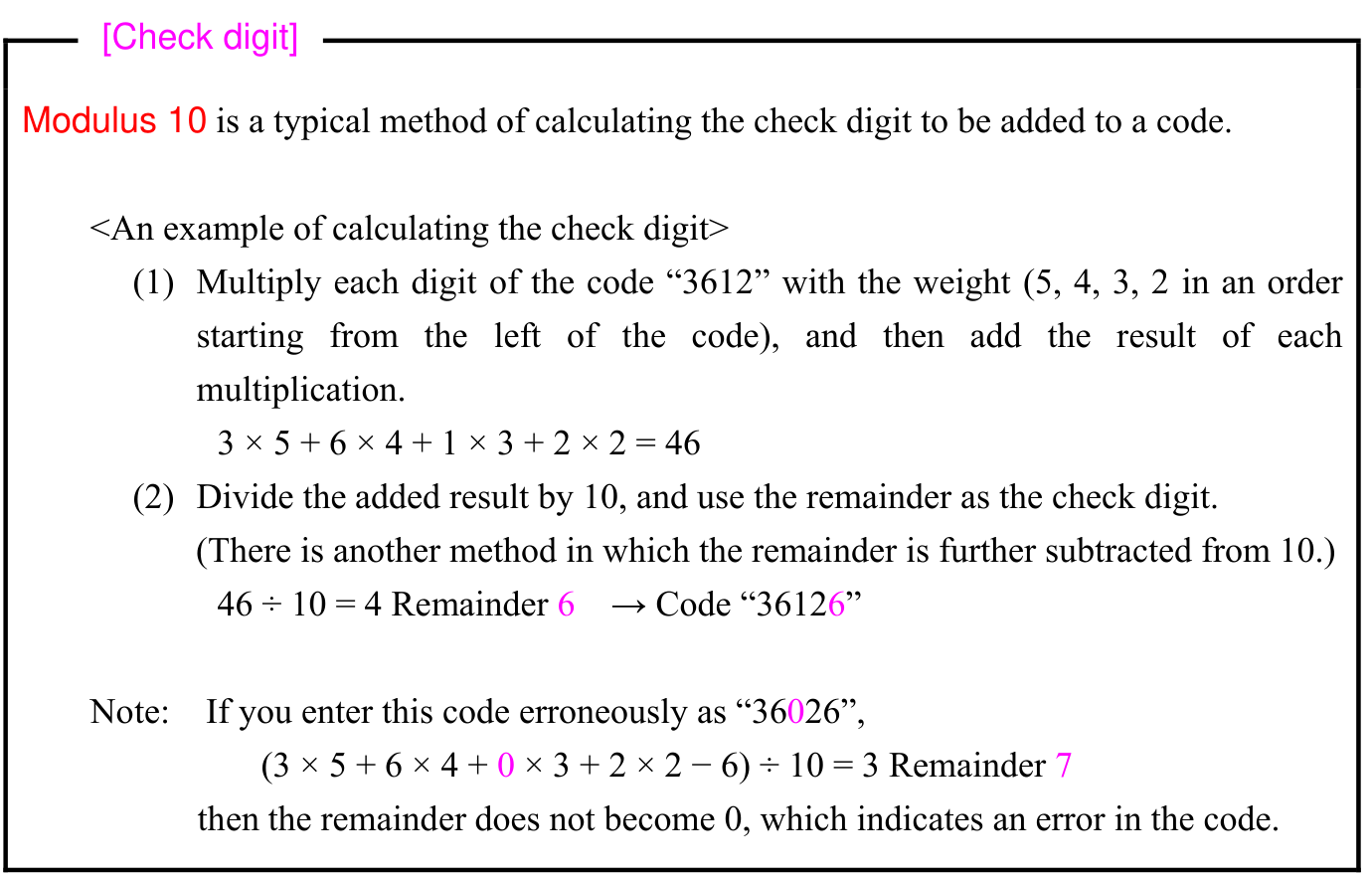
In the case of a code of important data, it is necessary to add a check digit in order to prevent an input error by the operator.
p. 162
Section progress
Original chapter exercises
Original chapter exercises →New FE Textbook Vol.1 · IT Fundamentals · First Edition, April 2015