Highlighted text? Practice this concept. Highlighted passages and figures open related questions.
Practice related questions (4)Progress & bookmarks
Current section
2 Configuration of High-reliability System
p. 131
Practice this section 4 linked exam questions with default filters
Progress
Not marked complete
Related questions in this lesson 6
Duplex standby systems2Fault-tolerant component redundancy1RAID 1 mirroring1Cold standby activation after failure1RAID0 speed without spare redundancy1RAID6 dual parity1p. 131
2 Configuration of High-reliability System
A point to consider in a system configured by computers and peripheral devices is the occurrence of a failure in devices. It is not possible for a device created by a human to have no failures at all. Therefore, the system configuration must be designed in view of the importance of the system.
2 - 1 Series System
A series system is a system configuration in which a backup system is not prepared for a fault. It has a reduced cost but low reliability, and therefore, is used in a system that does not pose any problems even if a device failure leads to stopping of the system.
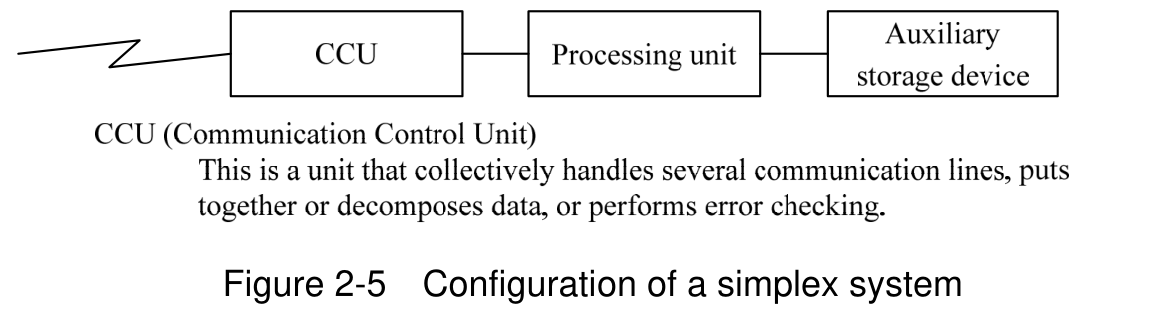
(1) Simplex system
A simplex system is a system in which all devices are connected in a series. It can be referred to as the basic configuration in an online transaction processing system.
(2) Tandem system
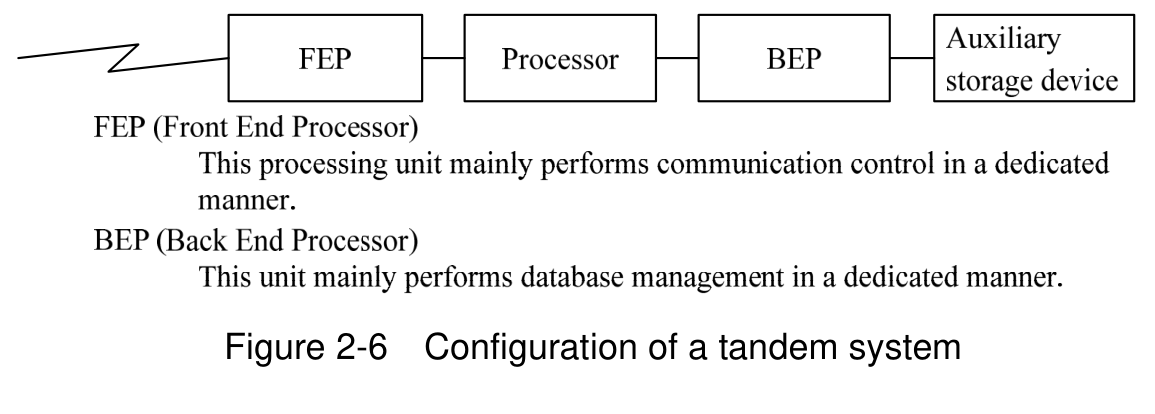
A tandem system is a system in which several processors are connected in series in order to distribute the load of the processors. Even if only one of the several processors fails, the entire system stops functioning.
p. 132
2 - 2 Parallel System
A parallel system is a system configuration in which a backup system is prepared beforehand. Although the parallel system involves a large cost, it is used in systems that require high reliability and have a social impact at the occurrence of a system failure.
(1) Duplex system
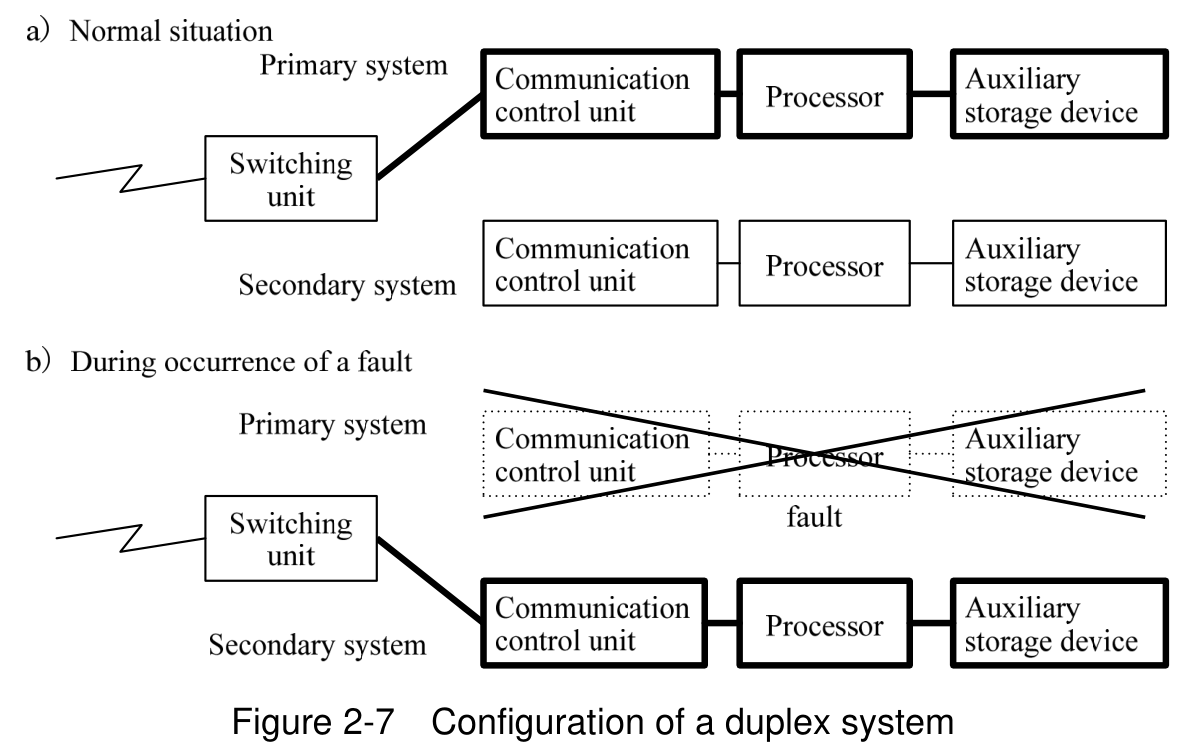
- • Cold standby method
This is a method that a separate local operation is executed (or stopped) in the secondary system (i.e., backup system). When a fault occurs in the primary system (i.e., currently used system), the operational system used in the primary system (i.e., currently used system) is activated in the secondary system (i.e., backup system), and the processing is inherited. · 1 question - • Hot standby method
This is a method that the same operational system as the primary system (i.e., currently used system) is activated and kept on standby in the secondary system (i.e., backup system). The secondary system (i.e., backup system) monitors the primary system (i.e.,
p. 133
currently used system) and immediately inherits the processing of the primary system (i.e., currently used system) when a fault occurs.
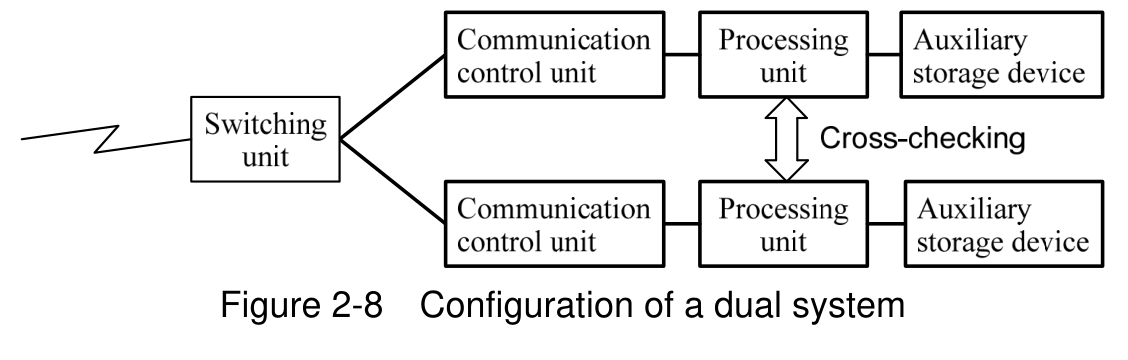
(2) Dual system
A dual system is a method that exactly the same processing is performed in two or more systems and the normality is confirmed (i.e., cross-checked) by collating the results. Although the cost per transaction is more than that of the duplex system, the reliability is extremely high as the processing is continued on the remaining system(s) when one system fails. It is used in systems (e.g., a medical system) concerning human life that must not stop under any circumstance.
2 - 3 Multiplexing System
A multiplexing system is a system that improves reliability through the use of several devices. A parallel system can be referred to as a multiplexing system in which the entire system is targeted.
(1) Fault tolerant system
A fault tolerant system is a system that is designed to be able to retain the necessary functions of the overall system even if a fault occurs in part of the system.
p. 134
Moreover, a fail-soft structure, such as the degraded operation of a system in which the main functions are not stopped even if several functions have been done away with, is also one of the fault tolerant systems.
(2) Multiprocessor system
A multiprocessor system is a system in which the processor is multiplexed. Each processor performs a parallel processing for a single purpose. Moreover, in the event of a fault, the corresponding processor is cut off, and the processing can be continued among the remaining processors, which results in an improvement in reliability. In a multiprocessor system, the processing performance (i.e., processing speed) is enhanced each time the number of processors to be multiplexed is increased. However, according to Amdahl’s law, which states that “the improvement in the processing performance in the parallel processing of a program is limited by the sequentially processed part,” even if the number of processors is increased by n times, the processing speed does not necessarily become n times (or processing time is 1/n).
(a) Tightly coupled multiprocessor system
This is a system in which processors that are controlled by the same OS (i.e., software that controls the computer) use a shared main memory unit and perform the processing at the same time. Each task (i.e., unit in which the work to be processed is divided) of the system can be executed on any processor. As a result, the load can be distributed in smaller units, but a function for securing synchronization (i.e., timing of the processes) between tasks is necessary.
(b) Loosely coupled multiprocessor system
This is a system in which processors that are controlled by the each OS use an individual main memory unit and perform the processing at the same time. The consistency of the processing is achieved by transmitting the information of the main memory unit through a high-speed I/O port. A cluster can be referred to as such a method.
p. 135
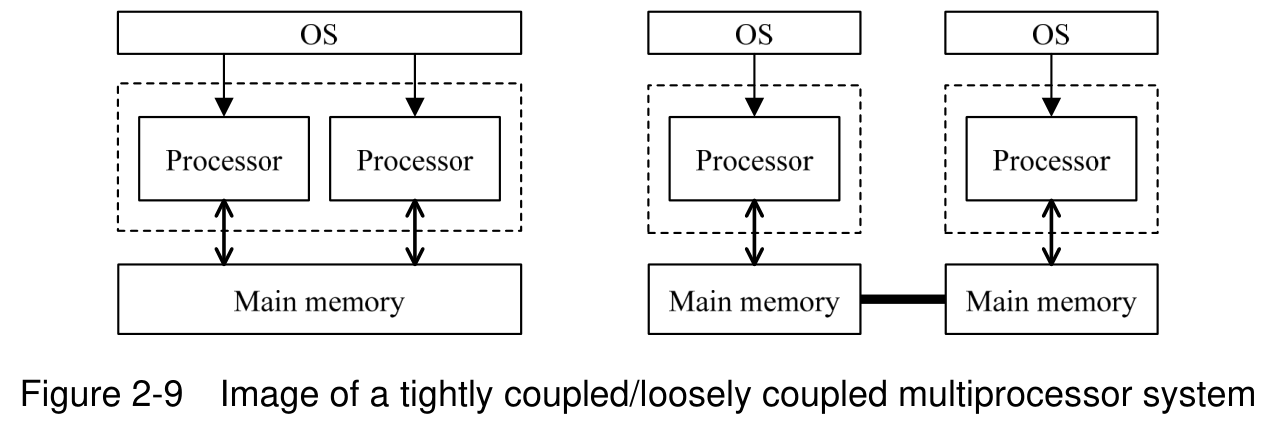
- • Polyprocessor system
This is a multiprocessor system in which the distribution of roles is performed for each processor. - • Load sharing system
This is a multiprocessor system in which tasks (or load) are distributed depending on the situation.
(3) RAID (Redundant Arrays of Inexpensive Disks)
RAID is a multiplexing system (or a device multiplexing technology) for hard disks. RAID improves reliability by handling several hard disks in an integrated manner and can be accessed without stopping the system even when a fault occurs. It is classified as described below depending on the recording method and position of data and redundant bits (i.e., bit used in error detection and correction).
- • RAID0 (striping or disk striping)
The access speed is improved by splitting and writing a set of data on several disks. There is no spare disk for improving reliability · 1 question - • RAID1 (mirroring or disk mirroring)
The reliability is improved by writing the same content at the same time in two disks that have the same capacity and using one disk for backup. Since the data is duplicated, the usage efficiency of the disk becomes 50% of the total capacity. · 1 question - • RAID2
The access speed and reliability are improved by using several disks for saving the data and a disk for data recovery (hamming code). - • RAID3
The access speed and reliability are improved by using several disks for saving the data and a disk for data recovery (parity code). - • RAID4
p. 136
The access speed and reliability are improved by performing data access in units of sectors in lieu of units of bits used for RAID3.
- • RAID5
This is a configuration that the parity data recorded in the parity disk for data recovery in RAID4 is distributed to the disks for saving the data. The access speed and reliability are improved by reducing the load of the parity disk. - • RAID6
This is a method that two parity codes are generated for data recovery in RAID5. · 1 question
RAID is also used in network storage. Typical network storage devices include NAS (Network Attached Storage) and SAN (Storage Area Network). NAS is a storage device that is used as a file server by connecting it directly to the network. File systems supporting several protocols (e.g., CIFS in Windows and NFS in UNIX) are provided within the storage. Therefore, data sharing between different OSs and machines (or servers) can be easily performed in units of files. On the other hand, SAN is a network storage system that is dedicated to data storage. While the load on the network is lower than in NAS, a demerit is that it is difficult to share data between OSs and machines (or servers) that have different file systems.
Section progress
Original chapter exercises
Original chapter exercises →New FE Textbook Vol.1 · IT Fundamentals · First Edition, April 2015