Highlighted text? Practice this concept. Highlighted passages and figures open related questions.
Practice related questions (15)Progress & bookmarks
Current section
1-1-2 Threats (or Perils)
p. 354
Practice this section 15 linked exam questions with default filters
Progress
Not marked complete
Related questions in this lesson 17
Social engineering and impersonation5Cross Site Scripting2Trojan horse disguise1DNS cache poisoning3Brute-force decryption-key search2Phishing1Original malware types including bots1Keyboard capture by a keylogger1Spoofing1p. 354
1-1-2 Threats (or Perils)
Threats (or perils) are things which may cause loss to information assets. Examples of threats that pertain to the Internet and other networks include the following.
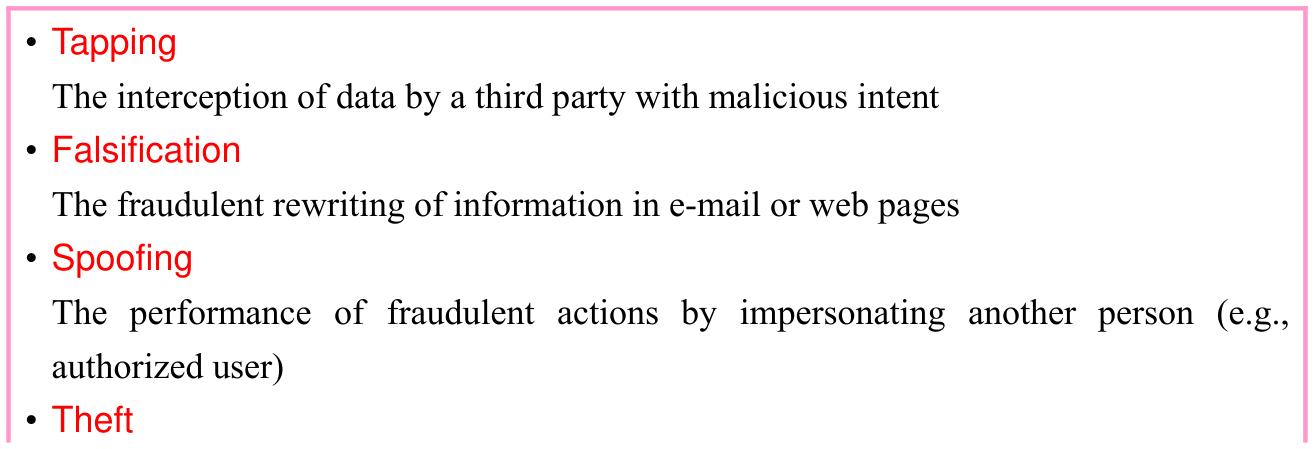
p. 355

Threats are classified into three types as follows:
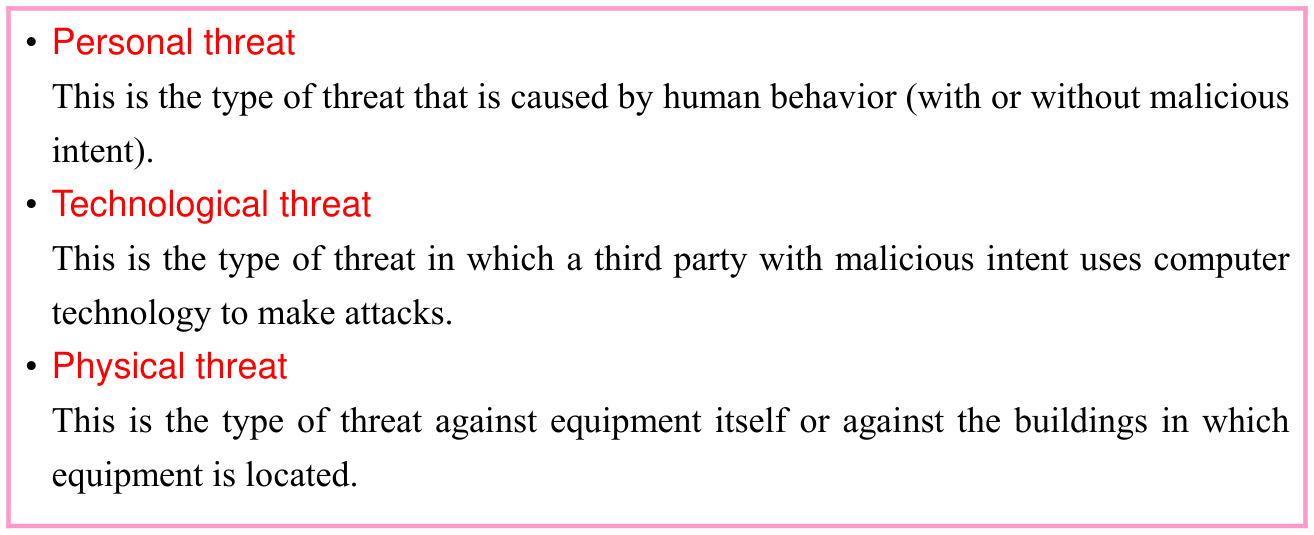
Specific examples of each type of threat are presented below. A case that corresponds to more than one type of threat is included among the type of threat that displays its characteristics most strongly.
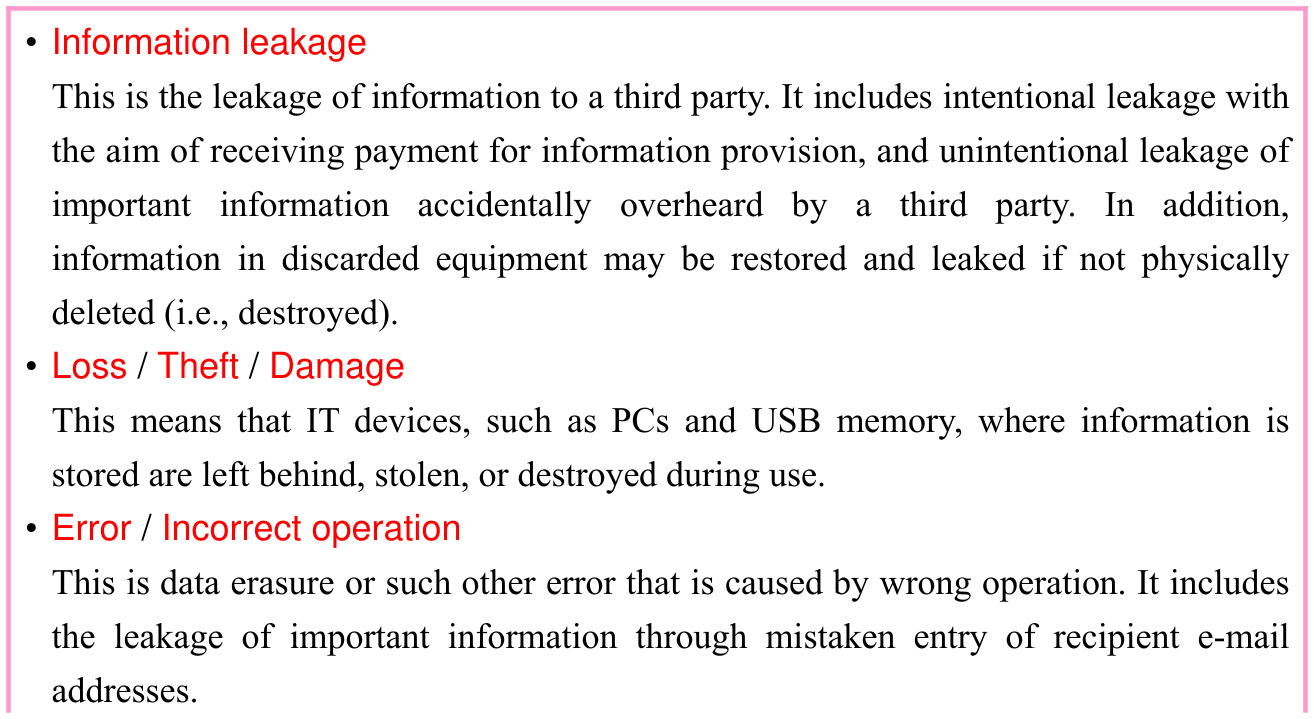
(1) Personal threats
Typical examples of personal threats include the following. In particular, the acts that are recognized as fraudulent are sometimes termed fraudulent behavior.
p. 356
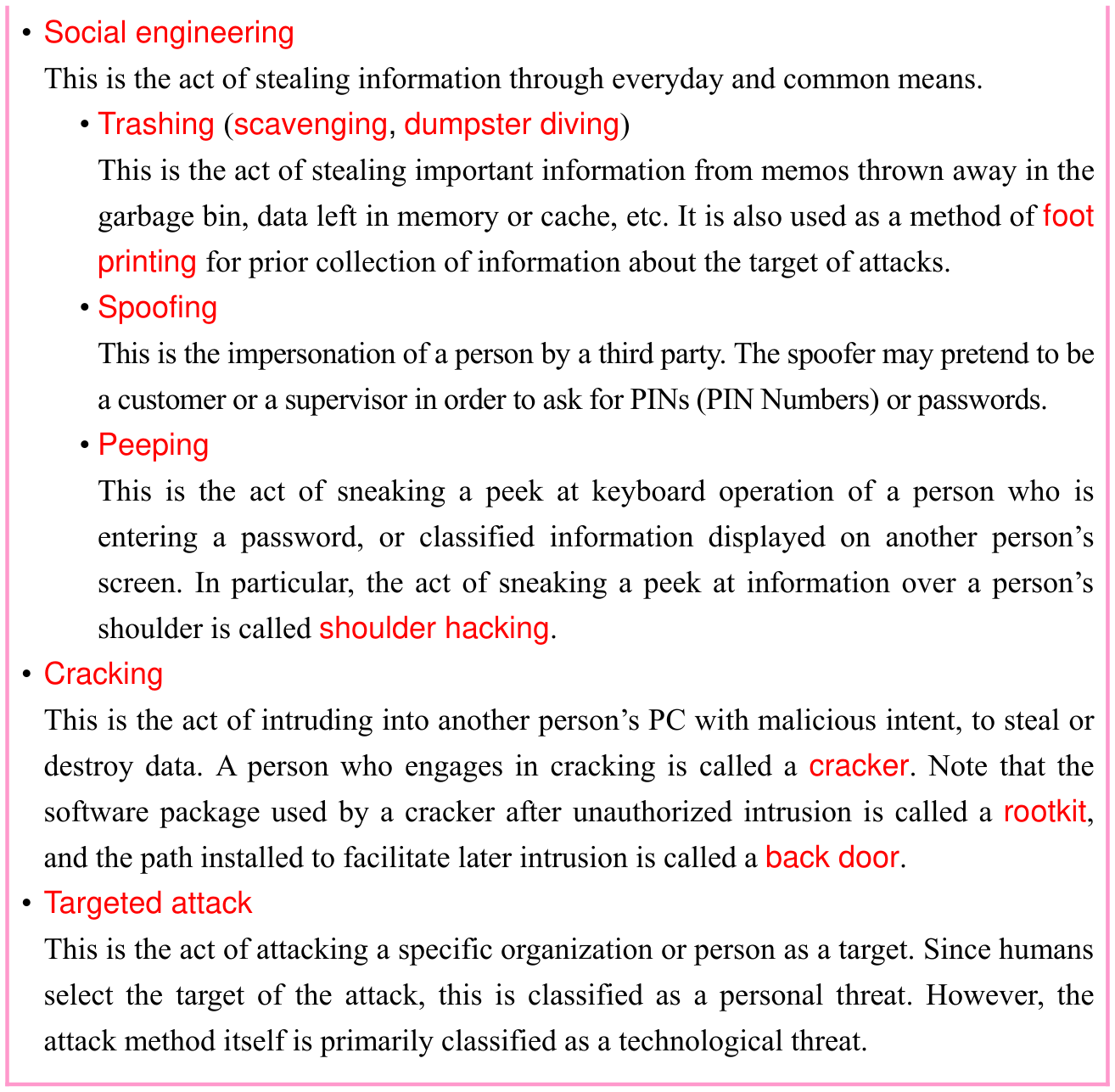
(2) Technological threats
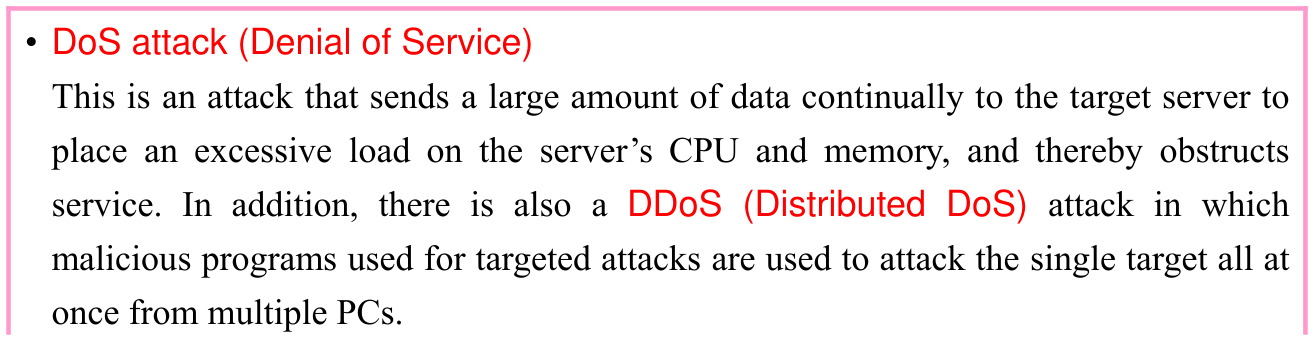
Typical examples of technological threats include unauthorized access or denial of service using computer technology, and computer crime. The compromise of safety due to advances in computer technology can also be called a technological threat. Typical attack methods using computer technology, which are classified as technological threats, include the following.
p. 357
- • Key logger
This is an attack that uses the mechanism (e.g., software) that records keyboard input, and fraudulently acquires information (e.g., password) entered by another person. · 1 question - • Clickjacking
This is an attack that sets up a web page with some sort of function that causes a user’s click to execute operations not intended by the user. - • Phishing
This is an attack that leads a user to a fake website through means such as e-mail pretending to be sent from a real company (e.g., financial institution), and defrauds the user of the credit card number, a bank account number, a PIN, and other personal information. · 1 question - • Cache poisoning
This is an attack that fraudulently overwrites cache information. In particular, DNS cache poisoning, which overwrites DNS cache, is used to lead users to fake websites for phishing. · 3 questions - • IP spoofing
This is an attack that sends packets to another party with the source IP address disguised. This is used in actions including leading users to fake websites for phishing. - • XSS (Cross Site Scripting)
This is an attack where a vulnerable target website is used as a stepping stone; a malicious script is sent to a user who is accessing the target website, and then executed on the user’s browser to enable the theft of information. · 2 questions - • CSRF (Cross Site Request Forgery)
This is an attack which, when a user is logged in to a website and then accesses another website that has a trap installed, causes a malicious request to be sent to and executed by the logged-in website in the guise of a request from the user (i.e., as a forgery). - • Session hijacking
This is an attack that takes over a session (i.e., a series of communications between specified parties) during communication between correctly authorized users. - • Directory traversal
This is an attack that accesses normally undisclosed directories (or files) by appending “../” to file names, to traverse upward through directories. - • Drive-by download
This is an attack that causes a user to download a malicious program, without permission during website browsing. - • SQL injection
p. 358
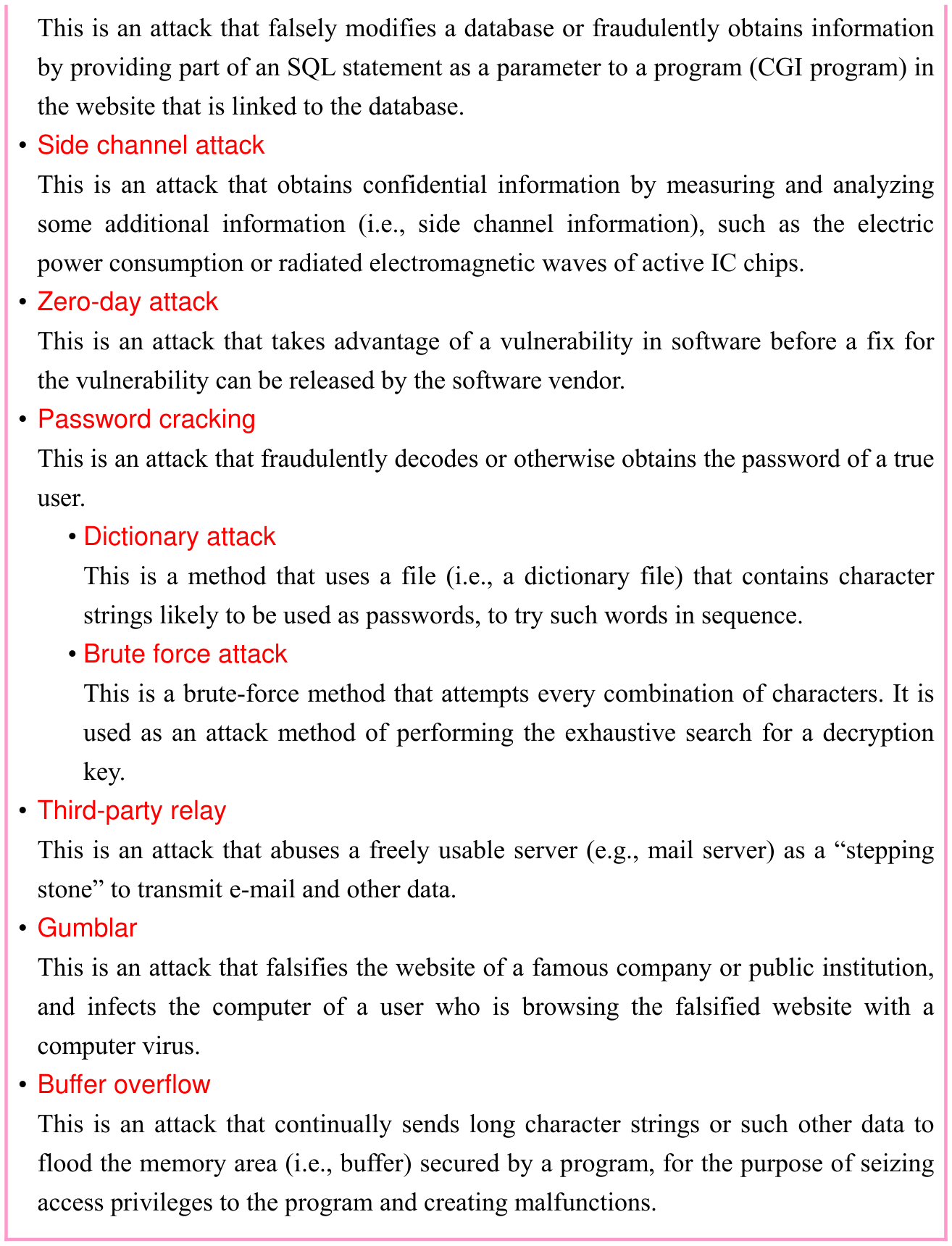
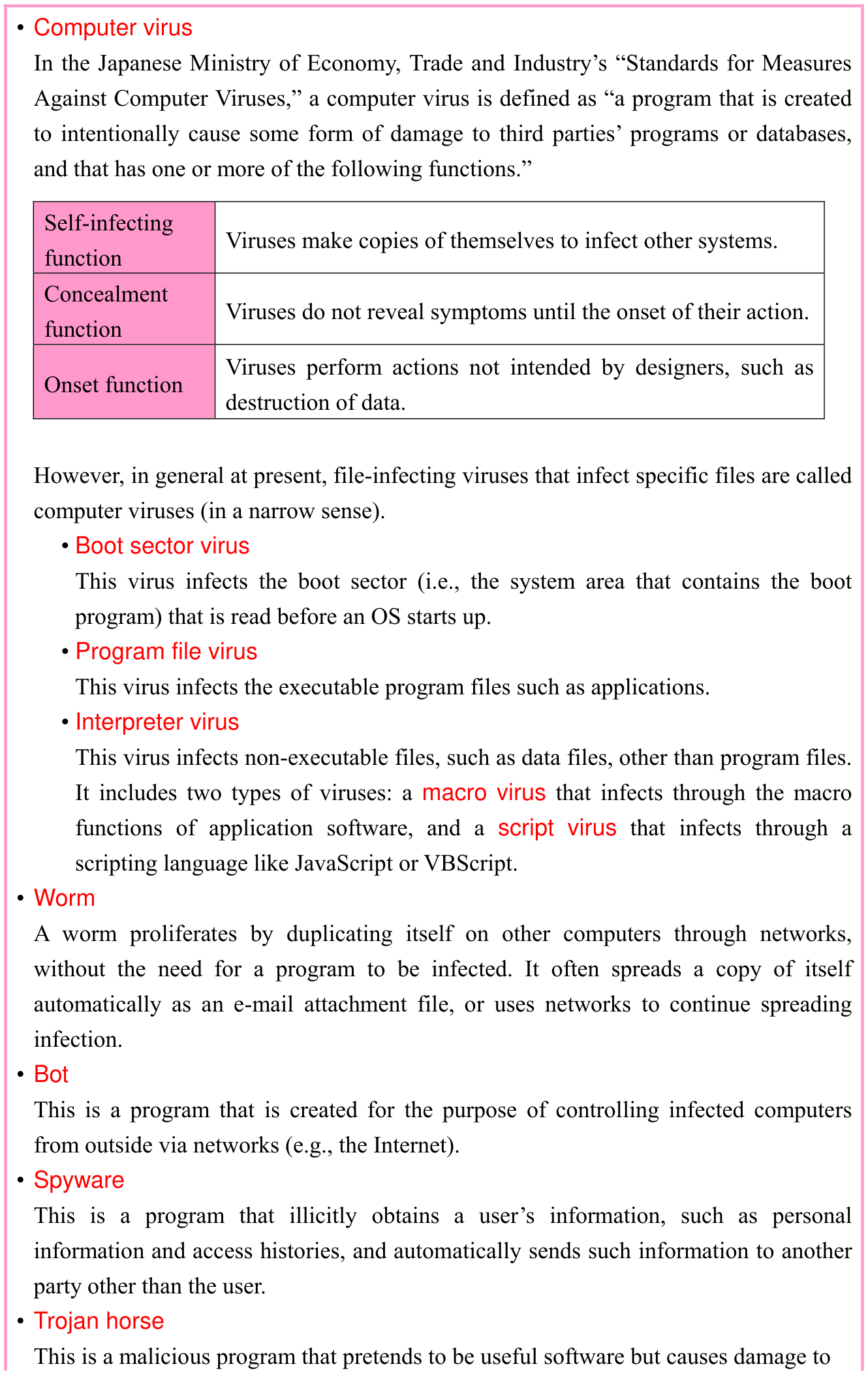
Fraudulent programs (i.e., malware) created with malicious intent are also classified as technological threats. The following are typical examples of malware.
p. 359
p. 360

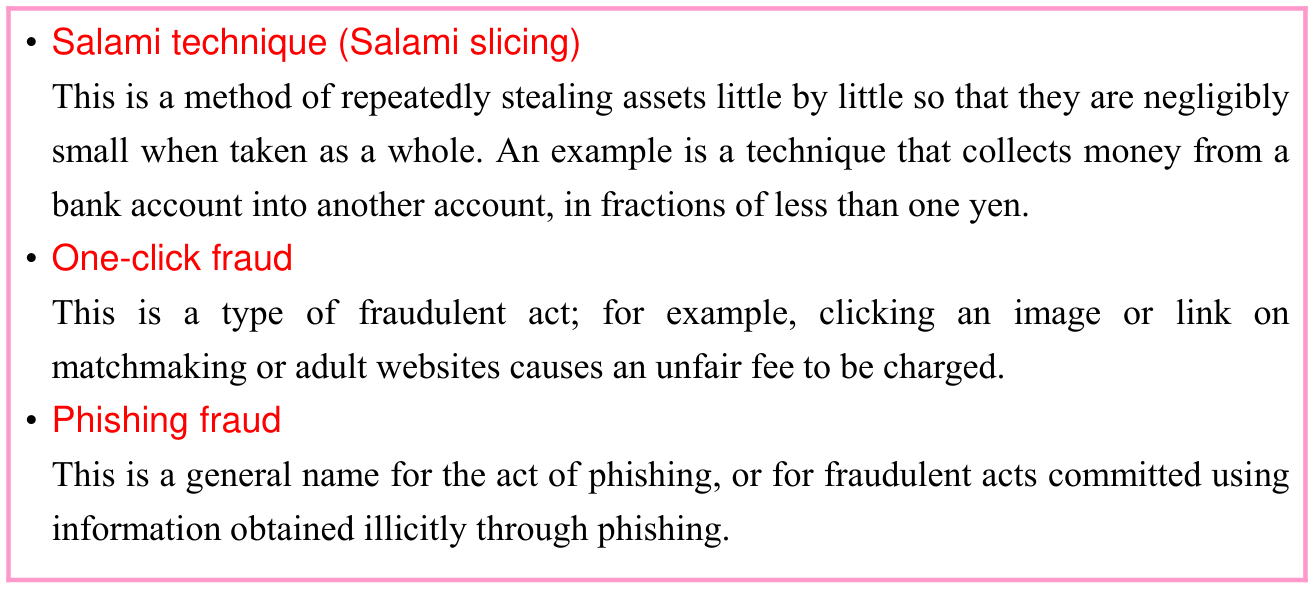
The following computer crimes are also said to be types of technological threats.
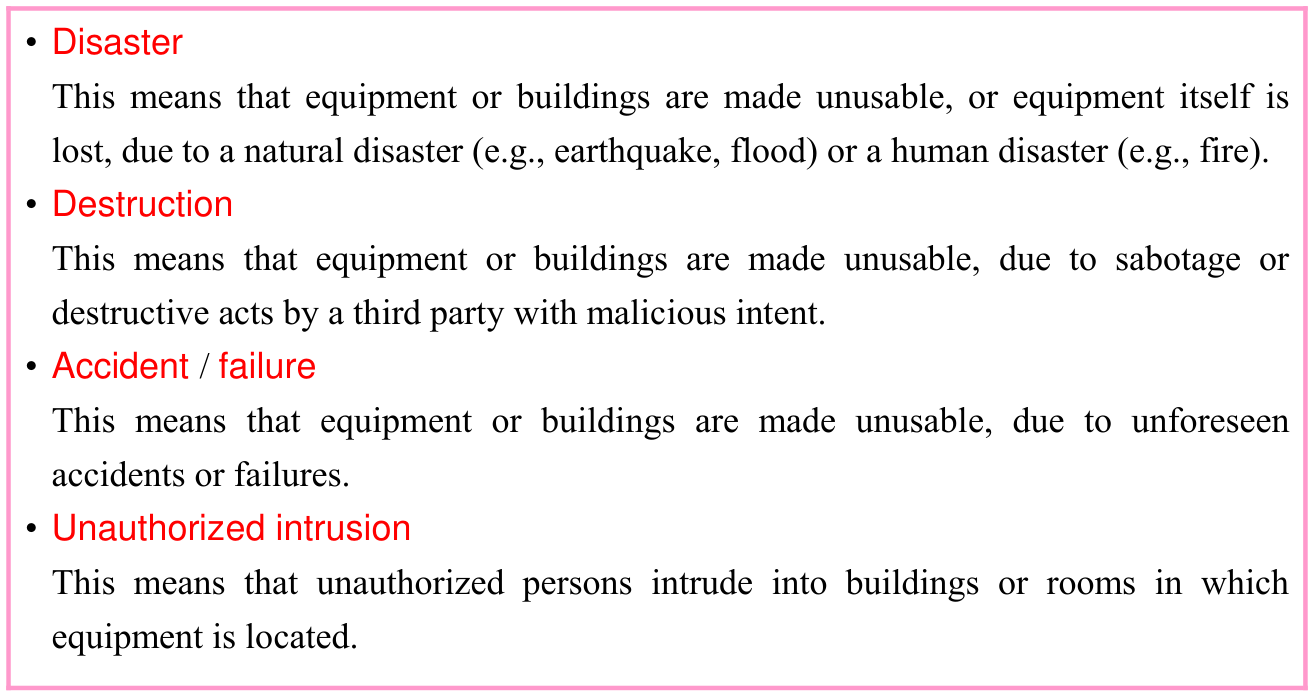
(3) Physical threats
The following are typical examples of physical threats.
Section progress
Original chapter exercises
Original chapter exercises →New FE Textbook Vol.1 · IT Fundamentals · First Edition, April 2015