Contents
Chapter 6 · SecurityPractice

LEARN WITH HARU

Video Lesson တွေက Haru အတန်းသားတွေအတွက်ပါ

Haru ရဲ့ ITPEC FE Full Course မှာ ယခု သင်ခန်းစာတွေကို တစ်ခုချင်း တစ်ကြောင်းချင်း အသေးစိတ်ရှင််ရှင်းပြထားပါတယ်

အခြေခံ မရှိတဲ့ ကျောင်းသားများစွာဟာလည်း ဒီ Course နဲ့ ပဲ အောင်မြင်ကုန်ကြပါပြီ

အတန်းမအပ်သေးပဲ Haru ဆီမှာ အစမ်းသင်ကြည့်ချင်ပါသလား?

သင်တန်းသားတွေရဲ့ စကားသံများ

သင်တန်းသားတွေရဲ့ စကားသံများ

Highlighted text? Practice this concept. Highlighted passages and figures open related questions.

Practice related questions (13)Progress & bookmarks

Current section

1-2 Information Security Technology

p. 361

Practice this section 13 linked exam questions with default filters

Progress

Not marked complete

Related questions in this lesson 8

Encryption against information leakage2Recipient public-key encryption4Original public-key procedure3Session key cryptography1Original session key procedure1Symmetric encryption with AES1
Progress and bookmarks

p. 361

1 - 2 Information Security Technology

Information security technology is computer technology used within the technological measures that are implemented as information security measures.

1-2-1 Cryptography
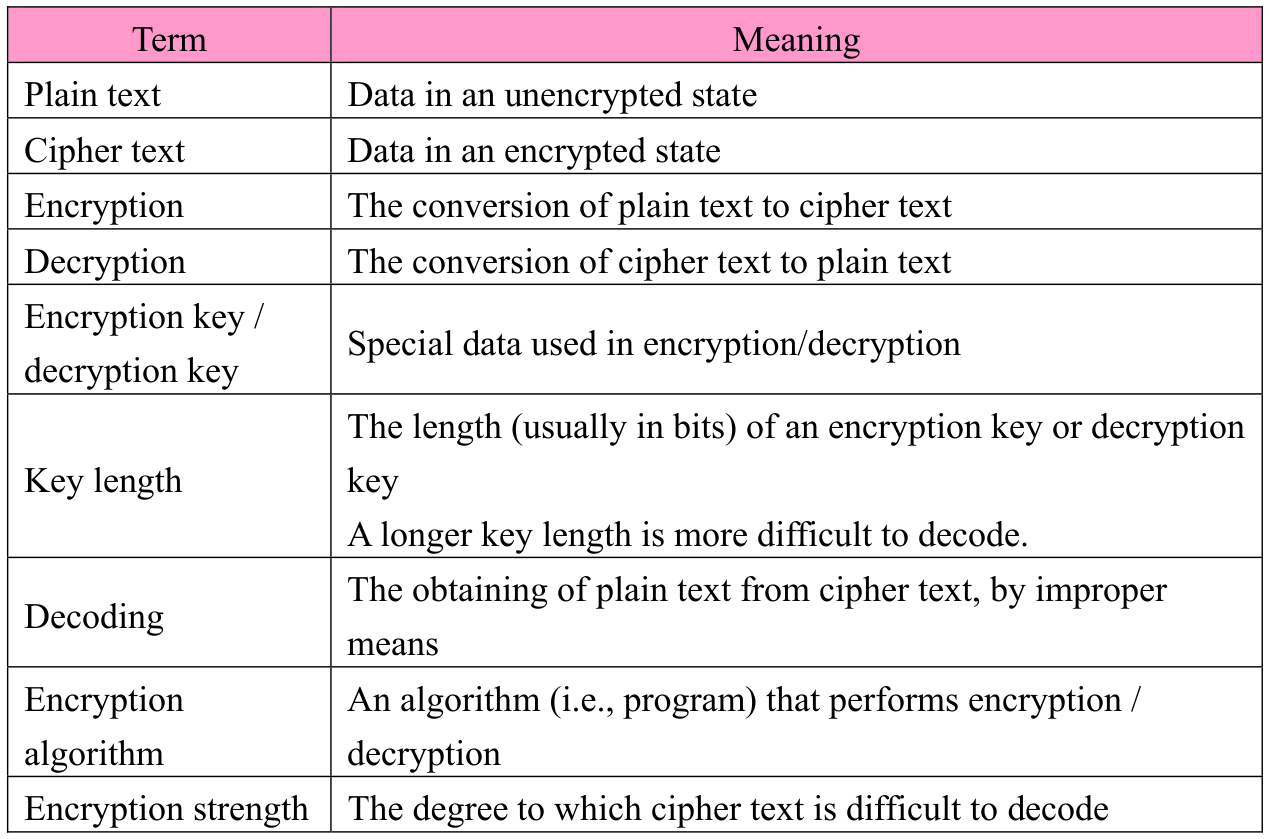
Cryptography is encryption technology implemented as measures against information leakage or measures against tapping of communications. Terminology that pertains to cryptography is defined as follows: · 2 questions

Original Security textbook callout or table, preserving the original labels, values, symbols and spatial arrangement. Source text: Term Meaning Plain text Data in an unencrypted state Cipher text Data in an encrypted state Encryption The conversion of plain text to cipher text Decryption The conversion of cipher text to plain text Encryption key / Special data used in encryption/decryption decryption key The length (usually in bits) of an encryption key or decryption Key length key A longer key length is more difficult to decode. The obtaining of plain text from cipher text, by improper Decoding means Encryption An algorithm (i.e., program) that performs encryption / algorithm decryption Encryption strength The degree to which cipher text is difficult to decode
p. 361 · Enlarge

p. 362

(1) Common key cryptography

Common key cryptography (also known as symmetric key cryptography or secret key cryptography) is a method for performing encryption/decryption between parties that exchange data, using a common key. This encryption method performs both encryption and decryption using the same key, and therefore, the parties must in advance have a common key that is kept secret from third parties.
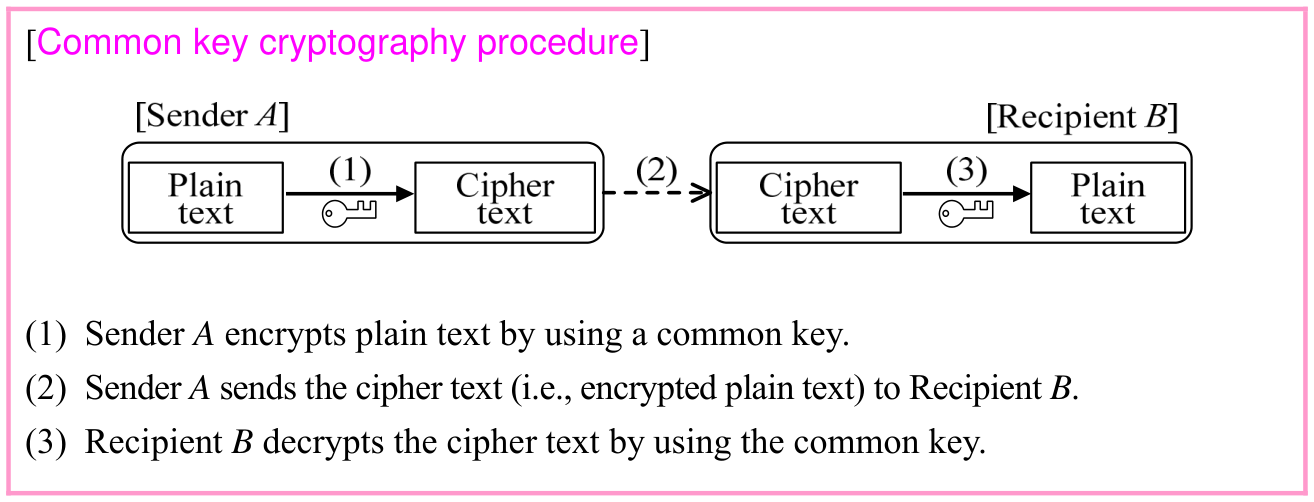
Common key cryptography procedure: Sender A encrypts plain text with the common key, transmits cipher text to Recipient B, and Recipient B decrypts with that same common key. Original numbered arrows and key symbols are preserved. Source text: [Common key cryptography procedure] (1) Sender A encrypts plain text by using a common key. (2) Sender A sends the cipher text (i.e., encrypted plain text) to Recipient B. (3) Recipient B decrypts the cipher text by using the common key.
p. 362 · Enlarge

Typical methods of common key cryptography include AES (Advanced Encryption Standard) from the NIST (National Institute of Standards and Technology) which adopted the Rijndael method, TripleDES which repeats DES three times, and IDEA (International Data Encryption Algorithm) which repeats several rounds of the XOR (exclusive OR), addition, and multiplication operations. · 1 question

(2) Public key cryptography

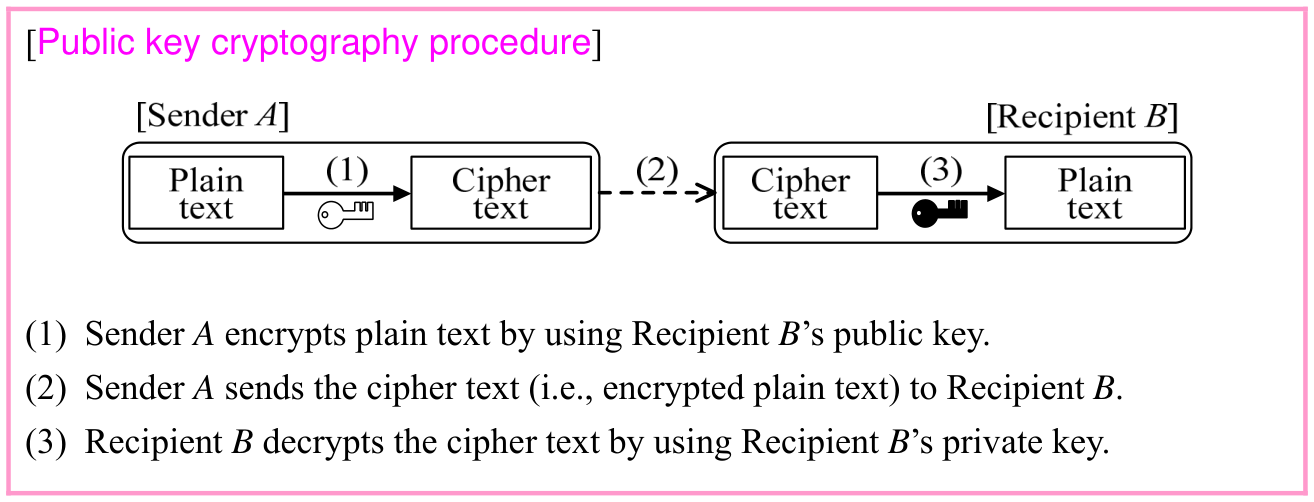
Public key cryptography is a method that uses a pair of private key and public key. The private key is concealed by its owner, while the public key is disclosed or distributed, and is made usable by anyone. This cryptography can encrypt plain text by using one key, and can decrypt the cipher text with the other key. However, this does not mean that the public key is always used for encryption and the private key for decryption; rather, they are used according to purpose (see details later). In order to prevent decryption of encrypted text by third parties when measures against information leakage or measures against tapping of communications are taken, encryption is performed with the recipient’s public key, and decryption with the recipient’s private key. · 4 questions

p. 363

Public key cryptography procedure: Sender A encrypts with Recipient B's public key, sends cipher text, and Recipient B decrypts with B's private key. Original numbered arrows and key symbols are preserved. Source text: [Public key cryptography procedure] (1) Sender A encrypts plain text by using Recipient B’s public key. (2) Sender A sends the cipher text (i.e., encrypted plain text) to Recipient B. (3) Recipient B decrypts the cipher text by using Recipient B’s private key.
p. 363 · Enlarge
Original public-key procedure · 3 practice questions

Typical methods of public key cryptography include RSA (from the initials of the three developers, Rivest, Shamir, and Adleman), ElGamal encryption which applies the discrete logarithm problem, and Elliptic Curve Cryptography which uses elliptic curve equations.

The strengths and weaknesses of common key cryptography and public key cryptography can be summarized as follows:
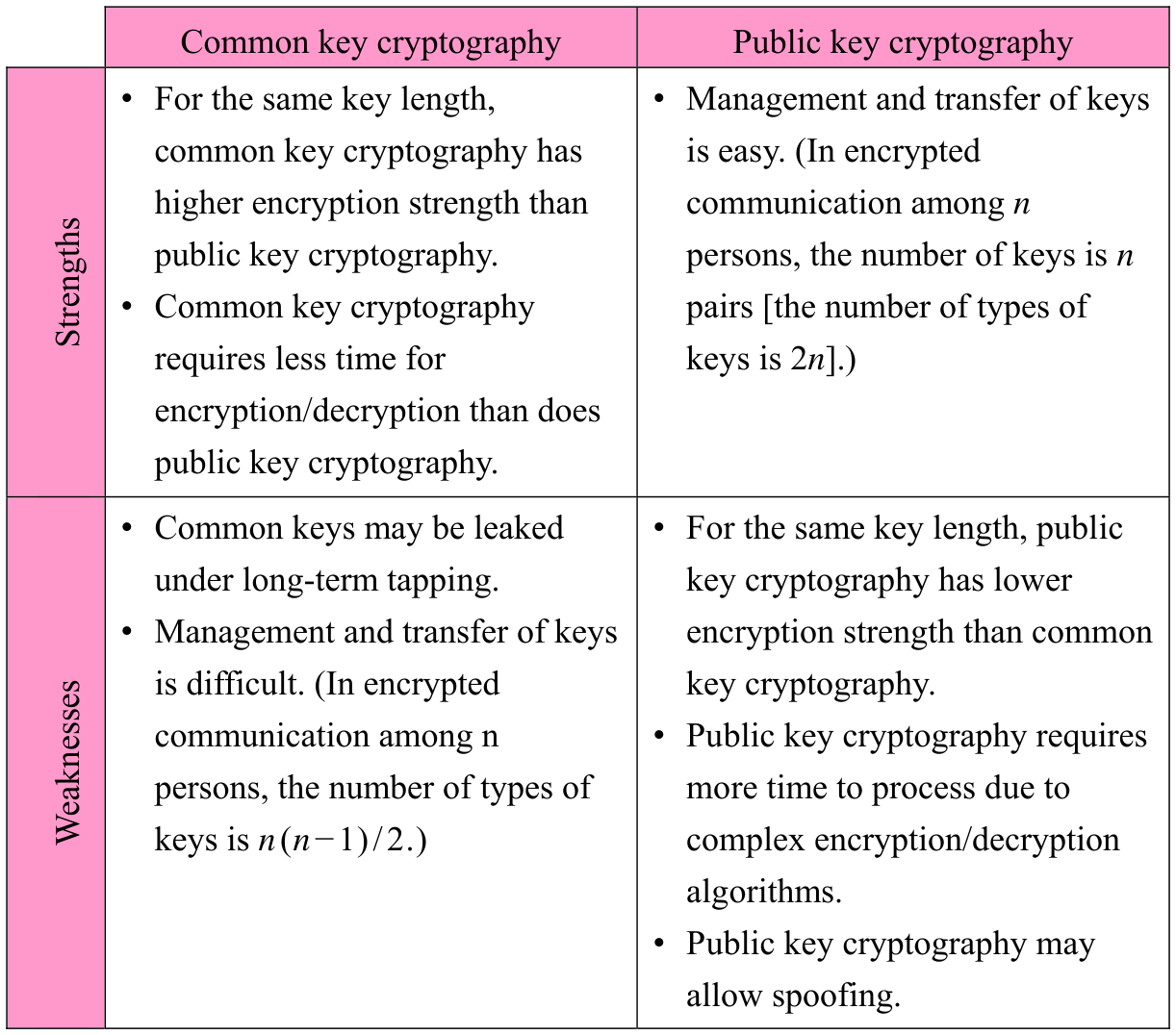
Original Security textbook callout or table, preserving the original labels, values, symbols and spatial arrangement. Source text: Common key cryptography Public key cryptography • For the same key length, • Management and transfer of keys common key cryptography has is easy. (In encrypted higher encryption strength than communication among n Strengths public key cryptography. persons, the number of keys is n • Common key cryptography pairs [the number of types of requires less time for keys is 2n].) encryption/decryption than does public key cryptography. • Common keys may be leaked • For the same key length, public under long-term tapping. key cryptography has lower • Management and transfer of keys encryption strength than common is difficult. (In encrypted key cryptography. Weaknesses communication among n • Public key cryptography requires persons, the number of types of more time to process due to keys is n(n−1)/2.) complex encryption/decryption algorithms. • Public key cryptography may allow spoofing.
p. 363 · Enlarge

p. 364

(3) Session key cryptography (hybrid cryptography)
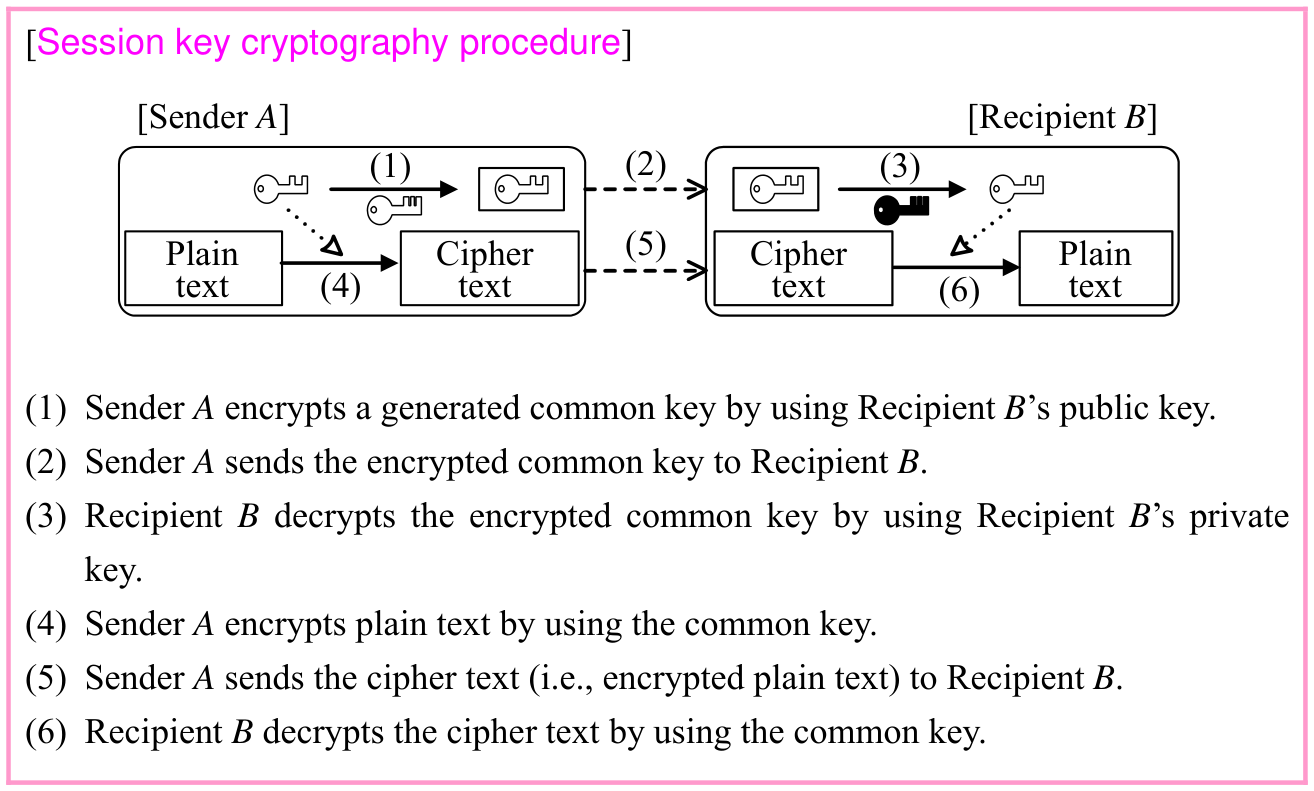
Session key cryptography (hybrid cryptography) uses public key cryptography for the transfer of keys, which has a weakness of common key cryptography, and performs encrypted communication using common key cryptography. · 1 question

Session key cryptography procedure with six original numbered steps: the common key is transferred using B's public and private keys, then the communication data is encrypted and decrypted with the common key. Original distinct key icons and arrow directions are preserved. Source text: [Session key cryptography procedure] [Sender A] [Recipient B] (1) (2) (3) (5) Plain Cipher Cipher Plain text (4) text text text (6) (1) Sender A encrypts a generated common key by using Recipient B’s public key. (2) Sender A sends the encrypted common key to Recipient B. (3) Recipient B decrypts the encrypted common key by using Recipient B’s private key. (4) Sender A encrypts plain text by using the common key. (5) Sender A sends the cipher text (i.e., encrypted plain text) to Recipient B. (6) Recipient B decrypts the cipher text by using the common key.
p. 364 · Enlarge
Original session key procedure · 1 practice questions

In session key cryptography, common keys are generated using means such as a hash function (i.e., a function that obtains a unique, fixed-length output value from an input value) which is based on the communication session number or a random number. The generation of a common key is performed for each encrypted communication session, and the key is transferred using public key cryptography. For that reason, damage is limited even if the common key is leaked. In addition, since only one pair of public key and private key usually needs to be managed, management of keys is simple, and encrypted communication can be carried out at high speed by using common key cryptography. In other words, this approach can be said to combine the strengths of common key cryptography and public key cryptography. However, even session key cryptography is not able to eliminate the possibility of spoofing.

p. 365
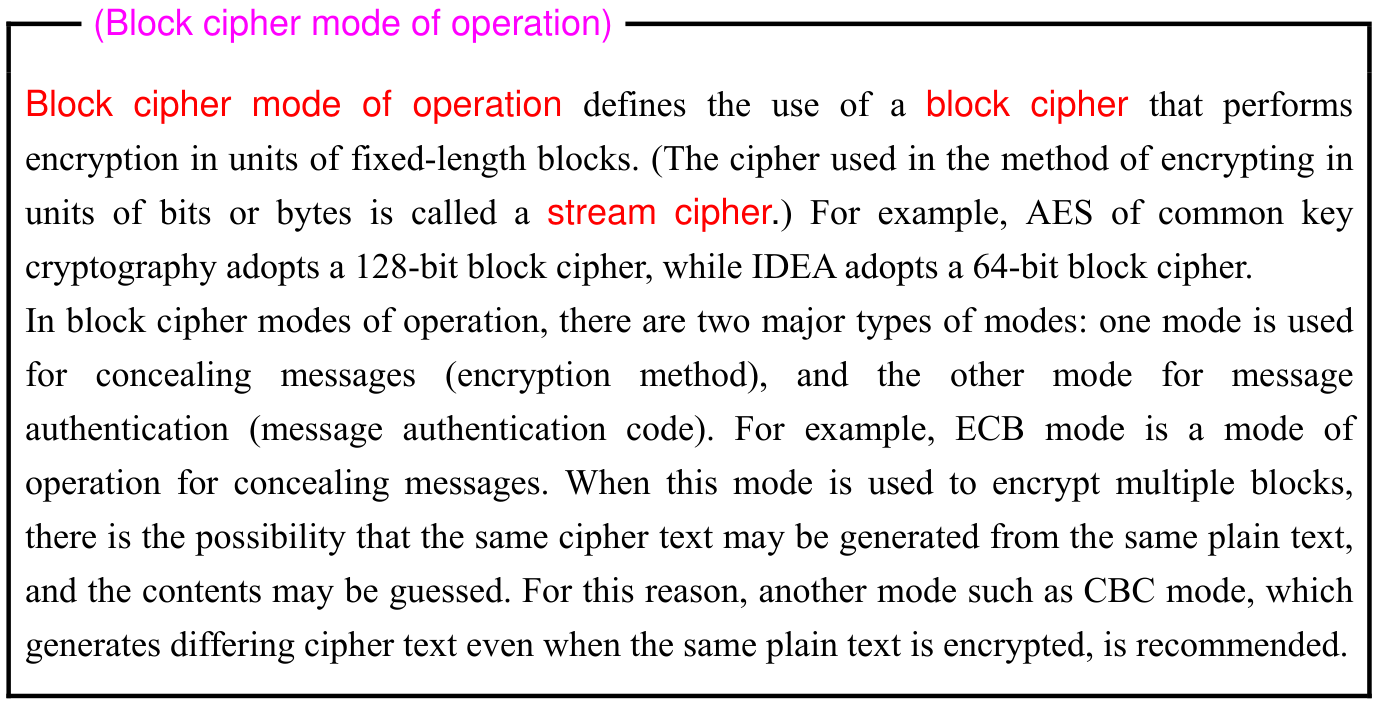
Original Security textbook callout or table, preserving the original labels, values, symbols and spatial arrangement. Source text: (Block cipher mode of operation) Block cipher mode of operation defines the use of a block cipher that performs encryption in units of fixed-length blocks. (The cipher used in the method of encrypting in units of bits or bytes is called a stream cipher.) For example, AES of common key cryptography adopts a 128-bit block cipher, while IDEA adopts a 64-bit block cipher. In block cipher modes of operation, there are two major types of modes: one mode is used for concealing messages (encryption method), and the other mode for message authentication (message authentication code). For example, ECB mode is a mode of operation for concealing messages. When this mode is used to encrypt multiple blocks, there is the possibility that the same cipher text may be generated from the same plain text, and the contents may be guessed. For this reason, another mode such as CBC mode, which generates differing cipher text even when the same plain text is encrypted, is recommended.
p. 365 · Enlarge

Original chapter exercises

Original chapter exercises →

New FE Textbook Vol.1 · IT Fundamentals · First Edition, April 2015