Contents
Chapter 6 · SecurityPractice

LEARN WITH HARU

Video Lesson တွေက Haru အတန်းသားတွေအတွက်ပါ

Haru ရဲ့ ITPEC FE Full Course မှာ ယခု သင်ခန်းစာတွေကို တစ်ခုချင်း တစ်ကြောင်းချင်း အသေးစိတ်ရှင််ရှင်းပြထားပါတယ်

အခြေခံ မရှိတဲ့ ကျောင်းသားများစွာဟာလည်း ဒီ Course နဲ့ ပဲ အောင်မြင်ကုန်ကြပါပြီ

အတန်းမအပ်သေးပဲ Haru ဆီမှာ အစမ်းသင်ကြည့်ချင်ပါသလား?

သင်တန်းသားတွေရဲ့ စကားသံများ

သင်တန်းသားတွေရဲ့ စကားသံများ

Highlighted text? Practice this concept. Highlighted passages and figures open related questions.

Practice related questions (8)Progress & bookmarks

p. 365

1-2-2 Authentication Technique

(1) User authentication

User authentication is an authentication technique that includes the process of verifying a user’s identity. It is used as a measure against the impersonation of authorized users by malicious third parties. In user authentication, there are a variety of methods according to purpose and application.

(1) User ID/Password A user ID is an identifier that is assigned to an individual user, while a password is a character string (i.e., a keyword) that is registered in advance. During the login process, this technique searches for a registered password corresponding the user ID entered by the user. If the registered password matches the password entered by the user, the user is authenticated as a valid user who knows the password. When this technique is used, it is necessary for users to thoroughly follow password management and password requirements to prevent any abuse of passwords.
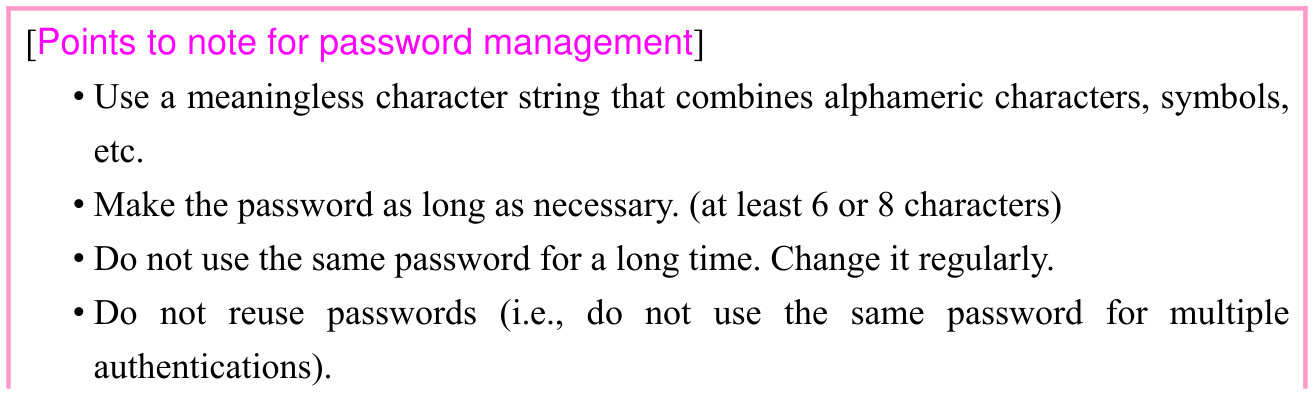
Original Security textbook callout or table, preserving the original labels, values, symbols and spatial arrangement. Source text: [Points to note for password management] • Use a meaningless character string that combines alphameric characters, symbols, etc. • Make the password as long as necessary. (at least 6 or 8 characters) • Do not use the same password for a long time. Change it regularly. • Do not reuse passwords (i.e., do not use the same password for multiple authentications).
p. 365 · Enlarge

p. 366

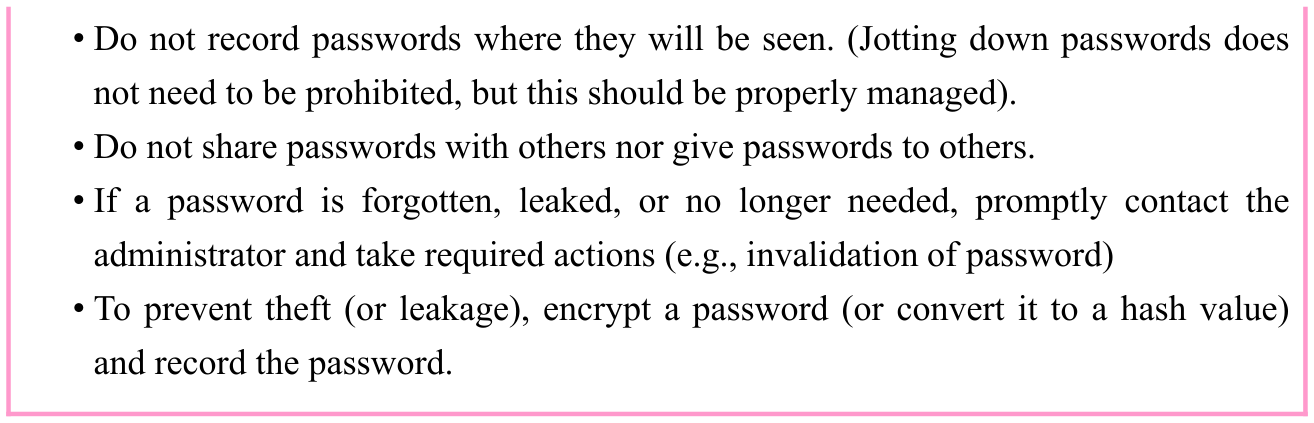
Original Security textbook callout or table, preserving the original labels, values, symbols and spatial arrangement. Source text: • Do not record passwords where they will be seen. (Jotting down passwords does not need to be prohibited, but this should be properly managed). • Do not share passwords with others nor give passwords to others. • If a password is forgotten, leaked, or no longer needed, promptly contact the administrator and take required actions (e.g., invalidation of password) • To prevent theft (or leakage), encrypt a password (or convert it to a hash value) and record the password.
p. 366 · Enlarge
Forgotten password handling · 1 practice questions

(2) IC card This is a technique that authenticates users through plastic IC cards with embedded IC chips that are able to record information. It is used for commuter passes, employee ID cards, etc. When an IC card is used, the user may be asked to enter the PIN code (Personal Identification Number) recorded in the IC chip in order to confirm that the user is the rightful holder of the card. IC cards have over 100 times more storage capacity than magnetic cards and enable data encryption to make the cards resistant to forgery. The cards also have an advantage in tamper resistance to prevent unauthorized access or falsification.

(3) OTP (One-Time Password) This is a password-based user authentication technique that is primarily used by computers connected to communication lines. By using a different password for each login, this technique avoids the risk of password leakage. Typical one-time password methods are as follows:
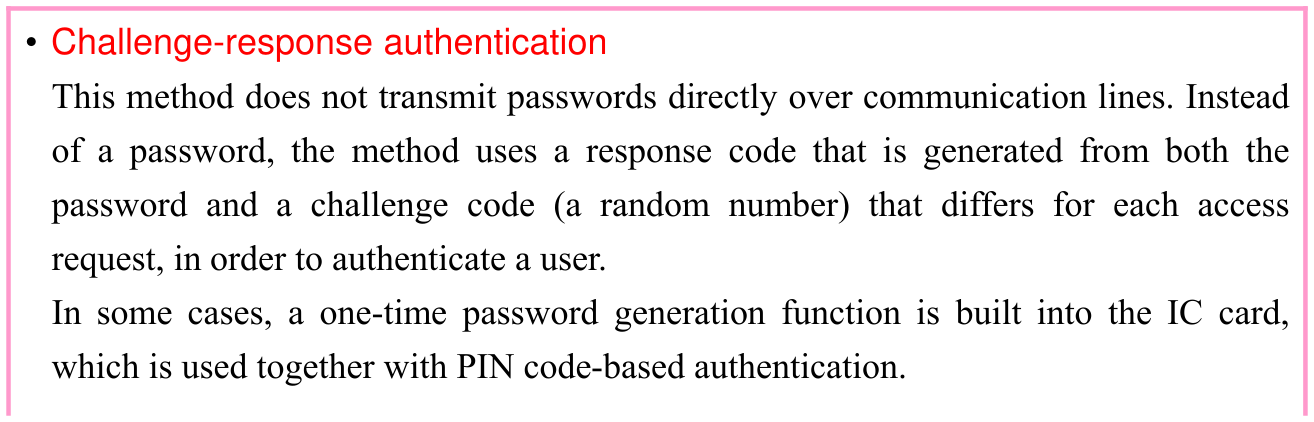
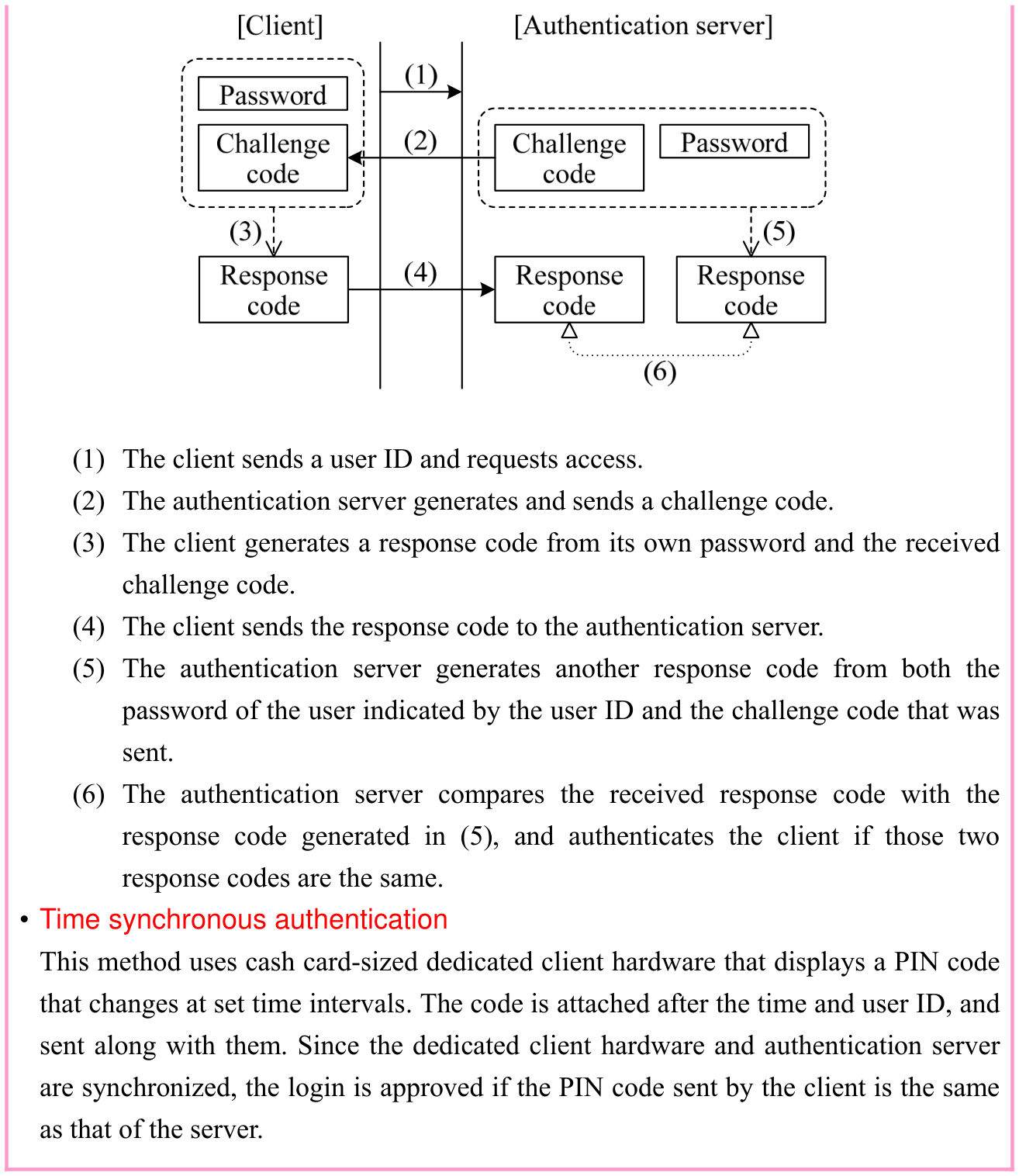
Original Security textbook callout or table, preserving the original labels, values, symbols and spatial arrangement. Source text: • Challenge-response authentication This method does not transmit passwords directly over communication lines. Instead of a password, the method uses a response code that is generated from both the password and a challenge code (a random number) that differs for each access request, in order to authenticate a user. In some cases, a one-time password generation function is built into the IC card, which is used together with PIN code-based authentication.
p. 366 · Enlarge

p. 367

Challenge-response authentication: parallel client and authentication-server columns preserve ID request, server challenge, local response generation, transmitted response, server calculation and comparison, with the six original numbered arrows and operations. Source text: (1) The client sends a user ID and requests access. (2) The authentication server generates and sends a challenge code. (3) The client generates a response code from its own password and the received challenge code. (4) The client sends the response code to the authentication server. (5) The authentication server generates another response code from both the password of the user indicated by the user ID and the challenge code that was sent. (6) The authentication server compares the received response code with the response code generated in (5), and authenticates the client if those two response codes are the same. • Time synchronous authentication This method uses cash card-sized dedicated client hardware that displays a PIN code that changes at set time intervals. The code is attached after the time and user ID, and sent along with them. Since the dedicated client hardware and authentication server are synchronized, the login is approved if the PIN code sent by the client is the same as that of the server.
p. 367 · Enlarge

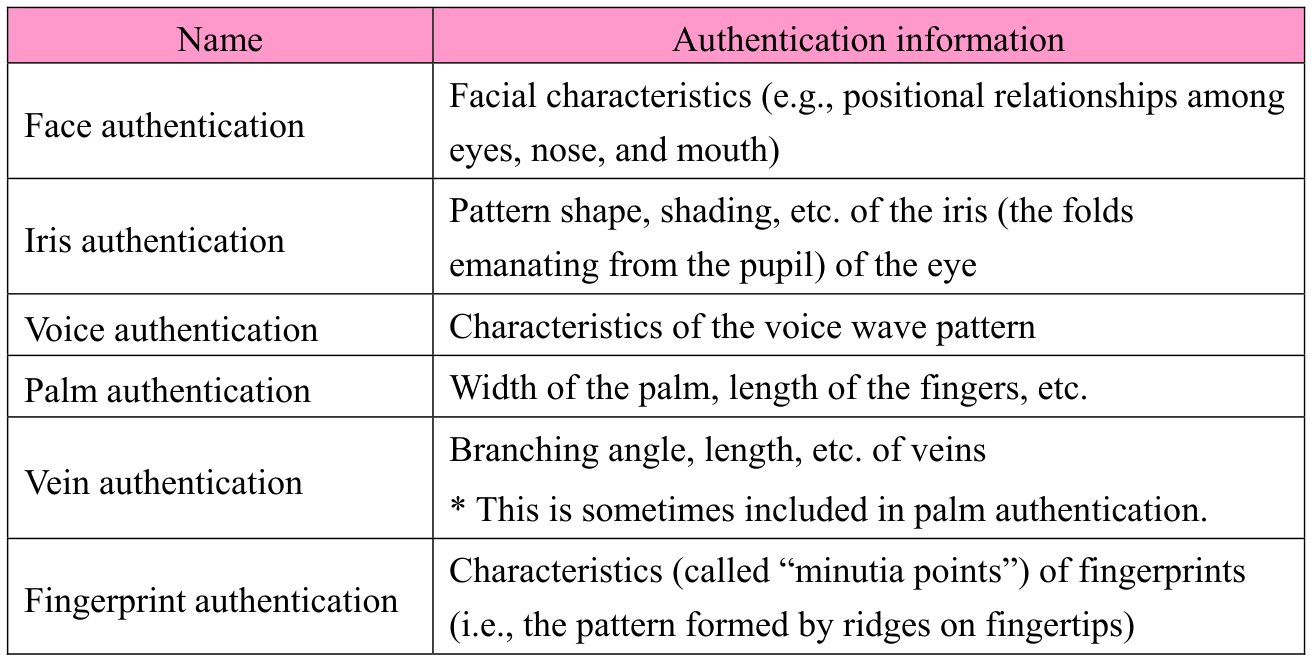
(4) Biometric authentication This authentication technique identifies an individual (i.e., a user) by using physical information or behavioral information (e.g., speed or pen pressure used in a signature) that is unique to the individual, and such information is registered in advance on the authentication system. In addition to managing entry into secure areas, this authentication is also used by bank ATMs and individual PCs. Although it is effective in preventing spoofing, it requires special authentication systems and continues to present issues in areas such as authentication precision (FRR (False Rejection Rate) and FAR (False Acceptance Rate)), difficulty of substitution, adaptation to physical changes over time, and personal information protection. · 1 question

p. 368

Original Security textbook callout or table, preserving the original labels, values, symbols and spatial arrangement. Source text: Name Authentication information Facial characteristics (e.g., positional relationships among Face authentication eyes, nose, and mouth) Pattern shape, shading, etc. of the iris (the folds Iris authentication emanating from the pupil) of the eye Voice authentication Characteristics of the voice wave pattern Palm authentication Width of the palm, length of the fingers, etc. Branching angle, length, etc. of veins Vein authentication * This is sometimes included in palm authentication. Characteristics (called “minutia points”) of fingerprints Fingerprint authentication (i.e., the pattern formed by ridges on fingertips)
p. 368 · Enlarge
Iris biometric authentication · 1 practice questions

(5) Public key cryptography This is an authentication technique that uses private keys that are kept secret by the holders.
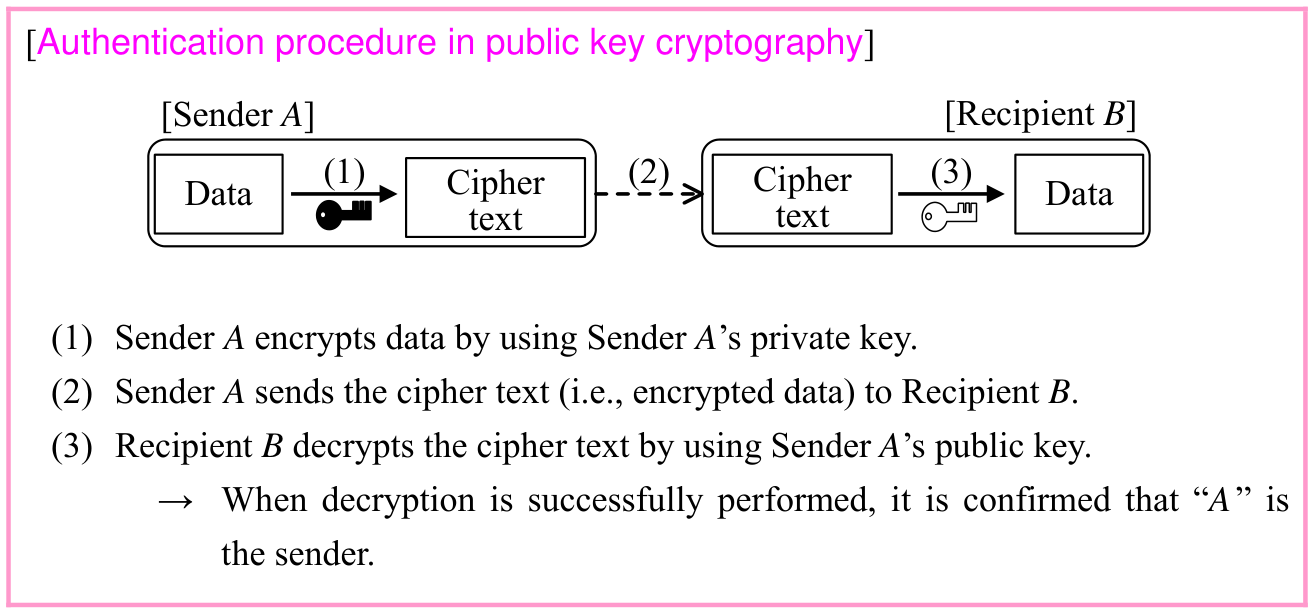
Authentication using public key cryptography: Sender A encrypts data with A's private key; Recipient B decrypts with A's public key. Original three numbered operations, transmission arrow and sender-authentication clarification remain intact. Source text: [Authentication procedure in public key cryptography] [Sender A] [Recipient B] (1) (2) (3) Cipher Cipher Data Data text text (1) Sender A encrypts data by using Sender A’s private key. (2) Sender A sends the cipher text (i.e., encrypted data) to Recipient B. (3) Recipient B decrypts the cipher text by using Sender A’s public key. → When decryption is successfully performed, it is confirmed that “A” is the sender.
p. 368 · Enlarge

Step (3) is the key point in user authentication. The fact that Recipient B successfully performed decryption using Sender A’s public key means that the cipher text had been encrypted using A’s private key (because cipher text encrypted from plain text by using one of the key pairs can only be decrypted using the other key). Since only A has (i.e., conceals) A’s private key, this cipher text cannot be created by any party other than A. In other words, it is confirmed (i.e., authenticated) that the sender is unquestionably A. However, it is necessary to note that this authentication works well on the assumption that A’s public key, which B has, must belong to A without doubt, and its paired private key must be owned by A alone.

p. 369

(2) Message authentication
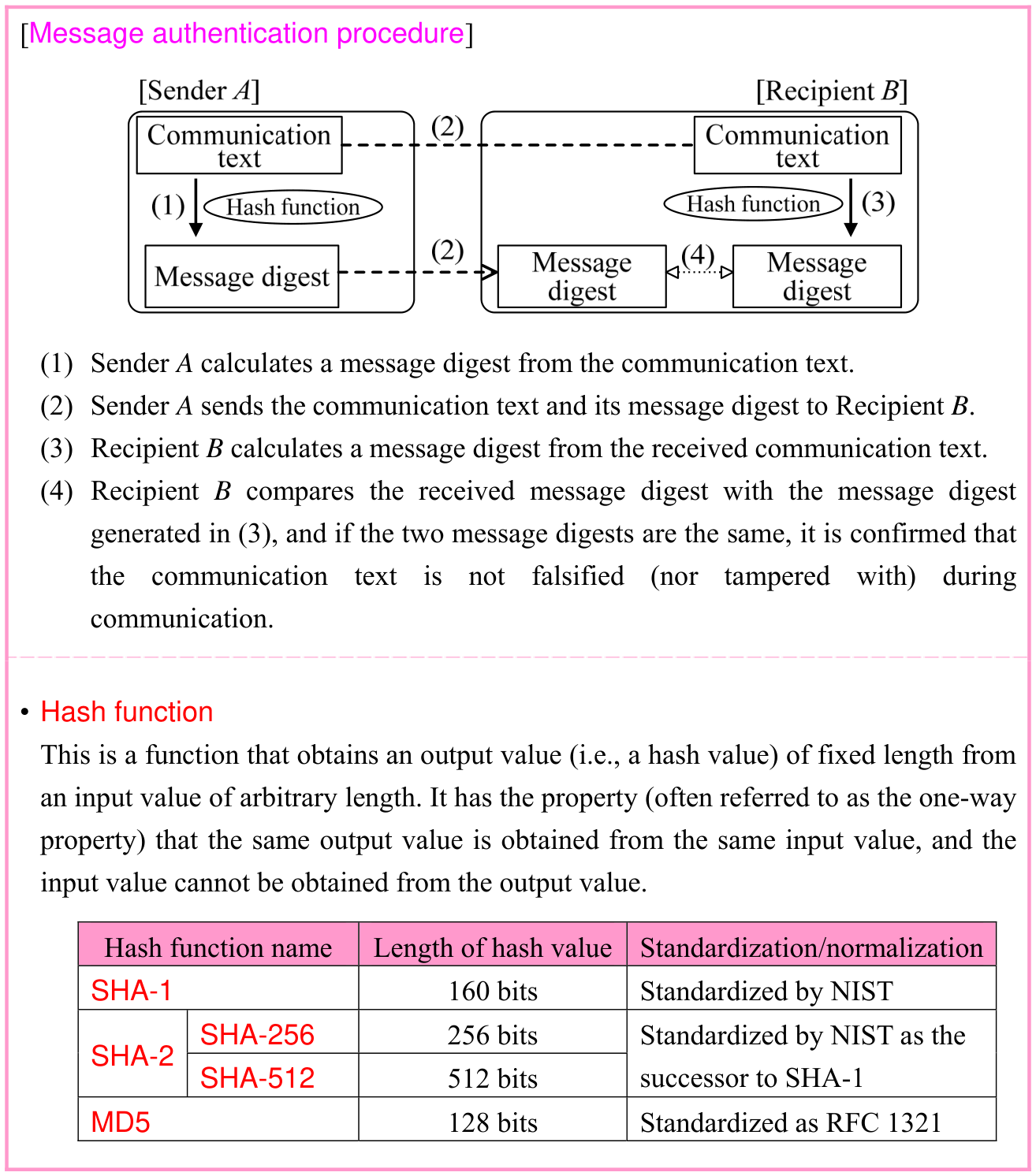
Message authentication is an authentication technique that confirms that data is not improperly overwritten. It is used as a measure to prevent falsification involving improper overwriting of data. As a typical message authentication method used in data communication, there is a method of calculating a message digest from the communication text (i.e., the data) by using a hash function. · 3 questions

Message authentication procedure: both sender and recipient hash the communication text, the text and message digest travel to the recipient, and the original comparison checks the two digests. Four numbered operations and all arrows are preserved. Source text: [Message authentication procedure] (1) Sender A calculates a message digest from the communication text. (2) Sender A sends the communication text and its message digest to Recipient B. (3) Recipient B calculates a message digest from the received communication text. (4) Recipient B compares the received message digest with the message digest generated in (3), and if the two message digests are the same, it is confirmed that the communication text is not falsified (nor tampered with) during communication. • Hash function This is a function that obtains an output value (i.e., a hash value) of fixed length from an input value of arbitrary length. It has the property (often referred to as the one-way property) that the same output value is obtained from the same input value, and the input value cannot be obtained from the output value. Hash function name Length of hash value Standardization/normalization SHA-1 160 bits Standardized by NIST SHA-2 SHA-256 256 bits Standardized by NIST as the SHA-512 512 bits successor to SHA-1 MD5 128 bits Standardized as RFC 1321
p. 369 · Enlarge
Original message digest procedure · 1 practice questions

On the basis of the property of a hash function, if there is even a small difference in the communication text between the sender side and the recipient side, the message digests that

p. 370

are delivered to and generated by the recipient side will be different, and as a result, falsification can be detected. However, when an already-known hash function is used, there is a possibility that both the communication text and the message digest can be falsified so as not to be detected. MAC (Message Authentication Code) is a technique that can resolve this issue. This method uses a key (i.e., a common key) owned by the sender and the recipient, and also uses a MAC value, which is calculated from the communication text plus the common key, as a message digest. (As a method for calculating the MAC value, a block cipher mode of operation or a hash function is used.) When this method is used, a third party who does not know the common key cannot calculate the correct MAC value, and therefore, the level of security is enhanced.

(3) Digital signature
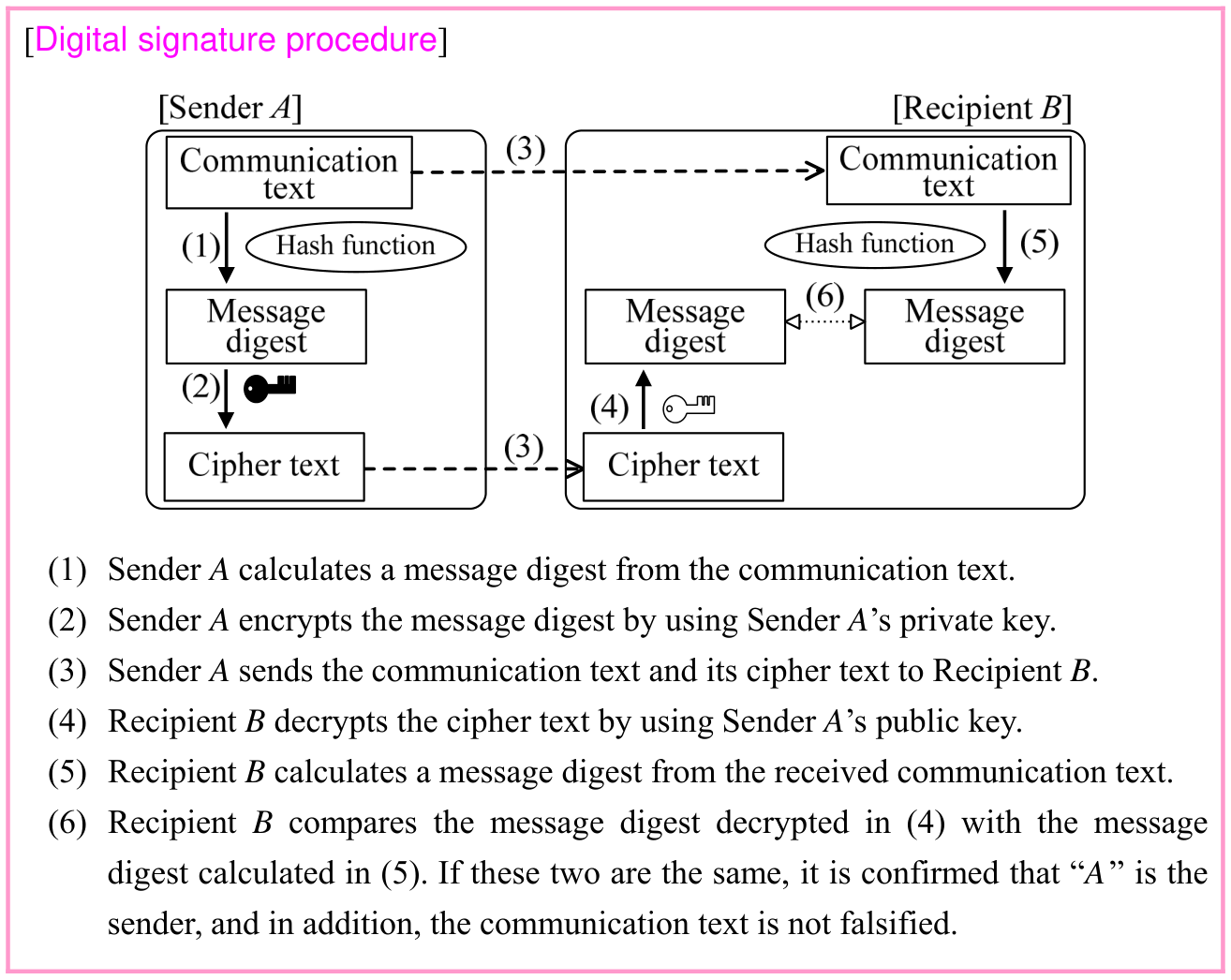
Digital signature is an authentication technique that combines user authentication and message authentication using public key cryptography. (To distinguish digital or other electronic-based signatures from regular signatures, these are sometimes called electronic signatures.) · 2 questions

Digital signature procedure: Sender A hashes text and encrypts its digest with A's private key; Recipient B decrypts with A's public key and compares against the locally computed digest. Original six numbered operations, keys, dashed transmission arrows and comparison remain intact. Source text: [Digital signature procedure] (1) Sender A calculates a message digest from the communication text. (2) Sender A encrypts the message digest by using Sender A’s private key. (3) Sender A sends the communication text and its cipher text to Recipient B. (4) Recipient B decrypts the cipher text by using Sender A’s public key. (5) Recipient B calculates a message digest from the received communication text. (6) Recipient B compares the message digest decrypted in (4) with the message digest calculated in (5). If these two are the same, it is confirmed that “A” is the sender, and in addition, the communication text is not falsified.
p. 370 · Enlarge
Original digital signature procedure · 2 practice questions

A typical digital signature method is DSA (Digital Signature Algorithm) developed by NIST

p. 371

(National Institute of Standards and Technology) as a US government standard. DSA is an improved version of ElGamal signature, which uses the ElGamal encryption scheme known as one of the public key cryptography standards, and generates message digests using SHA-1 or SHA-2. It is noted that SHA-1 is being migrated to SHA-2 (e.g., a general term for SHA-256, SHA-512). Another method is the W3C-recommended XML signature, which defines a digital signature syntax for XML documents. XML signatures can be attached to communication text like normal signatures, and can also be attached to specified elements or content. In digital signatures, third parties (private companies) known as certification bodies guarantee the validity of public and private keys on which user authentication by public key cryptography is predicated. These certification bodies are also used for specified purposes (e.g., public key cryptography) other than digital signatures.
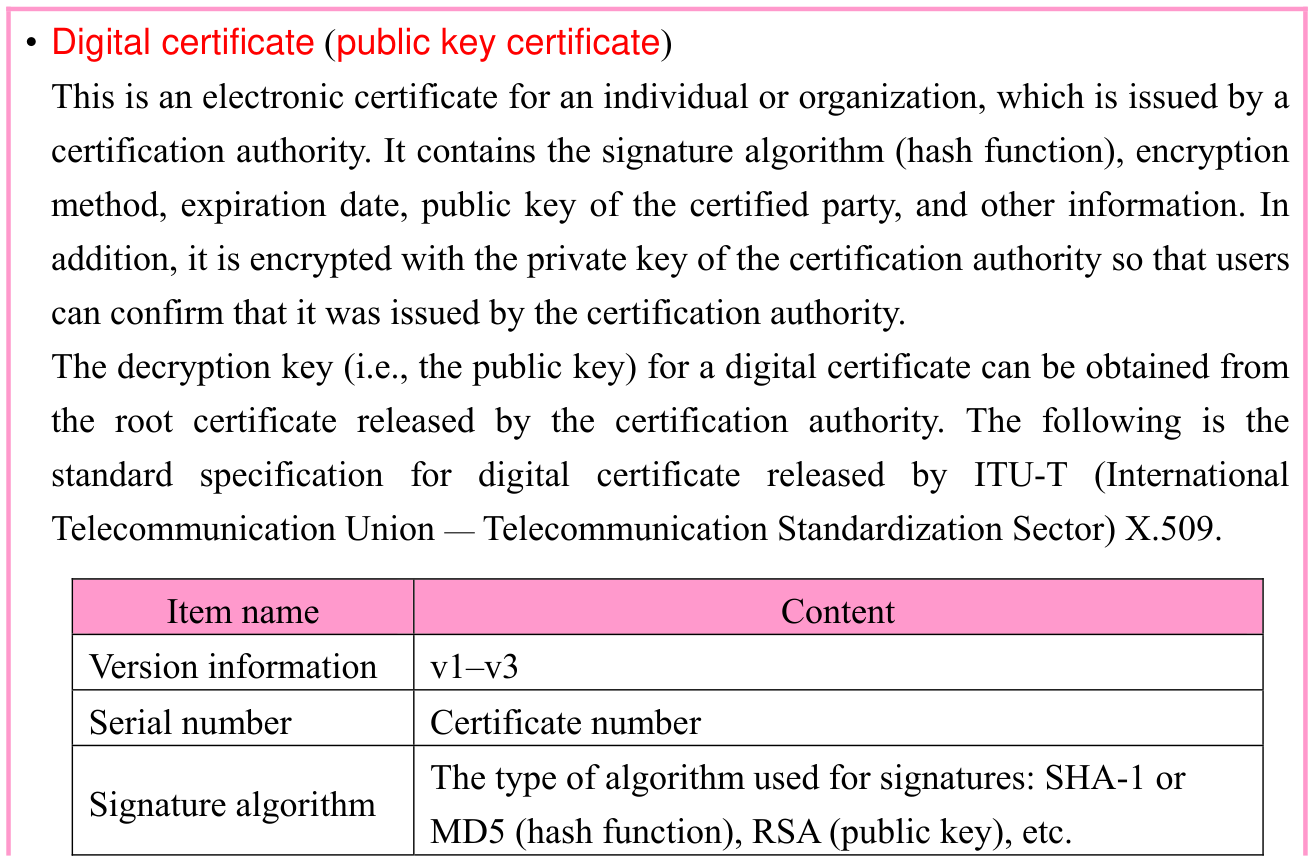
Certification bodies are composed of third-party organizations, such as CA (Certification Authority), RA (Registration Authority), and VA (Validation Authority), which issue digital certificates to users and lower-level certification authorities in order to guarantee the validity of public keys and digital signatures. In addition, in order to certify the validity of certification bodies themselves and distribute public keys, they issue root certificates signed with their own private keys. · 1 question

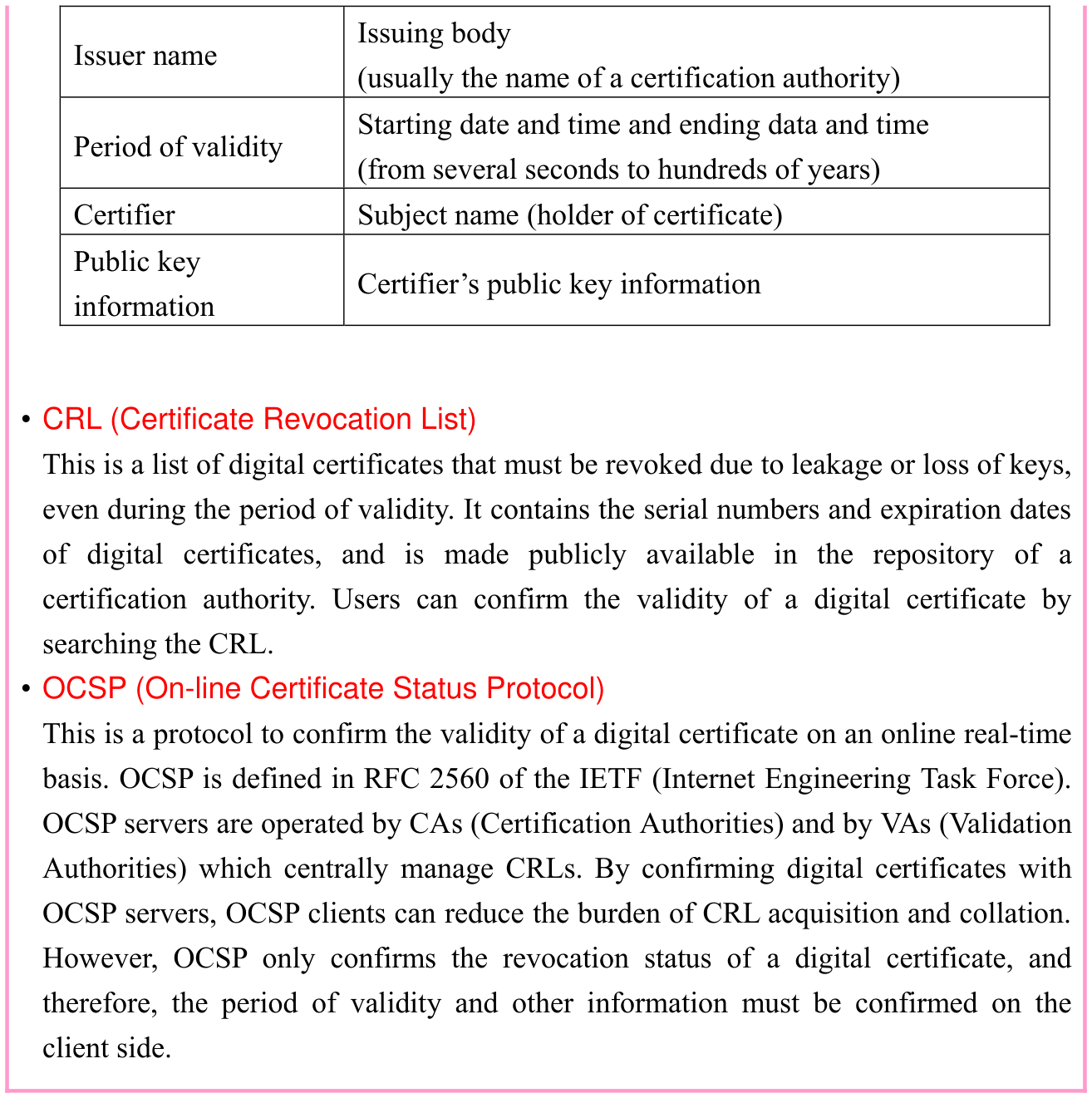
Original Security textbook callout or table, preserving the original labels, values, symbols and spatial arrangement. Source text: • Digital certificate (public key certificate) This is an electronic certificate for an individual or organization, which is issued by a certification authority. It contains the signature algorithm (hash function), encryption method, expiration date, public key of the certified party, and other information. In addition, it is encrypted with the private key of the certification authority so that users can confirm that it was issued by the certification authority. The decryption key (i.e., the public key) for a digital certificate can be obtained from the root certificate released by the certification authority. The following is the standard specification for digital certificate released by ITU-T (International Telecommunication Union — Telecommunication Standardization Sector) X.509. Item name Content Version information v1–v3 Serial number Certificate number The type of algorithm used for signatures: SHA-1 or Signature algorithm MD5 (hash function), RSA (public key), etc.
p. 371 · Enlarge

p. 372

Original Security textbook callout or table, preserving the original labels, values, symbols and spatial arrangement. Source text: Issuing body Issuer name (usually the name of a certification authority) Starting date and time and ending data and time Period of validity (from several seconds to hundreds of years) Certifier Subject name (holder of certificate) Public key Certifier’s public key information information • CRL (Certificate Revocation List) This is a list of digital certificates that must be revoked due to leakage or loss of keys, even during the period of validity. It contains the serial numbers and expiration dates of digital certificates, and is made publicly available in the repository of a certification authority. Users can confirm the validity of a digital certificate by searching the CRL. • OCSP (On-line Certificate Status Protocol) This is a protocol to confirm the validity of a digital certificate on an online real-time basis. OCSP is defined in RFC 2560 of the IETF (Internet Engineering Task Force). OCSP servers are operated by CAs (Certification Authorities) and by VAs (Validation Authorities) which centrally manage CRLs. By confirming digital certificates with OCSP servers, OCSP clients can reduce the burden of CRL acquisition and collation. However, OCSP only confirms the revocation status of a digital certificate, and therefore, the period of validity and other information must be confirmed on the client side.
p. 372 · Enlarge
Digital certificate contents · 1 practice questions

CAs (Certification Authorities) include two types of CAs: public CA that issues certificates for external web services, and private CA that takes on a role within a closed environment, such as a specified organization.

(4) Other certification techniques

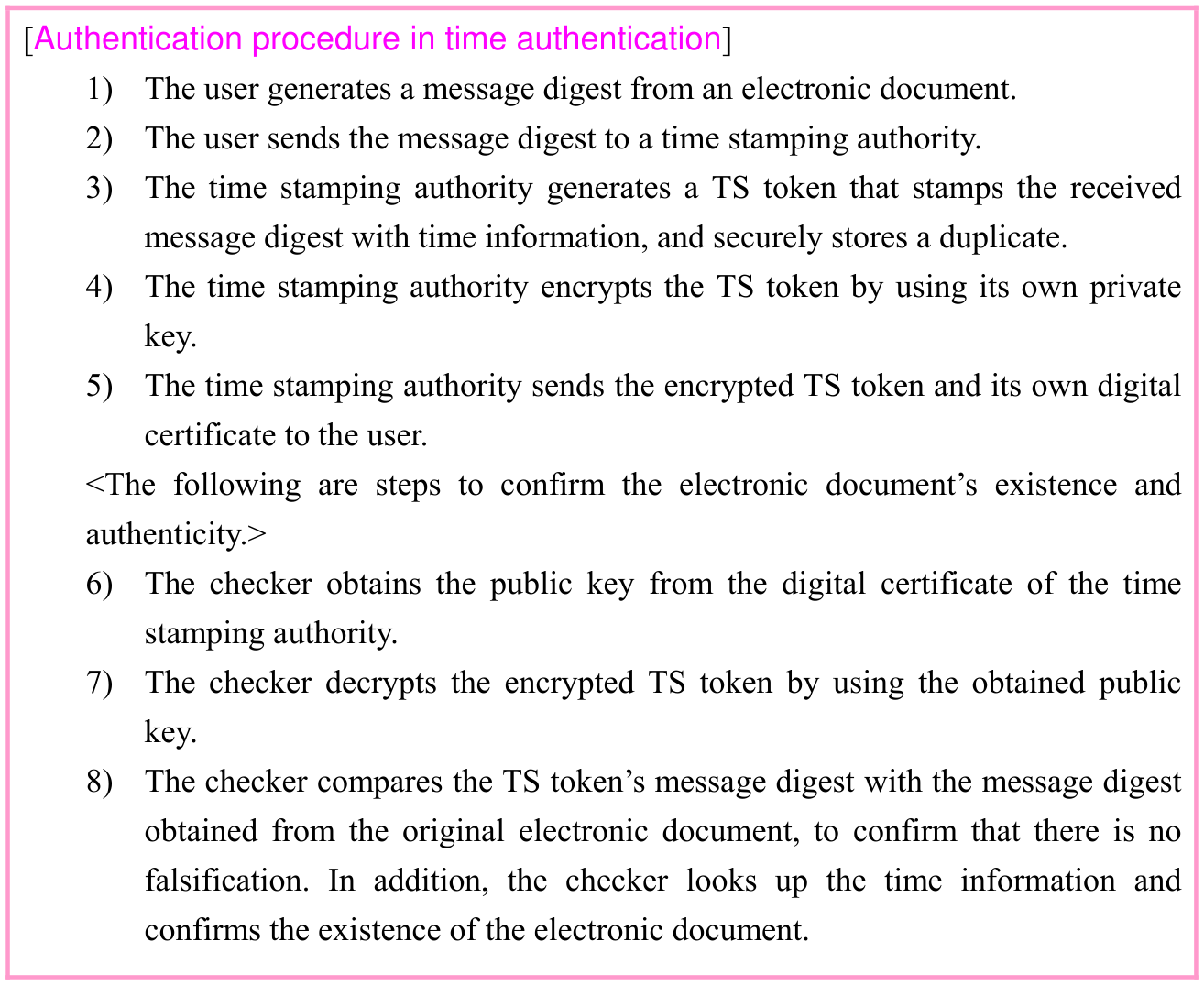
(1) Time authentication (timestamp authentication) This is a certification technique by which a third-party time stamping authority (TS authority, which may be a certification authority) guarantees the existence and authenticity of electronic documents, in accordance with the Japanese Act on Utilization of Telecommunications Technology in Document Preservation, etc. Conducted by Private Business Operators, etc. of 2005. Normally, a creator’s digital signature and digital certificate are attached to an electronic document. · 1 question

p. 373

Original Security textbook callout or table, preserving the original labels, values, symbols and spatial arrangement. Source text: [Authentication procedure in time authentication] 1) The user generates a message digest from an electronic document. 2) The user sends the message digest to a time stamping authority. 3) The time stamping authority generates a TS token that stamps the received message digest with time information, and securely stores a duplicate. 4) The time stamping authority encrypts the TS token by using its own private key. 5) The time stamping authority sends the encrypted TS token and its own digital certificate to the user. <The following are steps to confirm the electronic document’s existence and authenticity.> 6) The checker obtains the public key from the digital certificate of the time stamping authority. 7) The checker decrypts the encrypted TS token by using the obtained public key. 8) The checker compares the TS token’s message digest with the message digest obtained from the original electronic document, to confirm that there is no falsification. In addition, the checker looks up the time information and confirms the existence of the electronic document.
p. 373 · Enlarge
Timestamp verification procedure · 1 practice questions

(2) IEEE 802.1X This is a client authentication technique used for LANs. It is implemented using a RADIUS server or other authentication server, and authentication software (i.e., supplicant).

(3) CAPTCHA (image authentication) This is an authentication technique that requires users to identify a distorted image of letters or numbers displayed on the screen and then enter the corresponding correct characters, in order to confirm that they are human beings. It is used to prevent automatic posting by programs and such other automated processes.

Original chapter exercises

Original chapter exercises →

New FE Textbook Vol.1 · IT Fundamentals · First Edition, April 2015