Highlighted text? Practice this concept. Highlighted passages and figures open related questions.
Practice related questions (1)Progress & bookmarks
Current section
1-2-5 Software Integration Process
p. 265
Practice this section 1 linked exam question with default filters
Progress
Not marked complete
Related questions in this lesson 2
Top-down integration and stubs2p. 265 · PDF 269
1-2-5 Software Integration Process
In the software integration process, software units and configuration components are integrated to create software configuration items that have consistency with the software design and that fulfill the software requirements (i.e., functional requirements and non-functional requirements) within the operating environment (i.e., the production environment or equivalent environment).
[Activities of software integration process] (i) Software integration (ii) Evaluation and review of test readiness and software integration
(1) Software integration
Three tasks are executed in software integration.
p. 266 · PDF 270
(i) Development of a software integration plan
An integration plan to integrate the software units and the software components into the software configuration item is to be developed. In the integration plan, test requirements, procedures, data, responsibilities, schedules, and others are to be documented. (ii) Implementation of software integration test
Software units and software components are to be integrated in accordance with the integration plan. At this time, performing testing for each created collective will ensure that each aggregation satisfies the software requirements and that the software item is integrated at the conclusion of the integration activity. The results of integration and testing are to be documented as a software integration test report. – A test environment and test data are to be prepared and implemented under test plans in accordance with a software integration test specifications document defined in software architectural design and updated in later processes. (iii) Updating user documentation
User documentation is updated as necessary, with the inclusion of corrections of operation manuals.
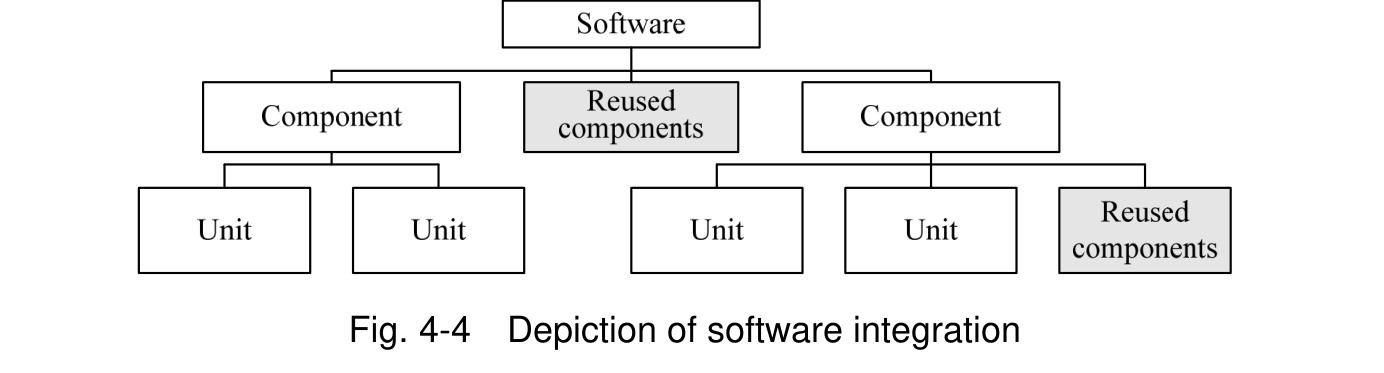
In software integration, the software units developed in the software construction process, the software components (i.e., programs) and software units to be reused, and other configuration components are assembled, and software configuration items are created.

Source visual description
Fig. 4-4. Software sits above Component, Reused components, and Component. The left Component divides into two Unit boxes. The right Component divides into two Unit boxes and a Reused components box.
The software integration test is a test that assembles partitioned and developed deliverables to verify correct operation (i.e., correct interfaces). Typical methods of an integration test include incremental testing and non-incremental testing.
- • Incremental testing
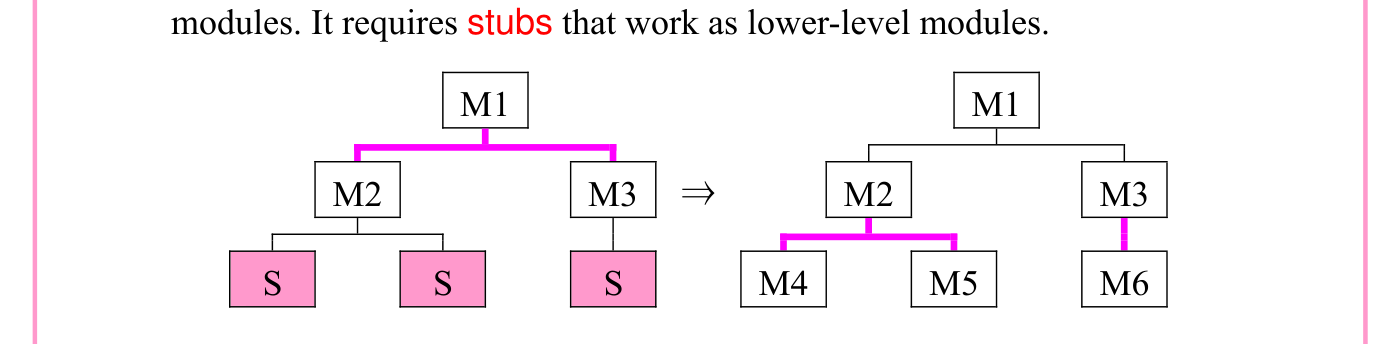
This is a test in which tested module groups are incrementally integrated with new
p. 267 · PDF 271
modules. It is a test suited to large-scale systems, and requires dummy modules for integration testing.
- • Top-down testing
This is a test that performs integration from top-level module to lower-level

Source visual description
The left hierarchy has M1 above M2 and M3, with S stub boxes as leaves: two below M2 and one below M3. A rightward transition arrow leads to M1 above M2 and M3, M4 and M5 below M2, and M6 below M3. Magenta source paths indicate the integration sequence; the S leaves are replaced by the actual lower modules.
- • Bottom-up testing
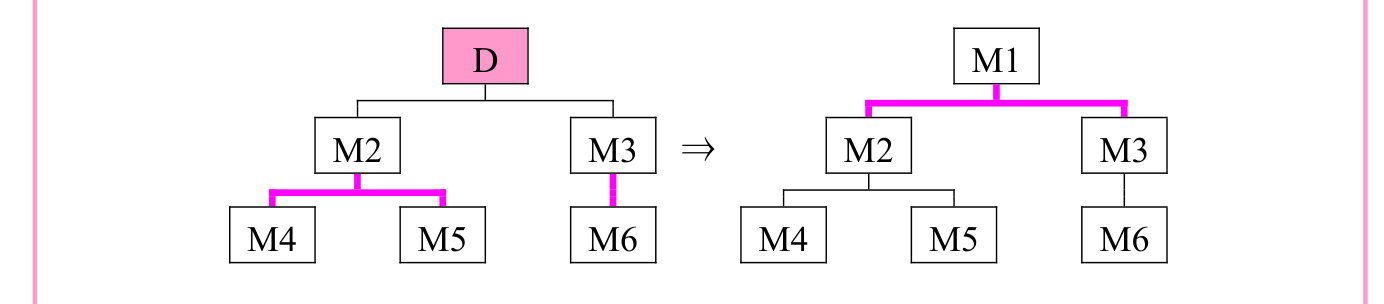
This is a test in which integration is performed from bottom-level modules to higher-level modules. It requires drivers that work as higher-level modules.

Source visual description
The left hierarchy has D driver above M2 and M3, with M4 and M5 below M2 and M6 below M3. A rightward transition arrow leads to the same lower hierarchy beneath M1. Magenta paths show lower-module integration followed by replacing D with M1.
- • Sandwich testing
In sandwich testing, a sandwich line is determined, after which top-down testing is performed on modules above the line and bottom-up testing is conducted on modules below the line. At the end, these are integrated at the sandwich line. This allows testing in a short period of time, but both stubs and drivers are necessary for use as dummy modules. - • Non-incremental testing (Big bang testing)
In this test, all modules are integrated and tested all together after each unit test is completed. It is suited to small-scale systems, and does not require dummy modules for integration testing. However, it has demerits, such as disallowing implementation in parallel with development activities, and difficulty in identifying the locations (i.e., interfaces) of the causes of detected errors.
In “(i) Development of a software integration plan,” the integration sequence of units and components, and others, are created in the form of an integration plan, in consideration of the software integration test methods. The integration plan is to also include test planning, covering the testing system (scope of testing, schedule, and test implementer), the test tools to
p. 268 · PDF 272
be used, and others, in accordance with the software integration test specifications document. In (ii), test preparation (e.g., preparation of test data and test environment) is performed in order to execute the integration plan.
(2) Evaluation and review of test readiness and software integration
Three tasks are executed in evaluation and review of test readiness and software integration.
(i) Preparation for software qualification testing
A set of tests, test cases (e.g., inputs, outputs, test criteria), and test procedures are developed and documented for conducting the software qualification testing. (ii) Evaluation of software integration
The results of software integration are to be evaluated, in consideration of standards including traceability to the system requirements (i.e., software requirements), external consistency with system requirements (i.e., software requirements), internal consistency, test coverage of the requirements of the software items, appropriateness of the test methods and test standards used, conformance to expected results, feasibility of the software qualification testing, and feasibility of operation and maintenance. The software is then to be modified and documentation updated as required. (iii) Implementation of joint review of software integration A joint review is conducted, and agreement is obtained concerning software integration.
Section progress
Original chapter exercises
Original chapter exercises →New FE Textbook Vol.2 · First Edition, April 2015