Highlighted text? Practice this concept. Highlighted passages and figures open related questions.
Practice related questions (1)Progress & bookmarks
Current section
3-2 Development Environment Management
p. 296
Progress
Not marked complete
Related questions in this lesson 1
Inspector and tracer1p. 296 · PDF 300
3 - 2 Development Environment Management
In development environment management, the hardware, software, network, development tools, and such others to be used in development are prepared (or constructed) in line with development requirements, and are appropriately managed.
(1) Development environment operating status management
In development environment operating status management, the operating status of the development environment (e.g., computer resources, development tools) is observed, and is appropriately managed for conducting efficient development.
- • Resource management
Computer resources, development tools, and other configuration management items are managed, and are prepared so that necessary resources are available when needed. - • Operations management
The development environment is managed so as to be operated appropriately, and operating status is observed. - • Maintenance management
The development environment is always maintained in an appropriate state. Maintenance of appropriate status does not always update the environment to the latest state, but rather periodic confirmation of operation to assure the ability to use the environment appropriately in line with objectives.
(2) Design data management
In design data management, version management, sharing management, safety management, and such others are performed for the various kinds of data (e.g., specifications documents) involved in design.
- • Change history control
The update history (i.e., versions) of the objects to be controlled is managed. In the version management system (i.e., database) for unified management of important information, various types of definition information, design information, program
p. 297 · PDF 301
information, test information, and such others are managed in a repository. In order to use the repository effectively, the format and such other of documents to be recorded is important. Recently, there is increased emphasis on design (i.e., document design) of physical/logical structure of design documents, reports, and other documents coupled with process automation and management methods. For example, there is a method of designing all documents in XML format and managing these in an XML-compatible repository by effectively using text information, diagrams, images, and such others.
- • Access rights control
Appropriate access rights are to be set and managed as required to prevent unauthorized search/removal/falsification of a company’s confidential information, such as trade secrets and personal information.
(3) Tool management
In tool management, the types and versions of development tools to be used are managed for the effective development of software. Developed software carries the risk of compatibility problems, because of differences in types and versions of development tools. Moreover, the occurrence of problems, such as bugs or security holes originating in development tools, may have adverse effects on the developed software. For those reasons, it is necessary to manage the development tools used.
[Typical development tools]
- • IDE (Integrated Development Environment)
This is a general name for tools that provide integrated support for the overall development process. Typical IDEs include the OSS Eclipse and such other tool. - • Design tools (design support tools)
These are tools to support design processes, and include support tools for various designs (e.g., screen design), database design support tools, and library management tools. - • Building tools (programming support tools)
These are tools to support programming, and include language processors (e.g., compilers, interpreters), editors, and such others. In the way that programs created with editors are translated by a compiler, the linking of development tools (in which the output of one tool is entered into the next tool) is called a tool chain. - • Program test support tools
Program inspection test tools (i.e., test support tools) include program static analysis tools to support static testing and program dynamic analysis tools to support dynamic testing.
p. 298 · PDF 302
- • Test execution support tools
These are test tools (i.e., test support tools) to support test implementation. - • Stub / driver tool
This automatically generates stubs or drivers. - • Test data generator
This automatically generates test data. - • Dump
The content of main memory and registers is written to a dump file. This type of tools includes memory dump that writes the status of main memory, and snapshot dumps that writes the status at a given time. - • Tracer
This traces the running state of a program. This is often used together with an inspector that writes the values of the variables used in a running program. · 1 question - • Assertion checker
This tests the validity of programs. (This test is called assertion check.) - • Emulator
This is a tool (i.e., a microprogram-based tool) that creates a virtual environment including a different OS or such other software, in which programs made for other computer types can be executed. - • ICE (In-Circuit Emulator)
In microprogram development, this emulates microprocessor functions through hardware. - • Simulator
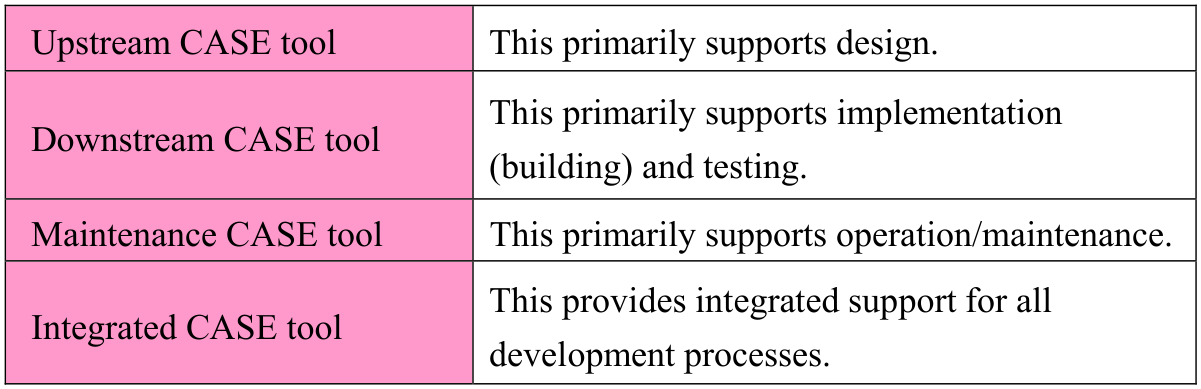
This is a tool that simulates the actions of programs. - • CASE (Computer Aided Software Engineering) Tools
CASE refers to a group of software to aid the processes of system development.
| Upstream CASE tool | This primarily supports design. |
|---|---|
| Downstream CASE tool | This primarily supports implementation (building) and testing. |
| Maintenance CASE tool | This primarily supports operation/maintenance. |
| Integrated CASE tool | This provides integrated support for all development processes. |

- • VDM (Virtual DOS Machine) Tool
This is a development support tool for VDM, one of the formal methods (i.e., methods that rigidly describe according to formal specification language to enhance
p. 299 · PDF 303
software quality).
Use of these development tools can promote EUC (End User Computing), by which users actively engage in system development, and EUD (End User Development), by which users themselves perform system development. For example, integrated CASE tools or such others are used in RAD (Rapid Application Development), by which users participate in development work from an early stage. EUC is a general name for the use of spreadsheet software, database software, and such other application software to execute work, and the technologies or methods to achieve this.
(4) License management
In license management, the number of target software installations and licenses held are regularly checked and verified with understanding of the content of the licenses, and management is performed to avoid violation of licensing conditions (e.g., unauthorized copying of software and other unauthorized usage).
[Points of caution for license management]
- • Software installation information, hardware configuration information, network
configuration information, and such others are collected from clients and are recorded in databases by using inventory collection functions and such other functions to accurately assess usage status. - • The number of licenses is accurately assessed by performing inventory taking and
such other control. - • Since using different versions of software can violate licensing conditions, software
version management is also to be conducted.
Section progress
Original chapter exercises
Original chapter exercises →New FE Textbook Vol.2 · First Edition, April 2015