Highlighted text? Practice this concept. Highlighted passages and figures open related questions.
Practice related questions (1)Progress & bookmarks
Current section
2-3 Development Process
p. 293
Practice this section 1 linked exam question with default filters
Progress
Not marked complete
Related questions in this lesson 1
CMMI maturity levels1p. 293 · PDF 297
2 - 3 Development Process
(1) SLCP-JCF (Software Life Cycle Process-Japan Common Frame)
SLCP-JCF is the Japanese version of SLCP, which is standardized by ISO/IEC as a common frame that clarifies the life cycle (e.g., development, operation, maintenance), with the aim of optimization of software development and its transactions. At present, Common Frame 2013 (SLCP-JCF2013), jointly drawn up by users, vendors, academic experts, and others in Japan, is in use. The content of Common Frame 2013 contains ISO/IEC 12207 (JIS X 0160), which was standardized as a “common yardstick” for development work overall, in order to clarify dealings between software acquirers and providers. JIS X 0160 is a JIS standard that provides collection of defined processes necessary for smooth communication among the acquirer, provider, and other concerned parties in the life cycle of a software product. It also defines the responsibilities of the acquiring party, such as the clarification of acceptance criteria and procedures.
(2) CMMI (Capability Maturity Model-Integrated)
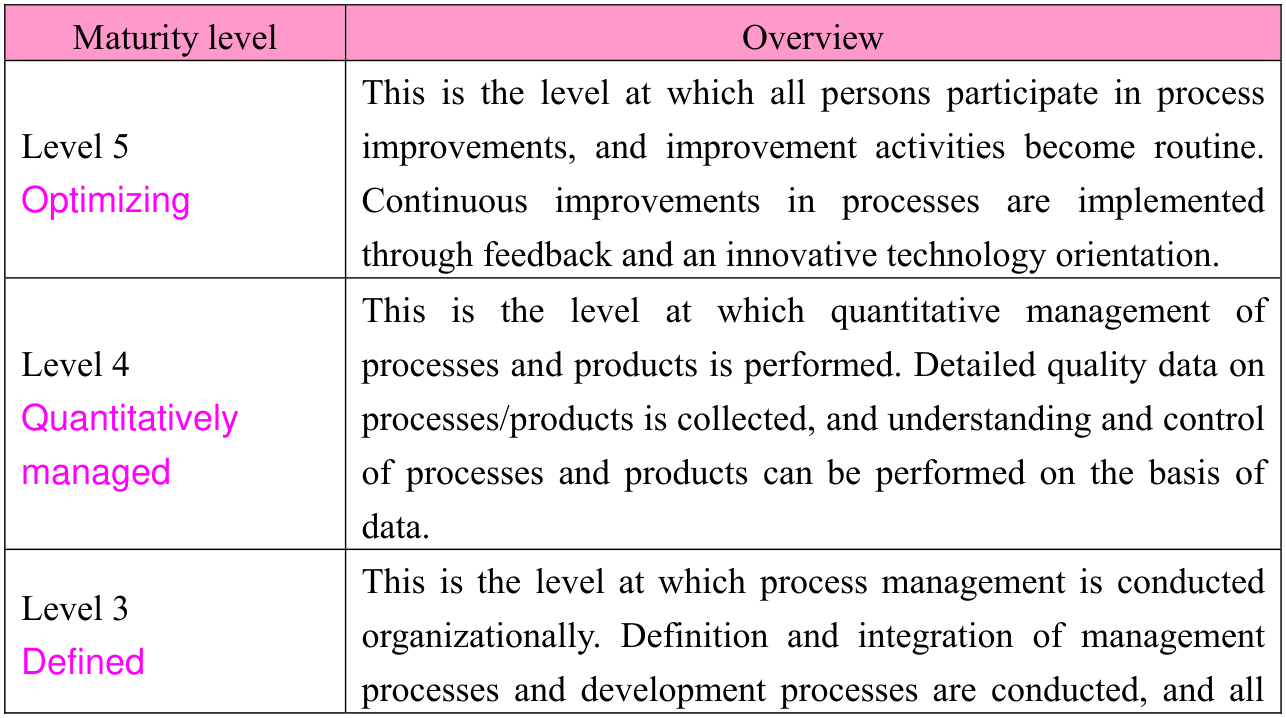
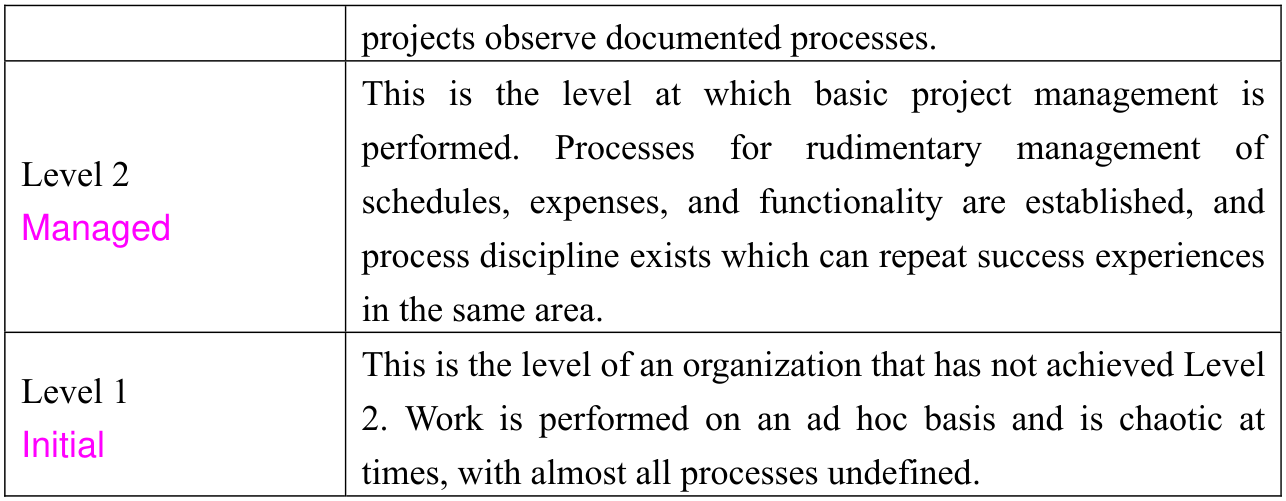
CMMI (Capability Maturity Model-Integrated) is a process improvement model developed at the SEI (Software Engineering Institute) at U.S. Carnegie Mellon University. It evaluates the maturity level of development processes through quality management standards that objectively indicate software development capabilities. It evaluates capabilities as a software development organization on a scale of 1 to 5 as shown in the table below, on the basis of the results of project management practice.
| Maturity level | Overview |
|---|---|
| Level 5 Optimizing | This is the level at which all persons participate in process improvements, and improvement activities become routine. Continuous improvements in processes are implemented through feedback and an innovative technology orientation. |
| Level 4 Quantitatively managed | This is the level at which quantitative management of processes and products is performed. Detailed quality data on processes/products is collected, and understanding and control of processes and products can be performed on the basis of data. |
| Level 3 Defined | This is the level at which process management is conducted organizationally. Definition and integration of management processes and development processes are conducted, and all |

p. 294 · PDF 298
| projects observe documented processes. | |
| Level 2 Managed | This is the level at which basic project management is performed. Processes for rudimentary management of schedules, expenses, and functionality are established, and process discipline exists which can repeat success experiences in the same area. |
|---|---|
| Level 1 Initial | This is the level of an organization that has not achieved Level 2. Work is performed on an ad hoc basis and is chaotic at times, with almost all processes undefined. |

Section progress
Original chapter exercises
Original chapter exercises →New FE Textbook Vol.2 · First Edition, April 2015