Highlighted text? Practice this concept. Highlighted passages and figures open related questions.
Practice related questions (9)Progress & bookmarks
Current section
1-2-4 Software Construction Process
p. 258
Practice this section 9 linked exam questions with default filters
Progress
Not marked complete
Related questions in this lesson 12
Code auditor1Decision condition coverage3Bug curves and test progress2Boundary-value analysis1Boundary-value test example1Program analysis without execution1All condition truth-value combinations1Original test coverage criteria comparison1Testing the combined interfaces of software units1Test drivers and stubs1Error embedding detection ratios1p. 258 · PDF 262
1-2-4 Software Construction Process
The software construction process produces executable software units that properly reflect the software design. (In general, this is called programming.)
[Activities of software construction process] (i) Software construction (ii) Evaluation of software code and test results
(1) Software construction
Five tasks are executed in software construction.
(i) Development of software units and databases
Each software unit and database are to be developed and documented. (ii) Development of test procedures and test data
Test procedures and test data for testing each software unit and database are to be developed and documented. (iii) Implementation of software unit and database testing
Each software unit and database is to be tested to confirm that it satisfies software requirements, and the results are to be documented in a software unit test report document. (iv) Updating user documentation
p. 259 · PDF 263
User documentation is to be updated as necessary. (v) Updating of test requirements for software integration
The test requirements and the schedule for software integration are to be updated.
In “(i) Development of software units and databases,” programming is performed according to the specifications for coding conventions and programming languages, on the basis of the software detailed design. (The work of creating (or writing) a program on the basis of algorithms (i.e., procedures) defined in the software detailed design and others is also called coding.) Coding conventions are rules for performing coding. If notational conventions for coding are not set, programs will be inconsistent and will have poor readability, which will reduce maintainability. For that reason, coding conventions (i.e., programming style) should be set, notational conventions should be unified, and program intelligibility (i.e., ease of understanding), efficiency (i.e., ease of creation), maintainability (i.e., ease of change), functionality, usability, and such other factor should be improved. In general coding conventions, indentation, depth of nesting, naming conventions (e.g., how variables are named), prohibited instructions, and others are to be set, in consideration of the standards (i.e., paradigm) of the programming languages used.
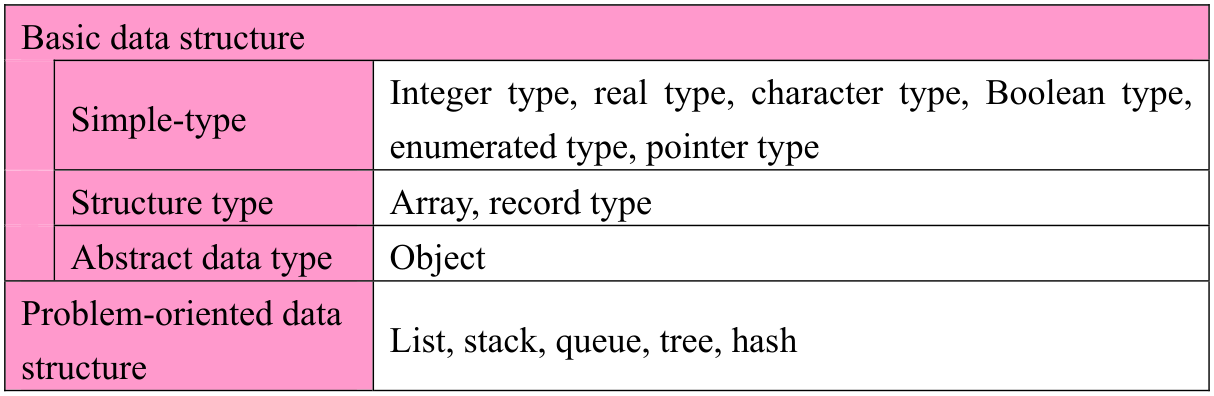
In programming, it is also necessary to determine the structure of the data (data structure) to be processed. Since appropriate data structures differ by programming language, the used data structures must be decided on the basis of the data processing to be achieved, the ease of implementation, and so on.
| Basic data structure | ||
|---|---|---|
| Simple-type | Integer type, real type, character type, Boolean type, enumerated type, pointer type | |
| Structure type | Array, record type | |
| Abstract data type | Object | |
| Problem-oriented data structure | List, stack, queue, tree, hash | |

One concept (i.e., technique) for creating easy-to-understand programs with high maintainability is structured programming. In structured programming, programs are created with processing procedures considered according to structure theorem, which can represent a program with one entrance and one exit as a combination of three basic structural units (i.e., sequence, selection, and iteration). Furthermore, in order to perform coding efficiently, coding support tools described below
p. 260 · PDF 264
should also be considered.
- • Code auditor
This is a tool to verify whether a program follows coding conventions. · 1 question - • Source code editor
This is dedicated software for creating programs (i.e., the source code). It offers functions, such as code completion which displays a menu when a portion of a command or a variable name is entered, so that an input item can be selected from the input candidates in the menu, and syntax highlighting which displays an instruction in a code in color according to the type or classification of the instruction.
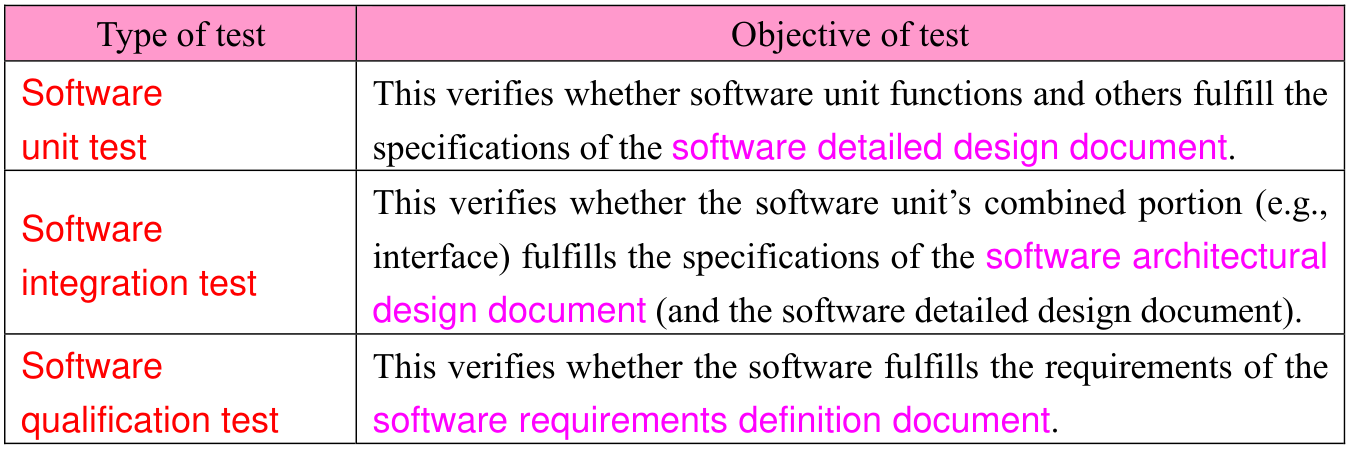
In “(ii) Development of test procedures and test data,” the test system (e.g., the scope and schedule of the test, the test implementer), the test tools to be used, and others are considered by using appropriate test methodology according to the software unit test specifications document, and test plans are drafted. After this, creation of test data, preparation of a test environment, and other test readiness are performed in order to execute test plans. The objective of all testing, including the software unit test performed in (iii), is the discovery of errors (i.e., bugs). Errors (i.e., bugs) are faults or defects in software, or portions of a program that do not fulfill specifications or requirements defined in design documents and specifications documents. The following is a list of testing objectives to be implemented in the software implementation process.
| Type of test | Objective of test |
|---|---|
| Software unit test | This verifies whether software unit functions and others fulfill the specifications of the software detailed design document. |
| Software integration test | This verifies whether the software unit’s combined portion (e.g., interface) fulfills the specifications of the software architectural design document (and the software detailed design document). |
| Software qualification test | This verifies whether the software fulfills the requirements of the software requirements definition document. |

In order to achieve such objectives, appropriate and efficient testing methods (i.e., techniques) must be used in order to reliably find errors ((i.e., bugs). Testing methods include white box tests and black box tests.
- • White box test
This is a test implemented with a focus on the internal specifications (e.g., algorithms, logic paths) of software units (i.e., modules). It is generally used only in the software unit test that is performed by developers.
p. 261 · PDF 265
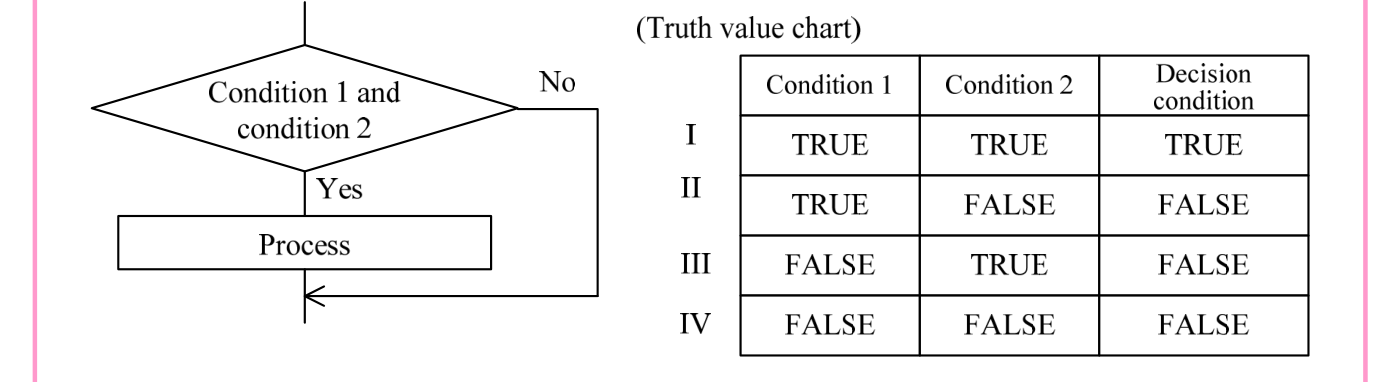
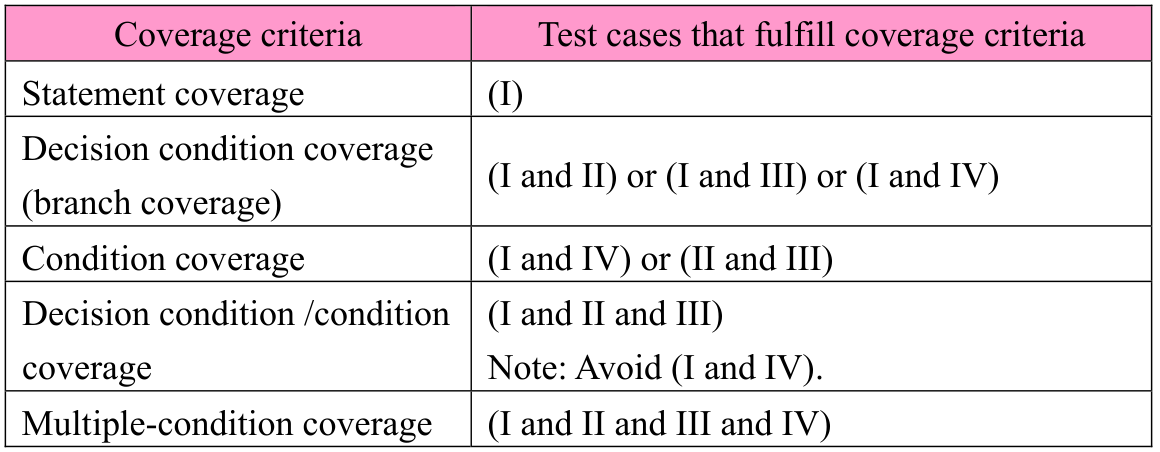
- • Statement coverage
This designs test cases that execute every statement in a unit (i.e., module) at least once. - • Decision condition coverage (branch coverage)
This designs test cases that execute TRUE/FALSE at least once for every “decision condition” (i.e., branch) in a unit (i.e., module). · 3 questions - • Condition coverage
This designs test cases that execute TRUE/FALSE at least once for every “condition” used as a decision condition. - • Decision condition / condition coverage
This designs test cases that fulfill both decision condition coverage (i.e., branch coverage) and condition coverage. - • Multiple-condition coverage
This designs test cases that include every combination of TRUE/FALSE for every condition. · 1 question

Source visual description
A decision diamond reads Condition 1 and condition 2. Yes flows down through Process; No follows the right branch and rejoins beneath Process. The Truth value chart has columns Condition 1, Condition 2, Decision condition. Row I: TRUE, TRUE, TRUE. Row II: TRUE, FALSE, FALSE. Row III: FALSE, TRUE, FALSE. Row IV: FALSE, FALSE, FALSE.
| Coverage criteria | Test cases that fulfill coverage criteria |
|---|---|
| Statement coverage | (I) |
| Decision condition coverage (branch coverage) | (I and II) or (I and III) or (I and IV) |
| Condition coverage | (I and IV) or (II and III) |
| Decision condition /condition coverage | (I and II and III) Note: Avoid (I and IV). |
| Multiple-condition coverage | (I and II and III and IV) |

Note: Verification of all test cases may be difficult when processing is complex. In such a case, coverage rate (i.e., test coverage), a metric that represents coverage rate of test cases (or of paths), is used. The idea is to set a test coverage target in consideration of the balance between productivity and reliability from perspectives of cost, delivery, and others; in other words, the test is completed when this target is cleared.
p. 262 · PDF 266
- • Black box test
This is a test performed with a focus on the external specifications (i.e., functional specifications and input/output (interface) specifications) of software units (i.e., modules). It is used in all software testing, including software unit test. - • Equivalence partitioning / boundary value analysis
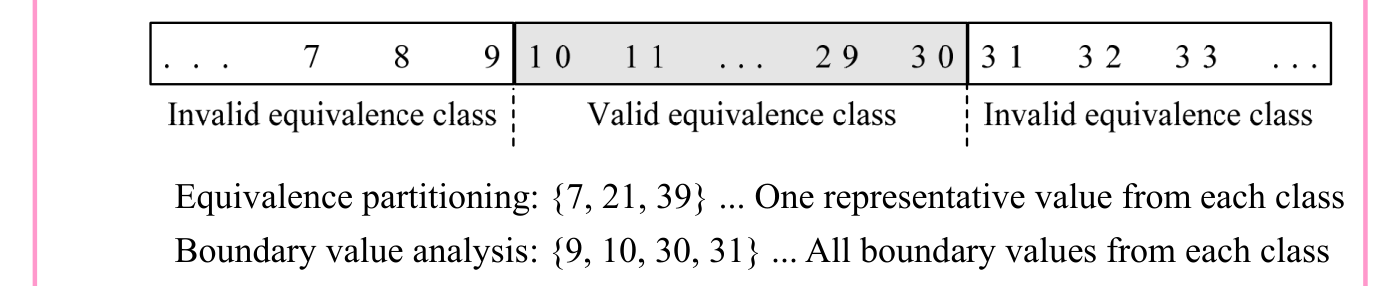
This is a method that partitions input data into several groups (i.e., classes), and test data is selected from each group. In general, input data is partitioned into a valid equivalence class (i.e., the group processed normally) and an invalid equivalence class (i.e., the group handled as an error), and then the valid equivalence class is further staged if necessary. From among these partitioned groups, representative values are used as test cases in the case of equivalence partitioning, and values at both ends of each class are used in the case of boundary value analysis. Example: For a unit processed normally when input data is between 10 and 30 · 1 question

Source visual description
The numeric strip reads ..., 7, 8, 9, 10, 11, ..., 29, 30, 31, 32, 33, .... The middle shaded Valid equivalence class runs from 10 through 30; each side is an Invalid equivalence class. Dashed boundaries separate 9 from 10 and 30 from 31. Equivalence partitioning: {7, 21, 39}, one representative value from each class. Boundary value analysis: {9, 10, 30, 31}, all boundary values from each class.
- • Cause-effect graph method
This method represents the cause-effect relationship of input (i.e., cause) and output (i.e., effect) as a graph (i.e., cause-effect graph) when class sorting of input data is difficult. It is a method that then creates a decision table based on the graph to sort out test data.
In addition to white box tests and black box tests, testing methods and test implementation methods include the following.
- • Error embedding method
This is a method that embeds the known errors in software, and the number of inherent potential errors is estimated from the ratio of the number of discovered known errors to the number of inherent errors (i.e., number of errors not already known). · 1 question - • Experimental design
This is a method that selects test data efficiently through statistical analysis, when tests that use large volumes of data are required. - • Metrics measurement
p. 263 · PDF 267
This is a method that collects and analyzes metrics for the size, complexity, and others of software on the basis of development information and others. Then, the possibility that errors or defects are present is investigated.

Source visual description
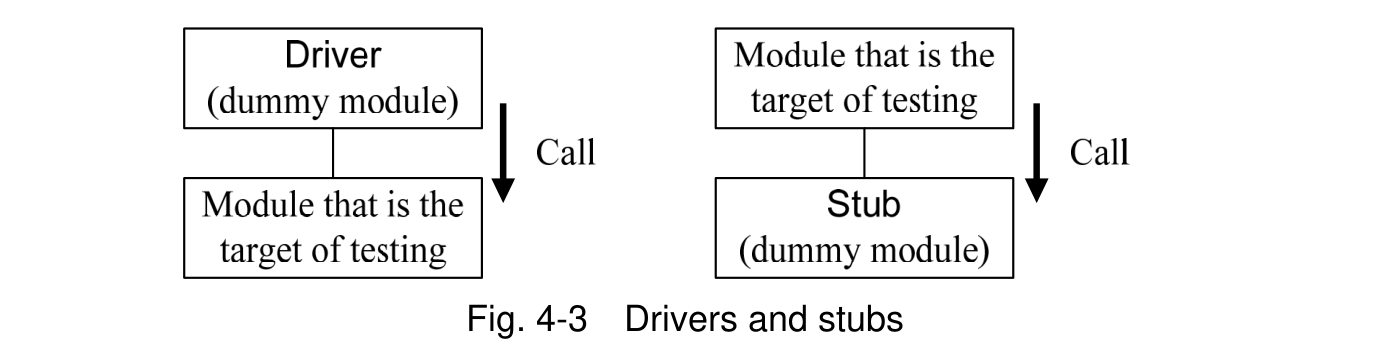
Fig. 4-3. At left, Driver (dummy module) sits above Module that is the target of testing, with a downward Call arrow. At right, Module that is the target of testing sits above Stub (dummy module), with a downward Call arrow.
Any errors (i.e., bugs) detected by testing are to be eliminated or corrected. This series of tasks, from detection of such errors (i.e., bugs) to their elimination or correction, is called debugging. For efficiency, a debugging environment that offers tools (i.e., debuggers) to support debugging and tools (i.e., test support tools) to support testing is used.
[Examples of test support tools]
- • Program static analysis tools
These are tools that support the analysis of static testing (i.e., testing that does not execute the program), such as desktop debugging for confirming on the desktop that values have not been substituted in variables that are no longer used. · 1 question - • Program dynamic analysis tools
These are tools that support analysis using dynamic tests (i.e., tests that execute the program), such as assertion checking, which embed a logical expression that describes the conditions or the relationships among variables at a specific point in time and verify the validity of the program.
(2) Evaluation of software code and test results
The following tasks are to be executed in evaluation of software code and test results.
p. 264 · PDF 268
(i) Evaluation of software code and test results
Software code and test results are to be evaluated, with consideration given to the criteria of traceability to the requirements and design of the software configuration item, external consistency with the requirements and design of the software configuration item, internal consistency between requirements for software units, test coverage of software units, appropriateness of coding methods and standards used, feasibility of software integration and testing, and feasibility of operation and maintenance.
In “evaluation of software code,” code review is performed. In code review, whether coding conventions are maintained and are based upon the software detailed design document, whether the efficiency and maintainability of code are appropriate, and others are verified along with the results of metrics measurement.
[Types of code review]
- • Peer code review
This is a review performed by members of the development team, colleagues, and other people primarily for the purpose of eliminating defects in deliverables (i.e., code). - • Code inspection
This is a formal review performed by determining a moderator (i.e., the person responsible for implementation), primarily for the purpose of improving the quality of deliverables (i.e., code).
In “evaluation of test result,” test results are to be comprehensively evaluated by using methods as described below. Through the evaluation, errors (i.e., bugs) in the program are to be corrected as necessary.
p. 265 · PDF 269


Source visual description
The horizontal Time axis points right. The vertical Cumulative number of bugs axis points upward. An S-shaped curve rises from the origin and levels off beneath a dotted upper horizontal line; a dot on the rising middle part is labelled Inflection point.
For using in progress management, the progress status and quality of the program are to be comprehensively assessed, including not only the cumulative number of bugs but also the number of finished test items, number of unresolved bugs, and others. As an example, even if the cumulative number of bugs exceeds expectations, the progress of testing can be considered fast if the number of finished test items also exceeds expectations. However, if the number of finished test items is below expectations, then the quality of the program should be assessed as low.
- • Bug control chart
This is used to understand test status, product quality, and others on the basis of bug curves. The actual bug curve is recorded onto a graph that already depicts the lower control limit line and the upper control limit line, which are predicted from past performance and such other factor, and is compared with these lines.
Section progress
Original chapter exercises
Original chapter exercises →New FE Textbook Vol.2 · First Edition, April 2015